Both channels work. The question is which one works for your situation. Your goals, budget, timeline, and audience stage all determine where your dollars should go. This article breaks down each channel, compares them head-to-head, and gives you a clear framework for making the call.
Key Takeaways
- Email marketing delivers exceptional ROI ($36 for every $1 spent, per Litmus) and builds a long-term owned audience asset
- PPC generates traffic on day one but stops yielding results the moment ad spend stops — and costs escalate fast in competitive industries
- Email wins on nurturing, retention, and cost-efficiency; PPC wins on speed and cold audience reach
- The strongest strategies combine both: use PPC to acquire leads, then email to convert and retain them
- Newsletter advertising bridges both: it reaches readers in the inbox like email, with the targeted placement model of PPC
Email Marketing vs PPC: Quick Comparison
| Factor | Email Marketing | PPC |
|---|---|---|
| Cost structure | Low ongoing cost once list is built | Continuous spend required; no residual value |
| Speed of results | Slow to start; compounds over time | Immediate — traffic on day one |
| Audience targeting | Warm, opted-in subscribers | Cold audiences by keyword or demographic |
| ROI potential | High — $36 per $1 spent (Litmus) | Variable; CPC averages $5.26 across industries |
| Long-term sustainability | High — list grows in value over time | Low — stops when budget stops |
| Ad blocker vulnerability | None — emails bypass ad blockers | Significant — 45% of US consumers use ad blockers |
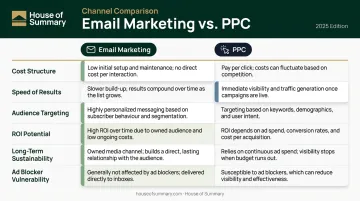
The numbers tell part of the story. To pick the right channel, you need to match each strategy's strengths to your specific stage, budget, and goals.
What Is Email Marketing?
Email marketing is the practice of sending targeted messages directly to a subscriber's inbox — newsletters, promotional campaigns, drip sequences, and transactional emails. Because subscribers have opted in, email is an owned audience channel: no algorithm decides whether your message reaches them.
The ROI Advantage
Litmus reports that email delivers an average $36 for every $1 spent. Their 2025 data shows 35% of companies reporting $10–$36 per dollar and 30% reporting $36–$50 per dollar — a wide range, but consistently positive at every tier.
Unlike PPC traffic that stops the moment spend stops, an engaged subscriber list is a compounding asset — it retains value and grows over time.
The Inbox Advantage
Email has a structural edge over every display-based channel:
- Bypasses ad blockers — eMarketer reports that 45% of US consumers have installed or used an ad blocker; email sidesteps this entirely
- No auction competition — your message reaches subscribers without bidding against rivals for placement
- Undivided attention — unlike display ads fighting for space alongside page content, email gets the full reading environment
This inbox dynamic is why premium newsletter advertising outperforms display alternatives. BSH Hausgeräte's CEO reported that advertising in Dubai Summary (part of the House of Summary network) delivered click-through rates 4x higher than Google AdWords — a direct comparison of newsletter inbox placement against paid search.
House of Summary's network of specialized newsletters reaches 500,000+ subscribers with 254,866+ emails opened daily, placing brand messages inside a focused reading environment rather than competing for peripheral attention.
When Email Marketing Works Best
Email is the right primary channel when:
- You have an existing list or a clear strategy to build one
- Your sales cycle is longer and requires multiple touchpoints
- You're focused on retention, loyalty, or repeat purchases
- Your audience is B2B, subscription-based, or high-income professional
Finance, luxury, and B2B companies in particular benefit from email's premium, curated communication format — audiences in these sectors expect it and respond to it.
What Is PPC?
Pay-per-click advertising lets you bid on keywords or audience segments to display ads on search engines (Google Ads, Microsoft Ads) or social platforms (Meta, LinkedIn, X). You pay when someone clicks. Two main variants:
- Search PPC — intent-driven; you appear when someone is actively searching for what you offer
- Display/social PPC — interruption-based; you appear in front of targeted audiences regardless of current intent
The Speed Advantage
PPC's primary value is immediacy. Campaigns go live within hours. Traffic starts on day one. For product launches, time-sensitive promotions, or businesses entering new markets without an established audience, that speed is irreplaceable.
The Core Limitations
Speed comes with real constraints:
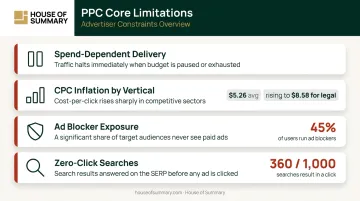
- Spend-dependent delivery — pause your campaign, traffic stops. Google's own documentation confirms that pausing a campaign stops ads from showing, with any residual performance lasting only hours
- CPC inflation by vertical — WordStream's 2025 Google Ads benchmarks report a $5.26 average CPC across industries, rising to $8.58 for legal services and $5.58 for business services
- Ad blocker exposure — 45% of US consumers use ad blockers, meaning a significant share of your target audience may never see your ads
- Ad blocker exposure — 45% of US consumers use ad blockers, meaning a significant share of your target audience may never see your ads
- Zero-click searches — SparkToro's 2024 research found that only 360 out of every 1,000 US Google searches result in a click to the open web, so search demand doesn't convert to site traffic as reliably as bid volume suggests
When PPC Works Best
PPC fits best when:
- You need immediate traffic without an existing audience
- You're testing new messaging with cold audiences before scaling
- You're running time-sensitive promotions or product launches
- You're targeting high-intent searchers at the exact moment they're looking
Email Marketing vs PPC: Which Is Right for You?
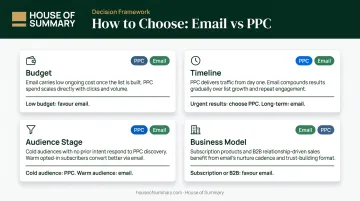
The decision comes down to four variables.
The Four Decision Factors
1. Budget Email has low ongoing costs once a list is established. PPC requires continuous spend with no residual value — the moment budget stops, so does traffic.
2. Timeline PPC delivers results now. Email delivers compounding returns over months and years. If you need traffic this week, PPC. If you're building a long-term audience asset, email.
3. Audience stage PPC acquires cold audiences who don't know you yet. Email converts and retains warm audiences who already do. These are fundamentally different jobs.
4. Business model Subscription businesses, B2B companies, and high-value purchase categories consistently see stronger email ROI. E-commerce brands running seasonal promotions and businesses entering competitive search markets often favor PPC for acquisition.
Situational Guidance
Choose email marketing if:
- You have an existing list or a defined strategy to grow one
- Your primary goal is retention, loyalty, or high-value lead nurturing
- Budget is limited and you need sustainable long-term returns
Choose PPC if:
- You need traffic now and have no established audience
- You're entering a new market or testing messaging
- You're running a promotion with a hard deadline
The Hybrid Approach
Most high-performing marketing programs don't pick one — they sequence them. PPC captures cold audiences at the moment of intent, then hands them off to email sequences for nurturing and conversion. Customer-list targeting tools across Google, LinkedIn, and Meta make this handoff technically straightforward to set up.
That said, the PPC-to-email pipeline has a gap: it struggles to reach audiences who've opted out of ad networks entirely. Finance professionals, C-suite executives, and global decision-makers increasingly fall into this category.
Newsletter advertising fills that gap. It delivers brand messages directly to the inbox — no ad blockers, no algorithm interference — but operates on a paid-placement model like PPC. You pay for guaranteed, verified reach to an opted-in audience. House of Summary connects advertisers with 500,000+ subscribers across four specialized publications covering US politics, global geopolitics, Dubai, and London.
Conclusion
There's no universal winner between email marketing and PPC. Businesses at different stages, with different budgets and different audiences, will draw the line differently.
Start with the channel that matches your most pressing constraint: time or budget. If you need traffic now, PPC gets you there. If you're building an audience that grows and retains value over time, email is where that work happens.
Over time, the goal is to run both — using PPC to fill the top of the funnel and email to convert and retain what it captures. The businesses that do this well don't treat the two as rivals. They use PPC to find new customers and email to keep them.
Frequently Asked Questions
Does email marketing still work in 2026?
Yes. Email reaches 4.59 billion users worldwide, with an estimated 376 billion emails sent daily. Engagement quality matters more than list size, and inbox delivery remains free from algorithm changes and ad blockers.
What is the ROI of email marketing compared to PPC?
Email marketing averages $36 for every $1 spent (Litmus). PPC costs average $5.26 per click across industries (WordStream 2025), with no guaranteed conversion on that spend. Direct per-dollar ROI comparisons are difficult, but email's owned-audience model consistently outperforms on cost-efficiency at scale.
Is PPC better for B2B or B2C companies?
PPC works for both, but B2B companies often find it expensive — Business Services CPCs average $5.58, and professional services run higher. LinkedIn offers better B2B targeting, though many B2B marketers find email more cost-effective for lead nurturing.
Can you run email marketing and PPC at the same time?
Running both simultaneously is common and effective. PPC builds awareness and captures leads from cold audiences; email then nurtures those leads through the sales cycle. The two channels reinforce each other rather than compete.
What's cheaper: email marketing or PPC?
Email marketing is generally cheaper at scale once a list is established, since PPC requires ongoing spend with no residual value when paused. However, list-building carries its own upfront costs — lead magnets, platform fees, content creation — so early-stage comparisons are closer than they appear.