Introduction
Digital ad budgets face unprecedented scrutiny as two fundamentally different formats compete for the same media spend: email newsletter advertising and search ads. Most comparisons conflate "running your own email list" with "buying ad placements in someone else's newsletter." That confusion distorts ROI comparisons — and budget decisions — before they start.
The stakes are tangible. Google Ads average CPC climbed from $4.01 in 2022 to $5.26 in 2025, with 87% of industries seeing year-over-year increases. Meanwhile, 64% of marketers now use newsletter ads, up 25% year-over-year — a clear signal that budget is following attention.
For media buyers navigating high-CPC verticals, the choice between these formats affects:
- Targeting precision and audience intent
- Cost structure and CPM/CPC benchmarks
- Measurable ROI and attribution clarity
Key Takeaways
- Newsletter ads place your brand inside an opted-in inbox, bypassing ad blockers and delivering undivided attention at lower CPMs
- Search ads reach users at the exact moment of active intent — but require continuous bidding to stay visible
- Newsletter advertising builds brand awareness and reaches decision-makers who tune out most digital channels
- Search ads are the stronger choice for direct-response and bottom-funnel conversion goals
- The smartest advertisers use both: search captures existing demand, newsletters build it
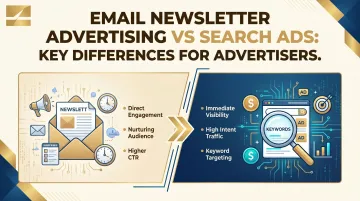
Email Newsletter Advertising vs. Search Ads: Quick Comparison
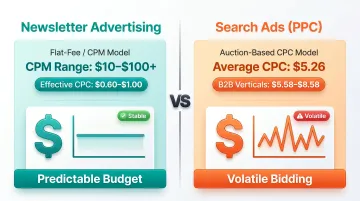
Cost Structure: Newsletter ads use flat-fee or CPM pricing — predictable budgets, no auction volatility. Search ads run on cost-per-click bidding where competitive keywords can drain spend fast.
Audience Targeting:
Newsletter advertising targets by reader demographics, publication niche, and subscriber interest. Search ads target by keyword, intent signal, location, and device.
Ad Blocker Vulnerability:
Newsletter ads land in the inbox and bypass browser ad blockers entirely. Search ads are vulnerable — over half of global consumers now use ad blockers.
Audience Relationship:
Newsletter subscribers actively opted into a trusted publication — advertisers inherit that pre-established trust. Search audiences have no prior relationship with the publisher.
Best Fit:
Newsletter ads suit brand awareness, thought leadership, and professional audience reach. Search ads are the stronger choice for immediate lead capture and transactional conversions.
What Is Email Newsletter Advertising?
Email newsletter advertising is the practice of purchasing ad placements — sponsored segments, banner slots, or dedicated sends — within an established newsletter that already has an opted-in subscriber base. This is not email marketing where you manage your own list. As an advertiser, you're borrowing reach from a trusted publisher without building infrastructure.
The core benefit: immediate, algorithm-free access to a curated, engaged readership. Unlike social or display ads competing in cluttered visual environments, newsletter ads appear in a reading context where subscribers are already attentive and information-consuming.
Typical formats include:
- Sponsored content segments: native editorial-style placements integrated into the newsletter's flow
- Display slots: banner positions within the newsletter body
- Dedicated sends: full-issue takeover for maximum brand presence
- Co-branded content: jointly produced pieces that blend with the publisher's editorial voice
Newsletter ads bypass two major pain points: ad blockers (which don't function inside email clients) and algorithmic feed suppression (newsletters arrive directly, not subject to platform reach throttling). With 52% of consumers globally using ad blockers, this immunity becomes materially valuable.
Specialized newsletter networks let advertisers reach highly specific audience segments. House of Summary, for example, spans publications covering global news, geopolitics, business, and regional markets — giving brands direct access to executives, finance professionals, and media decision-makers without the noise of mass-reach platforms.
Use Cases of Email Newsletter Advertising
Newsletter advertising fits strongest at the top and middle of the funnel — building brand familiarity, thought leadership positioning, and sustained visibility among professional audiences not yet in active buying mode but who will be.
Industries where newsletter ads dominate:
- B2B technology and SaaS platforms
- Financial services and wealth management
- Luxury goods and premium consumer brands
- Media and publishing companies
- Advertisers targeting time-scarce professionals
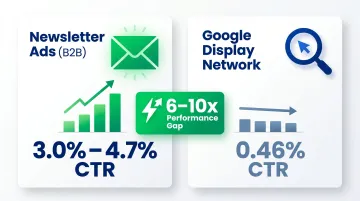
These readers don't respond to interruption ads but do engage with relevant content presented by a trusted source. Paved platform data shows newsletter sponsorship CTRs of 3.0%–4.7% for B2B categories — Business, Finance, and Tech — versus 0.46% for the Google Display Network, roughly 6–10x higher.
That gap reflects context, not just format. Readers opening a curated newsletter are in information-consuming mode. House of Summary advertisers have reported click-through rates 4x higher than Google AdWords, a result of editorial tone alignment with readers who are already primed to engage.
What Are Search Ads?
Search ads (PPC/paid search) allow advertisers to bid on keywords so their ads appear at the top of search engine results pages when users actively search for related queries. The advertiser pays per click, and placement is determined by bid amount and quality score. The key mechanic: the user initiates the interaction — the ad responds to expressed intent.
Core strengths include:
- Immediacy — campaigns generate traffic within 24-48 hours
- Precise intent targeting — reaching users at the exact moment they're looking for a solution
- Measurable direct-response performance — clicks, conversions, and ROAS tracked with granularity
Structural limitations:
- CPCs rise with competition (legal: $8.58, B2B services: $5.58, per 2025 benchmarks)
- Traffic stops the moment the budget is paused — Google confirms "pausing or removing a campaign will stop its ads from showing"
- Search ads are poorly suited for reaching audiences who don't yet know they need what you're selling — a blind spot for brand-building campaigns
Use Cases of Search Ads
Search ads are bottom-of-funnel and demand-capture tools. They work when clear search intent exists — a prospect already knows they have a problem and is actively researching solutions.
Industries where search ads consistently outperform:
- E-commerce and product categories with established search volume
- Local services with urgent needs (plumbing, legal, healthcare)
- Software comparisons and product evaluations
- Transactional queries with commercial intent
Limitations for audience quality: Search ads cannot discriminate between a casual researcher and a serious buyer based on professional profile alone. For advertisers targeting executive-level or niche professional audiences, keyword intent rarely maps cleanly to seniority or buying authority.
The inventory problem compounds this further. AI Overviews in Google Search reduced CTR from 19.7% to 6.34%, a 68% decline, compressing the paid search inventory available to B2B advertisers even as CPCs continue to climb.
Key Differences That Matter to Advertisers
These five distinctions shape how advertisers should plan, measure, and allocate budget across both channels.
Intent Stage and Audience Mindset
Search ads intercept high-intent, active searchers. Newsletter ads reach passive but engaged readers in a trust-rich, distraction-free environment. Both mindsets have value, but they serve different campaign objectives. Conflating the two leads to misallocated budgets.
Cost Predictability and Budget Control
Newsletter advertising operates on fixed, negotiable rates — flat fee per send or CPM between $10–$30 for healthy newsletters, $50–$100+ for specialized B2B publications. Advertisers know the cost before launching. Search ads operate on a live auction model where CPCs fluctuate daily based on competitor activity. For finance-sensitive buyers, that unpredictability is a meaningful planning liability.
Audience Quality vs. Audience Size
Search ads reach enormous volume, but advertisers have limited control over who actually clicks. Newsletter advertising, especially in specialized publications, offers a smaller but more demographically precise and professionally verified audience.
That distinction points to something worth measuring: attention quality. Newsletter readers have actively subscribed and consume content in a dedicated reading session. Search ad viewers are scanning results pages with divided attention. One undivided read often outperforms a dozen skipped banner impressions.
Ad Performance Benchmarks
Those attention differences show up in the numbers. Newsletter sponsorships deliver 3.0%–4.7% CTR for B2B categories versus 0.46% for Google Display Network. Search ads on Google's Search Network average 6.42%–6.66% CTR, but capture intent-driven clicks at $5.26 average CPC. Newsletter ads at $30 CPM with 3%–5% CTR yield an effective CPC of $0.60–$1.00 — roughly 5–8x more cost-efficient per click, though the clicks serve different funnel positions.
Measurement and Attribution
Search ads provide near-real-time conversion data tied to clicks. Newsletter advertising relies on open rates, CTR, pixel tracking, and downstream conversion measurement. Each channel requires its own measurement framework. Comparing raw metrics directly between the two formats produces misleading conclusions, since they operate at different stages of the buyer journey.
Which Ad Format Should You Choose?
Several factors should shape your decision: campaign objective, audience profile, budget structure, competitive environment, and sales cycle length. Here's how each format holds up against those variables.
Choose search ads when:
- Your product has clear, high-volume search demand
- You need immediate leads with measurable bottom-of-funnel attribution
- Your target audience is actively searching (product comparisons, service evaluations)
- You can sustain the bidding budget to remain competitive in your vertical
Choose newsletter advertising when:
- Your audience is a professional, time-scarce reader who filters digital noise aggressively
- You want brand presence in a trusted editorial context
- Your competitors are not yet active in newsletter formats (a meaningful first-mover window exists)
- You need to reach decision-makers across global markets — executives, media buyers, finance professionals — without relying on keyword intent alone (specialized newsletters like those in House of Summary's network are built precisely for this audience)
- You're in a high-CPC vertical ($6–$9+ per click) and need to reduce blended acquisition costs
The Case for Using Both
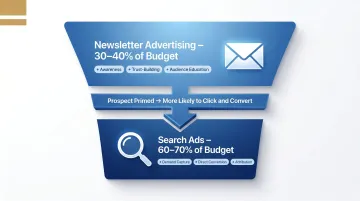
Sophisticated advertisers use search ads to capture demand at the moment of active search while using newsletter advertising upstream to build the brand familiarity that makes those search clicks convert. A practical budget split looks like this:
- 60-70% of budget to search for demand capture and direct conversion
- 30-40% to newsletter advertising for awareness, trust-building, and audience education
The logic is straightforward: newsletter advertising primes the audience, search advertising converts them. A prospect who already recognizes your brand from a newsletter is more likely to click — and more likely to buy — when your search ad appears.
Frequently Asked Questions
What is the difference between email newsletter advertising and running your own email marketing campaign?
Newsletter advertising means paying for ad placements inside a publisher's existing subscriber base — no list ownership, no list-building required. Email marketing means sending campaigns to a list you own and manage yourself. The former provides immediate reach; the latter requires infrastructure.
Are newsletter ads visible to users who use ad blockers?
Yes. Newsletter ads are delivered directly to subscribers' email inboxes, which means they are entirely unaffected by browser-based ad blockers. This is a meaningful advantage over display and search ads served on web pages, which can be blocked by the 52% of consumers using ad blockers.
How do you measure the ROI of newsletter advertising?
Core metrics to track:
- Open rate — measures reach and subject line effectiveness
- Click-through rate — measures engagement with your placement
- UTM-tracked site traffic — connects newsletter clicks to on-site behavior
- Pixel-based conversions — tracks downstream actions and purchases
- Brand lift surveys — for upper-funnel or awareness-focused placements
Set up UTM parameters and conversion tracking before launch — newsletter attribution works differently than search and needs to be configured in advance.
When should a brand choose search ads over newsletter advertising?
Choose search ads for campaigns targeting audiences already in active research or buying mode, where keyword intent is strong and the product category has demonstrable search volume. Search ads excel when immediate conversion and bottom-funnel attribution are the primary objectives.
Are newsletter ads better for brand awareness or direct response?
Newsletter advertising is strongest for brand awareness, audience trust-building, and top-to-mid funnel presence. However, it can support direct response when audience-to-offer alignment is high and the newsletter has strong niche relevance. Specialized B2B newsletters often deliver both brand lift and measurable clicks.
What CPM or CPC should advertisers expect for newsletter ads versus Google search ads?
Newsletter CPMs range from $10-$30 for general publications to $50-$100+ for specialized B2B titles. At $30 CPM with a 3%-5% CTR, effective CPC works out to roughly $0.60-$1.00 — well below Google Ads' cross-industry average of $5.26, and $5.58-$8.58 in B2B verticals. Newsletter ads carry lower cost-per-click; search clicks carry higher purchase intent.