Newsletter advertising places your brand directly in front of readers who chose to be there. No feed ranking, no ad auction volatility, no competition from the post above or below yours. Just your message, in a trusted publication, read by someone who opened it on purpose.
This guide covers everything you need to make newsletter advertising work — what it is, why it outperforms most channels, how to choose the right publication, how to write ads that convert, and how to measure results that actually matter.
Key Takeaways
- Newsletter ads reach opted-in readers in a distraction-free inbox — no algorithm throttling, no ad blockers
- Email open rates average 83% inbox placement globally; social media organic reach rarely breaks 4%
- Match your ad format (sponsored, native, dedicated, or classified) to your campaign goal first, budget second
- Audience alignment beats subscriber volume — a 10,000-subscriber niche list often outperforms a million-person disengaged one
- Track CTR, cost per acquisition, and post-click conversion — not just impressions
What Is Newsletter Advertising?
Newsletter advertising is the practice of placing paid promotional content inside a third-party email newsletter, reaching that publication's existing, opted-in subscriber base.
Two channels often get lumped in with newsletter advertising — they're worth separating clearly:
- Email marketing uses your own list — newsletter advertising uses someone else's
- Display advertising relies on cookies, pixels, and platform algorithms — newsletter ads bypass all of that
The mechanics are straightforward: an advertiser pays a publisher to feature their message inside a regular email issue. Readers encounter it as part of their normal inbox routine — alongside content they already trust and read consistently.
That inbox environment is what sets newsletter advertising apart. Readers have chosen to let a publication into their day — and the trust they've built with that publication carries over, at least partially, to the brands appearing alongside it.
Why Newsletter Advertising Works Better Than Most Marketers Expect
The Inbox Is an Algorithm-Free Zone
When a newsletter sends, it arrives. No feed ranking determines whether your ad gets shown. No platform throttles reach after publication. The placement delivers exactly as negotiated.
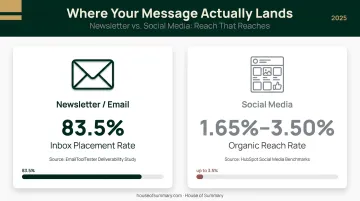
Compare that to social media: according to Socialinsider's 2025 benchmarks, average organic reach sits at 3.50% on Instagram and 1.65% on Facebook. Meanwhile, Validity's 2025 Email Deliverability Benchmark Report found a global inbox placement rate of 83.5% for legitimate marketing email.
An 83.5% placement rate versus sub-4% organic reach isn't a minor difference in channel performance — it reflects a fundamental difference in how the two mediums work.
Ad Blockers Can't Touch Email
Browser-based ad blockers and tracking prevention tools have no effect on newsletter ads. The ad is embedded in the email itself, not loaded from an external server.
Blockthrough reported in 2023 that 42.7% of internet users worldwide use ad-blocking software. For display and programmatic campaigns, that's a massive chunk of paid impressions that never render. For newsletter ads, that number is irrelevant — the placement is always seen.
The ROI Case for Email
Litmus reports that email marketing drives an average ROI of $36 for every $1 spent — one of the highest returns of any marketing channel. Newsletter advertising amplifies this through audience quality and editorial context — readers who actively chose a publication are more receptive to adjacent ads than passive scrollers on a feed.
High-Intent Audiences in Action
BSH Hausgeräte, advertising through House of Summary's Dubai Summary newsletter, reported click-through rates 4x higher than Google AdWords — attributing the result to editorial tone alignment and the quality of the reader base. That's the opt-in advantage in practice.
House of Summary's network — Presidential Summary, Geopolitical Summary, Dubai Summary, and London Summary — reaches over 500,000 subscribers with 254,866+ emails opened daily across the US, UK, and UAE. For media buyers and marketing decision makers targeting global executives and finance professionals, that kind of concentrated, high-intent reach is difficult to replicate through any other channel.
Types of Newsletter Ads: Which Format Is Right for Your Brand?
The Four Primary Formats
| Format | How It Works | Best For |
|---|---|---|
| Sponsored placement | Branded section embedded within regular newsletter content | Most campaign goals; high visibility without full-issue cost |
| Dedicated email | Advertiser takes over an entire newsletter issue | Product launches, complex messaging, maximum space |
| Native ad | Matches the editorial tone and format of the newsletter | Highest trust transfer; lowest reader friction |
| Classified ad | Short text listing, typically near the footer | Budget-conscious campaigns; niche audiences |
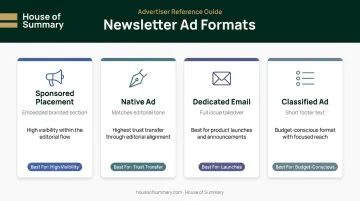
House of Summary offers all four of these formats across its network of four publications — Presidential Summary, Geopolitical Summary, Dubai Summary, and London Summary — including multi-newsletter bundle options for brands targeting coordinated reach across markets.
Pricing Models to Know
Most newsletter advertising runs on one of three models:
- CPM (cost per thousand subscribers or opens): pricing typically ranges from $15–$100+ depending on list size and niche, according to AdMailr's 2026 rate guide — predictable for budget planning
- CPC (cost per click): performance-based pricing; Paved cites typical rates of $1–$5 per click
- Flat-fee sponsorships: common in direct publisher relationships, negotiable, and often the most efficient structure for niche, high-engagement newsletters
Why Placement Position Matters
Where your ad appears within an email significantly affects performance. Placements at the top of an issue — above the fold, before readers scroll — consistently outperform footer placements. LiveIntent's research confirms that top-of-newsletter slots yield higher CTRs and CPMs because readers see them first, before attention drops off.
Key rule: Before confirming any sponsored placement, ask the publisher exactly where in the issue your ad will appear — top, middle, or footer position can meaningfully change your results.
How to Choose the Right Newsletter for Your Ad Campaign
Audience Alignment Is Non-Negotiable
The single biggest factor in newsletter ad performance is whether the publisher's readers match your buyer profile. Subscriber count tells you reach. It doesn't tell you whether the person opening that email is likely to buy from you.
When evaluating a newsletter, look for:
- Open rate — Paved recommends above 25% as a quality threshold; Mailchimp's industry average is 21.33%
- Click-through rate — aim for above 2% as a baseline signal of genuine engagement
- Subscriber demographics — professional titles, geographic distribution, income level
- Past advertisers — tells you what categories the publisher accepts and what brands trust them
- Unsubscribe and spam rates — under 0.3% and 0.1% respectively are healthy signals
Reading the Media Kit
A good media kit goes beyond headline subscriber numbers. It should include engagement trends over time, demographic breakdowns, and examples of past placements. A newsletter with 40,000 subscribers and a 38% open rate is a better advertising environment than one with 200,000 subscribers and 12% opens.
House of Summary's media kit provides geographic distribution (66% US, with significant UK and UAE concentration), gender composition, daily open counts, and reader profile data — the kind of specifics that let you assess fit before committing budget. Contact sales@houseofsummary.com to request it.
Editorial Fit and Brand Safety
The newsletter's editorial voice and credibility act as an endorsement of the ads inside it. A luxury brand appearing in a verified, human-written news publication carries more weight than the same ad placed in a scraper-aggregated digest — readers extend their trust in the content to the brands alongside it.
For advertisers in regulated industries, editorial standards matter as much as audience size. House of Summary enforces strict content policies that exclude:
- Gambling and betting promotions
- Adult or sexual content
- Political campaign advertising
- Sensationalist or misleading claims
- Get-rich-quick schemes
This makes it a fit for premium, healthcare, and financial services brands operating under tight compliance requirements.
Finding Newsletter Partners
Two routes are available:
- Direct outreach to publishers — more negotiation flexibility, custom placement options, relationship-driven pricing
- Newsletter advertising marketplaces — platforms like Paved (3,000+ newsletters) and the beehiiv Ad Network offer faster access, standardized pricing, and built-in tracking
For brands targeting high-intent, internationally distributed executive audiences, direct publisher relationships — like those available through House of Summary — deliver better audience quality than broad marketplace buys.
How to Write and Design Newsletter Ads That Convert
The AIDA Framework in Practice
Newsletter ads follow the same copywriting logic as any direct response format. The AIDA structure works because it moves readers through a logical sequence:
- Attention — a headline with a clear, specific promise or provocation
- Interest — a fact, stat, or observation that's directly relevant to the reader's situation
- Desire — focus on the reader's outcome, not your product's features
- Action — one unambiguous next step
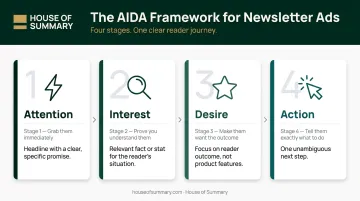
The most common mistake is skipping from attention straight to action. Readers need a reason to care before they're ready to click.
Lead Magnets vs. Direct Pitches
Newsletter environments reward lower-friction entry points. Offering a free report, trial, or guide reduces the commitment readers have to make, which typically produces higher click rates than cold product pitches. Save the hard sell for your landing page — let the newsletter ad get the click.
The rule of thumb: lead with value in the ad, convert on the landing page.
Design and Mobile Optimization
Apple devices account for 45.51% of email client market share as of 2024 (Litmus), with Gmail at 23.54%. The majority of email opens happen on mobile screens.
Keep your ad design:
- Clean and single-column — renders correctly across clients and screen sizes
- Matched to the host newsletter's visual style — native placements outperform jarring display-style creative
- Image-light enough to load quickly — use visuals that add context, not decoration
Use a Single CTA Per Ad
Every newsletter ad should have exactly one primary call to action. Multiple CTAs split attention and reduce clicks. Use action-oriented language that reduces perceived risk: "Download the Report," "Start for Free," "Read the Summary."
Vague CTAs like "Learn More" or "Click Here" consistently underperform specific ones.
A/B Testing That Actually Improves Results
Test one variable at a time, in this order:
- Headline (highest leverage)
- CTA copy
- Ad length
- Imagery or layout
Mailchimp and Campaign Monitor both report that even small headline changes can lift click rates 10–20% when tested systematically. The point isn't finding one winning ad — it's building a testing cadence that compounds results across campaigns.
How to Measure and Optimize Your Newsletter Ad Results
The Metrics That Matter
| Metric | What It Tells You |
|---|---|
| Click-through rate (CTR) | Primary engagement signal; how many readers acted |
| Cost per acquisition (CPA) | Efficiency measure; what each conversion actually cost |
| Post-click conversion rate | Whether clicks translate to meaningful actions |
| Downstream revenue | True ROI across the customer journey |
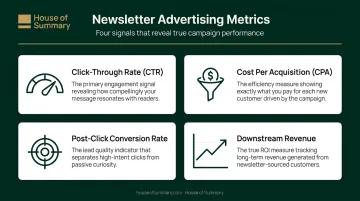
CTR alone is insufficient. A high CTR with zero post-click conversions usually means the ad attracted the wrong audience — or the landing page failed to continue the conversation the ad started.
Track Subscriber Quality, Not Just Volume
For campaigns designed to grow a list or fill a funnel, track what new subscribers do after they arrive:
- Do they open subsequent emails?
- Are they engaging with content beyond the first touchpoint?
- Do they convert within a reasonable window?
Cohort-level engagement data reveals whether a newsletter's audience is genuinely aligned with your offering — or just curious enough to click once.
Making Smarter Future Buys
Treat the first campaign in any new newsletter as a structured test with a defined hypothesis. After it runs:
- Identify which placements and formats delivered the best qualified traffic
- Reinvest in proven performers before testing new publications
- Use format and position data to negotiate better placements in subsequent runs
Each campaign adds a data point. Over time, those data points tell you exactly where to spend, what to say, and which audiences are worth returning to.
Frequently Asked Questions
What are the 4 types of advertising?
The four broad types are paid/traditional (TV, print, radio), digital (search, display, social), native, and direct response. Newsletter advertising spans the digital and native categories: it's a digital channel that typically uses native formats to reduce reader friction and blend with editorial content.
What are 5 elements of an effective newsletter?
A compelling subject line, clear and useful content, a consistent publishing schedule, defined audience focus, and a strong call to action. Publications that execute all five tend to carry the engaged audiences that make ad placements perform.
How much does newsletter advertising cost?
Costs vary significantly based on audience size, engagement rates, and placement type. CPM rates typically run $15–$100+ depending on list size and niche; CPC rates average $1–$5 per click. Premium niche newsletters cost more per placement but frequently deliver stronger ROI than larger, lower-engagement publications.
How do I measure the ROI of a newsletter ad campaign?
Track CTR as your engagement signal, CPA to assess efficiency, post-click conversion rate to evaluate lead quality, and total revenue generated to calculate true return. Campaigns that only measure clicks consistently underreport — or overreport — actual performance.
What is the difference between a sponsored newsletter ad and a dedicated email?
A sponsored ad is a placement within a regular newsletter issue alongside editorial content. A dedicated email gives the advertiser the entire issue: no competing content, maximum space. Dedicated emails cost more and suit complex messaging, product launches, or campaigns that need room to tell a full story.
How is newsletter advertising different from social media advertising?
Newsletter ads reach opted-in audiences who actively chose to receive the publication; social ads interrupt passive scrollers. Newsletter placements are also immune to ad blockers and algorithm changes. The editorial trust readers place in a newsletter transfers to the brands featured inside it — an implicit endorsement social platforms cannot replicate.