This guide covers why newsletter advertising works, how to choose the right newsletter partner, what effective ads look like, how to measure results, and what it costs. Whether you're a local shop looking to increase foot traffic or a service business building your reputation, newsletter ads offer a direct path to engaged, opt-in audiences who actually read what you send.
TLDR:
- Newsletter ads bypass ad blockers and algorithms, delivering your message directly to the inbox
- Opt-in subscribers are highly engaged—open rates average 21-44%, while organic social reach has collapsed below 4%
- Strong newsletter ads require a specific offer, benefit-driven headline, and one focused call to action
- Choose newsletters where the audience matches your geography, customer profile, and intent—not just subscriber count
- Pricing ranges from $50-$250 for small newsletters to $3,000+ for large publications, typically outperforming display ads on cost-per-engagement
Why Newsletter Advertising Works for Local Businesses
Newsletter advertising operates on a fundamentally different model than social media or display advertising. When someone subscribes to a newsletter, they've actively opted in to receive content in their inbox. That's a fundamentally different starting point from algorithmically-served feeds where users passively scroll past content they never asked for — newsletters reach people who chose to be there.
Inbox Delivery Means Your Ad Actually Gets Seen
Unlike social media posts that may reach only a fraction of your followers, or web display ads that are blocked before they load, newsletter ads are delivered directly to the reader's inbox. 32.5% of US internet users run ad blockers, meaning nearly a third of traditional display advertising is invisible before it's ever served. Newsletter ads bypass this entirely—they're already in the inbox when the reader opens their email.
Within the inbox, attention is focused. There are no competing posts, no autoplay videos, no infinite scroll designed to fragment attention. The newsletter is the content, and your ad appears within that trusted editorial flow. Your message actually has a chance to be read.
Contrast this with social media, where Facebook's organic reach has dropped to 1.20% and Instagram's sits at 3.50%. If you have 1,000 followers, only 12-35 of them will see your post organically. Newsletters don't suppress reach—they deliver to everyone who subscribed.
Newsletter Readers Are High-Intent and Engaged
Opt-in newsletter subscribers are a self-selected audience. They signed up because they value the content — which distinguishes them from passive social media users or random web visitors. Average email open rates range from 21.5% to 43.46%, significantly higher than the 1-4% organic reach on major social platforms.
Specialized newsletters built around clear editorial voices attract readers with defined interests — whether that's global news, city-specific content, or niche industries. Advertisers get a direct path to audiences that match their customer profile, without the guesswork of broad targeting.
Newsletter click-through rates typically range from 2% to 5%, which outperforms Google Display Ads (0.46%) but is generally comparable to Google Search Ads (3.17%-6.66%). The key difference: newsletter audiences are reading content they requested, not searching with commercial intent or passively browsing the web.
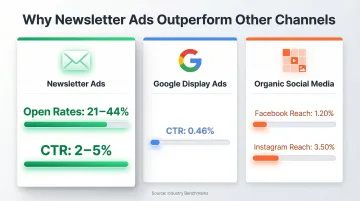
For local businesses, this engagement gap matters. A reader who opens a trusted newsletter about their city or neighborhood is far more likely to notice and act on a relevant local offer than someone scrolling Instagram while waiting in line.
Community Trust Transfers to Advertisers
Local and niche newsletters build trust with their readers over time. When a business appears in a newsletter that readers rely on for curated, useful information, some of that credibility carries over to the advertiser. For local businesses building reputation in a specific geography or community, that trust transfer is hard to replicate through other channels.
House of Summary's newsletters — including city-focused publications like Dubai Summary and London Summary — work on exactly this basis. Readers come for verified, noise-free content; advertisers benefit from the same credibility readers extend to the editorial voice itself.
For local businesses, appearing in a respected community newsletter signals legitimacy and relevance in a way that generic display ads cannot.
How Newsletter Advertising Works: Formats and Placements
Newsletter advertising offers several formats depending on budget, goals, and the newsletter's structure. Understanding these formats helps local businesses make smarter placement decisions and avoid wasting money on poorly suited options.
Sponsored Content and Native Placements
Sponsored content (also called native placements) refers to ads written in the editorial style of the newsletter, typically introduced as "presented by" or "sponsored by" a brand. The ad reads like a recommendation rather than a traditional advertisement, matching the tone and format of the surrounding content.
This format performs well in newsletters because it reduces friction. Native ads generate up to 8.8 times more click-throughs than traditional banner ads, largely because they don't visually disrupt the reading experience. The ad feels like part of the content, not an interruption.
Native placements work best when the offer aligns closely with the newsletter's subject matter. A restaurant advertising in a city food newsletter, or a financial advisor sponsoring a business newsletter, will outperform a generic service trying to force relevance.
Dedicated Sends and Solo Newsletters
A dedicated send (also called a solo email) is when the advertiser's message is the entire email, sent to the newsletter's subscriber list on the business's behalf. There's no other content—just your offer, your creative, and your call to action.
Dedicated sends command higher prices than inline placements because they deliver 100% of the reader's attention. This format makes sense for larger campaigns, significant launch offers, and businesses with professional creative assets ready to go.
Most local businesses won't need this format unless they're launching something significant or have a limited-time offer strong enough to carry an entire email on its own.
Inline Display and Banner Ads
For businesses that aren't ready for a dedicated send, inline ads offer a practical entry point. These shorter text-and-image placements appear between editorial sections and represent the most accessible format for local businesses with smaller budgets.
Placement position matters:
- Top position: Highest visibility, highest CPM
- Middle position: Balanced visibility and price
- Footer position: Lowest visibility, lowest price
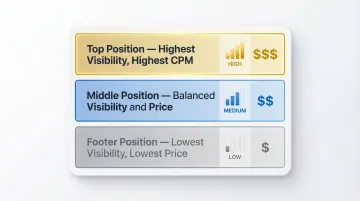
Some newsletters offer multi-issue packages where your inline ad runs across several consecutive editions. This repetition builds familiarity and trust with local audiences — exactly what local businesses need to earn community recognition over time.
How to Write a Newsletter Ad That Converts
A great newsletter placement with a weak ad is a wasted opportunity. The ad creative—headline, offer, call to action—determines whether a reader clicks or keeps scrolling.
Lead With a Headline That Earns Attention
Your headline must do two jobs simultaneously: capture attention within the email reading flow and communicate a clear, specific benefit.
Weak headlines are generic and brand-focused:
- "Smith & Co. – Your Trusted Partner"
- "Visit Our New Location"
Strong headlines are specific and benefit-driven:
- "Get 20% Off Your First Cleaning – Book This Week Only"
- "Free 30-Minute Tax Consultation for New Clients"
Keep headlines concise and focused on what the reader gains, not what your business does. Avoid misleading language—newsletter readers have little patience for vague promises. If the headline doesn't offer something concrete, they move on.
Make the Offer Clear and Specific
Vague ads ("We're here to help!") underperform because they give the reader no reason to act. The offer should be specific: a discount, a free consultation, a limited-time deal, or a concrete solution to a recognizable problem.
Think from the reader's perspective: what immediate value does clicking this ad deliver?
Good offers:
- "$50 off your first session—new clients only"
- "Free site audit this month"
- "Same-day appointments available"
Weak offers:
- "Quality service you can trust"
- "Contact us to learn more"
Write for Scan-Reading, Not Deep Reading
A compelling offer only works if readers can absorb it quickly. Structure your ad so the value proposition lands even for someone who only reads the headline and CTA.
- Keep ad copy to 2-4 sentences
- Use plain language
- Avoid jargon or excessive background about the business
- Front-load the benefit
End With a Single, Focused Call to Action
Every newsletter ad should have one clear call to action—not three. Emails with a single CTA generate up to 371% more clicks than those with multiple competing options.
Multiple CTAs split attention and reduce conversion. Decide what action you want—visit a landing page, claim an offer, book a call—then build the entire ad around that one goal.
Using a call-to-action button instead of a text link increases click-throughs by 28%. If the newsletter format allows, request a styled button for your CTA.
Align Your Ad With the Newsletter's Tone and Audience
Ads that feel jarring or misaligned with the newsletter's editorial voice get skipped. Before writing a single word, do this:
- Read several issues to understand the publication's voice and style
- Match the tone and vocabulary level of the editorial content
- Verify your offer is genuinely relevant to that newsletter's reader profile
- Check that your price point and category fit the audience demographic
Audience mismatch is one of the most common reasons newsletter campaigns underperform. A luxury service in a budget-focused newsletter, or a technical B2B offer in a consumer lifestyle publication, will burn budget with little to show for it.
How to Choose the Right Newsletter for Your Local Business
Audience fit matters more than audience size. A newsletter with 5,000 highly engaged, geographically relevant readers will outperform a newsletter with 50,000 disengaged or mismatched subscribers.
Key evaluation criteria:
- Confirm the subscriber base covers your actual service area
- Check that the readership matches your customer profile, not just your industry
- Review open rates and click-through rates — not just subscriber count
- Assess editorial reputation: do readers genuinely trust this publication?
City-focused newsletters illustrate this well. Publications built around a specific metro area — like a London lifestyle digest or a Dubai business roundup — attract readers who live, work, and spend money in that geography. That concentration gives local advertisers targeting precision that broad-reach platforms simply can't match.
For local businesses, geography and relevance are non-negotiable. A plumber in Austin should advertise in Austin-focused newsletters — not national publications read by people who will never call them.
Before committing to a placement, ask the newsletter publisher for:
- Media kit with audience demographics
- Average open rates and click-through rates
- Subscriber count and growth trend
- Geographic breakdown of readership
- Examples of past advertiser campaigns
A reputable newsletter publisher should provide transparent performance data. If they won't share this information, that's a red flag.
Interested in advertising opportunities with House of Summary's network of specialized newsletters? Reach out to sales@houseofsummary.com to request a media kit.
What Does Newsletter Advertising Cost?
Newsletter advertising costs vary widely based on audience size, niche, engagement rates, and placement type. Understanding the pricing models helps local businesses budget appropriately.
Three common pricing models:
- Flat-rate: A fixed fee per issue or per send, common for smaller or local newsletters
- CPM (cost per thousand impressions): Priced based on the newsletter's subscriber count, common for larger publications
- CPC (cost per click): Less common in newsletters but increasingly available through managed ad networks
Newsletter pricing benchmarks:
| Newsletter Size | Typical Flat-Rate | Typical CPM Range |
|---|---|---|
| Small (<5,000 subscribers) | $50 - $250 | $15 - $35 |
| Mid-Sized (5,000-50,000 subscribers) | $500 - $3,000 | $20 - $50 |
| Large (50,000+ subscribers) | $3,000 - $20,000+ | Varies widely |
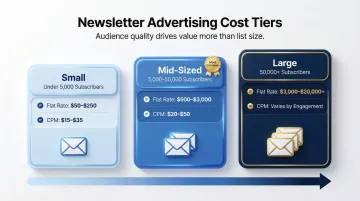
Audience quality drives these numbers more than list size. B2B newsletters in specialized industries command CPMs of $50-$100+, while broader consumer newsletters stay in the $15-$35 range.
Comparative context:
- Facebook ads average a CPM of $11.76 and CPC of $1.14
- Local newspaper print advertising varies dramatically by market but can range from $65-$200 per column inch depending on circulation and placement
The key advantage for local businesses: newsletter readers opt in and stay subscribed, making them a far more receptive audience than someone scrolling past a display ad. That translates directly to lower cost-per-engagement — even when the flat-rate price looks higher upfront.
How to Measure Whether Your Newsletter Ads Are Working
Tracking performance ensures you're getting ROI and helps you identify which newsletters, formats, and offers work best.
Primary metrics to track:
Click-through rate (CTR): Measures how compelling your ad and CTA were. Strong newsletter CTRs typically fall between 2% and 5%.
Conversion rate: Measures how many clicks resulted in the desired action—a purchase, booking, or sign-up. Good email conversion rates range between 2% to 3%.
Revenue or leads generated: The ultimate measure of campaign success.
CRITICAL: Do not rely on open rates as a performance metric. Apple's Mail Privacy Protection artificially inflates open rates by preloading tracking pixels, making this metric unreliable.
How to track accurately:
- Set up a dedicated landing page for each newsletter campaign so you can isolate performance from other traffic sources
- Use UTM parameters in your ad links to track traffic in Google Analytics (utm_source=newsletter name, utm_medium=email, utm_campaign=offer name)
- Remove navigation links from your landing page header and footer to eliminate distractions and maximize conversions
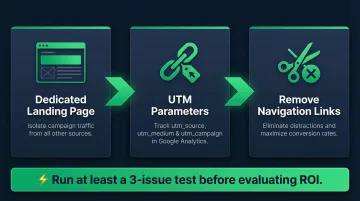
Once your tracking is in place, give the data time to mean something. Newsletter advertising typically requires multiple placements before results compound — a single ad in one issue rarely moves the needle. Run at least a 3-issue test before evaluating ROI, then reinvest in what performs.
Frequently Asked Questions
Where can I advertise locally?
Local businesses can advertise through community newsletters, local newspapers (print and digital), geo-targeted social media campaigns, Google Local Services Ads, and community bulletin boards. Newsletters tend to deliver the strongest engagement because readers have opted in — they're choosing to receive that content.
How much does it cost to advertise in a local newspaper?
Local newspaper advertising costs vary based on circulation size, ad dimensions, and placement. Print ads are typically priced by the column inch, ranging from $65–$200+ depending on market size — with digital placements often priced separately. For targeting a specific local audience, newsletters generally offer better cost efficiency.
Are newsletter ads effective for small businesses?
Newsletter ads work well for small businesses when the subscriber base matches the target customer profile. The opt-in, inbox-delivered format consistently produces higher engagement than display or social advertising — and it supports precise geographic targeting that broad-reach channels can't match.
What should a newsletter ad include?
A strong newsletter ad includes:
- A benefit-driven headline (not a brand name)
- A specific offer or value proposition
- Concise body copy — 2–3 sentences maximum
- One call to action with a trackable link
- A CTA button rather than a plain text link
Align the tone with the newsletter's editorial voice so the ad feels native, not intrusive.
How do I measure the success of a newsletter ad?
Measure success using click-through rate, conversion rate, and revenue or leads generated. Use a dedicated landing page or UTM-tagged URL to track performance accurately in Google Analytics. Ignore open rates as a primary metric due to Apple's Mail Privacy Protection inflating open rate data.
What is the difference between advertising in a newsletter vs. on social media?
Newsletter ads reach opt-in subscribers directly in their inbox without algorithmic filtering or ad blockers, while social media ads compete in a distracting feed environment and are subject to platform algorithm changes. Organic social reach has collapsed below 4%, while newsletter open rates average 21–44%, making newsletters a more reliable channel for guaranteed delivery and engagement.