
The challenge? Newsletter ad pricing has no universal sticker price. A single placement can run anywhere from $50 to $20,000+ depending on audience size, niche, engagement quality, and the pricing model used. Without context, advertisers either overpay for low-quality lists or write off high-performing newsletters as too expensive — without ever doing the ROI math.
This article breaks down real pricing ranges, the four main pricing models, the factors that drive costs up or down, and a practical framework for estimating your budget before you spend anything.
Key Takeaways
- Newsletter CPMs typically range $15–$30 for general audiences; specialized B2B and professional newsletters command $50–$100+
- CPM, CPC, flat rate, and CPA each shift performance risk differently — knowing which model fits your goals directly affects ROI
- A 50,000-subscriber niche list with high purchase intent will often outperform a 500,000-subscriber general list at a fraction of the CPM
- High-intent, niche audiences often deliver better ROI at higher CPMs than large general lists at lower rates
How Much Does Newsletter Advertising Cost?
There's no standard rate card for newsletter advertising. Audience size, engagement quality, niche, ad format, and pricing model all push costs in different directions. Two newsletters with identical subscriber counts can differ in price by 5x — and both can be fairly priced given their audiences.
Entry-Level Placements (Under 10K Subscribers)
Small newsletters are the testing ground for first-time advertisers and bootstrapped brands.
- Flat rate range: roughly $50–$500 per insertion
- Specific examples: a 3K-subscriber newsletter typically runs $75–$150; a 5K list runs $125–$250; 10K lists run approximately $250–$500 (Paved, 2024)
- Best for: testing the channel, validating creative, low-commitment entry
Engagement and niche create significant variance even at this level. A 5K-subscriber B2B newsletter can outprice a 10K general lifestyle list.
Mid-Range Placements (10K–100K Subscribers)
This is where pricing variation becomes most pronounced. According to beehiiv, newsletters in the 5K–50K subscriber range typically command $500–$3,000 per placement.
Key factors driving rates in this tier:
- CPM benchmarks: a 20K-subscriber marketing newsletter at 60% open rate can justify $35–$40 CPM, putting a primary placement at $700–$800
- Niche premium: finance and HR-focused newsletters at this size price far above general lifestyle titles
- Demographics: audience seniority and purchasing authority matter as much as subscriber count
Premium Placements (50K+ Subscribers or Elite Niches)
At this tier, pricing scales fast:
- Large general lists (50K+): $3,000–$20,000+ per insertion (beehiiv)
- Elite specialized audiences: pricing disconnects from subscriber count entirely
A useful illustration: fDi Intelligence, a newsletter reaching 12,500+ senior investment professionals, charges approximately £8,500 (roughly $10,700 USD) for a one-month campaign — with a reported 25% open rate and 5.5% CTR. The audience's decision-making power justifies the premium, not the list size.
What these rates typically include: one ad slot per send. Creative production, dedicated sends, multi-placement packages, and geographic targeting are usually priced separately.
Newsletter Ad Pricing Models Explained
The pricing model determines who carries the performance risk — publisher or advertiser. Each model suits different campaign objectives.
CPM (Cost Per Mille)
CPM charges per 1,000 subscribers reached. The formula: (Ad Cost ÷ Total Subscribers) × 1,000.
| Audience Type | Typical CPM Range |
|---|---|
| General interest | $15–$30 |
| Consumer/lifestyle | $15–$35 |
| Specialized B2B | $50–$100+ |
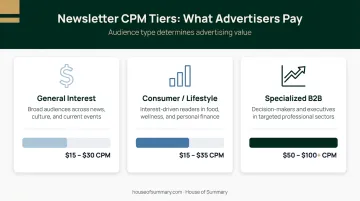
General primary sponsorships typically cost $15–$30 per 1,000 opens, according to data from Paved. Specialized B2B newsletters can command $50–$100+, as reported by beehiiv. CPM works best for brand awareness campaigns where reach matters and direct-response measurement is secondary.
CPC (Cost Per Click)
CPC charges only for verified clicks — no impressions, no guesswork.
- Bids typically start at $1–$6 per click, with most campaigns landing in the $1–$5 range (per Paved benchmarks)
- Reputable platforms charge only for authenticated human clicks, not bot traffic
- Works best for performance-driven advertisers with a clear landing page and measurable conversion goal
The key due diligence: confirm how clicks are verified before committing to a CPC deal.
Flat Rate
A fixed fee per insertion, regardless of opens or clicks. It's the most common model for direct publisher deals, with no formulas or performance variables to track.
Flat rates are typically derived from CPM and CPC benchmarks but presented as a clean price. For advertisers building long-term sponsor relationships, flat rate offers two clear advantages:
- Budget predictability: one fixed cost per placement, no surprises
- Simplified reporting: no click or impression tracking required to reconcile invoices
CPA / Affiliate Model
Pay only when a specific action — a sale, sign-up, or download — is completed. Maximum risk sits with the publisher.
Most premium newsletters don't offer CPA deals because they can't control advertiser landing page quality or conversion rates. This model suits performance-heavy campaigns where the advertiser has a proven funnel and known conversion rate.
Key Factors That Drive Newsletter Ad Costs Up or Down
Two newsletters with identical subscriber counts can sit at opposite ends of the pricing spectrum. The gap comes down to four variables that matter far more than raw list size.
Audience Niche and Commercial Intent
Niche is the single strongest CPM driver. Paved's 2026 sponsorship benchmarks show revenue per 1,000 subscribers varies dramatically by category:
| Category | Revenue per 1,000 Subscribers |
|---|---|
| Millennials | $66 |
| Human Resources | $43 |
| Startups | $35 |
| Marketing | $31 |
| Business | $15 |
| Lifestyle | $4 |
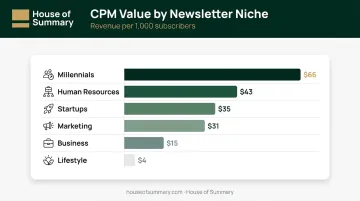
Finance, B2B, and executive-focused newsletters command 2–3x the CPM of general interest lists. The driver isn't the topic — it's the purchasing power and decision-making authority of the audience.
Open Rate and Engagement Metrics
A newsletter with a 40%+ open rate justifies a materially higher rate than one at 15% with the same subscriber count. You're paying for actual eyeballs, not a number on a spreadsheet.
Mailchimp's December 2023 benchmarks put the cross-industry average open rate at 35.63% and average click rate at 2.62%. Above-average engagement — especially click rates above 4–5% — signals an audience that reads rather than skims, which premium newsletters back up in their media kits.
Placement within a newsletter compounds the engagement picture — where your ad sits shapes both visibility and price.
Ad Placement Position
Where your ad appears directly determines what you pay:
- Top/primary slot carries the highest rate and maximum visibility
- Mid-newsletter placement runs at roughly 50–65% of the primary rate
- Footer and classified listings fall in the 25–35% range
- Dedicated sends (full-issue, one brand) command 2–5x the primary rate — and justify it with undivided inbox real estate
List Size vs. List Quality
Raw subscriber count is a starting point, not a valuation. A smaller, curated list of executives and decision-makers routinely outperforms a large mass-market list on every performance metric:
- Click and conversion rates run higher when subscribers have strong commercial intent
- Downstream revenue per placement reflects audience purchasing power, not list volume
- List hygiene — removing inactive subscribers — directly lifts open rates and strengthens the rate a publisher can justify charging
Advertisers paying for a niche list aren't paying for size. They're paying for signal.
What's Really Included in Your Newsletter Ad Budget
The placement fee is only part of the number you need.
Line items to account for:
- Ad placement fee — the negotiated rate per send, the biggest line item
- Creative production — copywriting and design if not handled in-house; native placements that match the newsletter's editorial tone require more work than display banners
- Tracking setup — UTM parameters, landing page configuration, and conversion attribution tools to measure actual performance
- Package vs. single-insertion pricing — multi-run packages typically offer meaningful savings; always ask about the price difference before booking a one-off
Ask publishers upfront:
- Does the rate include a resend to non-openers?
- Is the ad included in a web archive or newsletter page?
- Are there any social promotion components?
Those questions also help you evaluate what you're actually getting beyond the placement itself. Some publishers, including House of Summary, include dedicated brand consultation with every campaign. That kind of support matters when you're comparing a managed direct deal against a self-serve marketplace placement where you're largely on your own.
How to Estimate the Right Budget
Start from the outcome you want, then work backwards. Don't start from an arbitrary spend number.
A practical four-step framework:
- Define your target audience — match it to newsletter categories that serve that reader profile
- Request engagement data — ask publishers for open rate, average ad CTR, and audience composition; don't accept subscriber count alone
- Calculate expected cost per outcome — use eCPC (effective cost per click) or eCPA formulas to model what you'll actually pay per conversion, not per impression
- Benchmark against your current channels — compare newsletter eCPC against your paid social or search CPC for the same audience; for high-intent niches, the newsletter often wins on cost-per-qualified-click
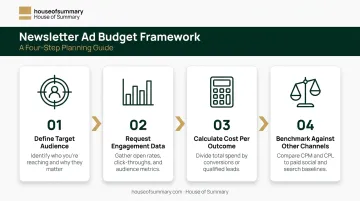
That benchmarking step is where niche audience quality becomes concrete. For brands targeting executives and senior professionals in finance, geopolitics, or global news, networks like House of Summary provide direct inbox access to decision-makers across the US, UK, and UAE. The BSH Hausgeräte campaign, run through that audience, reported CTRs 4x higher than Google AdWords — a meaningful gap when you're running the numbers in step four.
What Most Advertisers Get Wrong About Newsletter Ad Costs
Most newsletter ad campaigns underperform not because the channel is wrong, but because advertisers evaluate it incorrectly. Three mistakes come up again and again:
- CPM comparisons without engagement data. A newsletter with 500K subscribers and an 8% open rate delivers fewer real impressions than one with 50K subscribers and a 45% open rate. CPM alone doesn't tell you what you're actually buying.
- Skipping the cost-per-conversion math. When total spend is divided by actual clicks or conversions — not raw impressions — newsletter ads routinely outperform paid social and search for targeted niches, particularly at the premium end.
- Choosing on price instead of audience fit. A cheap placement in the wrong newsletter produces poor results, then a false conclusion that "newsletter advertising doesn't work." Audience-product alignment is the variable that pricing can't fix on its own.
Conclusion
Newsletter advertising costs range from $50 for a small-list entry placement to $20,000+ for a premium, high-engagement send — and neither end of that range is inherently right or wrong. The right cost is the one that produces your target cost-per-outcome, not the lowest number on a rate card.
The best newsletter ad investments share three traits:
- The advertiser understands how the pricing model works
- The ROI math is done before booking
- The publication's audience matches the brand's target customer precisely
Frequently Asked Questions
How to price newsletter ads?
Newsletter ad pricing uses CPM benchmarks based on subscriber count and open rate, CPC targets based on expected click behavior, or flat-rate negotiation with direct publishers. Most publishers set initial rates with room to negotiate discounts for multi-run commitments.
What's a good click rate for a newsletter?
Mailchimp benchmarks the cross-industry average at 2.62% CTR. High-performing niche newsletters — particularly B2B, finance, and media-focused publications — regularly report 4–6% CTR. Above-average click rates allow publishers to justify higher CPMs.
What is a good CPM for newsletter advertising?
CPMs under $30 are typical for general interest newsletters, while niche B2B or executive-focused publications command $50–$100+ CPM. Whether a rate is "good" depends on whether your resulting cost-per-click or cost-per-acquisition makes the campaign profitable.
How much does it cost to advertise in a newsletter?
Entry-level placements in small newsletters (under 10K subscribers) start around $50–$500 per send. Premium placements in large or high-engagement publications can reach $3,000–$20,000+ per insertion. Cost scales with audience size, niche, and engagement quality.
What is the difference between CPM and flat rate newsletter advertising?
CPM charges per 1,000 subscribers reached and makes rates easy to compare across publishers of different sizes. Flat rate is a fixed fee per insertion regardless of performance — simpler for direct deals and long-term sponsor relationships. Both can represent the same underlying value; the model changes how it's expressed.
Is newsletter advertising worth it for brands?
For brands targeting specific, high-intent audiences, newsletter advertising consistently outperforms social and display on engagement. Subscribers opted in, read without distraction, and no algorithm can bury the message. ROI depends on audience alignment and creative quality.