
Introduction
The inbox remains one of the last distraction-free advertising environments. No algorithm decides who sees your ad. No Chrome extension blocks it. No competing visual clutter dilutes your message. Premium newsletters have built a strong following among serious, engaged readers who've opted in for specific, high-value content — and brands have taken notice.
Pricing for native ad placements in premium newsletters typically ranges from a few hundred dollars to well over $50,000 per send — a spread driven by newsletter size, audience niche, pricing model, and ad format. Without a clear read on these variables, brands risk overpaying for placements that don't deliver or spending too little to reach a meaningful audience.
This guide covers the main pricing tiers, the factors that move costs up or down, and how to size your budget based on your goals and target audience.
Key Takeaways
- Native ad placements range from a few hundred dollars for smaller lists to $50,000+ in premium publications
- Flat-rate pricing dominates under 20,000 subscribers; CPM models become standard at larger scales
- Six factors shape cost: subscriber count, open rate, niche, ad format, placement position, and whether copy is included
- A $150 CPM reaching 5,000 executives often outperforms a $15 CPM reaching 100,000 general readers
How Much Does Native Advertising Cost in Premium Newsletters?
Newsletter native ad pricing is not standardized. Unlike programmatic platforms such as Taboola and Outbrain with publicly listed CPM floors, most premium newsletters sell inventory through direct deals, rate cards, or custom proposals negotiated with advertisers.
Three pricing mistakes sink campaigns before they start:
Underbudgeting for authority newsletters. Brands allocate $2,000 expecting multiple placements in a top-tier publication, only to discover a single insertion costs $15,000. According to Stacked Marketer's analysis, Morning Brew commands approximately $50,000 per primary placement.
Prioritizing list size over engagement. A 200,000-subscriber newsletter with a 10% open rate delivers 20,000 actual impressions. A 50,000-subscriber newsletter with a 40% open rate delivers the same 20,000 impressions at a fraction of the cost per engaged reader.
Ignoring creative production fees. The rate card shows $3,000, but content creation adds $500–$2,000 and attribution setup adds another $200–$1,000 — bringing the fully loaded cost to $3,700–$6,000.
Pricing Tier 1: Independent or Niche Newsletters (Under 20,000–30,000 Subscribers)
Flat-rate pricing dominates at this tier. According to Admailr's 2026 CPM Guide, newsletters under 5,000 subscribers typically charge $50–$250 per placement, while those with 5,000–20,000 subscribers charge $300–$1,000. CPM ranges span $15–$100+, depending on niche specialization.
What's included: One in-newsletter placement, basic targeting by niche
What's not included: Dedicated sends, custom content creation, multi-issue packages
Best entry point for brands with a specific niche audience and a budget under $2,000 — lower risk, faster learning curve.
Pricing Tier 2: Mid-Size Established Newsletters (30,000–150,000 Subscribers)
CPM-based pricing becomes standard. Admailr reports flat rates of $1,000–$3,000 for 20,000–50,000 subscriber newsletters and $3,000–$8,000 for 50,000–100,000 subscriber newsletters. CPM ranges narrow to $15–$60.
At this tier, publishers offer multiple formats:
- Sponsored sections with editorial copy
- Logo placement in header
- Inline native ad units
- Secondary text mentions
Open rates and audience quality begin to matter as much as list size. A 40,000-subscriber newsletter with a 50% open rate delivers 20,000 engaged impressions, justifying a higher CPM than a 100,000-subscriber list with 15% opens.
This tier suits brands with defined audience targets and moderate campaign budgets ($5,000–$15,000 per month).
Pricing Tier 3: Premium and Syndicated Newsletter Networks (150,000+ Subscribers)
Premium newsletters command $8,000–$20,000+ per primary placement at the 100,000+ subscriber level. Admailr and AdCommons report CPM ranges of $10–$35 at scale due to volume efficiencies, though niche premium audiences command significantly higher rates.
These placements typically include:
- Co-created content written by the newsletter's editorial team
- Prominent editorial integration that reads as a natural recommendation
- Multi-issue packages with frequency discounts
- Category exclusivity (only one advertiser per industry per issue)
Advertisers in finance, luxury goods, and B2B sectors operate at this tier where CPM can reach $150–$200+ for executive audiences. Newsletter networks operating at this level — such as House of Summary, which publishes Presidential Summary, Geopolitical Summary, and other specialized titles to 500,000+ professional readers — give advertisers direct inbox access that programmatic channels can't replicate. No algorithms, no ad blockers, no competing content on the same screen.
Key Factors That Affect the Cost of Newsletter Native Ads
Two newsletters with identical subscriber counts can differ by 3x or more in pricing. Raw list size is only one variable.
Audience Niche and Reader Profile
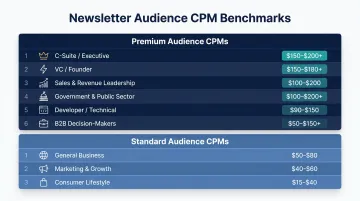
Newsletters serving high-value professional audiences command significantly higher CPMs than general interest publications. AdCommons provides specific benchmarks:
Premium Audience CPMs:
- C-Suite/Executive audiences: $150–$200+
- VC/Founder audiences: $150–$180+
- Sales & Revenue Leadership: $100–$200
- Government & Public Sector: $100–$200+
- Developer/Technical audiences: $90–$150
- B2B Decision-Makers: $50–$150+
Standard Audience CPMs:
- General Business: $50–$80
- Marketing & Growth: $40–$60
- Consumer Lifestyle: $15–$40
Advertisers in financial services, B2B tech, and luxury goods compete aggressively for access to executives and decision-makers who are scarce and difficult to reach through mass-market channels. These readers carry high lifetime value and real purchasing authority — which is why their attention commands a price premium.
Paved's marketplace data reveals a surprising disconnect: History newsletters averaged a 63.2% open rate but earned only $4 per 1,000 subscribers, while Millennials-focused newsletters averaged 44.4% opens yet earned $66 per 1,000 subscribers — a 16.5x revenue difference driven entirely by advertiser demand for the audience profile.
Newsletter Engagement Metrics (Open Rate and Click-Through Rate)
Most premium newsletter publishers price based on engaged subscribers or average opens, not total list size. A 40% open rate on 50,000 subscribers (20,000 engaged readers) is more valuable than a 10% open rate on 200,000 subscribers delivering the same 20,000 reads, even when the flat rate is higher.
MailerLite reports the average email open rate across industries was 43.46% in 2025, with an average click-to-open rate of 6.81%. Beehiiv reports platform average open rates of 39%, with newsletter CTRs hovering at 1.5–1.7%.
Publishers use two CPM calculation methods:
- List-based CPM: Calculated on total subscribers
- Open-based CPM (CPO): Calculated on unique opens
A 20,000-subscriber newsletter with 50% opens delivers 10,000 actual impressions. One with 25% opens delivers only 5,000. If both quote the same CPM against total subscribers, the effective cost per engaged reader differs by 2x.
Newsletter CTR vs. Other Channels:
| Channel | Average CTR |
|---|---|
| Newsletter Ads | 1.5–1.7% |
| Google Search Ads | 3.17% |
| Google Display Ads | 0.46% |
Newsletter CTRs outperform display advertising (3.3x higher) but trail search ads, which capture active purchase intent.
Ad Format and Placement Position
Placement position creates predictable cost multipliers. AdCommons and Paved provide consistent data:
Placement Cost Structure:
- Primary (Top-of-Newsletter): Base rate to 1.5–2x standard rate
- Secondary (Mid-Content): 50–80% of primary rate
- Classified/Footer: 20–35% of primary rate
- Dedicated Send (Solo Email): 2–5x the primary rate
Concrete example: A 20,000-subscriber newsletter charges $1,200–$1,800 for standard sponsorship, $2,400–$3,600 for primary placement (1.5–2x), and $6,000–$9,000 for a dedicated send (2–3x base CPM).
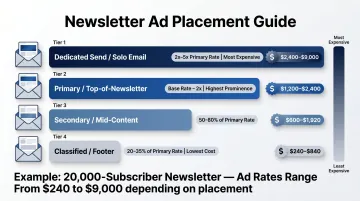
Dedicated sends (where the entire email is the advertiser's content) are the most expensive format because they deliver full-inbox exclusivity with zero competing messages.
Content Creation and Editorial Integration
Publisher-written native content that matches editorial tone typically carries a premium but outperforms standard display-style inserts.
Production Cost Breakdown (per AdCommons):
- Creative development (publisher-written copy): $500–$2,000
- Tracking/attribution setup: $200–$1,000
- Agency management fee (if applicable): 10–15% of spend
A $3,000 sponsorship with publisher-written copy and attribution tracking totals $3,700–$6,000 fully loaded.
eMarketer reports consumers view native ads 53% more frequently than banner ads, and native content produces an 18% increase in purchase intent. Editorial integration overcomes banner blindness by appearing as part of the content, not adjacent to it.
Frequency and Package Structure
Single-issue placements are priced at a premium per insertion. Multi-issue packages or annual sponsorships reduce the per-placement cost significantly.
Standard discount structures (per AdCommons):
- Frequency (4+ placements): 10–20% off
- Category exclusivity: 15–30% off
- Multi-newsletter packages: 10–15% off
- Annual commitments: 20–35% off
Beehiiv reports sponsors committing to 12-week campaigns see 40% better performance than one-off placements, driven by repeated exposure and trust-building.
Newsletter Native Ad Cost Breakdown
The published rate card rarely reflects the full cost of the campaign. Three cost layers typically make up total spend:
- Placement fee — The core media cost paid to the publisher, either flat-rate per issue or recurring across a package. This is the number on the rate card.
- Content production — If the advertiser writes copy, this is an internal cost. If the newsletter's editorial team produces the native ad, expect a $500–$2,000 creative fee on top of the media rate (AdCommons).
- Tracking and reporting — Most premium publishers include basic performance reports (opens, clicks, estimated reach). Enhanced analytics often carry an added fee, and some require advertisers to set up UTM parameters and third-party attribution independently.
Attribution deserves special attention. Apple's Mail Privacy Protection (MPP) now affects over 50% of email opens, artificially inflating open rate data. For email campaigns, click-based measurement is the only reliable signal.
Small Newsletter vs. Premium Newsletter — What's the Difference in Value?
A lower placement cost does not always mean a better deal. The metrics that matter for newsletter native advertising are engagement, audience alignment, and deliverability — not just raw list size.
Audience Quality and Intent
Premium newsletters serving professional or niche audiences deliver readers who opted in for specific, high-value content. That translates to higher message receptivity than broad-interest newsletters with lower editorial standards.
House of Summary's network — covering Presidential Summary, Geopolitical Summary, and other specialized publications — attracts readers who are inherently high-intent. Advertisers consistently see CTRs 4x higher than Google AdWords as a result.
Ad Avoidance and Deliverability
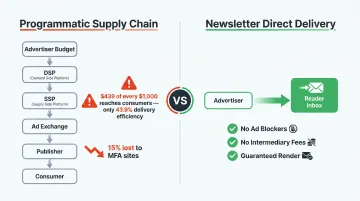
Backlinko reports approximately 1.77 billion internet users (29.5% globally) use ad-blocking tools. In the United States, 37% of desktop users employ ad blockers. Newsletter ads delivered to email inboxes are structurally immune — ad content renders as part of the email body, not from a third-party server that blockers target.
Compare guaranteed inbox delivery to the viewability uncertainty of programmatic web native ads. The ANA 2024 Programmatic Benchmark Study found that for every $1,000 entering a DSP, only $439 (43.9%) reaches consumers. Made-for-advertising (MFA) sites absorbed 15% of programmatic spend in 2023. Newsletter advertising cuts out the entire supply chain — there's no DSP, SSP, or ad exchange taking intermediary fees.
Brand Safety and Editorial Context
Premium newsletters with strong editorial reputations provide brand safety by association. Open programmatic environments routinely place ads next to low-quality or controversial content — a risk that simply doesn't exist in a curated newsletter.
When a brand appears in a trusted editorial context, readers extend that trust to the advertiser. That halo effect is difficult to buy anywhere else at comparable cost.
How to Estimate the Right Budget for Newsletter Native Advertising
The right budget for newsletter native advertising is defined by campaign objectives first — brand awareness, lead generation, or direct response — not by what seems affordable.
Factors to consider when estimating budget:
Define the target audience profile. Are they niche professionals, regional consumers, or general interest readers? A C-suite audience costs $150–$200 CPM while a general lifestyle audience costs $15–$40 CPM.
Set a minimum test budget covering at least two to three placements in the same newsletter to account for frequency effects. Beehiiv data shows 12-week campaigns deliver 40% better performance than single placements.
Calculate the expected CPM based on the publisher's open rate. If a newsletter quotes $5,000 for 100,000 subscribers with 40% opens, the effective CPM is $125 per 1,000 opens ($5,000 ÷ 40,000 opens × 1,000) — well above the list-based CPM of $50.
Compare this to other channels reaching the same audience. A $150 newsletter CPM reaching verified executives may be more efficient than a $5 programmatic CPM where only 43.9% of spend reaches real humans.
Before committing budget, request the publisher's verified open rate, audience demographics, and at least one past advertiser case study. The rate card tells you the price. Those three data points tell you whether it's worth paying.
Frequently Asked Questions
What is the average CPM for native ads?
General programmatic native ad CPMs on platforms like Taboola or Outbrain typically range from $3–$7, according to the Native Advertising Institute. Premium newsletter CPMs are significantly higher — $15–$40 for consumer audiences and $50–$200+ for B2B professional audiences — due to engaged, opted-in audiences and guaranteed deliverability that bypasses ad blockers.
Is a $5 CPM good?
A $5 CPM is competitive on programmatic platforms with broad reach, but in premium newsletter contexts, higher CPMs are often justified by better open rates, higher audience intent, and the absence of ad blockers. The real measure is cost per engaged reader — a $5 CPM reaching passive browsers rarely outperforms a $50 CPM reaching opted-in executives who actively read your message.
Which is better, CPM or CPC?
CPM suits brand awareness campaigns where impressions and exposure matter most. CPC is better for performance-driven goals where actual clicks to a landing page are the target. In premium newsletters, CPM is the more common model since publishers sell audience access rather than guaranteed clicks. Admailr reports newsletter CPC ranges of $1–$5 for mainstream placements and $5+ for specialized B2B newsletters.
What are the different types of native advertising?
In newsletter contexts, the three main formats are inline native ad units (ads within the content flow), sponsored sections (editorial-style brand content), and dedicated sends (solo emails where the entire message is advertiser content). Dedicated sends typically carry the highest price tag, while inline units are the most common entry point for new advertisers.
What is an advertising rate card?
A rate card is a publisher's standardized pricing document listing available ad placements, formats, audience size, and associated costs. For premium newsletters, the rate card typically includes subscriber count, average open rate, available formats (primary, secondary, dedicated send), and any exclusivity or creative service fees. The IAB defines it as standardized media space costs defined by ad sizes, platform, and creative formats.