
Introduction
Newsletter ad pricing spans an enormous range—from $50 for small, hyper-local lists to $50,000+ for premium placements in publications like Morning Brew. Many advertisers encounter this price spread and assume it's arbitrary or inflated. This variance reflects measurable differences in audience quality, engagement, niche specificity, and pricing model.
Newsletter ad spending surged 40% year-over-year in 2025, with publishers earning 30% more revenue as brands move budget away from rising acquisition costs on traditional platforms. Despite this growth, confusion persists around what placements actually cost and which ones drive conversions versus inflating open-rate reports.
This article breaks down exactly what newsletter ads cost by audience size, which pricing models exist, what drives costs up or down, and how to calculate whether a placement justifies the budget.
Key Takeaways
- Newsletter ad costs range from $50 to $20,000+ depending on audience size, niche, and engagement
- CPM rates typically fall between $10 and $100+, with premium niche lists commanding the highest prices
- Top cost drivers: audience size, engagement rate, niche specificity, and ad placement
- Smaller budgets suit flat-rate or CPC models; larger advertisers typically use CPM or CPA structures
- Subscriber count alone doesn't tell the full story: a 10,000-subscriber niche list often outperforms a 100,000-subscriber general one
- Cost-per-click and cost-per-acquisition matter far more than sticker price
How Much Do Newsletter Ads Cost? Pricing by Audience Size
Newsletter ad prices have no single standard rate. Costs vary enormously based on list size, audience quality, niche, and pricing model. Getting this wrong leads advertisers to overpay for underperforming placements — or write off high-CPM newsletters that consistently outperform on actual returns.
Small Newsletters (Under 5,000 Subscribers)
Typical placement cost: $50–$250 per placement at roughly $15–$35 CPM. Most small newsletters use flat-rate pricing for simplicity.
Best for:
- Brands testing newsletter advertising for the first time
- Local or niche businesses
- Advertisers targeting micro-audiences
At this tier, engagement metrics—open rate and click-through rate—matter more than list size. A 2,000-subscriber newsletter with a 45% open rate delivers more active impressions than a 5,000-subscriber list with 15% opens.
Mid-Size Newsletters (5,000–50,000 Subscribers)
Typical placement cost: $500–$3,000 per placement; CPM often $20–$50. Tiered placements (primary vs. secondary spots) commonly appear at this level. Advertisers should request a media kit with historical engagement data.
Best for:
- Brands with an established budget
- Defined target audiences seeking consistent reach
- Campaigns requiring measurable results
This tier hits a practical balance: enough reach for meaningful scale, with engagement rates that hold up. Beyond 50,000 subscribers, both pricing and commitment levels shift significantly.
Large Newsletters (50,000+ Subscribers)
Typical placement cost: $3,000–$20,000+ per placement. Top-tier publications can charge $50,000+ for certain packages. Minimum commitments and waiting lists are common at this scale.
Examples:
- Morning Brew (~4M subscribers): ~$50,000 for primary sponsor placement
- TLDR (1.6M tech subscribers): $6,000–$24,000 per placement
- Dense Discovery (38,000+ subscribers): $599 for main sponsor slot
Best for:
- Well-resourced brands running multi-touch campaigns
- Advertisers needing both scale and credibility
- Companies targeting specialized audiences where a premium CPM ($50–$100+) beats a lower CPM on a broad, passive list
The Four Newsletter Ad Pricing Models Explained
The total cost of a newsletter ad is shaped as much by the pricing model as by audience size. Different models suit different advertiser goals and risk tolerances.
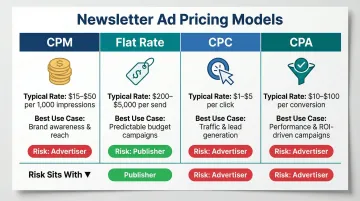
CPM (Cost Per Mille)
CPM charges per 1,000 subscribers. The formula is straightforward: Ad Cost = (Subscribers ÷ 1,000) × CPM rate. A newsletter with 30,000 subscribers at a $40 CPM costs $1,200 per placement.
Typical CPM ranges:
- General newsletters: $10–$30
- Niche B2B newsletters: $50–$100+
- Finance/investing newsletters: $80–$180
CPM prices potential reach, not guaranteed engagement. A $50 CPM with a 40% open rate delivers better value than a $20 CPM with 10% opens.
Flat Rate
Flat rate means one fixed price per placement, regardless of list size or performance. It's the simplest model — easy for small-to-mid newsletters to manage and straightforward for first-time advertisers to evaluate.
The catch: without engagement data, flat-rate comparisons are misleading. A $500 placement looks identical on paper whether the newsletter has 5,000 engaged readers or 20,000 inactive ones.
CPC (Cost Per Click)
CPC means you pay only for clicks on the ad link, typically $1–$5 per click.
Why advertisers use it:
- Transfers performance risk to the publisher
- Suits campaigns prioritizing traffic over brand awareness
- Links spend directly to measurable results
Verified click-tracking is non-negotiable — without it, fraud exposure is real.
CPA (Cost Per Acquisition)
CPA means you pay only when a reader completes a defined action — a purchase, sign-up, or trial activation. Rates typically run $10–$100+ per acquisition depending on industry and product value.
Why it appeals to advertisers:
- Lowest financial risk of any pricing model
- Aligns publisher incentives directly with advertiser outcomes
Publishers often decline CPA deals unless they trust the advertiser's funnel converts reliably — making it the hardest model to negotiate.
Quick Comparison: Which Model Fits Your Goal?
| Pricing Model | Typical Rate | Best For | Risk Sits With |
|---|---|---|---|
| CPM | $10–$180 per 1,000 | Brand awareness, reach | Advertiser |
| Flat Rate | Varies by newsletter | First-time buys, testing | Advertiser |
| CPC | $1–$5 per click | Traffic campaigns | Publisher |
| CPA | $10–$100+ per action | Conversion-focused campaigns | Publisher |
Key Factors That Drive Newsletter Ad Costs Up or Down
Two newsletters with identical subscriber counts can charge vastly different rates. Understanding which variables justify a higher price helps advertisers make smarter buying decisions.
Audience Niche and Industry
B2B newsletters targeting professionals in finance, technology, law, or global affairs command significantly higher CPMs than general-interest newsletters. Why? Those audiences are harder to reach elsewhere and have higher purchase intent.
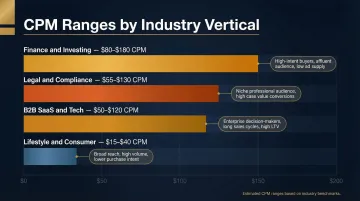
CPM by vertical:
| Vertical | Typical CPM Range | Why the Premium? |
|---|---|---|
| Finance & Investing | $80–$180 | Extraordinary financial value from converting a single subscriber |
| B2B SaaS & Tech | $50–$120 | Deep budgets targeting decision-makers with purchasing authority |
| Legal & Compliance | $55–$130 | Underserved, high-value niche with premium demand |
| Lifestyle & Consumer | $15–$40 | Broader audience with lower individual transaction values |
Premium networks focused on global executives and business professionals can deliver click-through rates 4x higher than Google AdWords — a difference that changes the cost calculation entirely for performance-minded advertisers.
Engagement Metrics (Open Rate and CTR)
Open rate and click-through rate are the most influential indicators of ad value. A newsletter with a 45% open rate delivers far more active impressions than one with 15%, even at identical subscriber counts.
Important context: Apple's Mail Privacy Protection (MPP) has artificially inflated average open rates to 35–45%, making them less reliable for measuring actual engagement. Click-to-open rate (CTOR) is now the most trustworthy metric.
Strong benchmarks to expect in publisher media kits:
- Open rate: 30–50% (though inflated by MPP)
- Click rate: 2–5%
- CTOR: 5–12%
Ad Placement and Format
Header placements (first visual in the email) command the highest prices. Mid-newsletter placements sit in the middle. Footer placements cost least.
Placement performance:
- Header ads: Highest visibility, premium pricing
- Mid-content ads: Can drive up to 22% higher CTR by catching readers mid-scroll in a high-attention state
- Footer ads: Lowest cost, lowest performance
Format differences:
- Native ads: Blended with editorial content, higher CTR, premium pricing
- Display/banner ads: Visually distinct, lower CTR, lower cost
Audience Geography and Targeting
Where your audience lives matters as much as how many there are. Newsletters with concentrated audiences in high-value markets — UAE, UK, US C-suite — command premium rates from advertisers targeting specific geographies or professional demographics. Broadly distributed global lists, by contrast, offer lower targeting precision and typically price accordingly.
Publication Frequency and List Hygiene
A newsletter published consistently (daily or multiple times weekly) with a clean, verified subscriber list commands higher rates than an infrequent or bloated list with low deliverability.
The hidden deliverability tax: Roughly one in six legitimate marketing emails never reaches the inbox, and the global average inbox placement rate sits around 84%. Poor publisher list hygiene acts as a hidden tax on CPM: you're paying for subscribers who never see the ad.
Before committing to a placement, ask publishers for their verified deliverability rate — not just their subscriber count.
Low-Cost vs. Premium Newsletter Ads: What's the Real Difference?
Price is the obvious difference between a $100 ad placement and a $3,000 one. What's less obvious is what you're actually buying at each level: audience quality, attention, and conversion potential.
Side-by-Side Comparison
| Factor | Low-Cost Placement | Premium Placement |
|---|---|---|
| Audience Quality | Passive, general interest | Engaged, niche professionals |
| Typical Open Rate | 15–25% | 35–50% |
| Typical CTR | 0.5–1.5% | 2–5% |
| Ad Environment | Cluttered, multiple ads | Curated, limited sponsors |
| Cost-Per-Click | Often higher | Often lower |
Browser ad blockers cost web publishers an estimated $54 billion in lost revenue in 2024. Inbox-delivered newsletter ads bypass these filters entirely — making them more reliable than web or social placements regardless of price tier.
The Real Cost Calculation
Cheap newsletter ads aren't automatically cost-effective, and expensive ones aren't automatically overpriced. The only metric that matters is cost relative to audience attention delivered.
Consider this comparison:
- $100 placement — 0.5% CTR on 20,000 subscribers = 100 clicks = $1.00 per click
- $2,000 placement — 3% CTR on 30,000 subscribers = 900 clicks = $2.22 per click
The premium placement delivers 9x more traffic for only 2x the spend. On a cost-per-outcome basis, it's the better value.
How to Estimate the Right Newsletter Ad Budget
The right budget question is not "how little can I spend?" but "what is a qualified lead or customer worth to me, and can this newsletter deliver that at a competitive cost?"
Simple Advertiser ROI Framework
Step 1: Identify your current customer acquisition cost (CAC) across other channels.
Step 2: Estimate expected clicks from the newsletter using the publisher's reported CTR.
Step 3: Apply your landing page conversion rate to estimate leads or sales.
Step 4: Compare resulting cost-per-acquisition against your CAC benchmark.
Worked example:
- Spend: $1,500
- Newsletter: 30,000 subscribers
- CTR: 2% = 600 clicks
- Landing page conversion: 3% = 18 customers
- Cost per acquisition: $1,500 ÷ 18 = $83.33
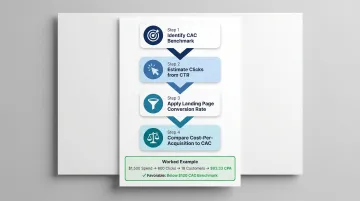
If your typical CAC is $120, this placement delivers strong value. When this framework breaks down, it's usually due to one of the same recurring mistakes.
Most Common Budgeting Mistakes
Evaluating by CPM alone: Ignoring engagement or niche fit leads to poor allocation decisions.
One-off placements: Advertisers who commit to 12-week campaigns see 40% better performance than one-off placements. Audiences need repeated exposure to trust a recommendation.
Overlooking inbox advantages: Inbox-delivered ads face no ad blockers and no algorithm suppression, which reframes how you should compare reach against paid social or display advertising.
Practical Starting Point
Recommended approach:
- Begin with one or two test placements in mid-size niche newsletters
- Track all metrics with UTM parameters
- Expand only to placements that meet or beat your CAC targets
For advertisers targeting executives, finance professionals, or global affairs readers, CPMs of $50–$100+ are common — and often justified when the audience closely matches your buyer profile. Pay the premium only when the niche fit is demonstrably tight.
Frequently Asked Questions
What's a good open rate for a newsletter?
Engaged niche newsletters typically hit 30–50% open rates, but Apple's Mail Privacy Protection artificially inflates these figures. Open rate directly affects cost-per-impression: a 40% open rate on a 30,000-subscriber list means only 12,000 readers actually see your ad.
What is the 60/40 rule in email marketing?
The 60/40 rule recommends that 60% of newsletter content be editorial or value-driven, with no more than 40% promotional. Newsletters that follow this ratio tend to have more engaged readers — a reliable signal of ad placement quality.
What is the average CPM for newsletter ads?
Average newsletter CPMs typically range from $10–$75, with niche B2B newsletters often reaching $50–$100+. The right CPM benchmark depends heavily on the audience's industry, engagement, and purchase intent — list size alone tells you very little.
Is advertising in newsletters more cost-effective than Google or social media ads?
Newsletter ads are not directly comparable to Google or social ads. They reach readers in a focused, uncluttered environment with no ad blockers. For reaching engaged, niche professional audiences, newsletter CTRs frequently outperform both channels on a cost-per-click basis.
What is the difference between CPM and flat-rate newsletter pricing?
CPM prices per 1,000 subscribers and scales with list size, while flat rate charges a fixed fee per placement regardless of audience size. Flat rates work best for first-time advertisers and smaller newsletters, while CPM is standard for mid-to-large publishers.
How do I know if a newsletter sponsorship is worth the cost?
Multiply estimated clicks (list size × CTR) by your landing page conversion rate to get your expected CAC. If that number matches or beats your CAC in other channels, the sponsorship pays for itself.