Financial newsletters offer a uniquely distraction-free, trust-driven environment where HNW readers are already engaged, making them one of the highest-ROI channels available to premium D2C brands. These readers have opted in, opened deliberately, and are consuming curated content—not scrolling passively. When your ad appears alongside trusted financial editorial, it inherits credibility that no programmatic placement can manufacture.
TLDR
- Financial newsletter readers earn 3x the median household income and self-select into premium content
- Newsletter ads bypass ad blockers entirely and deliver 2.78-3.5% CTR vs. 0.46% for display ads
- Trusted editorial environments generate 67% higher brand lift than non-premium placements
- Multi-send campaigns achieve 87% higher conversion rates than single exposures
- Email-sourced customers show higher lifetime value than paid social acquisitions
Who Reads Financial Newsletters — and Why They're Your Ideal Customer
Financial newsletter readers represent a fundamentally different audience than the general digital consumer. 38% of upper-income U.S. adults get news from email newsletters, compared to just 27% of lower-income adults—a 41% higher adoption rate among affluent consumers.
The profile is striking: Financial Times readers average £239,000 household income, with 32% qualifying as high-net-worth individuals (£1M+ liquid assets) and 29% holding C-suite positions. Wall Street Journal readers earn an average of $234,909—roughly three times the U.S. median household income of $80,000.
Why This Audience Is Different
Financial newsletter subscribers are not scrolling passively through social feeds. They have:
- Opened your email deliberately: this is an active choice, not an accidental impression
- Self-selected into premium content, signaling both disposable income and active information-seeking behavior
- Arrived in a focused reading mindset — making brand messages more memorable than anything competing in an algorithmic feed
House of Summary's network exemplifies this targeting precision. With 66% of subscribers concentrated in the USA (particularly New York and Los Angeles), 18% in the UAE (Dubai), and 10% in the UK (London), the newsletters reach decision-makers, executives, and policy professionals across wealth-dense metros.
The Trust Transfer Effect
When a respected financial publication carries your ad, that credibility transfers to your brand. Research from Comscore and Digital Content Next found that ads on premium publisher sites delivered 67% higher brand lift and 3x greater mid-funnel effectiveness (favorability, consideration, intent to recommend) compared to non-premium sites.
This halo effect is particularly powerful for D2C brands establishing premium positioning without extensive retail presence. A sponsored placement acts as a soft referral from a trusted editorial voice — a meaningful difference from an ad that interrupts someone mid-scroll with no contextual credibility behind it.
Why Financial Newsletter Advertising Outperforms Other Channels for D2C Brands
Newsletter advertising solves three critical problems that plague paid social and display campaigns: ad blocking, algorithmic volatility, and brand safety.
No Algorithm, No Ad Blocker, No Competition
Newsletter ads land directly in the inbox with guaranteed delivery. While 37% of desktop users run ad-blocking software that intercepts display ads, email newsletters bypass this barrier entirely. There's no algorithm deciding whether your message gets seen, no auction-driven price spikes, and no competing ads cluttering the page.
House of Summary's editorial approach strengthens this advantage. Subscribers to Presidential Summary, Geopolitical Summary, Dubai Summary, and London Summary receive human-written content free from sensationalism—creating an environment where readers trust the surrounding context and engage more deeply with sponsored messages.
Performance Data Shows Dramatic Uplift
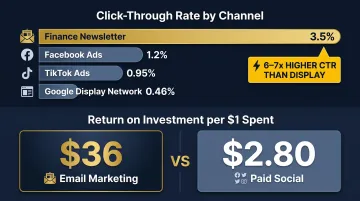
Business and finance newsletters achieve 2.78% average click-through rates according to Mailchimp benchmarks, while wealth management segments reach 2.8–3.5%. Compare this to:
- Google Display Network: 0.46% CTR
- Facebook Ads: 1.2% link CTR
- TikTok Ads: 0.95% CTR
Newsletter CTR in the finance category is 6–7x higher than display advertising and 2–3x higher than social media link clicks. Email marketing returns $36 for every $1 spent on average, versus $2.80 for paid social—a 13x difference in channel ROI.
Undivided Attention
A newsletter reader's focus is on a single piece of content. Your ad competes with one editorial voice, not an entire platform's worth of competing messages. That focused environment produces measurable gains in recall—and repeated exposure compounds it.
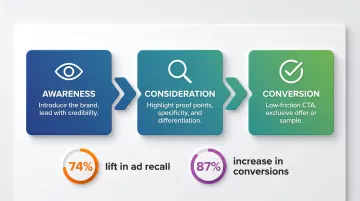
Sequential messaging research from the IAB found that repeated exposure across multiple sends delivers a 74% lift in ad recall and an 87% increase in conversions versus single-exposure placements. Inside a newsletter, that compounding effect builds brand familiarity within a context readers already trust.
Brand Safety and Quality Assurance
25% of marketers cite brand safety as a top concern for programmatic advertising. NewsGuard found nearly 400 ads from 141 major brands appearing on low-quality, AI-generated "made-for-advertising" sites.
Newsletter placements eliminate this risk entirely. You know exactly where your ad appears, what editorial content surrounds it, and who receives it. For premium D2C brands, that level of placement control protects both reputation and ad spend—two things no programmatic campaign can guarantee.
Ad Formats That Work for D2C Brands in Financial Newsletters
Not every ad format earns equal attention from HNW readers. The right choice depends on your objective, offer complexity, and where the buyer is in their decision process.
Sponsored Placement with Editorial Endorsement
Dedicated sponsored placements—typically 150-350 words written in the newsletter's editorial voice—work exceptionally well for D2C brands introducing premium products to unfamiliar audiences. The publisher's endorsement acts as a soft referral from a trusted source.
Native ad formats achieve 2-3x higher CTR than standard banner placements because they align with reader expectations. When content flows naturally with surrounding editorial, readers engage rather than scroll past.
House of Summary writes sponsored content on behalf of advertisers, maintaining the editorial tone readers expect while clearly disclosing advertiser relationships. This approach works especially well for brands that require context, such as:
- Supplement brands explaining clinical evidence
- Fintech products detailing security features
- Luxury goods conveying heritage and craftsmanship
Banner or Visual Inserts
Visual inserts suit campaigns where the product or offer speaks for itself:
- Product drops where visual impact matters
- Limited-time offers requiring urgency
- Brand awareness campaigns for visually distinctive products
- Luxury goods where premium packaging tells the story
Visual inserts outperform web display ads because they're delivered directly to the inbox without ad-blocker interference. However, they typically generate lower engagement than editorially integrated placements.
Classified or Text-Based Mentions
Short, text-based CTA mentions (50-75 words) work well for:
- D2C brands with compelling free trials or samples
- Testing new newsletter audiences before larger commitments
- Brands testing spend before scaling to full placements
These mentions trade storytelling depth for brevity and a lower price point — ideal for offers that need no setup or context to convert.
Multi-Send Campaign Sequences
HNW readers make considered purchase decisions. A single exposure rarely drives conversion for premium products.
Multi-send campaigns measurably outperform single placements. IAB research shows that sequential messaging delivers:
- 74% lift in ad recall
- 87% increase in conversions
- Optimal results with 3-stage creative sequences (awareness → consideration → conversion)
House of Summary offers multi-week and multi-issue campaign packages at discounted rates compared to single placements, enabling brands to build frequency within a trusted environment.
Writing Ad Copy That Resonates with HNW Readers
Financial newsletter audiences are sophisticated and skeptical of hype. Your copy must earn their attention.
Lead with Specificity, Not Superlatives
70% of HNW consumers value great storytelling, 62% value real-life expertise, and 58% say personalized multi-channel marketing significantly impacts brand perception. What they don't respond to: vague claims, urgency tactics, or lifestyle aspiration language that works on Instagram but reads as noise in a financial context.
Effective HNW copy includes:
- Say "Swiss-made movement with 72-hour power reserve," not "luxury craftsmanship"
- Cite provenance: founder backgrounds, certifications, third-party validation
- Quantify outcomes: "Reduces processing time by 40%" beats "transforms your workflow"
- Signal exclusivity without desperation: "Available to 500 founding members," not "Only 3 left—act now!"
CTA Construction for Sophisticated Buyers
Direct, low-friction calls-to-action outperform aggressive urgency tactics:
- "Request a sample" beats "Buy now before it's gone"
- "See the collection" beats "Shop the sale"
- "Learn what sets it apart" beats "Limited time offer"
These readers will not be rushed. They research, compare, and make deliberate decisions. Your CTA should invite exploration, not demand immediate purchase.
Align with Editorial Tone
The tone of your CTA and copy must match the publication it lives in — a mismatch breaks reader trust instantly. Read at least three issues of the target newsletter before writing a single line. Financial newsletters maintain distinct voices: Presidential Summary's focus on global news carries a different tone than Dubai Summary's emphasis on business and lifestyle developments.
House of Summary's brand consultation process works through this directly — reviewing draft copy against each newsletter's voice before anything reaches readers.
Choosing the Right Financial Newsletter for Your D2C Brand
Not all financial newsletters serve the same audience — and picking the wrong one means paying premium CPMs to reach readers who'll never convert. Before committing budget, evaluate each newsletter against these criteria.
Key Selection Criteria
Audience Demographics: Verify income bracket, professional background, and geographic concentration. Request subscriber data showing:
- Average household income or net worth
- Professional roles (C-suite percentage, entrepreneur concentration)
- Age range and gender distribution
- Geographic heat maps
Engagement Metrics: Open rates matter less post-Apple Mail Privacy Protection. Focus on:
- Click-through rates (2.5%+ is strong for finance newsletters)
- Click-to-open rates (10-13% is typical)
- Unsubscribe rates (under 0.2% indicates audience satisfaction)
Editorial Focus: Match newsletter subject matter to product category:
- Global news and geopolitics: Luxury travel, fintech, premium services
- Business and entrepreneurship: Productivity tools, executive services, B2B products
- City-specific content: Real estate, local lifestyle brands, regional services
Send Frequency: Daily newsletters (Monday-Saturday) provide more touchpoints but require stronger creative variation. Weekly newsletters concentrate attention but offer fewer repetition opportunities.
House of Summary's Specialized Network
Those criteria map directly onto House of Summary's four-newsletter network. Each publication targets a distinct reader profile — here's how they break down:
| Newsletter | Core Audience | Geographic Concentration | Best-Fit D2C Categories |
|---|---|---|---|
| Presidential Summary | Decision-makers following global news | 66% U.S. (NY/LA-heavy) | Premium credit cards, wealth management, luxury goods, executive services |
| Geopolitical Summary | Policy professionals, internationally-minded executives | Global | Global travel brands, international fintech, cross-border services |
| Dubai Summary | HNWIs and UHNWIs tracking UAE business and culture | 18% UAE | Luxury real estate, premium hospitality, high-end personal care, investment products |
| London Summary | Finance and policy professionals | 10% UK (London-focused) | Financial services, luxury lifestyle, premium experiences |
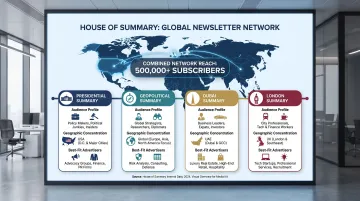
Combined, the network reaches 500,000+ subscribers with 254,866+ daily email opens across four distinct audience segments.
Request a Media Kit
Before committing budget, request detailed data:
- Total subscriber count and growth trajectory
- Average open rate and CTR by newsletter
- Previous sponsor categories and results
- Subscriber income or professional background (when available)
- Geographic distribution and concentration
- Sample issues to assess editorial tone
Pricing and ROI: What D2C Brands Can Realistically Expect
Newsletter advertising costs span a wide range — and for D2C brands, understanding the pricing structures upfront helps set realistic budgets and performance expectations.
Pricing Structures
- Flat-Rate Per Send: Fixed cost regardless of open rate — common in HNW-focused newsletters. Budget-predictable, but performance risk sits with the advertiser.
- CPM (Cost Per Thousand Impressions): Useful for cross-publication comparisons. Premium financial newsletters command higher CPMs than general-interest titles because the audience quality justifies it.
- CPC (Cost Per Click): Pay only for measurable engagement, lowering upfront risk. Less common for newsletter placements, but available from select publishers.
Newsletter sponsorships range from $150 to several thousand dollars per send on platforms like Paved, varying significantly by list size, open rate, and niche. Finance-focused and business newsletters command premium rates due to audience quality.
Those benchmarks reflect the broader market. House of Summary offers custom rate cards based on placement, frequency, newsletter selection, and campaign scope — with meaningful discounts for multi-week and multi-issue campaigns.
Measuring ROI Beyond Clicks
Click-through rate is only part of the picture. For D2C brands, the metrics that reveal true performance span both immediate and long-term windows:
Immediate Performance:
- Click-through rate (benchmark: 2.5-3.5% for finance newsletters)
- Landing page conversion rate
- Cost per acquisition
Long-Term Value:
- Average order value from newsletter-sourced customers
- Repeat purchase rate (email-sourced customers deliver roughly 40% higher LTV than paid social acquirees)
- Customer lifetime value over 12-24 months
Research compiled by Sequenzy shows customers acquired through email channels demonstrate higher lifetime value than those from paid social — which shifts the math significantly when calculating full campaign ROI.
Testing Approach
Start smart, scale strategically:
- Initial Test: Single sponsored placement in 2-3 newsletters simultaneously
- Compare Performance: Analyze CPC, conversion rate, and initial CAC across placements
- Scale Winners: Commit larger budget and multi-send packages to best-performing newsletters
- Optimize Creative: Test different CTAs, value propositions, and messaging angles
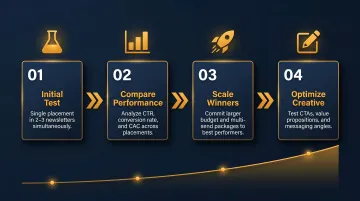
Most D2C brands find their highest-performing newsletter within the first two sends — at which point scaling becomes a straightforward budget decision, not a gamble.
Frequently Asked Questions
How do I advertise in a financial newsletter as a D2C brand?
Contact newsletter publishers directly (such as House of Summary at sales@houseofsummary.com) or work through newsletter advertising networks. Request a media kit, agree on format and pricing, and work with the publisher to match their editorial voice.
How much does it cost to advertise in a financial newsletter?
Costs vary widely based on audience size and engagement. Smaller HNW-focused newsletters may offer placements starting in the hundreds of dollars, while large publications command several thousand per send. CPC models are sometimes available for brands preferring pay-per-click arrangements.
What types of D2C products perform best in financial newsletter advertising?
Premium categories that align with HNW lifestyles tend to perform best:
- High-end personal care and beauty
- Luxury food and beverage
- Bespoke travel experiences
- Financial wellness products
- Wearable tech and luxury lifestyle goods
Products requiring context, brand origin narratives, or clinical evidence perform particularly well in editorial-integrated formats.
How do I know if a financial newsletter's audience matches my target customer?
Request subscriber demographic data including income brackets, professional roles, and geographic distribution. Review the editorial tone, ask about previous advertiser categories and their results, and read a few back issues to get a direct feel for the reader profile.
What metrics should D2C brands track after running a financial newsletter ad?
Track click-through rate, landing page conversion rate, cost per acquisition, and average order value from day one. Over time, monitor customer lifetime value and repeat purchase rates — newsletter-sourced buyers frequently show stronger retention than paid social cohorts.