

Mass-market financial content relies on urgency, aspiration, and emotional triggers that HNW audiences have learned to tune out. These readers aren't evaluating products; they're assessing judgment, philosophy, and long-term thinking. They're surrounded by advisors, have seen countless pitches, and can spot generic marketing from the first sentence.
This article examines the specific psychology of HNW audiences, the pillars and framework of effective finance storytelling, where these stories belong, and what most brands get wrong.
TLDR:
- HNW individuals resist traditional advertising but respond to credible, insight-driven narratives
- Effective finance storytelling requires intellectual honesty, restraint, and exclusivity of insight
- Premium newsletters outperform social and display advertising for reaching decision-makers
- Leading with performance data instead of perspective is the most common mistake
- Psychographic segmentation matters far more than demographic wealth brackets
Why High-Net-Worth Audiences Require a Different Storytelling Approach
HNW individuals are not passive consumers of financial content. They are information-sophisticated, often surrounded by advisors, and highly attuned to when they're being marketed to. Generic urgency, fear-based copy, or aspirational mass-market messaging registers as noise to them.
Trust plays a disproportionately large role at this wealth tier. The stakes are higher, so the bar for credibility must be higher before a relationship can even begin.
Among affluent Americans with $500K+ investable assets, 62% find advisors through personal referrals from friends and family, while 49% rely on referrals from trusted professionals. Only after these trust signals do search engines (50%) and online reviews (deemed important by 80%) enter the picture.
The discretion factor matters enormously. HNW audiences expect finance brands to demonstrate an understanding of their world without broadcasting it. Stories that name-drop luxury or status overtly tend to backfire; those that assume familiarity with sophisticated financial concepts and global contexts tend to succeed. Research from USC Marshall School of Business identifies "Patricians" — wealthy consumers with low need for status — who prefer subtle or no branding, signaling only to peers who can recognize craftsmanship.
HNW readers have seen the statistics, read the annual reports, and can spot a generic ROI pitch immediately. Effective storytelling for this segment treats them as peers, not prospects.
The 2025 Forbes Research HNW Survey found that among individuals with $2M+ investable assets who use an advisor, only one-third are "completely satisfied" with performance — a figure that suggests most financial communication fails to meet their standards.
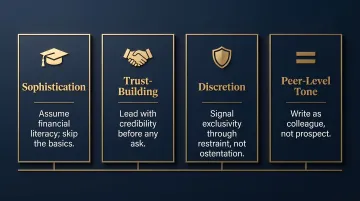
In short, HNW storytelling requires a distinct approach across four dimensions:
- Sophistication: Assume financial literacy; don't explain the basics
- Trust-building: Lead with credibility signals before making any ask
- Discretion: Signal exclusivity through restraint, not ostentation
- Peer-level tone: Write as if addressing a colleague, not a prospect
The Pillars of Finance Storytelling That Resonate With Wealthy Readers
Credibility Through Transparency
Rather than leading with achievements, effective HNW storytelling leads with intellectual honesty. Acknowledging complexity and real downside risk signals expertise. HNW readers have navigated enough financial cycles to recognize when complexity is being glossed over.
Contrast this with the polished optimism that pervades most financial content. When every market commentary predicts opportunity and every pitch promises outperformance, credibility erodes. HNW audiences respond to firms that acknowledge what they don't know, name the trade-offs, and explain their decision-making process rather than just the outcome.
Vision Over Features
HNW individuals are not evaluating a product checklist. They want to understand a firm's philosophy and long-term view of the world. The most compelling finance stories connect a firm's strategic worldview to the client's own sense of legacy and purpose.
McKinsey research on the US HNW segment ($1M-$30M investable assets, representing approximately $19 trillion) recommends shifting from "portfolio performance" to "total life goals" including health, legacy, and tax. Approximately 50% of HNW clients expressed willingness to move assets if their firm did not provide holistic advice.
Exclusivity of Insight, Not Access
Exclusivity in HNW storytelling isn't about "limited invitations." It means offering ideas, perspectives, or analysis that can't be found in mainstream financial media — research the audience can't get elsewhere. That positions a brand as a genuine thought partner, not another content producer.
The data backs this up. According to the Edelman-LinkedIn B2B Thought Leadership Impact Report:
- 73% of decision-makers find thought leadership more trustworthy than traditional marketing materials
- 60% are more willing to pay a premium based on thought leadership quality
- 86% are likely to invite a company to bid if it consistently produces high-quality thought leadership
Human-Led Narratives
Even among institutional and private wealth audiences, decisions turn on how clients perceive the people behind the firm. Stories that reveal judgment, character, and long-term thinking — through leadership profiles, investment philosophy pieces, or case narratives — build stronger affinity than product-centric content.
Research shows that 84% of HNW individuals are interested in building their financial education, yet only 54% report currently receiving that education from their advisor. Firms that fill that gap through editorial content earn trust before any sales conversation begins.
Restraint in Tone
The language register matters enormously with this audience. Understated confidence, precise language, and avoiding hyperbole all signal that the brand understands its audience.
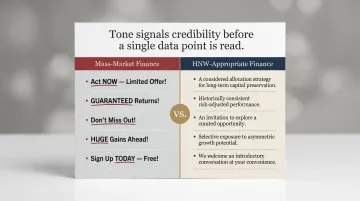
Tonal differences between mass-market and HNW-appropriate communication:
| Mass-Market Finance | HNW-Appropriate Finance |
|---|---|
| "Maximize your returns!" | "Our approach to risk-adjusted performance" |
| "Don't miss this opportunity" | "Current market conditions suggest" |
| "Guaranteed wealth-building system" | "A disciplined approach to portfolio construction" |
| "Join thousands of satisfied clients" | "We work with a select group of families" |
| Exclamation marks and urgency | Periods and measured confidence |
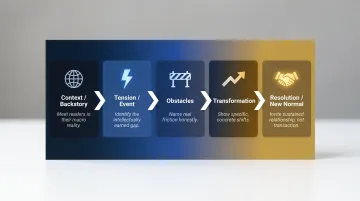
A 5-Step Framework for Finance Stories That Convert HNW Prospects
Step 1 — Establish the Context (Backstory)
Every effective HNW finance story begins not with the brand but with the world the audience inhabits — current macroeconomic conditions, geopolitical shifts, or wealth management challenges the target reader is already thinking about. Meeting them in their world earns immediate relevance.
Start with the forces shaping their financial reality:
- Central bank policy shifts affecting portfolio allocations
- Succession planning complexities for business owners
- Regulatory changes impacting estate structures
- Emerging market dynamics affecting global exposure
From there, your perspective enters a conversation already in progress — not a cold pitch.
Step 2 — Introduce the Tension (Event)
For HNW audiences, the "aha moment" isn't a product discovery — it's recognizing a gap between where they are and where they need to be. The tension must feel intellectually earned, not manufactured.
Examples of genuine tension:
- Recognition that traditional 60/40 portfolios no longer provide adequate diversification
- Realization that family governance structures haven't kept pace with wealth complexity
- Discovery that tax efficiency strategies haven't adapted to new legislation
- Understanding that investment approach doesn't align with impact or legacy goals
Step 3 — Acknowledge the Obstacles Honestly
HNW individuals have navigated enough to know that every financial path has friction. Great finance storytelling names the real obstacles — regulatory complexity, illiquidity, concentration risk, behavioral biases — rather than glossing over them. This honesty is itself a differentiator.
Acknowledging that alternative investments require longer lockup periods, or that tax optimization creates administrative burden, signals something rare in financial communications: you're describing reality. That alone builds credibility before a single solution is offered.
Step 4 — Show the Transformation
Move from problem to possibility through specificity, not sweeping claims. For HNW readers, a concrete shift carries far more weight than a promised outcome.
Effective transformation narratives:
- "We restructured the portfolio to reduce correlation across asset classes while maintaining liquidity for near-term commitments"
- "The family established a governance framework that separated ownership from management decisions"
- "We identified tax-loss harvesting opportunities that reduced effective tax rate by 300 basis points"
Step 5 — Articulate the Resolution (The New Normal)
The closing of a finance story for HNW readers should feel like an invitation into a sustained relationship, not a transaction close. The resolution should describe what ongoing partnership actually looks like in practice — the cadence, the communication, the shared frame for what comes next.
Describe the rhythm of the relationship:
- Quarterly strategy reviews tied to portfolio objectives
- Annual family meetings addressing succession and governance
- Proactive communication during market volatility
- Access to specialized research and proprietary insights
Done well, the closing leaves the reader picturing a working relationship — not wondering whether to respond to an offer.
Choosing the Right Channels to Tell Your Finance Story to HNW Audiences
Most finance storytelling is built for platforms that HNW individuals barely use in their decision-making. Social media algorithms, retargeted display ads, and mass email campaigns lack the editorial gravity that this audience associates with credibility.
Research shows that 52% of high-income users (earning over $100,000) use ad blockers, compared to 29% of those earning below $50,000. High-income users prefer premium, ad-free experiences and are more willing to pay for them. This means traditional display advertising simply doesn't reach this audience.
That gap creates a real opportunity — but only if the alternative channel carries the same editorial weight HNW readers already expect.
Why Premium Newsletters Work
Premium newsletters are one of the highest-signal environments for reaching HNW audiences. They arrive in the inbox without algorithmic distortion, carry editorial credibility from the publication, and capture attention in a focused reading context.
Channels like House of Summary — which reaches global executives, business professionals, and high-intent finance readers through specialized newsletters covering international news, geopolitics, and business — offer finance brands a direct, uncluttered path to the right audience. The network reaches over 500,000 subscribers with 254,866+ emails opened daily, concentrated in financial hubs: 66% in the USA (New York, Los Angeles), 18% in the UAE (Dubai), and 10% in the UK (London).
The engagement numbers back this up. Financial services emails average 31.35% open rates and 2.78% click rates according to Mailchimp benchmarks. Typical display advertising achieves approximately 0.35% CTR. Newsletter ads bypass ad blockers entirely and deliver engagement that display formats can't match.
House of Summary's human-written, fact-checked content provides the editorial context that HNW readers trust. The newsletters avoid sensationalism, verify all information before publication, and maintain the clarity and objectivity that decision-makers expect. This brand-safe environment makes native ads and sponsored features feel like editorial extensions rather than interruptions.
Complementary Channels
Other channels suited to HNW audiences:
- Place bylined content in CFA Institute publications, the Journal of Financial Planning, or institutional research platforms
- Sponsor invitation-only forums, roundtables, and industry conferences where attendance itself signals seniority
- Distribute white papers through advisor channels or professional associations — trusted networks amplify reach
- Build permission-based email programs with consistent editorial standards, not campaign-by-campaign blasts
Each channel decision is also a credibility signal. HNW readers notice where a brand chooses to appear — and where it doesn't.
Common Mistakes Finance Brands Make When Storytelling to HNW Audiences
Mistake 1 — Leading With Performance Data Instead of Perspective
Numbers without narrative context are the baseline expectation of HNW audiences. A firm that opens with its 10-year annualized return without the philosophy and discipline behind it has told the audience nothing useful.
Spectrem Group research found that 64% of advisor communication is focused on investments, while only 35% is related to financial planning — despite "almost all" investors expecting financial planning as part of wealth management services. Only 33% of investors feel they receive what could be described as "wealth management services."
Lead with the worldview that shaped the strategy — the trade-offs considered, the risks acknowledged, the convictions held. Data earns its place as evidence of that thinking, not the headline.
Mistake 2 — Treating HNW as a Demographic, Not a Mindset
Wealth-level segmentation is too crude. A 55-year-old business founder and a 55-year-old inherited-wealth recipient have entirely different orientations toward financial storytelling. Effective messaging targets psychographic clusters, not just wealth brackets.
BCG's Global Wealth Report explicitly advocates moving from "inside-out" wallet-based segmentation to a "client-led" needs-based model. The report identified $90 trillion in global investable wealth within the "Affluent Retiree" segment alone — a group often missed by traditional wealth-bracket models.
Segment by:
- Risk orientation — conservative preservers vs. sophisticated risk-takers
- Legacy focus — multi-generational wealth transfer vs. personal consumption
- Control preference — hands-on involvement vs. delegation to professionals
- Global exposure — domestic focus vs. international portfolio complexity
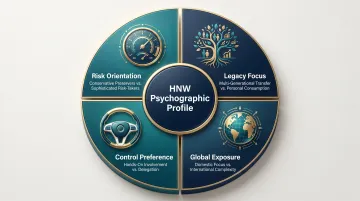
Brands that map to these dimensions speak directly to what a client actually cares about — not just how much they have.
Mistake 3 — Inconsistency Across Touchpoints
HNW individuals engage with a brand over an extended consideration period, often across multiple formats and platforms. If the tone, depth, and intellectual standard of content varies significantly between a firm's LinkedIn posts, email communications, and pitch materials, it signals a lack of coherence that erodes trust before a conversation even starts.
Research shows that customers who feel an emotional connection to a financial brand are 5.7 times more likely to trust it. Companies excelling at emotional engagement outperform peers by 36%. Trust is built through "consistency, transparency, clear communication" — not product launches or marketing campaigns.
Audit your content ecosystem:
- Does your LinkedIn content reflect the same intellectual standard as your white papers?
- Do your email newsletters match the tone of your in-person presentations?
- Does your website copy align with the philosophy expressed in thought leadership?
When a brand speaks in different registers across channels, sophisticated readers notice. And they move on.
Frequently Asked Questions
What are the 5 P's of storytelling?
The 5 P's — People, Place, Plot, Purpose, and Perspective — are a framework for structuring narratives. In finance storytelling for HNW audiences, they map onto client relationships, market context, the financial journey, legacy objectives, and the firm's distinct worldview.
Why does financial storytelling matter for reaching high-net-worth individuals?
HNW individuals are resistant to traditional advertising but respond to credible, insight-driven narratives that demonstrate a brand's philosophy and judgment. Storytelling is one of the few formats that can build lasting trust at this level, where personal referrals and reputation matter more than promotional claims.
How is finance storytelling different from general brand storytelling?
Finance storytelling for HNW audiences demands intellectual rigor, tonal restraint, and a longer trust-building arc — with the firm's worldview taking precedence over product features. This audience evaluates judgment over promises and expects precision at every step.
What channels work best for reaching high-net-worth audiences with financial content?
Premium newsletters, curated thought leadership publications, private events, and high-quality email channels outperform mass digital advertising for this segment — their editorial credibility and opt-in nature mean the audience arrives with intent, not distraction.
How do you balance data and narrative in finance storytelling?
Data should support the narrative rather than lead it. HNW readers expect precision, but numbers without context feel hollow. The story should establish the "why" first — the philosophy, the market context, the decision-making framework — then deploy metrics as evidence of that approach in action.
How often should finance brands publish storytelling content for HNW audiences?
Consistency matters more than frequency for this audience. A well-reasoned, insight-driven piece published monthly builds more credibility than weekly content that lacks depth or coherence. For this segment, a single authoritative piece remembered is worth more than a dozen forgettable ones.