Introduction
Reaching C-suite executives and high-net-worth individuals through traditional digital channels has become increasingly difficult. 52% of consumers globally have installed ad blockers, making display advertising effectively invisible to this demographic. Social media presents its own challenges: organic posts from company pages on LinkedIn now reach only 1.6% of followers, and algorithmic suppression ensures most sponsored content never appears in executive feeds.
Premium newsletter advertising offers a direct alternative. When a brand's message lands in a curated inbox that readers have actively chosen to subscribe to, there's no algorithmic filter, no ad blocker, and no competing visual clutter.
For marketers targeting decision-makers who control significant budgets, this guide covers the email advertising formats, audience targeting approaches, and placement strategies that consistently reach executive and high-net-worth readers.
Key Takeaways
- Newsletter ads bypass ad blockers and social algorithms, delivering directly to opted-in readers
- B2B email newsletters achieve 2.0%–4.0% CTR, compared to 0.46% for Google Display Network
- 75% of C-suite leaders rely on email newsletters as their primary information source — making inbox placement critical for executive reach
- Not all newsletter networks are equal — the right placement depends on audience verification and editorial credibility, not subscriber count alone
- This guide covers five services — House of Summary, Morning Brew, Axios, Puck, and Beehiiv Ad Network — ranked by what matters to serious advertisers
Why Email Is the Best Channel to Reach Executive and HNW Audiences
Executives and high-net-worth individuals have become virtually unreachable through traditional digital channels. Ad blockers are standard on corporate devices, with global adoption reaching 763 million users. Social media feeds offer no better prospects—LinkedIn's organic company page posts reach fewer than 2% of followers, down from 7% in 2021.
Yet these same decision-makers read their newsletters daily. Research shows 94% of executives use email newsletters for daily news, making the inbox the most reliable channel for reaching them. That reach advantage only matters, though, if the audience is actually paying attention when they arrive.
Unlike a webpage covered in competing ads, a newsletter ad appears in a focused reading environment. The reader opened the email intentionally—a mindset fundamentally different from passive scrolling. That focused context translates directly into performance: newsletter advertising CTR (40%) consistently outperforms programmatic display (32%) according to marketing benchmarks.
Delivery works differently here too. When a newsletter sends, every subscriber receives it. No bidding war for placement, no feed suppression, no throttled reach. The entire opted-in audience sees the placement at send time: a guarantee social and display advertising cannot replicate.
The performance gap across channels makes the case clearly:
| Channel | Average CTR |
|---|---|
| Newsletter advertising (top-quartile) | 10%+ |
| B2B email newsletters (average) | 2.0%–4.0% |
| Google Display Network | 0.46% |
| LinkedIn sponsored content | 0.44%–0.65% |
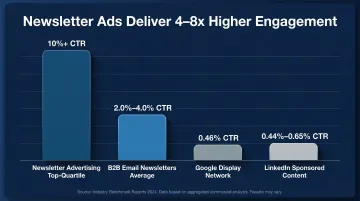
Newsletter ads deliver 4–8x higher engagement for high-value audiences.
Top Email Advertising Services That Reach Executive and HNW Audiences
The services below were selected based on verified audience quality, editorial credibility among senior decision-makers, measurable advertiser outcomes, and transparency regarding audience data. Each offers distinct advantages depending on campaign goals, target geography, and brand positioning.
House of Summary
House of Summary operates a network of specialized newsletters—Presidential Summary, Geopolitical Summary, Dubai Summary, and London Summary—written by subject-matter experts for readers who demand clarity over sensationalism. This editorial positioning draws global executives, senior professionals, and high-net-worth individuals across international markets, with particularly strong presence in the UAE and UK.
Key advertiser differentiators: Inbox delivery with no ad blockers, click-through rates 4x higher than Google AdWords (verified in campaigns with BSH Hausgeräte), and an editorial environment that lends credibility through brand adjacency. The network reaches 500,000+ subscribers with 254,866+ daily email opens, concentrated among decision-makers and C-suite professionals.
Interested advertisers can contact sales@houseofsummary.com for current rates, audience analytics, and campaign options.
| Category | Details |
|---|---|
| Audience Profile | Global executives, senior professionals, and HNW readers across USA (66%), UAE (18%), and UK (10%); 58% male, 42% female; decision-maker concentration |
| Ad Formats & Placements | Native ads embedded in curated editions; sponsored content written in editorial voice; full-newsletter takeovers; no competing visual clutter |
| Pricing / Key Differentiator | Contact sales team for current CPM and campaign packages; differentiator is premium positioning with verified editorial standards, multi-region reach, and proven 4x CTR advantage over Google AdWords |
Morning Brew
Morning Brew reaches over 4 million daily subscribers drawn from finance, consulting, marketing, and tech sectors. Its business-casual editorial tone makes it suitable for brands seeking broad executive-adjacent reach at scale. The publication's business-focused content attracts mid-to-senior professionals, though the audience skews more mass-market business than ultra-premium HNW.
Morning Brew's scale means higher competition for ad slots and more general business demographics compared to specialized executive publications. The platform offers transparent CPM pricing and multiple format options including sponsored segments, native placements within the daily edition, and dedicated newsletters targeting specific industries through verticals like Marketing Brew and Retail Brew.
| Category | Details |
|---|---|
| Audience Profile | US-heavy business professionals, mid-to-senior level across finance, tech, consulting, and marketing; described as "next-gen professionals" and "industry leaders" |
| Ad Formats & Placements | Native ads in flagship daily; targeted ads across seven industry-specific newsletters; creator-led integrations; custom direct sends using first-party data segmentation; podcast sponsorships |
| Pricing / Key Differentiator | Contact Morning Brew media team for current CPM (pricing not publicly disclosed); differentiator is scale (4M+ subscribers), brand familiarity, and first-party demographic data from 10,000+ research community |
Axios
Axios publishes smart-brevity newsletters covering politics, finance, technology, and media, with readership that skews heavily toward senior government officials, policy influencers, C-suite leaders, and institutional investors. The publication's subscriber base includes 33 CEOs from the top 1,000 U.S. companies, and 57% of newsletter recipients are C-suite level or higher.
The proprietary "smart brevity" format mirrors the reading habits of time-pressed executives: bolded key points, strategic white space, and "Why it matters" explanations that reach the point in seconds. Ads appear in context with this trusted, authoritative content, putting sponsor messages directly in front of engaged, senior readers.
With 4.8 million+ newsletter subscriptions and 50% of readers earning $100K+ household income, Axios offers premium positioning for brands targeting regulated or high-stakes industries.
| Category | Details |
|---|---|
| Audience Profile | Senior government, policy, finance, and tech executives; strong Washington D.C. concentration; 57% of readers C-suite level+; 50% household income $100K+; 33 Fortune 1000 CEOs subscribed |
| Ad Formats & Placements | Native sponsored content blocks within 22 trend-focused newsletters; display via Axios Onsite; 100% brand share of voice per placement; dedicated newsletter sponsorships |
| Pricing / Key Differentiator | Contact Axios media partnerships for current rates and media kit; differentiator is prestige audience concentration (C-suite and government decision-makers) and editorial authority through smart-brevity format |
Puck
Puck is a premium subscription media outlet whose editorial focus on power, money, and media attracts an unusually concentrated audience of senior executives, investors, entertainment industry figures, and political insiders. The publication deliberately positions itself as "pro-success" and insider-focused, serving readers who identify as C-suite, senior executives, or senior directors when subscribing.
With approximately 200,000 email subscribers (including 20,000 paid members), Puck offers one of the highest-quality HNW-adjacent advertising environments in newsletter media. Advertising inventory is intentionally limited to preserve reader experience, creating exclusivity for sponsoring brands.
Puck's personality-driven newsletters, written by 11 star reporters covering power centers from Wall Street to Hollywood, command premium pricing. Advertising revenues have surpassed subscription revenues. Notable readers include government officials, major investors, and media executives.
For advertising inquiries, contact ads@puck.news.
| Category | Details |
|---|---|
| Audience Profile | Senior media, finance, and political executives; high HNW concentration; C-suite and senior director self-identification; notable readers include White House staff, billionaire investors, and industry leaders |
| Ad Formats & Placements | Limited sponsorship placements within 10 personality-driven long-form newsletters; premium ad products inspired by high-end print magazine advertising; direct-sold only (no programmatic) |
| Pricing / Key Differentiator | Contact ads@puck.news for current sponsorship pricing (rates not publicly disclosed); differentiator is extreme audience quality, scarcity of ad inventory, and editorial credibility in power/money circles |
Beehiiv Ad Network
Beehiiv's ad network operates as a programmatic advertising platform distributing sponsored placements across a curated portfolio of newsletters on the Beehiiv publishing platform. This model allows brands to access diverse business, finance, and professional audiences at scale without negotiating individual publisher deals.
The network uses SSP (Supply-Side Platform) technology with intelligent offer matching based on publication content, audience profile, and historical performance. Beehiiv manually vets all advertisers for brand safety, and publishers retain full discretion to accept or reject offers. However, audience quality varies significantly by publisher — this network is better suited for brands seeking broad reach rather than pinpoint targeting of specific executive demographics.
CPM ranges from $10–$30 for general newsletters to $50–$100+ for B2B and specialized industries. The network has generated $37.8M+ in creator earnings, indicating substantial inventory and scale.
| Category | Details |
|---|---|
| Audience Profile | Variable by publisher; broad business, creator, and professional audience segments across multiple niches; no guaranteed executive or HNW concentration |
| Ad Formats & Placements | Programmatic sponsored link placements served across network publishers; up to 3 ads per newsletter (1 primary with logo, 2 secondary); keyword targeting and format selection available |
| Pricing / Key Differentiator | $10–$30 CPM for general audiences; $50–$100+ CPM for B2B/specialized; contact Beehiiv for network minimums; differentiator is ease of access, scale across multiple properties, and automated brand safety controls |
What to Look for When Evaluating an Email Advertising Service
Demand Audience Verification Before Committing
Subscriber count alone reveals nothing about value. Ask for proof of demographics: job titles, industries, income brackets, or geographic concentration. An engaged list of 50,000 verified executives delivers far more value than 500,000 unverified general subscribers. Request data on open rates, click-through rates by placement type, and any available information on reader seniority or income.
Research from Pew confirms that newsletter readership increases with income — 38% of upper-income adults use newsletters for news, compared to 27% of lower-income adults. The same pattern holds for education: 35% of college graduates versus 25% of those without a degree. Quality newsletters self-select for higher-value audiences precisely because their editorial standards attract serious readers.
Editorial Environment Directly Affects Brand Perception
That self-selection dynamic only holds where editorial quality is genuine. The credibility of the newsletter you advertise in reflects on your brand. Placements inside sloppy, sensationalized publications erode trust. Placements inside rigorous, respected editorial products reinforce it. Evaluate the publication's fact-checking processes and writer expertise before booking.
Performance Metrics Matter More Than Vanity Numbers
Before signing, request:
- Current open rate (industry average: 35.9% for email; higher for premium newsletters)
- Click-through rate by placement type (top-quartile programs achieve 10%+)
- Click-to-open rate (clicks as percentage of openers—more accurate than CTR alone)
- Reader demographics: seniority, income, industry concentration
- Geographic distribution if targeting specific markets
According to DMA benchmarking data, email unique click rate reached 2.3% in 2024 — rising for the third consecutive year. Any newsletter that can't clear this bar on a consistent basis isn't worth the spend.
How We Selected These Services
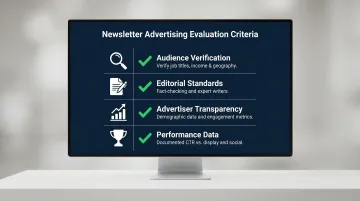
Not every newsletter claiming an "executive audience" actually delivers one. These services made the list because they met a consistent set of criteria — verified audience quality, editorial rigor, advertiser transparency, and documented performance advantages over conventional digital channels.
Selection criteria included:
- Verified audience quality: Evidence of C-suite, senior professional, or HNW readership concentration
- Editorial standards: Rigorous fact-checking, expert writers, and reputation for accuracy
- Advertiser transparency: Willingness to share demographic data, engagement metrics, and performance benchmarks
- Performance data: Documented CTR advantages over display and social advertising
Rates, formats, and inventory shift frequently in newsletter advertising. When you reach out to any publisher on this list, request their media kit, rate card, and audience analytics upfront — that data tells you far more than a sales pitch.
Conclusion
For brands trying to reach executive and HNW audiences, the inbox remains one of the few channels where readers give their undivided attention. Premium newsletter advertising offers the most direct route to earn that attention—reaching readers without ad blockers, algorithmic filtering, or the visual noise that undermines most digital formats.
When selecting an email advertising partner, marketing decision-makers should weigh audience quality, editorial credibility, and engagement depth over raw subscriber numbers. A smaller, verified executive list consistently outperforms a larger, undifferentiated one—and the gap widens as campaign objectives get more specific.
Those criteria point toward publishers like House of Summary, whose newsletter network—covering global news, geopolitics, and business through publications including Presidential Summary, Geopolitical Summary, Dubai Summary, and London Summary—delivers advertising placements to engaged executives and decision-makers worldwide. Contact sales@houseofsummary.com to discuss campaign formats, audience analytics, and current availability.
Frequently Asked Questions
How much does an email ad cost?
Email newsletter advertising costs vary widely depending on audience quality and list size. General consumer newsletters charge $10-$30 CPM, while business and professional newsletters command $30-$70+ CPM. Specialized B2B and executive-focused newsletters charge $50-$100+ CPM. Pricing depends on subscriber count, audience verification, ad format, placement position, and the publication's editorial prestige. For executive-focused placements, audience verification matters more than list size — a smaller verified list commands higher CPMs than a large unverified one.
How much is a 1,000-email list worth?
The value of a 1,000-person email list depends entirely on who those 1,000 people are. A list of verified C-suite executives in finance is worth multiples more than a general consumer list of the same size. A niche 10,000-subscriber newsletter focused on fintech routinely commands higher CPMs than a 100,000-subscriber general business newsletter — because audience quality, not volume, drives advertiser value.
How do I measure email engagement?
The three core metrics are open rate, click-through rate (CTR), and click-to-open rate (CTOR). For newsletter advertising, CTR is the most important indicator of real placement performance. Top-performing B2B newsletter ads achieve 2.0%-4.0% CTR or higher.
What is newsletter advertising, and how does it differ from email marketing?
Email marketing is when a brand sends emails to its own subscriber list. Newsletter advertising means paying an independent publisher to place a sponsored message inside their newsletter — giving brands access to a trusted, pre-built audience they don't own, along with the editorial credibility the publisher has already earned.
How do email newsletter ads perform compared to display and social ads for executive audiences?
Newsletter ads consistently outperform display and social formats for high-value audiences because they bypass ad blockers, arrive without algorithmic filtering, and appear in a distraction-free reading environment. B2B email newsletter CTR averages 2.0%-4.0%, compared to 0.46% for Google Display Network, 0.90% for Facebook ads, and 0.44%-0.65% for LinkedIn sponsored content. This represents a 4-8x performance advantage for executive targeting.