Introduction
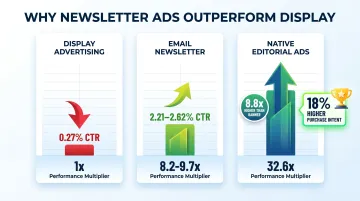
D2C brands face a stark reality: traditional digital advertising is losing its effectiveness. Ad blockers now affect 52% of consumers across 48 global markets, algorithm changes constantly suppress organic reach, and banner blindness causes users to scroll past display ads without registering them. The average display ad CTR sits at just 0.27% — meaning 997 out of 1,000 impressions produce zero engagement.
That's exactly where executive newsletters fill the gap. Readers have opted in, opened the email, and are reading with undivided attention — no algorithms, no ad blockers, no competing visuals. This article covers the specific best practices D2C brands must follow to make sponsored content in executive newsletters actually convert: creative approach, disclosure requirements, and post-campaign measurement.
Key Takeaways
- Executive newsletter readers expect value — sponsored content must offer insight or relevance to earn its place in the inbox
- Transparency and clear disclosure are both legally required and essential for maintaining reader trust
- Successful D2C newsletter ads match the newsletter's editorial voice, not the brand's promotional one
- Focused copy with one clear message and one CTA consistently outperforms multi-message promotional content
- Track conversion rate, customer acquisition cost, and repeat engagement — not just click-through rate
Why Executive Newsletters Are a Powerful D2C Advertising Channel
Executive newsletters solve three structural problems that plague other digital channels: algorithmic suppression, ad blocking, and attention competition. When a reader opens a newsletter, they've chosen to engage with that publication. No algorithm decides whether your ad appears. No ad blocker strips your placement. And because readers move linearly through the content, your sponsored placement appears in sequence with editorial they've already decided to consume.
The numbers back this up. Email newsletter CTRs range from 2.21% to 2.62% across industries — roughly 8-10 times higher than display advertising's 0.27% benchmark. Native ads embedded in editorial content deliver CTRs 8.8x higher than banner ads and increase purchase intent by 18%.
Who Reads Executive Newsletters
Executive newsletter readers are time-constrained professionals with real purchasing power. House of Summary's network — Presidential Summary, Geopolitical Summary, Dubai Summary, and London Summary — reaches readers concentrated in high-income metros: 66% in the US (primarily New York and Los Angeles), with strong segments in London and Dubai.
The readership skews toward:
- Senior executives and C-suite decision-makers
- Policy professionals and government advisors
- Founders and entrepreneurs
- High-net-worth individuals tracking global developments
For D2C brands in premium or lifestyle categories, that reader profile is the point. These aren't passive scrollers — they subscribed, they opened, and they're reading. Your ad isn't competing with autoplay video or infinite scroll; it's sitting inside content this audience actively sought out. House of Summary's network reports 254,866 emails opened daily across 500,000+ subscribers, reflecting sustained engagement rather than passive impressions.
What Makes Sponsored Content Work in Executive Newsletters
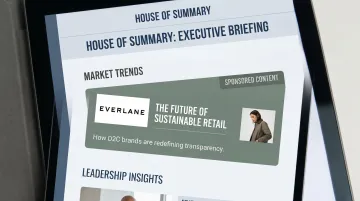
The best-performing newsletter sponsorships follow the editorial native principle: they read like a well-written editorial brief, not a product ad. That means matching the publication's tone, structure, and value delivery while clearly disclosing that the content is sponsored.
Trust Transfer Is the Core Asset
Executive readers trust the newsletter they subscribe to. That trust is temporarily extended to sponsors when the sponsored content respects the editorial environment. 56% of global consumers trust emails they signed up for, positioning email as one of the most trusted advertising formats. Brands that abuse this trust with overly promotional or irrelevant content damage both their campaign performance and the publisher's credibility.
The Relevance Test
Sponsored content must connect meaningfully to the newsletter's subject matter. A D2C wellness brand advertising in a geopolitics newsletter needs a strong editorial angle — executive performance, stress management, cognitive health — or the placement will feel jarring. The content must answer an implicit question: "Why is this here, and why does it matter to me?"
Value First, Brand Second
Answering that relevance question well usually means leading with something useful. The highest-performing sponsorships open with an insight or a reframe that connects to the reader's world — before the brand message appears at all. That sequencing consistently outperforms pure promotional copy.
Luxury fragrances, wearable wellness tech, and premium consumer goods brands have placed successfully within House of Summary's network by leading with context — craftsmanship narratives, clinical evidence framing for biometric devices, or origin storytelling — before transitioning to the brand message and call to action.
Sponsored Content Best Practices for D2C Brands in Executive Newsletters
Set Clear Campaign Goals Before Placing
Before booking a placement, pin down exactly what success looks like. Are you building brand recognition among a new professional audience, driving direct conversions, growing your email list, or acquiring premium customers? Each goal demands a different approach. Brand awareness campaigns can afford a softer CTA and more narrative copy. Direct-response campaigns need focused product messaging and one clear next step.
Always Disclose Clearly — It's Both Legal and Strategic
In the US, the FTC's updated 2023 Endorsement Guides require disclosures to be "unavoidable" in digital formats. Accepted terms include:
- US (FTC): "Ad," "Advertisement," or "Paid Advertisement"
- UK (ASA): "Advertisement" or "Advertisement Feature" — "Sponsored" alone has been ruled ambiguous
Clear disclosure is also a strategic filter. Readers who engage despite the commercial label are signaling genuine interest — not accidental clicks. That's a higher-quality prospect than anything an unlabeled placement produces.
Write One Message, One CTA
Executive readers scan with intent. Content that simultaneously introduces a product, explains a feature, offers a discount, and asks for a follow fails — it demands too much cognitive work in too little time. Email body copy of 50–125 words generates response rates above 50%, while very short (~25 words) or very long (500+ words) copy both underperform.
A single, focused message with one clear next step — a landing page, a discount code, a free trial — consistently outperforms cluttered copy. CTA buttons increase click-through rates by more than 25% compared to text links.
Brief the Publisher Properly
A strong brief makes the difference between a placement that converts and one that blends into the inbox. Before content is drafted, share:
- Your target customer profile
- Brand voice guidelines and tone preferences
- The single key message you want to land
- Restrictions — competitor mentions, sensitive topics, off-limits claims
Vague briefs produce generic placements. House of Summary includes dedicated brand consultation with every campaign to align the advertiser's goals with the newsletter's editorial voice.
Respect the Editorial Environment
Submitting overtly promotional copy and expecting the publisher to run it as-is is a common mistake. The publisher knows their audience best. D2C brands that give creative latitude within defined parameters get better placements and stronger reader response. At House of Summary, sponsored editorial articles are written in the natural voice of the relevant newsletter while including clear advertiser disclosure.
Test Before Scaling
Start with a single newsletter placement, measure the response, and iterate before committing to a larger sponsorship package. Audience-copy fit matters more than most brands expect — and you won't know where the gaps are until you test. Admailr recommends first-time newsletter advertisers allocate $500–$2,000 across 2–3 newsletters to establish baseline performance before scaling.
Writing Copy That Converts for an Executive Audience
Earn Continued Reading in the First Sentence
Executive readers skim first, then decide whether to read. The opening sentence of a sponsorship block must earn continued attention — not with a marketing hook, but with a relevant, substantive opening that signals value. This could be a counterintuitive fact, a direct statement of benefit, or a question that connects to their professional reality.
Weak opening: "We're excited to introduce our new productivity platform."
Strong opening: "The average executive loses 2.3 hours per day to tool-switching between apps — a productivity tax most don't realize they're paying."

Keep Copy Concise and Specific
Newsletter sponsorships for executive audiences perform best when concise. Campaign Monitor research shows the ideal body copy length is 50-125 words, with response rates dropping significantly above or below this range. Longer copy that genuinely informs can work, but padding for the sake of it kills retention.
Specificity builds credibility faster than vague claims. Executive readers ignore marketing language like "premium quality" or "designed for high performers."
Concrete, verifiable claims land where generic adjectives don't — for example:
- "Built with medical-grade stainless steel"
- "Used by teams at Fortune 500 companies"
- "Delivers 40% faster processing in controlled tests"
Align Landing Pages With Newsletter Copy
Even the sharpest copy fails if the landing page doesn't follow through. If your sponsored copy sets a specific expectation — a product benefit, an offer, a piece of content — the landing page must deliver exactly that. Common post-click failures that kill newsletter-sourced conversions include:
- Introducing new offers or messaging not mentioned in the ad
- Failing to reflect the specific benefit promised in copy
- Adding unnecessary steps before the conversion point
Email-sourced traffic converts at 19.3% on landing pages — nearly double the performance of paid search traffic. This advantage disappears if the landing page introduces new friction, fails to match the offer, or forces unnecessary steps before conversion.
How to Measure the ROI of Your Newsletter Sponsorship
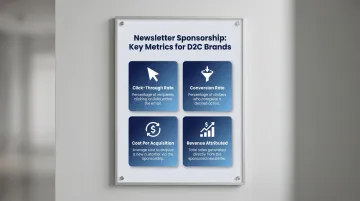
Newsletter sponsorships require different measurement frameworks than social ads. The primary KPIs relevant to D2C brands are:
- Click-through rate (CTR) — measures immediate engagement with the sponsored content
- Conversion rate — tracks how many clicks result in a purchase, sign-up, or download
- Cost per acquisition (CPA) — calculates total campaign cost divided by conversions
- Revenue attributed to the placement — ties campaign performance to actual sales
Unlike social ads, newsletter sponsorships often produce a longer attribution window. Readers may click days after the edition was sent, as newsletters remain in inboxes and are frequently revisited. That extended window makes clean tracking essential — without it, you'll undercount the channel's real impact.
Use UTM Parameters and Dedicated Landing Pages
Isolate newsletter-sourced traffic using UTM parameters in your links and dedicated landing pages or discount codes. This enables accurate comparison against other paid channels and reveals which newsletters, placements, or creative approaches deliver the highest ROI.
Set Realistic Expectations
Newsletter sponsorships typically drive fewer total clicks than social ads but at significantly higher intent. B2B decision-maker newsletter CPMs range from $50–$150, compared to $9–$15 for Meta and $2–$10 for Google Display. That gap reflects what you're buying — a reader who chose to open the email, not one who scrolled past an ad.
Downstream metrics are where newsletter sponsorships often pull ahead. Track:
- Average order value — newsletter-referred buyers frequently spend more per transaction
- Repeat purchase rate — high-intent audiences convert to loyal customers at a higher clip
- Customer lifetime value — the real justification for a premium CPM
Top-of-funnel engagement tells only part of the story. These conversion quality metrics tell the rest.
Conclusion
Sponsored content in executive newsletters works when D2C brands treat the reader's trust and attention as the real currency. The best campaigns feel like a natural addition to the reading experience — relevant, insightful, and pointing toward one clear next step rather than broadcasting at the reader.
For D2C marketers and media buyers seeking direct, inbox-first access to high-intent readers across global news and business newsletters, House of Summary's network of executive publications offers an ad environment with no algorithms, no blockers, and no visual noise. Reach out to explore opportunities at sales@houseofsummary.com.
Frequently Asked Questions
What counts as sponsored content?
Sponsored content is any paid promotional material published by a third-party platform on a brand's behalf, designed to match the look and tone of surrounding editorial content. Formats include newsletter placements, sponsored articles, influencer posts, and branded podcast segments.
Do you legally have to disclose sponsored content?
Yes, disclosure is legally required in most jurisdictions. The FTC in the US mandates clear labeling such as "Sponsored," "Paid Partnership," or "Ad," with similar rules in the UK and EU. Failure to disclose can result in regulatory penalties and, more immediately, loss of reader trust.
How is sponsored content in a newsletter different from a social media ad?
Newsletter placements reach readers in a focused inbox environment — no competing feeds, no algorithm interference, no ad blockers. This typically produces higher engagement and purchase intent per click than social ads, though at lower total volume.
What type of D2C products perform well in executive newsletter sponsorships?
Products aligned with executive lifestyle, productivity, health, travel, and premium consumer goods perform well — provided the offer connects credibly to the professional identity or daily life of the newsletter's readers.
How long should sponsored copy be in an executive newsletter?
Concise, focused copy works best: a short paragraph of 60–120 words with one clear CTA. Executive readers skim quickly and respond better to specificity and brevity than to lengthy promotional descriptions.
How many times should a D2C brand run a sponsored placement before evaluating results?
Run at least 2-3 placements before drawing conclusions. Newsletter audiences need repeated exposure to build recall, and single-run sponsorships rarely reflect the channel's true performance potential.