
Introduction
UK advertisers face a paradox: the country boasts nearly 55 million social media users, yet most campaigns fail to reach the professionals who actually control budgets. According to recent platform data, active posting across Instagram, Facebook, and X has dropped from 61% to 49% of UK adults in just one year — declining engagement quality, even as reach plateaus.
The advertising edge no longer comes from demographic volume. Age groups, gender splits, income brackets: these are available across every platform. The real advantage lies in understanding which reader profile actually converts, buys, and influences.
Executive newsletter readers stand apart on every measure — purchasing power, decision-making authority, and engagement rates that outperform standard display and social benchmarks.
This article explains what makes UK executive newsletter readers the most valuable audience segment available to advertisers today, using demographic, behavioural, and performance data.
Key Takeaways
- Executive newsletter readers aged 35–54 hold the highest disposable household income among prime working-age Britons
- Newsletter subscribers actively opt in — delivering CTRs 2.5–5x higher than Facebook or LinkedIn ads, not passive impressions
- Executive readers control budget sign-off directly, shortening B2B and premium B2C deal timelines without additional gatekeepers
- Newsletters bypass ad blockers entirely while 44% of university-educated users block display and social ads
- For finance, law, technology, and senior management audiences, social campaigns consistently cost more per qualified lead than newsletter placements
What Are UK Executive Newsletter Readers?
Executive newsletter readers are professionals who voluntarily subscribe to curated, topic-specific newsletters covering business, finance, geopolitics, or London-specific affairs. They read these publications as a habit of staying informed during their workday or commute—not for entertainment, but to make better decisions.
In UK terms, this audience skews heavily toward:
- Age 35–54 professionals based in urban centres, particularly London and the South East
- Senior, managerial, or C-suite roles with significant personal and professional spending authority
- London and the South East, a region that accounts for nearly a third of the UK's total population
The mindset they bring to their inbox is distinct from social browsing. These readers open newsletters with purpose, seeking information that directly impacts their work and investment decisions. That purposeful attention is what makes them worth more per reader than almost any other digital audience.
Key Advantages of Targeting UK Executive Newsletter Readers
The advantages below are grounded in measurable outcomes: purchasing power, decision-making authority, and engagement quality. Reach statistics alone don't tell the story.
Advantage 1: Concentrated Purchasing Power Among the UK's Highest-Income Bracket
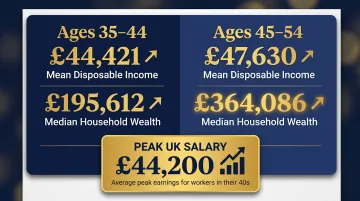
UK households headed by someone aged 45-54 report mean disposable income of £47,630 per year, with the 35-44 bracket at £44,421. Combined, the 35-54 cohort sits at the intersection of peak earnings and peak career influence.
Beyond annual income, wealth accumulation tells a more compelling story. Median household wealth for the 45-54 age group reaches £301,900, nearly three times the £109,800 held by 25-34 year-olds. Individual total wealth approximately doubles between ages 35-44 (£195,612) and 45-54 (£364,086).
Executive newsletter readers overwhelmingly fall within this age cohort, translating into real advertiser value:
- Not aspirational buyers: they have the income and authority to act on high-ticket products, luxury goods, financial services, travel, and enterprise software
- Higher average order values: campaigns targeting this cohort convert more strongly on premium-tier offerings with lower cost-per-acquisition than mass demographic campaigns
- Sustained purchasing power: workers in their 40s earn the highest average annual salary in the UK, approximately £44,200
KPIs impacted: Customer lifetime value, average transaction value, conversion rate on premium offers, return on ad spend (ROAS)
When this advantage matters most: Luxury brands, financial institutions, and professional services firms whose products sit above the mass-market price point.
Advantage 2: Direct Decision-Making Authority — B2B and High-Value B2C
Executive readers don't just have money; they hold formal authority over organisational budgets. Where a younger social media audience might discover a product and refer it upward, an executive reader can approve or recommend spending without additional sign-off layers.
Over half of B2B companies involve four or more decision-makers in purchase processes, yet 67% of B2B buyers now prefer a rep-free buying experience. They make decisions based on content consumption, not direct sales contact.
A senior finance professional reading a business-focused newsletter is both:
- A high-value B2C consumer: wealth management, premium travel, executive education
- A B2B decision-maker: software procurement, professional services, corporate event planning
Reaching the decision-maker directly shortens both sales cycles and reduces cost-per-acquisition. Approximately 94% of executives cite email as a primary news source, and 48% of C-suite decision-makers report that thought leadership content has directly influenced purchasing decisions.
KPIs impacted: Lead quality scores, B2B deal size, sales cycle length, campaign-to-revenue attribution
When this advantage matters most: SaaS companies, financial services advertisers, professional training providers, and luxury brands selling to individuals with significant disposable income and professional status.
Advantage 3: Intent-Based Engagement That Social Media Cannot Replicate
A newsletter subscriber has made a deliberate choice to invite a specific source of information into their inbox — a fundamentally different context from encountering an ad mid-scroll through a social feed.
The mechanics of the advantage:
- No algorithmic gatekeeping: newsletters deliver to every subscriber who opted in, every time
- Not subject to ad blockers: display and social ads face 36% blocking rates among UK adults aged 16-24, rising to 44% among university-educated users
- Undivided attention: readers engage with one email at a time, not an infinite competing feed
The performance gap is measurable. B2B email newsletters achieve 2.21% CTR, outperforming:
- Facebook ads: 0.90% CTR (2.5x difference)
- Instagram ads: 0.68% CTR (3.3x difference)
- LinkedIn Sponsored Content: 0.44-0.65% CTR (3.4-5x difference)
House of Summary's newsletter placements deliver click-through rates 4x higher than Google AdWords, reflecting the direct-to-inbox, no-competition environment that premium newsletters provide.
Why higher engagement matters:
The professionals advertisers most want to reach are also the most likely to block display and social ads. Ad-blocker adoption runs at approximately 33.5% among men aged 35-44 and 32.6% among men aged 45-54 — the precise demographic with the most purchasing authority. Email newsletters bypass this barrier entirely, reaching the audience that other channels increasingly cannot.
KPIs impacted: Click-through rate (CTR), open rate, ad recall, brand consideration uplift, cost-per-click versus benchmark
When this advantage matters most: Advertisers experiencing declining CTRs on social and display, those in regulated industries where social ad targeting is restricted, and brands that need sustained attention to communicate value.
What Happens When Advertisers Ignore This Audience
Brands allocating their entire UK budget to social media demographics often find strong impressions but weak conversion—because reach without purchasing authority rarely closes at premium price points.
Three specific risks compound when executive readers are excluded from the plan:
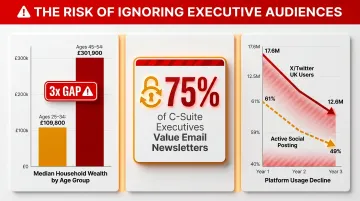
- Social platforms over-deliver younger, lower-wealth demographics. The 25-34 age group represents 33.3% of Instagram users and 40.3% of TikTok users — yet holds just £109,800 in median household wealth versus £301,900 for the 45-54 cohort. That's a 3x spending-power gap that social CTR optimisation routinely obscures.
- Newsletter channels are the one environment where decision-makers engage with professional content outside meetings. Approximately 75% of C-suite executives rate email newsletters as valuable or very valuable information sources — an access point that disappears entirely when newsletter spend is cut.
- Algorithm-driven platforms carry structural fragility. X/Twitter UK users dropped from approximately 17.6 million to a forecasted 12.6 million in 2024, and active social media posting among UK adults fell from 61% to 49% year-on-year. When platform engagement erodes, advertiser ROI follows.
How to Get the Most Value from UK Executive Newsletter Advertising
Accessing executive newsletter audiences works best when the approach is precise, consistent, and matched to the editorial environment.
Match Your Offer to the Reader's Mindset
Executive newsletter readers respond to messaging that respects their intelligence and time. Lead with clear value, not vague brand awareness. Content-native placements — sponsored insights, briefings, or summaries — outperform interruptive formats because they fit the reading flow rather than interrupt it.
Choose Newsletters with Verified, Specialised Readership
Editorial credibility transfers directly to the advertiser. Being seen in a publication that executives trust is a brand signal in itself. House of Summary's London Summary delivers London-focused news and professional content to a verified UK readership concentrated in the capital and South East — placing brands inside editorial content their audience reads deliberately.
Track the Right Metrics
Move beyond impression counts. With executive newsletter audiences, meaningful KPIs include:
- CTR against benchmark (2.21% for B2B email vs 0.44–0.90% for social)
- Post-click conversion quality and lead-to-revenue attribution
- Average order value and customer lifetime value
- Cost per qualified engagement with decision-makers
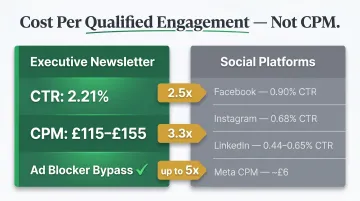
Premium executive newsletter placements command £115–£155 CPM versus approximately £6 for Meta platforms. The relevant comparison isn't CPM — it's cost per qualified engagement with a decision-maker who has real buying authority.
Conclusion
The UK's most valuable advertising audience isn't the largest—it's the most decisive. Executive newsletter readers combine the highest disposable income bracket among working-age Britons, direct purchasing authority, and genuine engagement into a single, accessible channel.
The advantages compound over time. Consistent newsletter advertising builds brand recognition and trust with decision-makers in a low-noise, high-attention environment—where messages land directly in the inbox, unfiltered by algorithms and unblocked by ad blockers.
For advertisers serious about reaching UK professionals who buy, recommend, and decide: executive newsletter readers are the audience that converts. No other digital channel delivers the same combination of purchasing power, attention quality, and direct access at scale.
Frequently Asked Questions
How do you gather audience demographics data?
Audience demographics are gathered through subscriber surveys, first-party registration data, newsletter analytics platforms, and periodic audits. Premium newsletter publishers tend to have more accurate data than social platforms because subscribers voluntarily provide professional context when opting in.
What audience demographics are commonly tracked?
Standard demographic variables include age, gender, income level, job title or seniority, industry sector, geographic location, and device usage. For executive newsletter audiences, job seniority and industry are most important — they determine purchasing authority, not just purchasing power.
What are the major demographic trends in the UK?
The UK's median age is rising—currently around 40.5 years and projected to climb—with the 35-54 cohort being both the largest working-age segment and the highest-earning. London and the South East remain the most concentrated hubs of executive and professional populations, making UK newsletter advertising particularly effective for advertisers targeting urban professionals.
Why are newsletter readers more valuable than social media audiences for reaching UK professionals?
Newsletter readers actively opt in and engage in a distraction-free environment, whereas social media users passively encounter ads mid-scroll — an intent gap reflected in measurably higher engagement (2.21% CTR for B2B email vs. 0.44–0.90% for social ads). Unlike social and display placements, newsletters bypass ad blockers and algorithmic suppression, ensuring consistent delivery to every subscriber.
What makes UK executive readers different from general newsletter subscribers?
Executive readers self-select into specialised publications because they need reliable information to make business decisions — not to browse. Their income, authority, and responsiveness to relevant B2B and premium B2C advertising are all consistently higher than those of a general consumer newsletter audience.