Introduction
Advertisers today compete for executive attention in shrinking windows. Social feeds scroll past in seconds, display ads get blocked at scale, and traditional digital channels struggle to reach decision-makers who've learned to tune out noise. Yet inboxes remain one of the last places professionals deliberately show up — not to scroll, but to read.
That reading behavior is exactly where the opportunity lies — and it's what separates advertising inside a curated executive newsletter from generic digital marketing. It affects who sees your ad, in what mindset, and what they do next. The format bypasses ad blockers, eliminates algorithm dependency, and places your message inside an editorial environment readers already trust.
This article explains why email advertising inside executive newsletters delivers distinct, measurable advantages — covering reach, engagement, and the specific metrics advertisers consistently see improve.
Key Takeaways
- Executive newsletter placements reach decision-makers while they're actively reading, not passively scrolling
- These ads bypass ad blockers, ignore algorithm changes, and land in a distraction-free inbox
- Readers represent high-intent, high-purchasing-power audiences difficult to reach through mass channels
- Newsletter CTRs hit 3–5% in business and finance verticals, vs. 0.05–0.1% for display ads
- Performance is fully measurable through open rates, CTR, and downstream conversions
What Is Email Advertising Inside Executive Newsletters?
Email advertising inside executive newsletters refers to sponsored placements—ads, branded segments, or sponsored content—embedded within curated newsletters delivered to opted-in professionals and decision-makers.
These are not mass-market blasts. They're specialized publications read by executives, business leaders, finance professionals, and policy-focused audiences — people who chose to be there. House of Summary's portfolio illustrates the format well:
- Presidential Summary — global news, written for readers who need the full picture fast
- Geopolitical Summary — international politics, fact-checked and context-driven
- Dubai Summary — UAE business and lifestyle, built for regional decision-makers
- London Summary — London-focused content for professionals in one of the world's top financial hubs
Each is human-written and delivered to readers who expect accuracy, not noise.
The format's real strength comes from three factors working together: the quality of the reader, the editorial environment surrounding the ad, and direct inbox delivery with no algorithms or ad blockers in the way. That combination makes these placements particularly effective for reaching audiences who are otherwise difficult to target at scale.
Key Advantages of Email Advertising Inside Executive Newsletters
The advantages below are grounded in operational and commercial outcomes: audience quality, delivery reliability, brand positioning, and measurable return. Each advantage ties directly to metrics that marketing decision-makers, media buyers, and brand teams actively track when evaluating ad spend.
Advantage 1: Direct Access to High-Intent Executive Audiences
Executive newsletters attract professionals who deliberately subscribed to stay informed. These aren't passive users scrolling through a feed—they're individuals who open their inbox with purpose. This audience profile is rare and disproportionately valuable for B2B brands, luxury advertisers, and financial services.
Because readers opted in for specialized, high-quality content, they arrive in a receptive state. The advertiser's message appears inside an environment the reader already trusts and values, increasing the likelihood of engagement.
Reaching C-suite executives, senior decision-makers, and high-net-worth professionals through traditional digital channels is inefficient. They use ad blockers at higher rates, skip pre-roll video, and suffer from banner blindness. Research shows that 67% of consumers admit to banner blindness, completely ignoring display ads. Newsletters bypass all of this because the reader chose to be there.
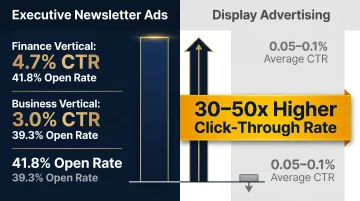
According to Paved's 2026 benchmark data, finance newsletters achieve 4.7% average CTR with 41.8% open rates, while business newsletters achieve 3.0% CTR with 39.3% open rates. Compare this to display advertising, which averages 0.05-0.1% CTR—newsletter placements deliver 30-50x higher click-through rates.
The outcome is measurable cost-efficiency: fewer wasted impressions, higher probability of reaching an actual decision-maker rather than a mid-funnel bystander.
KPIs impacted:
- Click-through rate
- Qualified lead volume
- Cost-per-decision-maker-reached
- Brand recall among senior audiences
When this advantage matters most:
This is especially high-impact for:
- B2B brands launching products requiring executive sign-off
- Luxury brands targeting high-net-worth individuals
- Financial services firms needing to reach CFOs, fund managers, or policy-facing professionals
Advantage 2: Inbox Exclusivity—No Algorithms, No Ad Blockers, No Visual Competition
Unlike social media or web display, email placements inside newsletters are delivered directly to the reader's inbox. There's no algorithm deciding whether the ad gets shown, no ad blocker that can suppress it, and no competing banner or auto-play video crowding the frame.
The reader opens the newsletter and the sponsored placement appears as part of the reading experience—typically in a clean, text-forward format—giving the brand's message uninterrupted presence in an uncluttered environment.
29.5% of internet users globally use ad blockers, according to GWI data compiled by DataReportal in Q2 2025.
Among age 25-34 professionals—the demographic most likely to include rising executives—usage reaches 34.5% for men. Programmatic display increasingly struggles with viewability, brand safety, and fraud.
None of these problems apply to inbox-delivered newsletter placements. Ad blockers operate at the browser level and cannot suppress content delivered directly to an email inbox. An advertiser buying a newsletter placement knows their ad will be delivered and seen, not buried by an algorithm update or suppressed by a browser extension.
The absence of visual noise—no competing ads, no recommended content widgets, no pop-ups—means the reader's attention isn't fractured. The brand message receives a higher proportion of cognitive focus than almost any digital format.
KPIs impacted:
- Ad delivery rate
- Viewability rate
- Share of attention
- Unaided brand recall
- Click-through rate
When this advantage matters most:
This matters most when:
- Brands have experienced declining returns from programmatic display
- Concerns exist about brand safety in algorithmic environments
- You're trying to reach audiences known to use ad-blocking tools at high rates (common among tech-savvy executives)
Advantage 3: Editorial Context Credibility—Trust by Association
When a brand appears inside a respected, editorially rigorous newsletter, it inherits a degree of the publication's credibility. Readers who trust the newsletter's content extend a measure of that trust to brands appearing within it—a dynamic that research on contextual advertising consistently confirms.
Executive newsletters covering global news, geopolitics, and business are read because they're perceived as accurate, clear, and free from sensationalism. A brand appearing in this environment is implicitly associated with those values rather than placed beside algorithmic clickbait.
Brand safety is a persistent concern in programmatic advertising.
Ads appearing beside low-quality or controversial content damage brand perception. Newsletter advertising eliminates this risk because the editorial environment is curated and consistent.
Research by IAS and Neuro-Insight using biometric brain activity measurement found that contextually matched ads achieve a 23% lift in detail memory and 27% lift in global memory versus unmatched ads. When ads solve a problem presented in the article (endemic match), detail memory increases 36% and emotional intensity rises 43%.
The study also found that 72% of consumers say page content impacts their perception of surrounding ads, 73% find it more appealing when an ad relates to article content, and 60% are likely to remember a contextually relevant ad.
Repeated exposure inside a trusted editorial environment builds positive brand association rather than ad fatigue.
KPIs impacted:
- Brand sentiment scores
- Brand recall
- Consideration uplift
- Customer trust metrics
- Repeat engagement rate
When this advantage matters most:
Context credibility is especially critical for:
- Brands in regulated industries (finance, healthcare, legal services)
- Premium and luxury brands where perception is central to value
- Any brand recovering from reputational challenges where placement environment carries extra weight
What Happens When Brands Skip Executive Newsletter Advertising
Mass-market digital channels weren't built to reach executives — and the numbers show it. Here's what brands are actually losing by skipping newsletter advertising:
Less than $0.50 of every programmatic dollar spent actually reaches a consumer, per ANA's Q2 2025 Programmatic Transparency Benchmark — and waste has grown 34% in two years, reaching $26.8 billion. Broad demographic targeting contains few genuine executive decision-makers.
Display ads are losing ground with precisely the audience you're trying to reach. Ad blocker adoption and banner blindness among high-income, tech-savvy users have pushed banner CTRs below 0.1% — a 99%+ drop from mid-1990s peaks.
Social platform visibility can evaporate without warning. When Facebook adjusted its algorithm between January and May 2016, organic reach dropped 42% for publishers — a reminder that campaign performance on rented platforms is never fully in the advertiser's hands.
Programmatic placements have no editorial filter. Brand risk rates sit at 1.5% globally, but IAS's 20th Media Quality Report found offensive content share increased 72% year-over-year — meaning ads can appear beside content that actively contradicts brand positioning.
Consistent presence in trusted editorial environments builds cumulative recognition with senior audiences. Brands that skip this format don't just miss one impression — they reset the familiarity clock every time they return.

How to Get the Most Value from Executive Newsletter Advertising
Newsletter advertising performs best when treated as a precision channel, not a mass-reach channel. The value is in audience quality and environment, so creative, message, and placement should reflect that.
Strong placements share three characteristics:
- Lead with a clear value proposition—executive readers respond to specificity, not brand-speak
- Track downstream metrics like time-on-site and qualified lead rate, not just open rate or CTR
- Choose newsletters with a defined editorial voice and transparent, verified audience data
On the metrics side: Paved's 2026 data shows CTR for business and finance verticals typically lands between 3–5%, with top performers reaching 7.4% or higher. That benchmark matters when evaluating a placement before you commit.
Audience verification is equally important. House of Summary's network—Presidential Summary (254,866+ daily opens), Geopolitical Summary, Dubai Summary, and London Summary—reaches 500,000+ verified subscribers. Roughly 66% are US-based, 18% in the UAE, and 10% in the UK, concentrated in wealth-dense metros like New York, Los Angeles, London, and Dubai.
Conclusion
Email advertising inside executive newsletters works because it brings together what most digital channels can no longer deliver at once: a verified, high-intent audience reading in a distraction-free environment — with editorial context that reinforces rather than undermines brand credibility.
That credibility compounds. Brands that commit to consistent newsletter placement build genuine recognition among decision-maker audiences — the kind that one-off campaigns or mass-market display simply can't replicate over time.
With ad blocker adoption rising and social feeds growing harder to cut through, the inbox — specifically a curated executive newsletter like those in the House of Summary network — is one of the few places where a brand's message still arrives with full context and undivided attention.
Frequently Asked Questions
What are the advantages of email advertising?
Email advertising offers direct delivery to opted-in audiences, immunity from ad blockers, measurable performance metrics, and high engagement rates—especially when placed inside specialized newsletters where readers are already focused and primed to act on what they read.
What is the 60/40 rule in email?
The 60/40 rule refers to a content-to-promotion balance—around 60% editorial or value-adding content and 40% promotional material—designed to maintain reader trust and reduce unsubscribe rates. In executive newsletters, that editorial majority is what builds the credibility advertisers step into.
What is the 3-3-3 rule in marketing?
The 3-3-3 rule suggests a message must capture attention in 3 seconds, communicate its point in 3 sentences, and prompt action in 3 steps. Executive newsletter placements are ideal for this rule because readers are already engaged and the clean layout supports fast, clear messaging.
How does advertising in executive newsletters compare to social media ads?
Executive newsletter ads reach opted-in professionals with no algorithm filtering their attention, while social ads compete in fragmented feeds where placement and visibility are platform-controlled. The audience quality and delivery reliability are simply not comparable.
Can email ads inside newsletters be blocked by ad blockers?
No—ad blockers operate at the browser level on web traffic and cannot block content delivered directly to an email inbox. This makes newsletter advertising one of the few digital formats that reaches audiences regardless of their ad-blocking settings.
How do I measure the ROI of advertising inside an executive newsletter?
Track open rate for reach, click-through rate for engagement, and downstream metrics like lead quality and conversion rate. Attribution is cleaner than display advertising because the CTA link is the single action point in a focused inbox environment.