Introduction
Brands targeting executives are increasingly bypassing traditional ad channels in favor of sponsoring curated newsletters that already hold the attention of decision-makers, C-suite professionals, and senior business leaders. Nearly 75% of executives rely on email newsletters as their primary information source — most reading before 8:00 A.M., well before they open social feeds or news sites.
While buying ad space in an executive newsletter sounds straightforward, results vary widely based on how well the publisher, format, audience fit, and creative are matched. Most brands treat newsletter sponsorships like display advertising — choosing publishers by reach alone, submitting generic creative, and skipping tracking setup. This approach rarely delivers results.
This guide covers:
- When outsourcing email advertising to executive newsletters makes sense
- What to prepare before you start
- The step-by-step placement process
- Key variables that determine performance
- Common mistakes and how to avoid them
Key Takeaways
- Outsourcing newsletter advertising means paying a publisher to place your brand message directly in front of a verified, high-value executive audience
- Best fit for brands targeting senior decision-makers in business, finance, geopolitics, or luxury — segments that social and search ads rarely reach effectively
- Newsletter ads bypass ad blockers (32.5% of U.S. internet users use them), algorithm filters, and visual noise — landing where executives actually read
- Results depend on choosing the right publisher with a verified, engaged audience — not just the largest list
- Before starting, have a clear offer, a defined audience profile, text-first ad creative, and measurable conversion goals ready
How to Outsource Email Advertising Inside Executive Newsletters
Step 1: Define Your Advertising Goals and Target Executive Profile
Specify what outcome you're optimizing for: brand awareness among C-suite readers, lead generation from a specific geography or sector, or driving traffic to a landing page targeted at business decision-makers.
Build a precise executive audience profile before approaching any publisher:
- Job title and seniority (CFO, VP, Director level)
- Industry and sector (finance, technology, manufacturing)
- Geography and regional focus (North America, UK, Gulf markets)
- Reading behavior and content preferences (global news, geopolitics, trade intelligence)
Without this profile, you cannot evaluate whether a newsletter's audience is actually the right fit. Most newsletter advertising failures start here, with poorly defined targeting that wastes both budget and opportunity.
Step 2: Research and Shortlist Relevant Executive Newsletter Publishers
Search for newsletters that specialize in the sectors your target executives care about: global news, geopolitics, finance, trade, regional business (such as UAE, London, Gulf markets). Look for publishers with named editorial teams and verifiable readership claims.
For brands targeting globally mobile executives, niche multi-publication networks offer concentrated access to readers who consume verified, specialized content daily. House of Summary (which spans Presidential Summary, Geopolitical Summary, Dubai Summary, and London Summary) reaches decision-makers, C-suite professionals, and high-net-worth individuals in wealth-dense metros including New York, Los Angeles, London, and Dubai.
Request a media kit from each shortlisted publisher. According to newsletter consultancy Wellput, a credible media kit should contain:
- Newsletter summary and publisher background
- Audience demographics (age, gender, location, job titles, purchasing authority)
- Engagement metrics (open rate, CTR, unique clicks per ad unit)
- Case studies or testimonials from previous sponsors
- Ad placement options, pricing, technical specs, and estimated clicks per format
Decline publishers who cannot provide these basics.
Step 3: Evaluate Newsletter Quality and Audience Legitimacy
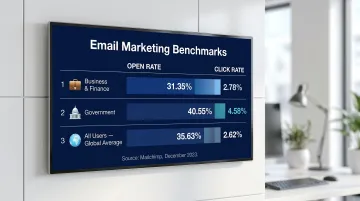
Verify open rate and CTR claims independently. Industry benchmarks for executive and B2B newsletters run much higher than consumer email averages. Mailchimp's industry benchmarks (December 2023) report:
| Industry | Avg. Open Rate | Avg. Click Rate |
|---|---|---|
| Business and Finance | 31.35% | 2.78% |
| Government | 40.55% | 4.58% |
| All Users (Global Avg.) | 35.63% | 2.62% |
Premium B2B professional newsletters achieve 35-50%+ open rates with 2-5% CTRs on well-matched placements, according to Admailr's 2026 data. The beehiiv platform reports an average 39% open rate across its publisher network.
Subscribe to each shortlisted newsletter yourself and evaluate:
- Does the tone match the claimed executive readership or feel generic?
- How many ad placements appear per issue?
- Are ads integrated naturally or stuffed into footer sections?
High ad-to-content ratios reduce reader attention and devalue your placement. Premium executive newsletters typically limit sponsored slots per send to maintain editorial quality and audience trust.
Step 4: Negotiate Placement Format, Position, and Terms
Understand the ad formats on offer and their performance implications:
- Sponsored sections — branded editorial-style blocks written in the newsletter's voice
- Classified-style text ads — short links in footer roundups
- Dedicated sends — full email sent to the publisher's list on your behalf (priced at 2x-5x primary rate)
- Native mentions — integrated references within editorial flow
Negotiate placement position carefully. Paved's benchmark data (2026) documents a tiered pricing structure reflecting performance differences:
| Placement Position | Percentage of Base Rate |
|---|---|
| Primary / Top of newsletter | 100% |
| Secondary / Mid-content | 50-65% |
| Classifieds / Footer | 25-35% |
Ads featured above the fold or early in the newsletter receive significantly higher engagement than those buried at the bottom. Confirm whether the publisher offers guaranteed positioning.
Clarify terms before committing:
- Minimum run lengths (multi-issue commitments typically earn 10-20% discounts)
- Creative submission deadlines
- Revision allowances
- Cancellation policies
- How performance data will be reported back to you
Step 5: Submit Creative, Brief the Publisher, and Confirm Tracking
Prepare ad copy that respects the tone of executive newsletter readers — concise, direct, credible, and benefit-led rather than promotional or hype-driven. Executive audiences disengage quickly from copy that feels out of place with the editorial environment.
Publishers like House of Summary often write or assist in writing sponsored ad copy to ensure it matches the editorial voice of each publication, embedding branded content naturally into the reading flow while maintaining clear advertiser disclosure.
Set up UTM-tagged destination URLs so you can attribute traffic, sign-ups, or conversions directly to each newsletter placement. According to Napkyn's 2024 best practices, use this structure:
utm_source=newsletter(or specific publisher name)utm_medium=emailutm_campaign=[descriptive campaign name]
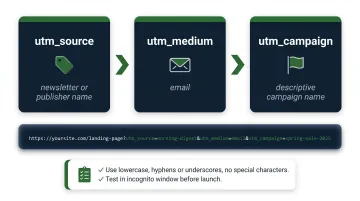
Use lowercase, underscores or hyphens as separators, and avoid special characters. Test links in incognito mode before launch.
Confirm the send date, preview the placement in context if the publisher allows it, and ensure any compliance requirements (FTC disclosures, brand guidelines, regulated claims) are reviewed before the issue goes live.
When Should You Outsource Email Advertising to Executive Newsletters?
Executive newsletter advertising works for brands whose product or service is genuinely relevant to senior professionals. If your priority is scale over targeting precision — mass-market consumer goods, broad awareness plays — this channel will likely disappoint.
Newsletter advertising makes strong sense when:
- Your target audience is too small and specialized to reach efficiently through social or search ads
- Your sales cycle requires repeated exposure to build trust among cautious buyers
- You need your message to appear in an environment that signals credibility by association
- Traditional digital channels are saturated or blocked (ad blocker usage reaches 32.5% in the U.S.)
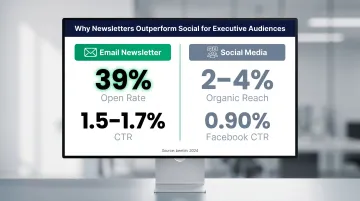
The performance gap between newsletters and other channels is significant. According to beehiiv's 2024 data, newsletter open rates average 39% — compared to organic social media reach of just 2-4%. CTRs tell a similar story: newsletters hold at 1.5-1.7% while Facebook averages 0.90%.
This approach becomes inefficient or wasteful when:
- The newsletter's audience does not closely match your buyer profile
- You have no defined conversion goal and cannot measure return
- Your budget cannot sustain at least 2-3 placements needed to assess performance fairly
The marketing "Rule of 7" holds that buyers need at least seven touchpoints before committing to a purchase. A single newsletter placement rarely gives you enough exposure — or enough data — to draw any real conclusions.
What You Need Before Getting Started
Show up to a publisher without a defined offer, a working landing page, or tracking in place, and you've already wasted the placement — before a single email goes out.
Creative and Messaging Readiness
Prepare ad copy variants suited to email format:
- Text-heavy, no image dependence
- Strong headline and clear call-to-action
- Tone that matches the sophistication of executive readers
- Avoid creative designed for social media or display — it rarely translates well
Tracking and Conversion Infrastructure
Ensure your destination URL, analytics tagging, and conversion events are set up before the first send goes live. Define what a successful placement looks like:
- A sign-up
- A demo request
- A content download
- A qualified lead
Measure ROI rather than relying on click counts alone.
Budget and Run Commitment
Allocate budget for at least 2-3 placements in the same newsletter before drawing conclusions. A single issue won't produce enough data to act on — and repeated exposure is what builds the audience familiarity that makes newsletter advertising work.
Publishers typically offer 10-20% discounts for booking 3+ placements, so committing to a test run pays off in both data and cost.
Key Variables That Affect Results When Outsourcing Newsletter Advertising
Two brands placing ads in the same newsletter can see dramatically different results based on four controllable variables: audience fit, ad format, creative quality, and placement frequency.
Audience Engagement Quality, Not Just List Size
An engaged list of 15,000 executives with a 45% open rate will consistently outperform a disengaged list of 150,000 with an 8% open rate. B2B professional newsletters achieve 35–50%+ open rates versus general consumer email averages of 20–35%. CTR on well-matched B2B newsletter placements ranges 2–5%, compared to Mailchimp's all-user average of 2.62%.
That gap shows up in pricing, too. A specialized B2B newsletter with only 8,000 subscribers can command a $2,000 placement fee, while a general lifestyle newsletter with 100,000 subscribers may command just $1,000 — a direct reflection of the engagement quality premium.
Ad Format and Editorial Integration
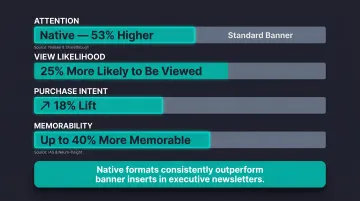
Native formats that mirror the newsletter's editorial style consistently outperform generic banner-style inserts. The research backs this up clearly:
- Native ads drive 53% higher attention than standard display formats (Nielsen & Sharethrough)
- Readers are 25% more likely to look at a native ad than a banner
- Native ads register an 18% lift in purchase intent over banner formats
- Contextually matched ads are up to 40% more memorable (IAS & Neuro-Insight, "The Context Effect," 2021)
An ad that feels out of place signals inauthenticity to sophisticated executive readers and damages both click rate and brand perception.
Placement Position Within the Email
Position within the email has a direct effect on exposure. Most readers don't scroll to the end of a long issue — which means ads placed in the bottom third face significantly lower effective reach.
Premium "above-the-fold" or "top sponsor" slots command higher rates because they capture attention before reader fatigue sets in. Confirm exact positioning with the publisher before committing spend, and evaluate whether the price premium is justified based on the publication's typical issue length and layout.
Brand-Audience Alignment and Editorial Tone Match
Executive newsletter readers chose that publication for its editorial voice and credibility. Ads that feel tonally inconsistent create friction — even when the audience demographics look right on paper.
A finance brand advertising in a verified geopolitical briefing read by senior decision-makers will outperform the same brand advertising in a general lifestyle newsletter with a similar open rate, because the reader mindset in the former context is primed for financial decision-making. Match the editorial identity, not just the audience size.
Common Mistakes When Outsourcing Email Advertising to Executive Newsletters
Avoid these pitfalls that consistently undermine campaign performance:
- Selecting newsletters on list size alone — skip verifying open rates, CTR, or audience demographics and you're likely buying a large, disengaged list that outperforms nothing
- Submitting generic ad creative built for social or display without adapting it for inbox reading — executive audiences disengage fast when copy clashes with the newsletter's editorial tone
- Running a single placement and drawing ROI conclusions from it — one send provides insufficient data; familiarity and repetition drive results in this format, not single exposures
- Failing to set up conversion tracking before launch — without it, you're limited to raw click counts with no way to justify spend or improve future placements
- Ignoring content-to-ad ratios — publishers who maintain lower ad ratios (80/20 or 60/40 content-to-advertising split) typically deliver better performance for individual sponsors because reader attention isn't diluted across too many promotional messages
Conclusion
Outsourcing email advertising into executive newsletters puts your brand message directly in front of decision-makers — inside a medium they actively choose, check daily, and trust. It only produces strong results when the publisher, audience, format, and creative are aligned from the start.
Most failures in this channel come from treating newsletter advertising like programmatic display buying — choosing publishers by reach alone, submitting generic creative, and skipping conversion tracking. Brands that invest in proper vetting, tailored copy, and sustained placements consistently see higher engagement than comparably priced digital ad alternatives.
That engagement edge traces back to one key behavior: executives choose these newsletters. They open them before their first meeting. They trust the editorial judgment behind every issue. When your brand appears in that context — with the right message in a voice that fits the publication — you earn focused attention that display and social formats rarely produce.
Frequently Asked Questions
Is outsourcing legal in the USA?
Outsourcing advertising placements to newsletter publishers is fully legal in the USA. Brands must ensure ad disclosures comply with FTC Endorsement Guides (sponsored content must be clearly labeled as "Ad," "Paid ad," or "Sponsored"). Under the CAN-SPAM Act, both the company whose product is promoted and the company that sends the message may be held legally responsible, with penalties up to $53,088 per violation.
What are the four types of outsourcing for email advertising?
There are four main models for outsourcing newsletter advertising:
- Direct publisher buys — paying a newsletter operator directly for a sponsored slot
- Newsletter ad networks — platforms like Paved or beehiiv that aggregate multiple newsletters for centralized buying
- Media agency placement — hiring an agency to manage newsletter buys on your behalf
- Programmatic newsletter advertising — automated bidding for slots across a network of opted-in publications
What are common ratio rules in email marketing (e.g., 80/20 and 60/40)?
The 80/20 rule suggests 80% of newsletter content should deliver editorial value while only 20% is promotional or advertiser-driven. The 60/40 rule reflects a slightly higher allowable ad-to-content ratio. These ratios matter because they signal how cluttered a newsletter's ad environment is — publishers who maintain lower ad ratios typically deliver better performance for individual sponsors because reader attention isn't diluted.
How much does it cost to place an ad in an executive newsletter?
Pricing varies based on list size, open rate, audience seniority, and ad format. B2B decision-maker newsletters typically range from $50–$150+ CPM, while general B2B newsletters run $30–$60 CPM. Flat rates for mid-size newsletters (20K–50K subscribers) generally fall between $1,000–$3,000 per placement.
What metrics should I use to measure the performance of outsourced newsletter advertising?
Your core metrics are CTR (benchmark: 1.5–5% for well-matched B2B placements), conversion rate on the destination page, and cost per acquisition (CPA). Open rate is the publisher's metric — your performance starts at the click. If publisher-reported clicks exceed server-side data by more than 80%, investigate list quality for bot traffic.