
Running an ad inside a newsletter seems straightforward on the surface, but results vary dramatically based on newsletter selection, ad format, copy quality, and how well the brand message fits the editorial context. A 5,000-subscriber newsletter with a 45% open rate will outperform a 50,000-subscriber list with a 12% open rate every time. The quality of attention matters more than the size of the list.
This article walks through exactly when newsletter advertising makes sense, what you need to prepare before launching, the step-by-step execution process, the variables that control performance, and the most costly mistakes advertisers make.
Key Takeaways
- Newsletter advertising means placing your brand's message inside a third-party newsletter with an engaged, opted-in audience — borrowing an established trust relationship rather than building your own list from scratch
- Works best for reaching specific professional or interest-based demographics where brand trust matters more than raw volume
- Before launch, confirm your campaign goal, audience profile, placement terms, ad copy, and UTM tracking links
- Audience quality and engagement drive results — a smaller, highly engaged list consistently outperforms a larger but passive one
- Track click-through rate, conversion rate, and cost per acquisition — impressions alone tell you very little
When Should You Run an Email Advertising Campaign Inside a Newsletter?
Newsletter advertising serves a specific purpose: brand reach, lead generation, or direct response among a pre-built audience you don't own. It complements owned email marketing — it doesn't replace it.
The strongest fit occurs when:
- You're launching to a new audience and need immediate access to readers who already trust the publisher's editorial voice
- Your target demographic — finance professionals, global executives, niche B2B buyers — is hard to reach efficiently through paid social or search
- Trust matters more than volume — luxury goods, financial services, and executive-facing B2B offerings perform well here because newsletter readers arrive in an information-seeking mindset, not a scrolling one
Newsletter advertising becomes the wrong fit when:
- The newsletter's audience doesn't match your offer — creative optimization can't fix a fundamental audience mismatch
- You need mass reach at low CPM — newsletters price on engagement, not raw impressions. Average CPM ranges from $6.53 for general audiences to $23.01 for premium niches, versus $1–$5 for programmatic display
- Your campaign depends on real-time behavioral triggers or retargeting — newsletters run on a fixed publisher schedule, not user behavior
For retargeting or behavioral segmentation at scale, paid social or programmatic display will serve you better. For long-term relationship-building with an existing customer base, building your own list is the smarter investment. But for reaching engaged, high-intent readers quickly — with no ad blockers, no algorithms, no visual clutter — newsletter advertising is hard to match.
What You Need Before Running Your Newsletter Ad Campaign
Preparation determines whether a newsletter ad campaign generates ROI or generates only impressions. The inputs matter as much as the execution.
Newsletter and Audience Fit Requirements
Research the target newsletter's open rate, click-through rate, subscriber count, and audience demographics before committing budget. Look for newsletters with engagement levels that signal a genuinely active readership rather than a large but dormant list.
What qualifies as "good" engagement?
According to GetResponse's 2024 benchmarks based on 4.4 billion messages:
- Average newsletter open rate: 40.08%
- Average newsletter CTR: 3.84%
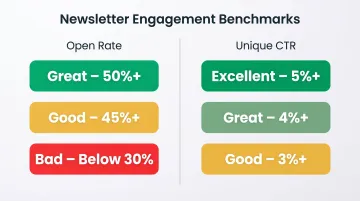
Newsletter operators with 100K-2M+ subscribers define benchmarks more aggressively:
- 50%+ open rate = Great
- 45%+ = Good
- Below 30% = Bad
- 3%+ unique CTR = Good; 4%+ = Great; 5%+ = Excellent
Always ask for open rate and CTR data before committing budget. A newsletter with 200,000 cold subscribers will deliver far fewer clicks than one with 20,000 actively engaged readers.
Ad Creative and Copy Readiness
Before submitting your ad, have these elements locked in:
- A finalized offer with a single clear call-to-action
- Ad copy written in a tone that complements the newsletter's editorial voice
- Creative reviewed against the newsletter's audience expectations before submission
- At least three to five issues read so you understand the tone before writing a word
Mismatched copy that feels like a hard-sell insertion into an editorial product will underperform regardless of audience quality.
Tracking and Goal Configuration
Before the send date, confirm three things are in place:
- UTM parameters on every link in the ad, tagged to the specific newsletter and send date
- A defined conversion goal — sign-up, purchase, or demo request — with tracking confirmed on the destination page
- A landing page built for newsletter traffic: concise, offer-focused, and matched to the reading mindset of someone arriving from their inbox
How to Run an Email Advertising Campaign Inside a Newsletter
Step 1: Define Your Campaign Goal and Audience Profile
Before contacting any newsletter, clarify the specific business goal this campaign is meant to achieve:
- Brand awareness
- Lead generation
- Direct product sales
- Event registrations
The goal determines which newsletters to target, what ad format to request, and how to write the copy.
Build a precise audience profile including:
- Industry and job title
- Income bracket
- Geography
- Interest set
The more specific this profile, the more accurately you can match it to a newsletter's readership.
Step 2: Identify and Evaluate Newsletter Partners
Research newsletters that serve your target audience. Evaluate them on:
- Subscriber engagement (open rate, CTR)
- Audience demographics
- Editorial positioning
- Sending frequency
Reach out to the newsletter's advertising or sales contact to request a media kit.
Assess audience-brand alignment: Does the newsletter cover topics your target buyer actively reads about? For example, a finance-sector brand targeting global executives would look for newsletters covering geopolitics, global business, and markets. Publications like those in the House of Summary network (Presidential Summary, Geopolitical Summary, Dubai Summary, London Summary) are designed around exactly this kind of high-intent, globally-minded readership.
Check ad policies: Understand exclusivity windows, required lead times, content restrictions, and cancellation terms before committing.
Step 3: Select Your Ad Format and Negotiate Placement
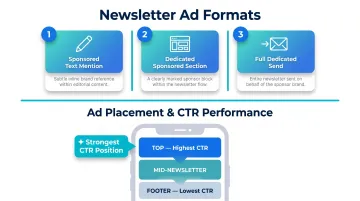
Common newsletter ad formats include:
- Sponsored text mentions — brief brand callouts embedded in the editorial flow
- Dedicated sponsored sections — clearly labeled, with headline and body copy
- Full dedicated sends — the entire email is the advertiser's message, sent to the newsletter's list
Each carries different CPM pricing, reader attention levels, and production requirements.
Negotiate placement position within the newsletter: Above-the-fold placements (top of email) typically outperform mid-newsletter or footer placements. Research from Aalto University and Oulu Business School analyzing 110 newsletters found that upper-left position has the strongest positive impact on CTR, and left-side links consistently outperform right-side links.
Confirm pricing model: Newsletters typically price on CPM (cost per thousand subscribers), flat rate per send, or occasionally on a CPC basis. Clarify what you're paying for and how performance will be reported.
Step 4: Write and Submit Your Ad Creative
Write ad copy that matches the newsletter's editorial voice. The best newsletter ads read as a natural, useful recommendation — not a pitch. Overly promotional language erodes reader trust in the publication and, by extension, in your brand.
Keep the creative focused:
- Lead with a headline that addresses a real pain point or desire of the audience
- Include a single, specific CTA with a trackable link
- Avoid brand-name-first openings that feel like display ads
Send creative to the publisher within the required lead time (typically 3-7 days before the send date) and request a proof before the email goes live.
Step 5: Launch, Monitor, and Optimize
On send day, verify that your tracking links are live and that the landing page is functioning correctly across mobile and desktop.
Monitor initial performance within 24-48 hours. Newsletter engagement peaks fast — most opens and clicks happen on day one. Track:
- Click-through rate from the ad link
- Traffic behavior on the landing page
- Conversion rate
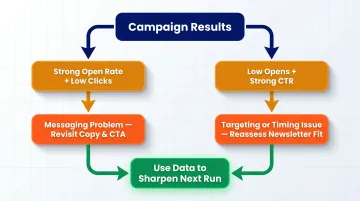
Use the data to assess two things: whether the newsletter's audience matched your target, and whether the copy converted. A strong open rate with low clicks usually points to a messaging problem. Low opens with strong CTR suggests a targeting or timing issue. Each run sharpens the next.
Key Variables That Affect Newsletter Ad Campaign Results
Newsletter advertising outcomes are controlled by a small number of high-leverage variables. Optimizing these is more important than volume of sends.
Newsletter Audience Engagement Quality
A newsletter with a 45% open rate and 5,000 subscribers will drive more qualified clicks than one with a 12% open rate and 50,000 subscribers. The engaged reader is the asset, not the raw subscriber count.
Newsletter ads generate an average CTR of 3.84%, compared to just 0.27% for display ads across all platforms — roughly 14x higher click-through performance. Higher engagement directly translates to more ad impressions from active, attentive readers, making cost-per-click and cost-per-conversion more favorable.
Ad Placement Position Within the Newsletter
Readers scan newsletters in a predictable pattern. Early placements receive more attention before engagement drops off further down the email, and upper-left positioning consistently outperforms other placements.
In practice, this means:
- Top-of-newsletter placements outperform mid-newsletter and footer positions on CTR
- Short, dense teasers consistently outperform long-form text
- Long ad titles negatively correlate with click-through rates
Copy and Offer Alignment With Reader Intent
Newsletter readers arrive in a consumption mindset — they came for editorial content, not ads. Ads that feel like a natural extension of the newsletter's subject matter generate higher response rates than generic promotional copy.
Relevance is the deciding factor. A mismatched offer produces near-zero response regardless of placement quality — the best position in the best newsletter still fails if the product doesn't fit the audience.
Frequency and Timing of the Campaign
A single placement is rarely enough to drive awareness or conversions from cold audiences. Multiple placements across one or more issues build familiarity and increase response probability.
Research shows that 40% of consumers say seeing an ad multiple times helps them remember the brand name, and 25% are more likely to buy after repeated exposure. The optimal threshold before annoyance outweighs helpfulness is approximately 3–5 exposures.
Multi-run campaigns in the same newsletter typically see improved CTR as audience familiarity grows. Each successive placement builds on the last — repetition drives trust, and trust drives action.
Common Mistakes When Advertising Inside a Newsletter
Choosing a Newsletter Based on Subscriber Count Alone
Advertisers frequently prioritize raw list size over engagement quality. A newsletter with 200,000 cold or disengaged subscribers will deliver far fewer clicks than one with 20,000 actively engaged readers. A 500,000-subscriber list with less than 20% active engagement over 90 days means the advertiser is actually reaching only approximately 100,000 readers.
Before committing budget, always ask for open rate and CTR data — not just total subscribers.
Writing Ad Copy That Doesn't Match the Newsletter's Tone
Dropping a formal press-release-style ad into a casual, opinionated newsletter — or vice versa — signals to readers that the placement is transactional rather than curated. This erodes both click-through rates and brand perception.
Read several issues before writing a single line of copy. The voice has to fit.
Skipping UTM Tracking and Conversion Setup
Many advertisers run newsletter ad campaigns without properly tagging their links or defining what a conversion looks like. This makes it impossible to measure ROI or compare performance across newsletter partners.
Before the first send, set up UTM parameters for every link and agree internally on what counts as a conversion — a purchase, a sign-up, a demo request.
Expecting Immediate Scale From a Single Placement
Newsletter advertising builds performance through repetition. Treating one send as a full campaign test and abandoning the channel after weak first-run results is one of the most common reasons advertisers underestimate this channel's potential.
Conclusion
Running a successful email advertising campaign inside a newsletter requires the right newsletter-audience match, copy that respects the editorial environment, and proper tracking measured against a defined goal.
Newsletter advertising has structural advantages most digital channels can't match:
- No ad blockers intercepting your message
- No algorithm deciding who sees it
- Opted-in readers who chose to be there
When campaigns fall short, the cause is almost always poor newsletter selection or misaligned creative — not the channel. Email advertising delivers an ROI of $36–$42 for every dollar spent. Get the inputs right, and those returns are yours to capture.
Frequently Asked Questions
What is a good email marketing campaign?
An effective email campaign has a clearly defined goal, a well-matched audience, a compelling and relevant message, and a measurable call-to-action. These principles apply equally to campaigns run inside third-party newsletters, where audience alignment and editorial tone-matching determine success.
How much is a 1,000 email list worth?
List size alone doesn't determine value — engagement and audience relevance do. A 1,000-person newsletter with a 50% open rate in a targeted niche can deliver stronger ROI for an advertiser than a 100,000-person list with low engagement and weak audience fit.
What are the 5 C's of email?
Practitioners commonly reference five C's: Content, Consistency, Calls-to-Action, Customization, and Compliance. All five matter when placing an ad inside a newsletter — from matching editorial tone to ensuring permission-based delivery.
What are the most common newsletter ad formats?
The three main types are: sponsored text mentions embedded in editorial content, dedicated sponsored sections with headline and body copy, and full dedicated sends where the entire email is the advertiser's message. Each carries different pricing, placement prominence, and creative requirements.
How do I measure the success of a newsletter advertising campaign?
Focus on click-through rate on the ad link, conversion rate on the landing page, and cost per acquisition. Open rate data from the newsletter is a proxy for potential audience reach but not a direct measure of ad performance. Track these metrics using UTM parameters on all campaign links.
What's the difference between sponsored content and a display ad in a newsletter?
Sponsored content is written in the newsletter's editorial voice, blending into the reading experience and often generating higher engagement — though it requires closer collaboration with the publisher. A display ad is a clearly demarcated promotional block with less editorial integration but simpler execution.