This guide covers what email newsletter advertising is, why it works, the types of formats available, how pricing works, and how to choose the right newsletter to advertise in.
Key Takeaways
- Newsletter ads appear inside curated content subscribers opted into, reaching audiences that are already engaged and receptive
- Unlike social or display ads, newsletter advertising bypasses ad blockers and algorithms entirely
- Pricing typically uses CPM ($15–$100+ depending on niche), CPC, or flat-rate sponsorships
- Effective newsletter ads match the editorial tone of their host publication — not just the audience demographics
- Choose newsletters based on audience fit and engagement metrics, not just subscriber count
Why Email Newsletter Advertising Outperforms Other Channels
The Earned Attention Advantage
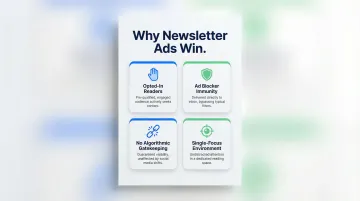
The core advantage of inbox placement is simple: the reader has already opted in and is actively reading. This is a different dynamic from scrolling a social feed or being retargeted on a website.
This "earned attention" translates to measurable performance. Email click-through rates average 2.3% to 2.62%, significantly outperforming social media (0.66%) and retail media (0.39%). For context, House of Summary's newsletter advertising delivers click-through rates 4x higher than Google AdWords — a concrete benchmark demonstrating what engaged newsletter audiences can deliver.
Newsletter Ads Bypass Ad Blockers
Between 32.5% and 52% of global internet users now use ad blockers — roughly 900 million to 1.77 billion people worldwide. That's half your potential audience actively blocking your display and video ads.
Newsletter ads are immune. They're embedded in email content, not served through browsers, so ad blocker extensions never see them. Every impression is delivered in full.
No Algorithmic Interference
Social media platforms and search engines decide whether your ad reaches the reader. Newsletters go directly to the inbox with no platform acting as gatekeeper. If the newsletter is sent, the ad is delivered — no algorithm required.
Undivided Attention in a Contained Environment
Unlike a web page with multiple competing ads, banners, and content blocks, a newsletter is a linear reading experience. Each ad placement receives full reader focus without visual clutter or competing messages. Native newsletter ads drive 53% higher attention and an 18% lift in purchase intent compared to standard display banners.
In short, newsletter advertising has structural advantages no other channel matches:
- Opted-in readers who are actively engaged, not passively scrolling
- Ad blocker immunity — delivered via inbox, not browser
- No algorithmic gatekeeping — if it's sent, it reaches the reader
- Single-focus environment with no competing ads or visual noise
Types of Newsletter Ads: Formats and Placements
Sponsored Content / Native Ads
This is the most common and highest-performing format. Ad copy is written in the editorial voice of the newsletter, labeled "sponsored" or "partner." It performs well because it reads as part of the newsletter rather than an interruption.
Native ads are 9 times more likely to be clicked compared to traditional display ads, and users spend 18% more time interacting with them. The format blends seamlessly with editorial content, reducing reader resistance.
Dedicated Send / Solo Newsletter
An advertiser sponsors an entire issue or a dedicated email sent to the newsletter's list. This format is appropriate for:
- Product launches requiring full attention
- Major announcements or partnerships
- Limited-time offers or events
- High-value campaigns with premium budgets
Dedicated sends carry higher price points because advertisers get exclusive attention and complete creative control over the issue.
Display Banner Ads
Standard embedded image ads (banner, leaderboard, medium rectangle) placed at the top, middle, or bottom of newsletters. Common sizes include:
- 300x250 (medium rectangle)
- 728x90 (leaderboard)
- 468x60 (banner)
These formats make it easy for brands to repurpose existing creative assets. However, they underperform native formats by a wide margin due to banner blindness and lack of editorial integration.
Text-Based Classified / Blurb Ads
Short paragraph or two-to-three sentence ad formats often seen in digest-style newsletters. Despite being text-only, these perform strongly because they feel organic to the reading experience. Their brevity and plain-text format make them nearly indistinguishable from editorial content blocks.
Placement Position Matters
Top-of-newsletter (primary sponsor): Highest visibility, highest CTR, priced accordingly.
Mid-content (secondary placement): Placed between editorial sections, these blend naturally with content and typically cost 50-65% of the primary rate.
Footer (classified placement): Lower visibility but can drive high intent for direct transactional offers. Priced at 25-35% of the primary rate.
Above-the-fold placements consistently outperform sidebar or end-of-newsletter positions.
How Newsletter Advertising Is Priced
CPM (Cost Per Mille)
The standard pricing model — cost per 1,000 email impressions delivered. CPM rates vary widely based on niche, audience quality, and engagement.
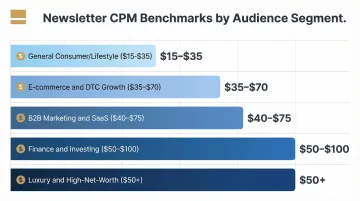
CPM Benchmarks by Audience Segment:
| Newsletter Segment | Average CPM Range |
|---|---|
| General Consumer / Lifestyle | $15 – $35 |
| E-commerce & DTC Growth | $35 – $70 |
| B2B Marketing & SaaS | $40 – $75 |
| Finance & Investing | $50 – $100 |
| Luxury & High-Net-Worth | $50+ |
Audience net worth, B2B purchasing power, category fit, and advertiser demand drive CPMs — not subscriber count alone.
CPC (Cost Per Click)
Advertisers pay only when a reader clicks the ad. This model offers lower risk for advertisers, but publishers often charge premium CPC rates to compensate for unpredictable click volume.
Niche newsletters average $18.36 CPC compared to $4.96 for general-interest newsletters, reflecting the premium advertisers pay for high-intent clicks.
That said, up to 63% of email clicks can be bot-driven — making CPC less reliable for direct sponsorships. The model is far more common in programmatic email ad networks than in curated newsletter placements.
Flat-Rate Sponsorships
Many premium newsletters sell sponsorships at a fixed price per issue, regardless of open or click volume. Unlike performance-based models, flat-rate pricing gives publishers predictable revenue and advertisers straightforward budgeting.
This model suits publishers with small but highly valuable audiences. It's most common for lists under 50,000 subscribers, particularly those reaching:
- C-suite executives and senior decision-makers
- Niche industry professionals with high purchasing authority
- High-net-worth readers in finance, luxury, or global business
How to Choose the Right Newsletter to Advertise In
Audience Alignment Is the Primary Criterion
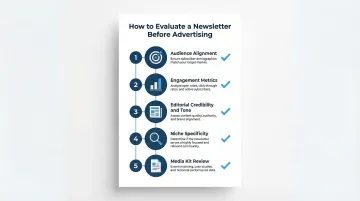
Subscriber count matters far less than whether those subscribers match your ideal customer profile. A 10,000-subscriber newsletter of finance executives may outperform a 500,000-subscriber general consumer list for a B2B financial product.
Niche newsletters consistently deliver higher value. Brands advertising in specific, highly relevant editorial sections saw a 55% increase in CTR compared to run-of-site placements.
Evaluate Engagement Metrics Before Buying
Request these key metrics before committing:
- Open rate (note: Apple's Mail Privacy Protection inflates this to 41%+, so treat it with caution)
- Click-through rate (CTR) — industry average runs 2.3% to 2.62%
- Click-to-Open Rate (CTOR) — more reliable than open rate, averaging 5.3% to 10.5%
- List growth trend over the last 12 issues
These should be rolling averages, not cherry-picked peak performance.
Assess Editorial Credibility and Tone
The trust readers place in a newsletter extends to the brands advertised within it. Publications known for accurate, high-quality editorial content transfer that credibility to their sponsors — while low-quality or sensationalist outlets can quietly undercut brand perception regardless of reach.
Before committing, spend time reading several recent issues. If the editorial tone doesn't reflect the standards your brand maintains, the audience alignment won't matter.
Consider Niche Specificity Over Broad Reach
Specialized newsletters deliver higher purchase intent, less advertiser competition, and deeper reader loyalty than general-interest publications.
The House of Summary network — which includes Presidential Summary, Geopolitical Summary, Dubai Summary, and London Summary — illustrates this principle. Each title serves a distinct, defined audience: global executives, business professionals, and high-intent readers in specific geographies. For brands in finance, luxury, and B2B sectors, that kind of precision is often more useful than raw scale.
Request a Media Kit
A legitimate media kit includes:
- Subscriber demographics (age, location, job titles, income)
- Open/click rate history (12-issue rolling average)
- Ad format options and specifications
- Pricing and sponsorship packages
- Audience persona descriptions
If a newsletter can't produce a media kit — or the data inside looks suspiciously perfect — treat that as a red flag.
Best Practices for Newsletter Ad Creative That Converts
Match the Editorial Tone
The most effective newsletter ads sound consistent with the newsletter's voice, not like a generic ad transplanted from another channel. Ask the publisher for examples of past ads that performed well and use them as tone references.
One Message, One Action
The opening line must communicate a specific benefit or spark curiosity — generic taglines lose readers before they reach the CTA. Apply this principle: one ad, one message, one action. Don't introduce multiple products or benefits in a single placement.
Include a Single, Prominent Call-to-Action
Emails with a single, focused CTA see up to 371% more clicks compared to emails with multiple competing buttons. Using a dedicated CTA button instead of a text link increases click-throughs by 28%.
The reader's path from ad to action should require zero interpretation. That means one button, one destination, and phrasing that tells them exactly what they'll get — not "Learn More," but "Get the Free Report" or "See Pricing."
A few quick checks before your ad goes live:
- Button copy describes the outcome, not just the action ("Download the Guide" beats "Click Here")
- Landing page matches the ad's offer and tone exactly
- No competing links or secondary CTAs pulling attention away
- CTA appears above any body copy, not buried at the end
Frequently Asked Questions
What is an e-newsletter?
An e-newsletter is a regularly distributed email sent to opted-in subscribers, covering curated content on a specific topic, industry, or interest area. Unlike promotional emails, it focuses on editorial content — news, insights, or curated updates — rather than selling.
What is the purpose of an e-newsletter?
It builds a direct, algorithm-free relationship between publishers and their readers — no platform intermediaries, no filtered reach. That direct connection is what makes newsletters valuable ad placements: the audience chose to be there.
How do online newsletters make money?
Newsletters generate revenue through three main streams: paid advertising and sponsorships, paid subscription tiers, and affiliate or referral revenue. Advertising is the most common model, especially for free newsletters with large readerships.
What are 3rd party ads?
Third-party ads in newsletters are placements purchased by external brands (not the newsletter publisher itself), typically served through an ad network or sold directly. The publisher's own product promotions don't count — third-party ads come from outside advertisers paying for access to the audience.
What are examples of display advertising?
Common display ad formats in email newsletters include banner ads, leaderboard images, medium rectangles, and sponsored image blocks. These are image-based placements — static or animated — that appear visually within the newsletter layout.
What is the 80/20 rule in email marketing?
The 80/20 principle suggests roughly 80% of newsletter content should deliver genuine value to the reader (information, insight, entertainment) and 20% can be promotional or advertiser-driven. This balance preserves reader trust and keeps engagement high.