Introduction
Digital advertising faces unprecedented barriers. Over 32% of internet users globally run ad blockers, filtering out traditional display campaigns before they ever reach the screen. Meanwhile, social media algorithms determine whether your carefully crafted post appears in front of the audience you've paid to reach — and organic reach on most platforms has shrunk to single-digit percentages. Brands that rely solely on display and social ads are paying more to reach fewer people.
Email newsletter advertising reaches readers directly, with no algorithm filtering your message and no browser extension stripping your creative. These are opted-in audiences who chose the publication. When a reader opens their trusted newsletter, your brand appears alongside content they actively sought out.
This guide covers why newsletter advertising works, the ad formats available, how to choose the right newsletter partner, best practices for creating ads that perform, and how to measure results in a privacy-first environment.
Key Takeaways
- Newsletter advertising reaches opted-in readers who chose to receive the content, so engagement is built on trust from the start
- Bypasses ad blockers and social algorithms, delivering your message directly to the inbox
- The best ads match the publication's tone, topic, and audience — context matters more than format
- Audience quality outweighs audience size when choosing newsletter partners
- Track performance by pairing open and click-through rates with conversion data via UTM parameters
What Makes Email Newsletter Advertising Different — and Why It Performs
Email newsletter advertising is fundamentally different from email marketing. Email marketing communicates with your own subscriber list — people who already know your brand. Newsletter advertising places your content inside someone else's publication, reaching a new, opted-in audience that trusts the publisher but may have never heard of you.
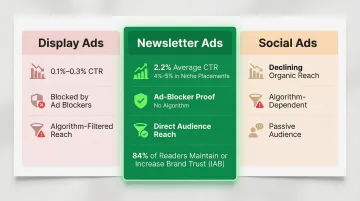
The engagement advantage is real. Newsletter subscribers are verified humans who actively chose to receive the content. They're not passive scrollers or retargeted strangers. While standard display ads average 0.1% to 0.3% click-through rates, newsletter ads average 2.2% CTR across all placements, with top-performing placements in niche newsletters reaching 4% to 5%.
Newsletter ads bypass two major barriers to reach:
- Browser-based ad blockers cannot filter content rendered inside an email — newsletter ads are part of the HTML itself, not external scripts
- No platform algorithm decides whether your ad appears. Once the newsletter sends, every subscriber receives it
Bypassing those barriers is only part of the advantage. When a respected, editorially rigorous newsletter carries your message, readers extend that trust to your brand — a credibility transfer that paid search and social simply can't replicate. According to the IAB, 84% of news consumers feel that advertising within trusted news environments either increases or maintains their trust in the brand.
This matters most when targeting high-intent, discerning readers: executives, professionals, and business decision-makers.
House of Summary's network — including Presidential Summary, Geopolitical Summary, Dubai Summary, and London Summary — exemplifies this premium inventory. These newsletters reach serious, globally-minded readers with verified content. Advertisers partnering with House of Summary have seen click-through rates 4x higher than Google AdWords, a result audience quality and editorial alignment drive directly.
Types of Email Newsletter Ads
Sponsored Content and Native Ads
Sponsored content or native ads are written and formatted to match the newsletter's editorial style. They blend with the surrounding content rather than interrupt the reader, which increases engagement. These ads must be clearly labeled as "Sponsored," "Advertisement," or "Paid Content" to comply with FTC guidelines — and transparency actually builds trust rather than undermining it.
Native ads mimic the newsletter's design, tone, and structure. If the newsletter uses short paragraphs and bullet points, your ad should follow the same format. If the editorial voice is authoritative and data-driven, your copy should reflect that.
Display Ads
Display ads are visual banner-style placements that appear in header, mid-email, or footer positions. These are static or animated image-based ads, typically 600 pixels wide to accommodate mobile rendering.
Unlike web display ads, email display ads cannot use JavaScript or iFrame formats due to email client security restrictions. All interactivity must be achieved through:
- Static images
- Animated GIFs
- Simple HTML tables with inline CSS
One critical GIF caveat: Outlook 2007 and later versions only display the first frame, so any call-to-action must appear in that first frame — not buried in the animation.
Dedicated Sends and Exclusive Sponsorships
Exclusive sponsorships mean one advertiser per edition — your brand is the only commercial message in that send. Dedicated sends go further: the entire email is your message, sent to the publisher's list with subscriber consent.
Both formats command higher pricing because the reader's full attention is yours. Dedicated sends are especially effective for product launches, major announcements, or direct-response campaigns where conversion is the primary goal.
How to Choose the Right Newsletter for Your Brand
Start with audience fit, not list size. A niche newsletter of 50,000 highly engaged executives in finance will outperform a general newsletter of 500,000 passive readers for most B2B or premium brands. The quality of the readership matters more than the volume of subscribers.
Define campaign objectives before approaching publishers. Your goal determines the placement type, pricing model (CPM, CPC, or flat fee), and which metrics actually matter:
- Brand awareness — reach new audiences who haven't encountered your brand yet
- Direct traffic — send clicks to a landing page or product page
- Lead generation — collect qualified contact information from engaged readers
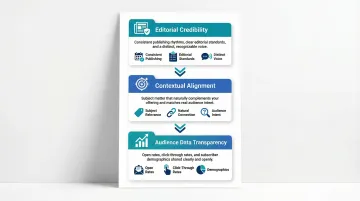
Before you commit to a placement, evaluate each newsletter across three dimensions:
- Editorial credibility — consistent publishing schedules, clear editorial standards, and a distinct point of view signal a publication readers actually trust. That trust transfers to the brands they see advertised there.
- Contextual alignment — the newsletter's subject matter should connect naturally to what you offer. A finance brand appearing in a geopolitics newsletter reaches readers already tracking global economic shifts, not a general lifestyle digest.
- Audience data transparency — a credible partner will share open rates, click-through rates, and subscriber demographics without hesitation.
On performance data: treat open rates with caution. Mailchimp's 2023 benchmarks put the average open rate at 35.63% and average CTR at 2.62%, but open rates are inflated by Apple's Mail Privacy Protection, which preloads tracking pixels regardless of whether the reader engaged. Click-based metrics are the more reliable signal.
Key questions to ask publishers:
- What is the average click-through rate for sponsored placements?
- Can you share audience demographic data (job titles, industries, geography)?
- What is your editorial verification process?
- How do you define and maintain subscriber quality?
Best Practices for Creating Effective Newsletter Ads
Ads that clash with the surrounding editorial content consistently underperform. Before building creative, study the newsletter's writing style, visual language, and reader expectations — then match them deliberately.
Keep the copy tight and the CTA singular. The ad has limited space and the reader's attention is finite. A single, clear call-to-action (visit this page, download this report, claim this offer) consistently outperforms ads that try to communicate multiple messages. Link to a dedicated landing page, not a homepage.
Use high-quality visuals that load correctly across email clients. Email has technical constraints that don't apply to web ads:
- No JavaScript or iFrames: Email clients block these for security reasons
- Limited CSS support: Use inline styles, not external stylesheets
- Table-based layouts: Most emails still rely on HTML tables for cross-client compatibility
- GIF limitations: Outlook displays only the first frame of animated GIFs
Test your creative across Gmail, Outlook, Apple Mail, and mobile before sending. Use email testing tools to validate rendering.
Once the creative is technically sound, the next priority is transparency. Label sponsored content clearly as required by FTC guidelines and most publishing agreements. Use terms like "Advertisement," "Sponsored," or "Paid Content" — not ambiguous language like "Promoted." Readers who know what they're looking at, and find it relevant, are more likely to engage.
Build a landing page that continues the promise of the ad. The landing page should directly reflect the ad's message, not drop readers on a general homepage. This is called message match — the headline and offer on the page should echo the headline and offer in the ad. If your ad promises "5 Strategies to Reduce Cloud Costs," the landing page headline should reference those same 5 strategies, not pivot to a generic product overview.
How to Measure Newsletter Ad Performance
Three metrics do most of the work when evaluating newsletter ad performance:
- Click-through rate (CTR): Direct engagement with the ad
- Conversion rate: Actions taken on the landing page (form fills, purchases, sign-ups)
- Cost per acquisition (CPA): Total spend divided by conversions
Important limitation: Open rate is no longer a reliable metric. Apple's Mail Privacy Protection, launched in 2021, preloads tracking pixels regardless of whether the recipient actually opens the email. Over 50% of email opens now happen on devices with Apple MPP activated, which artificially inflates reported open rates. Focus on clicks and conversions — MPP doesn't affect either.
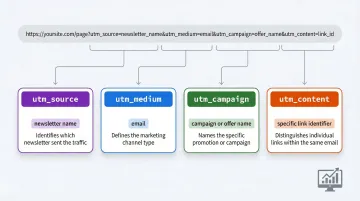
Use UTM parameter tagging as the baseline practice for tracking clicks from newsletter ads into your own analytics. Without this, there's no way to attribute traffic or conversions back to the newsletter placement.
UTM parameter structure:
https://yourdomain.com/landing-page?utm_source=newsletter-name&utm_medium=email&utm_campaign=spring-sale&utm_content=top-link
| Parameter | Purpose | Example |
|---|---|---|
utm_source |
Identifies the newsletter or publisher | presidentialsummary, morningbrew |
utm_medium |
The marketing channel | email |
utm_campaign |
The specific campaign or offer | spring-sale, product-launch |
utm_content |
Differentiates multiple links in the same ad | top-link, button-cta |
Use lowercase, consistent naming conventions to prevent data fragmentation in Google Analytics.
With tracking in place, evaluating results becomes straightforward. Compare your CTR against the benchmarks you requested during partner selection, then assess traffic quality — time on site, bounce rate, and conversion rate — not just volume. Also factor in brand awareness: placements that don't convert immediately still contribute to longer-term brand recall.
Frequently Asked Questions
What is the difference between email marketing and email newsletter advertising?
Email marketing uses your own subscriber list to communicate with existing contacts. Email newsletter advertising involves paying to place content inside another publisher's newsletter, reaching a new, opted-in audience that trusts the publication.
Are email newsletter ads affected by ad blockers?
No. Unlike web and social media ads, newsletter ads are delivered inside the email itself and cannot be blocked by browser-based ad blockers. This is one of the key reach advantages of the channel.
How much does it cost to advertise in an email newsletter?
Pricing varies based on list size, audience niche, and placement type. Common models include CPM, flat-fee sponsorships, and CPC. Premium niche newsletters — finance and B2B especially — typically charge £60–£135 CPM, while broader audiences range from £25–£55 CPM.
What types of ads perform best in email newsletters?
Native and sponsored content formats see the highest engagement because they blend with editorial content. Display ads suit visual brand awareness campaigns. Match the format to your goal — conversion-focused campaigns lean native; awareness campaigns lean display.
How do I know if a newsletter audience is a good fit for my brand?
Ask publishers for audience demographic data, average open and click-through rates, and editorial topic alignment. Prioritize relevance and engagement quality over raw subscriber count. A smaller, highly engaged list of decision-makers beats a large, passive general audience.
Can small or mid-sized brands benefit from newsletter advertising, or is it only for large advertisers?
Newsletter advertising is scalable and accessible across budget levels. Flat-fee sponsorships offer predictable costs, and niche newsletters deliver targeted reach without the spend that programmatic or paid social demands. Many smaller brands find stronger ROI here than in traditional digital channels.