

Introduction
Most sponsored content campaigns don't fail because the creative was bad. They fail because the message landed in front of the wrong people.
Brands today aren't just competing for impressions — they're competing for attention from readers who are genuinely likely to care, act, or buy. Yet a surprising amount of sponsored content budget gets spent broadcasting to audiences that were never qualified.
Fixing that starts with understanding how targeting actually works. This guide covers how audience targeting operates in sponsored content, the main targeting types available, why newsletter audiences behave differently from social and display, and what smarter placement decisions look like.
Key Takeaways
- Sponsored content targeting places branded editorial in front of pre-defined readers, not a general population
- Five core targeting types matter most: demographic, psychographic, behavioral, contextual, and interest-based
- Newsletter subscribers are self-selected, opt-in audiences with verified intent before you spend a dollar
- IAB Europe data shows 81% of consumers prefer ads that match the content they're already reading
- Audience quality — not raw size — determines whether sponsored content actually converts
What Is Sponsored Content Audience Targeting?
Sponsored content audience targeting is the practice of placing branded editorial content in front of a specific, predefined group of readers. That group is defined by who they are, what they read, and how they behave — not chosen at random from an unqualified pool.
Two terms often get conflated here, and the distinction matters:
- Target market — the full universe of people who could potentially buy from a brand
- Target audience — the specific, narrower group a particular ad or sponsored piece directly addresses
For sponsored content decisions, you're working at the target audience level. You're not asking "who might ever buy from us?" You're asking "who is reading this publication right now, and do they match the buyer we need in front of this message?"
How This Differs From Display Advertising
Banner and display advertising interrupts a browsing session the reader never chose to begin. Sponsored content sits alongside editorial content the reader actively sought out. That shift in context changes the reader's receptivity — trust built by the editorial environment carries over to the sponsored placement beside it.
When a reader opens a newsletter covering international business policy, they're already in a focused, high-attention mental state. A sponsored placement in that environment benefits from that attention, which a banner ad on a general content page cannot match.
The Main Types of Audience Targeting in Sponsored Content
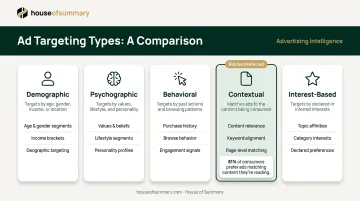
Most targeting strategies combine several of these approaches rather than relying on a single method.
Demographic Targeting
Demographic targeting covers the basics: age, income level, profession, geographic location, education. It's foundational, but insufficient on its own. Knowing a reader is between 35–55 with a household income above $150,000 says nothing about their mindset, interests, or proximity to a purchase decision.
Psychographic Targeting
Psychographic targeting goes deeper, matching readers based on values, interests, lifestyle, and worldview. For long-form editorial content, this alignment is especially powerful.
A reader who actively follows geopolitical developments and international business news brings a worldview that makes them genuinely receptive to certain categories of brand messaging — not just demographically adjacent to them.
Behavioral Targeting
Past actions reveal intent. Pages visited, content clicked, purchase history, and subscription choices all signal what a reader cares about. In newsletter advertising, the subscription behavior itself is one of the cleanest behavioral signals available — a reader who chose a specialized newsletter on UAE business or global politics has already self-identified as high-relevance.
Contextual Targeting
Contextual targeting matches the sponsored content to its editorial environment. A finance brand appearing in a geopolitics newsletter read by executives achieves something precise: the message lands while the reader is already in a professional, analytical mindset.
IAB Europe reports that 81% of consumers prefer ads that match the content they're reading, and a Seedtag/Nielsen study found contextual targeting boosted consumer interest in ads by 32%. Those numbers reflect a real mechanism: relevance at the moment of reading drives response.
Interest-Based and Niche Audience Targeting
Specialized publications — newsletters covering specific topics like global affairs, international politics, or regional business — deliver pre-aggregated niche audiences. For advertisers, this eliminates the guesswork of building segments from scratch on ad platforms. The audience has already self-selected around a shared interest.
Key advantages of niche newsletter audiences include:
- Pre-qualified intent — readers chose the topic, not an algorithm
- Consistent engagement — subscriber open rates outperform broad display channels
- Reduced targeting overhead — no need to build custom segments from scratch
- Editorial alignment — brand message lands in a contextually relevant environment
Why Newsletter Audiences Are Different From Social and Display
The fundamental difference comes down to one word: choice.
The Self-Selection Advantage
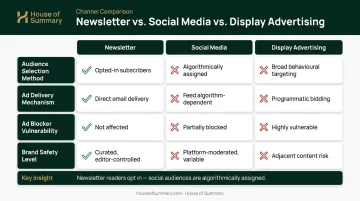
Newsletter subscribers opted in. They raised their hand for a specific type of content, which means their interests and intent are already verified before an advertiser places a single dollar. Social media audiences, by contrast, are algorithmically assigned — the platform decides who fits a targeting category, not the reader.
This distinction matters enormously for sponsored content. Self-selection produces audiences with genuine alignment. Algorithmic assignment produces audiences with estimated alignment.
The Inbox Environment
Email inboxes are personal, low-distraction reading environments. DMA's 2023 Consumer Email Tracker reports an average email dwell time of 11 seconds, with 68% of readers scrolling past the initial view — attention metrics display advertising rarely matches.
That depth of engagement matters for sponsored content. A message that needs more than a split second to land performs far better in an inbox than in a social feed competing with dozens of other stimuli.
Direct Delivery: No Algorithms, No Ad Blockers
That inbox attention comes with another structural advantage: newsletter sponsored content reaches the reader directly. No platform algorithm decides to deprioritize it. No bidding war determines whether it appears. Ad blockers, which Blockthrough/PageFair reports now affect 912 million active users worldwide, don't apply to email.
House of Summary communicates this to media buyers directly: "Web ads get blocked. Social ads get ignored. Ours don't." The inbox provides "a direct path to the reader. No algorithms, no ad blockers, no visual clutter. Just undivided attention."
Brand Safety Through Editorial Standards
Sponsored content in a premium newsletter carries the credibility of the editorial brand. When readers trust a publication's accuracy and editorial judgment, some of that trust extends to the brands appearing within it.
House of Summary's editorial standards — human-written reporting, pre-publication source verification, and a no-sensationalism policy — give advertisers something programmatic placements rarely offer: a predictable, fact-checked environment. When programmatic buys routinely surface brand messages next to unreliable or inflammatory content, appearing inside a verified editorial product is a meaningful protection.
How Brands Choose the Right Newsletter for Sponsored Content
Match Audience to Publication, Not Just Category
The first question isn't "what topic does this newsletter cover?" It's "who actually reads it, and do they match our buyer?"
A finance brand sponsoring a geopolitics newsletter read by C-suite executives and policy professionals achieves qualified reach. The same brand buying display ads targeted at a generic "finance interest" segment on a programmatic platform gets breadth without depth.
House of Summary's network — covering global news (Presidential Summary), international politics (Geopolitical Summary), UAE business (Dubai Summary), and UK city life (London Summary) — reaches 500,000+ subscribers with 254,866+ emails opened daily. The reader base skews toward decision-makers and executives, concentrated in New York, Los Angeles, London, and Dubai. That geographic and professional concentration is what makes it valuable for specific advertiser categories, not raw subscriber count alone.
Editorial Tone and Brand Fit
The newsletter's voice must be compatible with the brand's image. Sponsored content appearing in an editorial environment that contradicts a brand's positioning creates friction — the message feels out of place rather than natural.
Editorial fit is also a protection mechanism. House of Summary enforces strict advertiser category restrictions: prohibited categories include gambling, sensationalist content, and political campaigns. These restrictions protect the editorial environment that makes the audience valuable to premium advertisers.
Audience Size vs. Audience Quality
A smaller newsletter with 50,000 deeply engaged subscribers in international business may outperform a mass-market platform with millions of loosely defined impressions. But that comparison only holds when you have publisher-specific data to back it up.
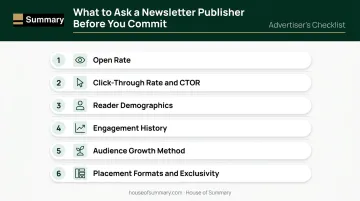
When evaluating any newsletter opportunity, ask for:
- Average open rate (and whether Apple Mail Privacy Protection affects their measurement)
- Click-through rate and click-to-open rate (CTOR)
- Reader demographics: job function, geography, income range
- Engagement history for comparable advertisers
- How the audience was built (organic opt-in vs. incentivized growth)
- Available placement formats and exclusivity options
House of Summary provides advertisers with geographic distribution data (66% US, 18% UAE, 10% UK), gender demographics, monthly ad click data, and subscriber growth trends — all accessible through their analytics portal before you commit to a campaign.
How to Measure Whether Your Sponsored Content Reached the Right Readers
Primary Metrics to Track
| Metric | What It Signals |
|---|---|
| Open rate | Directional reach indicator (treat cautiously post-Apple MPP) |
| Click-through rate (CTR) | Reader action and content relevance |
| Click-to-open rate (CTOR) | Engagement quality among those who opened |
| Time on content | Depth of attention for long-form placements |
| Conversion rate | Downstream action from qualified readers |
Campaign Monitor benchmarks email CTR at 2.3% with an optimal range of 1%–5% depending on industry. Use these as orientation points, not targets — publisher-specific historical performance is more meaningful than industry averages.
Beyond Clicks — Measuring Intent Signals
High-quality targeting produces quality traffic, not just volume. After a sponsored content placement, track:
- Form fills and content downloads
- Product or service page visits from referred traffic
- Return visits from the same source
- Sales inquiries mentioning the publication
- Pipeline quality from attributed leads
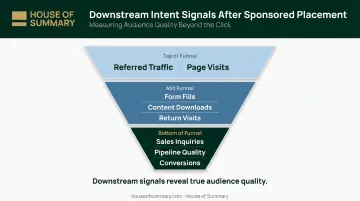
These downstream signals reveal whether the sponsored content reached readers with genuine purchase intent — which is the actual goal of audience targeting, not click volume.
Iteration and Refinement
Once those signals are in, the work shifts from measurement to refinement. The first placement is a data point, not a verdict — use it to identify which publications, formats, and message angles resonated most.
A finance brand that sees strong CTOR but low conversion may need to adjust its landing page rather than its newsletter placement. A brand seeing low CTOR despite high opens may need to reconsider whether the audience-editorial alignment was as strong as assumed.
Frequently Asked Questions
What are the 7 types of audiences?
The commonly referenced framework covers seven types: demographic (age, income, location), psychographic (values, lifestyle), behavioral (past actions), geographic (regional location), contextual (content environment), interest-based (topic affinity), and intent-based (active purchase signals). This is a teaching framework — IAB Tech Lab's actual audience taxonomy spans more than 1,600 standardized attributes.
What is audience targeting in sponsored content?
It's the process of placing branded editorial specifically in front of a pre-defined reader group based on shared characteristics — demographics, interests, context, or behavior — rather than distributing it to an unqualified general audience. The goal is relevance, not reach.
How is newsletter audience targeting different from social media targeting?
Newsletters reach self-selected, opt-in audiences in distraction-minimized inbox environments. Social media targeting relies on algorithmic matching that can be undermined by ad fatigue, feed competition, and platform-side changes. Newsletter readers opted in; social audiences were placed there by an algorithm.
What makes a newsletter audience valuable for advertisers?
High intent, editorial trust, focused reading attention, and active subscription choice. Readers who chose a specific newsletter have already signaled their interests, making them far more receptive to relevant sponsored content than a broadly defined programmatic audience.
How do brands measure sponsored content campaign success?
Track open rate, CTR, and CTOR as primary metrics — but the real measure of targeting success is downstream behavior: form fills, product page visits, sales inquiries, and conversion quality. A hundred high-quality clicks that convert outperform a thousand that bounce.
How do I choose the right newsletter for my sponsored content?
Prioritize audience-editorial alignment over raw size. Ask publishers for reader demographics, geographic distribution, engagement benchmarks, and historical performance data for comparable advertisers. Niche alignment beats scale for most sponsored content goals.