These aren't passive scrollers. They actively filter out anything that feels promotional. They use ad blockers, skip pre-roll ads within seconds, and have developed an almost automatic immunity to banner advertising. Interrupting their attention doesn't work. Earning it does.
That's the core argument for branded content: it reaches premium readers not by forcing its way in front of them, but by delivering genuine value in contexts they already trust. This article covers why conventional ads fail with this audience, how branded content works psychologically, which channels actually reach high-intent readers, and how to build a strategy that performs where traditional advertising falls short.
Key Takeaways
- Conventional ads fail with premium audiences: they're blocked, filtered, or ignored before the message lands
- Branded content earns attention by delivering value; trust transfers from the editorial source to the brand
- The Forbes/IPG/Newhouse study found branded content produced brand recall 59 percentage points higher than display ads
- Newsletter environments bypass ad blockers and deliver branded content with undivided reader attention
- Measure success through engagement depth — read-through rates, CTR, brand search lift — not raw impressions
Why Premium Audiences Are Impossible to Reach Through Conventional Advertising
A premium audience isn't just defined by income. These are readers who actively seek information, hold real purchasing or strategic authority, and invest time in content that serves their professional needs. They read with purpose — not to be entertained, but to stay informed and make better decisions.
That's precisely why conventional advertising fails with this group in ways volume and spend can't fix.
The Ad Blocker Problem
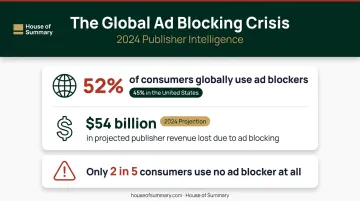
According to January 2024 YouGov data cited by EMARKETER, 52% of consumers across 48 global markets had installed or used an ad blocker. In the US, that figure sits at 45%. YouGov frames the same data from the other direction: only two in five consumers use no ad blocker or anti-tracking service at all.
The scale of this is significant. eyeo's 2023 Ad-Filtering Report forecast that publishers would lose $54 billion in ad revenue to ad blocking in 2024 — roughly 8% of total global ad spend. That's not a minor inefficiency; it's a structural degradation of web display reach.
Tech-savvy, high-income professionals are disproportionately represented in that ad-blocking population. The very audience brands most want to reach is the most likely to have removed conventional ads from their media diet entirely.
The Attention Problem
Even when ads get delivered, they frequently go unseen. Lumen Research data shows that only 30% of viewable ads are actually seen — meaning viewability and human attention are two very different things.
Premium readers don't just block ads technically. They filter them cognitively. Years of exposure to digital advertising has trained high-intent readers to visually skip anything that resembles a banner or pre-roll format. The ad appears in the viewport; the reader registers nothing.
Volume-based logic doesn't fix this. More impressions against a disengaged audience produce more ignored placements — and reaching premium readers requires a fundamentally different approach to earning attention in the first place.
What Branded Content Is — and What It Isn't
Branded content is often confused with adjacent formats, but the distinction matters for strategy.
Branded content centers on a brand's values, perspective, and story — not its products — and is designed to inform, educate, or entertain. Readers choose to engage with it; it doesn't interrupt them to demand attention.
Here's how it differs from related formats:
| Format | Core purpose | Product focus |
|---|---|---|
| Branded content | Build identity, trust, emotional connection | Minimal or absent |
| Native advertising | Mimic editorial form for a promotional message | Present — drives toward product |
| Content marketing | Solve a specific reader problem tied to product use | Moderate — addresses use cases |
| Product placement | Embed product visibility in entertainment context | High — product is the point |
Branded content can take many forms — editorial partnerships, sponsored newsletters, documentary-style video, podcasts, events, and interactive experiences. The format should follow the audience, not the brand's convenience. Premium readers have finite attention; meeting them where they already focus is the starting point.
Wherever branded content appears, disclosure is required. The FTC's guidance on native advertising is unambiguous: commercial relationships must be transparently labeled. "Sponsored" or "Paid Advertisement" labels are mandatory when a reasonable reader might otherwise mistake branded content for independent editorial.
Why Premium Readers Respond to Branded Content
The Trust Transfer Effect
When a credible publication presents branded content, readers transfer their trust in that source to the brand. This isn't just a theory — it's measurable.
A study by Forbes, IPG Media Lab, and Syracuse University's Newhouse School across more than 4,000 readers found that branded content outperformed display advertising across every key metric:
- Brand recall: 59 percentage points higher than display ads
- Purchase consideration: up 9 points after a single exposure
- Brand favorability: up 7 points
- Content seeking: readers were 14% more likely to seek out additional brand content
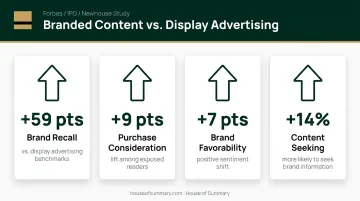
The mechanism? Readers perceived branded content as educational rather than promotional — which lowered resistance and increased retention.
Opt-In Attention Changes the Psychology
Premium audiences read by choice, not by accident. When branded content appears in a context they actively sought — a curated newsletter, a trusted publication — their cognitive filters aren't active the way they are during an unwanted ad interruption.
This is the fundamental difference between earned attention and coerced attention. Intrusive formats force the reader into a transaction: tolerate the interruption, or skip. Branded content in a trusted editorial context doesn't trigger that reflex. The reader is already open.
Shelf Life and Long Consideration Cycles
Unlike a promotional ad that expires with the campaign, branded content continues building familiarity and positive association over time. For premium audiences — who often have extended consideration cycles before making high-value decisions — this matters.
The 3-7-27 rule captures the pattern well: roughly 3 exposures to notice a brand, 7 to remember it, 27 to trust it enough to consider purchasing. Mere-exposure research backs this up — repeated, attentive contact improves evaluation. One-off ad placements don't get near these thresholds. Regular placement in a trusted publication does.
The Best Channels for Reaching Premium Audiences With Branded Content
Content quality alone doesn't determine branded content performance. The channel matters just as much. A well-crafted story placed in a low-trust, algorithmically driven environment will consistently underperform the same story delivered through a high-trust, opted-in channel.
Why Email Newsletters Are the Standout Channel
The inbox is an ad-blocker-resistant, algorithm-free environment where the reader has explicitly opted in to receive curated content. There's no competing visual clutter, no autoplay video fighting for attention. The reader chose to be there.
Mailchimp's December 2023 benchmark data shows all-industry email open rates of 35.63% with click rates of 2.62%. Business and Finance newsletters specifically averaged 31.35% open rates and 2.78% click rates — strong performance relative to any web display benchmark, where Lumen's data shows only 30% of viewable ads receive actual human attention.
This gap reflects something structural, not incidental. Newsletter readers opened that email on purpose — they're not scrolling past it, they're reading it.
House of Summary as a Premium Newsletter Environment
House of Summary is a network of specialized newsletters — Presidential Summary, Geopolitical Summary, Dubai Summary, and London Summary — built for high-intent, serious readers. The combined network reaches 500,000+ subscribers, with 254,866+ emails opened daily and 66% of readership concentrated in the US (New York and Los Angeles), plus significant audiences in London and Dubai.
The reader profile is executive-level: decision-makers, policy professionals, founders, and high-net-worth individuals. These are not casual news consumers. They read because their work requires it.
Advertisers access this audience directly in the inbox, with branded content integrated into the editorial flow. BSH Hausgeräte, one named advertiser, reported click-through rates 4x higher than their Google AdWords campaigns when running in Dubai Summary. That result reflects a real difference in how newsletter readers engage compared to web display traffic.
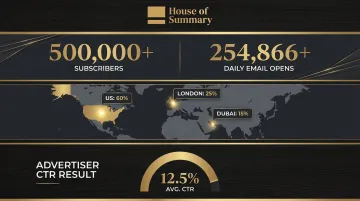
Campaigns are available as single-newsletter placements, multi-newsletter packages, or full-network takeovers, with formats ranging from native ads and sponsored content to full-issue exclusives.
Other High-Trust Branded Content Channels
Newsletters aren't the only option, but they share key traits with other effective channels for premium audiences:
- Placements in niche editorial outlets (FT, specialist vertical media) where readers arrive with high intent and editorial credibility is established
- Branded integrations in professional podcasts, where host trust carries over to sponsors in a way banner ads never achieve
- Thought-leadership features in B2B vertical media, targeting readers who actively seek expertise
The selection principle is consistent: choose channels with an opted-in audience, a high-trust editorial environment, and limited advertising competition. Reach volume is not the goal — precise, receptive reach is.
Building a Branded Content Strategy for High-Intent Readers
Start With Audience Clarity
Branded content aimed at premium readers fails when brands treat it like a mass campaign. Before writing a word, understand the specific professional context, information needs, and values of the target reader.
The 2024 Edelman-LinkedIn B2B Thought Leadership Impact Report makes the stakes concrete:
- 75% of decision-makers researched a product or service after consuming thought leadership
- 60% of buyers were willing to pay a premium for demonstrated expertise
- Only 15% rated the thought leadership they consume as excellent
- Half of organizations admitted their efforts were under-resourced
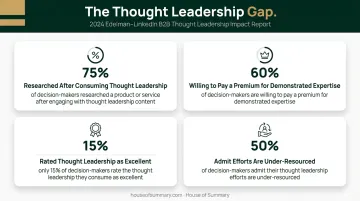
The implication: premium audiences want substantive content that reduces their decision risk. Generic promotional articles don't qualify.
Match Content to Editorial Environment
Branded content must feel consistent with the editorial context it lives in. For a finance-focused newsletter audience, that means factual, clear, and substantive — not lifestyle-vague or promotional in tone. Brands that respect the reader's time earn a disproportionate share of attention.
Format is just as consequential. For premium audiences, long-form editorial analysis, concise expert commentary, and curated briefings consistently outperform entertainment-heavy or video-first formats. The rule: match the format to how your specific reader actually consumes information — not to what's easiest to produce.
Consistency Is Not Optional
A single branded content placement builds minimal familiarity. Sustained presence in a trusted editorial environment compounds over time — each exposure builds on the last, creating the recognition and trust that drives action among audiences with long consideration cycles.
The 3-7-27 heuristic puts this in practical terms: if 27 exposures are needed before a premium reader trusts a brand enough to act, a single placement isn't a strategy — it's a test run with no follow-through.
Measuring Whether Branded Content Is Reaching the Right Premium Audience
Vanity metrics mislead branded content campaigns. A smaller number of deeply engaged, high-intent readers is worth more than a large number of passive impressions.
Metrics that actually reflect branded content performance with premium audiences:
- Read-through rate and dwell time measures genuine engagement, not just delivery
- Click-through rate on calls to action is the clearest signal that readers acted with intent, not by accident
- Direct traffic and brand search lift confirms readers actively sought the brand out after seeing the content
- Subscriber-level engagement in newsletter contexts reveals whether the same readers are coming back consistently
For longer campaigns focused on awareness and trust rather than immediate conversion, brand lift studies measure ROI more accurately. Both Meta and Google define brand lift as the measurable difference in brand perception between exposed and control groups — tracking recall, favorability, and purchase consideration over time, not just short-term clicks.
The IAB/MRC Attention Measurement Guidelines (November 2025) reinforce this approach. They define attention across four dimensions:
- Exposure — was the content seen?
- Engagement — did the reader interact with it?
- Focus — did it hold their attention?
- Cognitive impact — did it register mentally?
Critically, the guidelines emphasize measuring attention at the person level, not the device or impression level.
Frequently Asked Questions
What is the 3-7-27 rule in branding?
The 3-7-27 rule is a practitioner heuristic: 3 exposures to notice a brand, 7 to remember it, 27 to trust it enough to consider purchasing. It's directionally consistent with mere-exposure research and explains why sustained branded content in a consistent editorial environment outperforms scattered one-off placements.
Why is branded content more effective than traditional ads for premium audiences?
Premium audiences have developed strong resistance to interruptive advertising through both ad blockers and cognitive filtering. Branded content bypasses that resistance by delivering genuine value within contexts readers already trust — making it far more likely to be read, remembered, and acted on than a banner or pre-roll format.
What makes an audience "premium" in the context of branded content?
A premium audience is defined by intent, not just demographics. These readers actively seek information, hold real decision-making authority, and engage deeply with curated content — making their attention qualitatively different from casual consumer reach.
How is branded content different from native advertising?
Native advertising mimics editorial format but remains fundamentally promotional and product-focused. Branded content centers on the brand's story, values, and perspective — without necessarily referencing products at all. It functions more like journalism or editorial content than advertising, which is why it performs differently with skeptical, high-intent readers.
How do you measure the ROI of branded content aimed at premium readers?
The strongest ROI signals are engagement depth (read-through rates, dwell time, CTR), direct brand search lift after exposure, and — for longer campaigns — brand lift studies tracking shifts in awareness and perception. Impression counts alone don't reflect the quality of attention premium audiences deliver.
What types of brands benefit most from branded content in newsletter environments?
Brands with longer consideration cycles, complex offerings, or premium positioning — finance, luxury, professional services, B2B, healthcare — benefit most. Newsletter audiences are high-intent readers who take time with purchasing decisions and respond to substantive, credibility-building content rather than quick promotional messages.