
Yet healthcare brands still need to reach patients, caregivers, and healthcare professionals (HCPs). That tension — between the need to promote and the audience's distrust of promotion — is exactly where branded content earns its place.
Branded content doesn't interrupt. It informs. And in healthcare, that distinction changes everything.
This article covers what branded content actually means in a healthcare context, why it outperforms traditional advertising for engagement, which formats work best, how to create it compliantly, and where to distribute it effectively.
Key Takeaways
- Branded content combines a brand's identity with useful information — it promotes without feeling like an ad
- Trust is healthcare's highest-value asset, and branded content builds it in ways display ads cannot
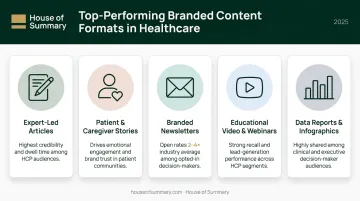
- The formats that drive the highest engagement include patient stories, expert-led articles, branded newsletters, educational video, and data-driven infographics
- HIPAA, FDA, and FTC compliance shapes how healthcare content is created — and the strongest brands treat these rules as a creative framework, not a barrier
- Distribution channel matters as much as content quality; inbox-based channels like newsletters deliver opted-in, algorithm-free audiences
What Is Branded Content in Healthcare?
Branded content sits between a full advertisement and a neutral educational piece. It carries the brand's identity and commercial intent — but it leads with information the audience actually wants.
That might look like:
- A sponsored article co-authored by a clinician, published under the brand's name
- A patient story produced by a pharmaceutical company with proper consent
- An expert interview series published in a brand's newsletter
- A disease education guide that mentions the brand's role naturally at the end
This distinguishes branded content from unbranded content (disease awareness campaigns with no brand mention) and from traditional advertising (which leads with a product claim and asks for an immediate response). That distinction has real consequences in healthcare — where the credibility of the source shapes whether the audience acts on the information at all.
Why the Distinction Matters in Healthcare
Healthcare audiences — patients, caregivers, and HCPs — make high-stakes decisions. They're not choosing between two shampoos. They're evaluating treatments, managing chronic conditions, or advising patients on prescribing decisions.
Audiences in this space evaluate who is behind the information before they consider acting on it. A brand that leads with education — rather than a product claim — signals that it understands the patient's situation, not just the sales opportunity. That's what moves a skeptical HCP or caregiver from passive reader to engaged prospect.
Why Healthcare Branded Content Drives More Engagement Than Traditional Ads
The Attention Problem
Digital advertising in healthcare faces the same structural challenges as every other industry — banner blindness, ad blockers, and declining click engagement — but the trust deficit makes it worse.
According to the 2024 Edelman Trust and Health report:
- 83% of people trusted their primary care provider as a source of health information
- Product advertisements ranked as the top source of health misinformation
- US trust in healthcare companies sat at just 49%
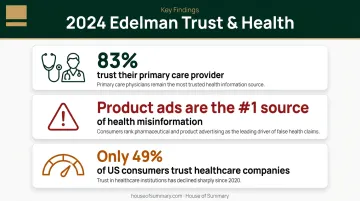
That's the baseline skepticism a healthcare ad is fighting. A display ad or a product-first promotional message lands in an environment where less than half the audience already trusts the category.
Branded Content Meets Audiences at Intent
That trust gap extends to clinicians, too. HCPs actively seek clinical information online — mobile medical reference apps have become a primary channel for prescribing decisions, according to Epocrates' 2025 HCP Engagement Report, which surveyed 1,001 physicians and 202 HCPs.
Branded content designed to answer real clinical or patient questions meets this audience at the point of intent. A traditional display ad interrupts them — and in a low-trust environment, interruption rarely converts.
Emotional Resonance Drives Recall
Healthcare decisions are personal. A patient deciding whether to pursue a treatment option, or a caregiver navigating a diagnosis for a family member, is not in an emotionally neutral state.
Branded content that uses patient stories, caregiver perspectives, or clinician expertise creates emotional connections that increase time-on-page, sharing behavior, and brand recall well beyond what a standard ad produces. Research on health narratives confirms that experience-based storytelling supports health communication by helping audiences process health decisions — a direct engagement advantage.
Long-Term Equity vs. Short-Term Impressions
A paid impression is gone the moment the page scrolls. A well-crafted branded article gets bookmarked, shared with a colleague, or cited in a clinical conversation. Consistent branded content compounds — each piece that gets shared, saved, or referenced adds to a body of work that no single ad campaign can replicate.
Content Formats That Generate the Highest Engagement
Expert-Led Articles and Sponsored Editorial
Long-form pieces authored or co-authored by medical professionals — published under the brand's name in credible environments — combine authority with visibility. According to eHealthcare Solutions' HCP media benchmarks, HCP articles average 45–90 seconds of time-in-content, with high-performing campaigns exceeding 120 seconds and scroll depths of 60–75%.
For pharmaceutical, medical device, and health technology brands targeting HCPs, this format is particularly effective. The clinician's name carries credibility; the brand's sponsorship creates association with that credibility.
Patient and Caregiver Stories
First-person narratives drive the highest emotional engagement in healthcare content. A patient describing their experience with a chronic condition — told honestly and with clinical accuracy — creates the kind of human connection that no product description achieves.
Handle carefully:
- Obtain explicit written consent before using any patient's story
- De-identify health information where required under HIPAA
- Avoid disclosing protected health information (PHI) in any campaign materials
Done correctly, patient stories build trust at a human level and produce content that readers genuinely share.
Branded Newsletters
Newsletters are among the most effective branded content vehicles in healthcare for a straightforward reason: the reader opted in. Unlike display ads or social posts, newsletter content reaches a reader who actively chose to receive it — in an environment free from competing distractions.
Campaign Monitor's healthcare email benchmarks reported 23.7% open rates and a 13.4% click-to-open rate for healthcare services — meaningfully above general digital advertising engagement. That's an audience actively reading, not passively scrolling past.
Educational Video and Webinars
When the goal is active participation rather than passive consumption, video and webinars consistently outperform static formats. Clinical expert interviews, product demonstrations, and patient journey narratives all translate well on screen — and webinars add real-time Q&A that static content simply can't replicate.
A peer-reviewed study of health professional webinars recorded 3,607 enrolled participants, with the highest attendance concentrated in clinical emergency management sessions. HCPs show up when the content speaks directly to what they face in practice.
Data-Driven Reports and Infographics
Healthcare audiences respond to verified data. Original research, clinical outcome summaries, or survey findings formatted as branded infographics or downloadable reports position the brand as a credible source — and generate backlinks and citations that extend reach organically.
Formats that perform well in this category:
- Branded clinical outcome summaries (downloadable PDF or landing page)
- Survey-based "State of [condition/specialty]" annual reports
- Infographics translating complex trial data for broader audiences
- Comparative data visualizations tied to treatment decisions
How to Create Branded Healthcare Content That Builds Trust
Start With the Audience, Not the Product
Healthcare brands that lead with product messaging lose audiences before the second paragraph. Start by mapping what each audience actually needs:
- Patients — surface their core fears, unanswered questions, and information gaps around their condition or treatment
- HCPs — identify clinical gaps, workflow friction points, or emerging evidence they'd want to act on
- Caregivers — offer practical guidance, emotional support resources, and clear decision-making frameworks
The content strategy follows from the audience, not from the product roadmap.
Build Credibility Through Expert Involvement
Edelman's data is unambiguous: 83% of people trust primary care providers as their most credible health information source. Content co-created with or reviewed by licensed clinicians, researchers, or subject matter experts borrows that trust.
That credibility has measurable criteria. The NIH's guidance on evaluating online health information advises readers to check who wrote and reviewed the content, whether it's grounded in scientific evidence, and whether it's current. Branded content that satisfies those criteria earns engagement. Content that doesn't, audiences will dismiss.
Navigate Compliance Without Killing Creativity
Three regulatory frameworks govern healthcare branded content in the US:
| Framework | What It Governs |
|---|---|
| HIPAA | Patient privacy — requires authorization before using PHI for marketing purposes |
| FDA | Drug and device claims — requires balanced risk/benefit presentation |
| FTC | Disclosure — requires clear, conspicuous disclosure of sponsored content |
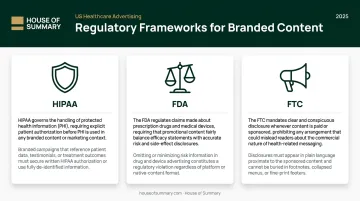
Skilled healthcare brands build these frameworks into their content process from day one, not as an afterthought checklist. The FTC's standard is direct: disclosures must be "hard to miss and use simple language." A brief, natural disclosure at the top of a sponsored article satisfies this without disrupting the reading experience.
Lead With Information, Close With Brand
The structure that works in healthcare branded content:
- Open with a genuine insight or problem the audience recognizes
- Develop with credible, expert-backed information
- Introduce the brand's role at the point where it's most relevant — not at the opening
A pharmaceutical brand sponsoring an article on managing treatment adherence earns the right to mention its product after delivering real clinical value — not before.
Where to Distribute Healthcare Branded Content
Owned Channels
Website, blog, and email list give full control over messaging and audience data. The limitation is reach — owned channels only access the existing audience, making them better for nurturing than for acquisition.
Social Platforms
LinkedIn works for HCP audiences; Facebook and Instagram serve patient communities. Both require either organic reach (inconsistent and declining on most platforms) or paid amplification. Algorithm-driven distribution means branded content competes for visibility in an environment where engagement rates are unpredictable.
Specialized Newsletter Networks
Newsletter advertising reaches opted-in readers directly in the inbox, bypassing algorithm filtering, ad blockers, and visual competition from surrounding content. Readers have actively subscribed, which means attention is already present when the content arrives.
House of Summary's network of specialized newsletters delivers healthcare brand messages to decision-makers, executives, and high-income professionals. Key network stats:
- 500,000+ subscribers across specialized publications
- 254,866+ emails opened daily, providing consistent daily reach
- 66% US-based readership, concentrated in New York and Los Angeles
- Audience skews toward affluent consumers and healthcare purchasing decision-makers
For healthcare brands navigating FDA, MHRA, and platform restrictions, the editorially controlled, human-written format provides compliance-friendly placement. Sponsored content appears inline with editorial — read, not scrolled past.
Credible Third-Party Publishers
Placing branded or sponsored content in trusted healthcare publications — clinical journals, specialist HCP platforms, or health news outlets — borrows the publication's credibility. Platforms like Doximity (which reports reach across 85% of US MDs) and Medscape provide direct access to HCP audiences with sponsored content formats built for that environment.
Common Branded Content Mistakes Healthcare Marketers Make
Leading With the Product
Content that opens with a product claim or brand promotional message triggers immediate skepticism. Healthcare audiences — especially HCPs — recognize promotional intent within the first sentence and disengage. Lead with clinical insight, patient data, or a real-world outcome. The brand association follows naturally.
Ignoring Compliance Until the End
Treating HIPAA, FDA, and FTC requirements as a final review step is expensive. The FTC's action against GoodRx — which resulted in a $1.5 million civil penalty for sharing users' sensitive health information with advertising platforms — shows exactly where that approach leads. Build regulatory review into the content creation process from the first draft.
Over-Relying on Medical Jargon
Even for HCP audiences, jargon-dense content reduces engagement and shareability. The CDC recommends plain language for health communication, and both the NIH and AMA advise writing patient education materials at or below a 6th-grade reading level.
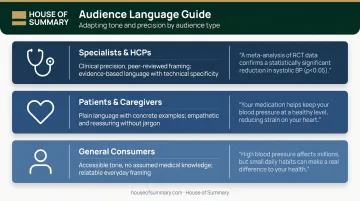
Match language to audience:
- Specialists and HCPs: clinical precision, peer-reviewed framing
- Patients and caregivers: plain language, concrete examples
- General consumers: accessible tone, no assumed medical knowledge
Frequently Asked Questions
What is branding in healthcare?
Healthcare branding refers to how an organization defines and communicates its identity, values, and promise to patients, partners, and the public. It encompasses visual identity, messaging, positioning, and the experience delivered at every touchpoint — from the waiting room to the website.
What is branded content in healthcare marketing?
Branded content in healthcare is content that carries the organization's brand identity while delivering genuine value to the audience — such as expert articles, patient stories, or educational newsletters. Unlike traditional advertising, it leads with information rather than a direct sales message.
How is branded content different from traditional healthcare advertising?
Traditional healthcare ads interrupt audiences with a promotional message. Branded content earns attention by delivering useful information or emotional resonance — which builds trust more durably than a campaign that leads with a pitch.
What types of branded content work best for healthcare brands?
Expert-led articles, patient stories, branded newsletters, educational videos, and data-driven infographics consistently drive the highest engagement. The best format depends on the target audience (patients vs. HCPs) and the specific campaign goal.
How do healthcare brands stay HIPAA compliant when creating branded content?
HIPAA compliance in branded content centers on protecting patient privacy. In practice, that means getting explicit written consent before using patient stories, de-identifying health data, and never disclosing protected health information (PHI) in any marketing material.
What channels are most effective for distributing healthcare branded content?
Opted-in channels — particularly newsletters — consistently outperform algorithm-driven social feeds for healthcare content. Owned channels nurture existing audiences, while specialized newsletter networks and credible third-party publishers offer the reach and editorial credibility that healthcare brands need.