That's the gap healthcare advertorials are built to fill. They look and read like journalism. They open with a person, not a product. And they reach readers who aren't in defense mode.
This article covers what healthcare advertorials actually are, why storytelling is their most effective trust-building mechanism, how to structure one that works, what compliance requires, and where to place it so the right people actually read it.
Key Takeaways
- Healthcare advertorials are paid content formatted like editorial journalism — narrative depth is what separates them from standard ads
- 64% of consumers trust health content from doctors and health systems (McKinsey, 2024) — advertorials borrow that credibility by matching the format readers already trust
- The most effective structure follows a human arc: real problem, honest journey, natural resolution — always brand last
- FTC disclosure is non-negotiable — and it doesn't have to undermine good storytelling
- Newsletter placements outperform other channels for healthcare advertorials: no ad blockers, no algorithms, and readers who opted in
What Healthcare Advertorials Are (and Why Regular Ads Fall Short)
An advertorial is paid content formatted to look and read like editorial or journalistic writing. The distinction matters: unlike a banner ad, PPC listing, or 30-second social clip, an advertorial uses depth, narrative structure, and an informational tone to persuade. Readers experience it as content first, promotion second.
That experience gap is why standard ad formats underperform in healthcare. When someone sees a display ad about a medical treatment or wellness product, they immediately know they're being sold something about their body. Skepticism is the default.
A 2021 BMC Public Health survey of 1,564 health consumers found 57.3% felt confused about whether health advertising was actually relevant to their needs — and only 56.5% felt confident they could judge whether health claims were scientifically grounded.
The underlying dynamic is vulnerability. People making health decisions are often scared, confused, and operating under uncertainty. They don't respond to urgency tactics. They respond to information that feels honest and was written with their situation in mind.
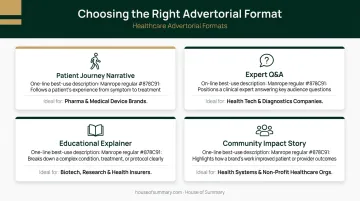
The Four Formats Healthcare Advertorials Take
Each format suits a different objective:
- Patient journey narrative: a real person's experience with a health challenge and how they found a path forward; best for direct-to-consumer (DTC) brands, wellness products, and condition-specific campaigns
- Expert Q&A: a practitioner or researcher sharing their perspective, with the brand as context; works well for clinical and B2B healthcare brands
- Educational explainer with embedded brand relevance: teaches something useful about a condition or category, then introduces the brand naturally; ideal for building category trust before asking for consideration
- Community or public health impact story: positions the brand as a contributor to broader health outcomes; suited for hospital systems, health insurers, and large pharmaceutical companies
The format that works best is whichever most directly removes the specific trust barrier standing between the audience and the brand — whether that's skepticism about efficacy, unfamiliarity with a condition, or uncertainty about whether the product is meant for someone like them.
Why Storytelling Is the Trust Engine in Healthcare Marketing
The case for storytelling in healthcare isn't intuitive. You might assume that skeptical patients want data, not narrative. The research tells a more complicated story.
Green and Brock's foundational work on transportation theory found that readers who become absorbed in a narrative — focused on its events, forming images, feeling emotion — identify fewer logical counterarguments and update their beliefs more readily. Highly transported readers flagged far fewer "false notes" in a story than less-transported readers (M = 4.13 vs. M = 10.52). They weren't less intelligent; they were less defensive.
For healthcare brands, lower defensiveness is the whole game.
What Stories Actually Dissolve
Generic brand messaging bounces off four trust barriers that healthcare brands consistently face:
- Fear of the unknown: A story that names the fear and follows someone through it makes the unknown feel survivable
- Skepticism of corporate health claims: A patient speaking in their own voice carries credibility no brand tagline can manufacture
- Medical complexity: Narrative translates clinical information into human experience without oversimplifying it
- Personal vulnerability: A story that acknowledges difficulty gives readers permission to admit they're struggling — the prerequisite for seeking help
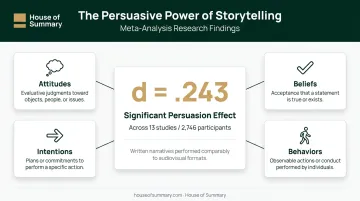
A 2021 meta-analysis of 13 studies with 2,746 participants found health narratives had a significant persuasion effect on attitudes, beliefs, intentions, and behaviors (d = .243, p < .01). Written narratives performed comparably to audiovisual formats. A well-written advertorial can do the same work as a video.
The Three Story Types That Consistently Work
- Patient transformation — someone living with a problem who found a path forward; the brand's role is part of the path, not the whole story
- Community impact — a brand whose work changed health outcomes at scale. This format works best when a brand has documented, verifiable public health contributions to point to.
- Expert perspective — a clinician or researcher shares their genuine point of view; the brand appears as context, not hero
Authenticity vs. Promotion: What Separates Them
The difference comes down to specificity. Promotional storytelling rushes to the resolution. Authentic storytelling spends time in the problem : it gives the problem texture, names the specific moments that were hard, and uses the language real patients actually use.
A patient who describes waking up at 3 a.m. convinced something was wrong is more believable than one who "struggled with symptoms." The more precisely a reader recognizes the experience being described, the more invested they become. Give the struggle its due before introducing the solution. That's what makes the resolution land as a discovery rather than a pitch.
The Anatomy of an Effective Healthcare Advertorial
Lead With the Human, Not the Brand
The opening paragraph should place a real — or realistically composite — person in a specific, recognizable moment of difficulty. No product claim. No brand name. Readers decide in seconds whether to keep reading, and they continue for stories, not pitches.
Build the Problem With Emotional Specificity
Describe what it actually feels like to live with the health challenge. Clinical abstraction loses readers. Sensory language, real-world scenarios, and honest acknowledgment of difficulty create the identification that makes the rest of the story land.
Introduce the Solution as a Discovery
The brand or product should appear at the natural moment when the protagonist is seeking help. Frame it as something they found, not something being sold to them. This is where credibility markers belong:
- Cited clinical evidence or peer-reviewed research
- A credentialed expert quote
- Specific, measurable outcomes
These satisfy the skeptical reader without breaking the story's momentum. They also align with what readers already use to judge health content. The 2021 National Academy of Medicine guidance on credible health information identifies exactly those signals: science-based sourcing, transparency about who produced the content, clear accountability, and current evidence. An advertorial that builds these in earns trust by the time it reaches the close.
Use a CTA That Feels Like a Next Step
The closing call to action should extend the journey, not end it abruptly.
| Instead of... | Try... |
|---|---|
| "Buy now" | "See if this is right for you" |
| "Call today" | "Read other experiences" |
| "Limited offer" | "Learn more about your options" |
The tone of the CTA either preserves or destroys the trust built through the preceding narrative. Promotional urgency at the close signals that everything before it was a sales pitch — and the reader will feel it.
Compliance Considerations: Transparency Without Killing the Story
FTC Disclosure Is Mandatory
Any paid content must be clearly labeled as sponsored. The FTC's native advertising guidance requires that disclosures be prominent and unambiguous: not buried in a footer, not rendered in a smaller font than the body copy. The label must appear before the reader engages with the content.
Transparency doesn't undermine trust. Readers who understand content is sponsored still engage when the story delivers genuine value. The 2016 Lord & Taylor enforcement action established that the FTC will pursue cases where paid editorial placement is disguised. Healthcare brands, already under regulatory scrutiny, can't afford that exposure.
HIPAA and Patient Story Consent
Real patient stories require written authorization before any identifiable information can be used. HIPAA's marketing provisions are clear: using or disclosing protected health information to encourage use of a product or service requires individual written consent.
Composite or fictionalized stories passed off as real create two distinct risks:
- FTC deception exposure if the fabrication surfaces publicly
- Patient trust damage that's difficult to recover from once readers feel misled
Use explicit written consent for real stories. When accounts are anonymized or composite, disclose that clearly upfront.
Health Claims Require Substantiation
Every efficacy or outcome claim in an advertorial, even one embedded in narrative, is subject to FTC and FDA standards. The FTC Health Products Compliance Guidance defines the standard as "competent and reliable scientific evidence," and for many health claims, that means randomized, controlled human clinical trials.
Two categories to keep distinct:
- General wellness language ("supports overall wellbeing"): lower regulatory bar, governed by FDA's general wellness policy
- Disease or treatment claims ("reduces symptoms of X," "clinically proven to treat Y"): strict substantiation required, often requiring RCT-level evidence
Flag any claim that could be read as a treatment or efficacy claim before publication. One unsubstantiated claim can undermine an otherwise credible piece.
Where to Place Healthcare Advertorials for Maximum Impact
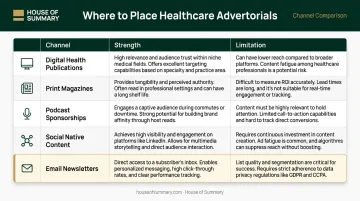
Channel Comparison
| Channel | Strength | Limitation |
|---|---|---|
| Digital health publications | Scale, category relevance | Ad clutter, banner blindness |
| Print magazines | Prestige, longevity | Limited targeting, no real-time data |
| Podcast sponsorships | Intimacy, loyalty | No visual storytelling, short attention window |
| Social native content | Reach | Algorithm unpredictability, shorter attention spans |
| Email newsletters | Focus, opt-in engagement, no ad blockers | Requires the right publisher match |
Why Newsletter Placement Works for Healthcare
Email newsletters reach readers who actively chose to receive them, in an environment free from ad blockers and social algorithms. Campaign Monitor's 2022 healthcare services benchmarks show an average open rate of 23.7% and a CTR of 3.0% for healthcare email — comparing favorably against display formats that compete with 290M+ active desktop ad-blocker users globally, per the 2022 PageFair report.
For healthcare advertorials specifically, that combination of opt-in attention and ad-blocker immunity matters. The format requires the reader to actually read — and newsletter placement is one of the few environments where that condition reliably holds.
House of Summary's network of specialized newsletters — including Presidential Summary and Geopolitical Summary — reaches 500,000+ subscribers with over 254,000 emails opened daily. The audience skews toward decision-makers, C-suite executives, and high-income professionals, primarily in the US (66%), with additional reach in the UK and UAE. For healthcare brands targeting executives, policy professionals, or affluent consumers, that's a direct path to the buyer, not a broad demographic approximation.
The network offers sponsored editorial content and native ad placements integrated within each newsletter's reading flow — formats that support the depth and narrative structure healthcare advertorials require. No banner competition, no algorithm interference; just the content and the reader.
What to Evaluate in a Newsletter Partner
Before selecting a newsletter for healthcare advertorial placement, assess:
- Editorial alignment — does the publication's tone and content credibility match what your advertorial needs to borrow?
- Audience specificity — are subscribers health-literate or professionally relevant to your target segment?
- Engagement metrics — open rates, CTR, and reply rates (not just subscriber count)
- Editorial standards — a newsletter with a reputation for accuracy lends that credibility to sponsored content placed within it
Frequently Asked Questions
Frequently Asked Questions
What makes a healthcare advertorial story feel authentic rather than promotional?
Authenticity comes from leading with the patient or person — their situation, uncertainty, and decision process — before the brand enters the story. When the narrative focuses on a real experience rather than a product feature, readers stay engaged rather than feeling sold to.
What makes a healthcare advertorial different from a regular ad?
A regular ad announces a product. An advertorial draws the reader into a story before the brand appears — the format, length, and editorial tone create a higher-trust reading experience that matters especially in healthcare, where skepticism of advertising runs consistently high.
Do healthcare advertorials require FTC disclosure?
Yes — any paid content must be clearly labeled as sponsored, with the disclosure prominent and unambiguous before the reader engages. Readers who know content is paid still engage when it delivers genuine value — the label doesn't break the story, it builds credibility.
What story format works best for a healthcare advertorial?
The patient journey narrative (problem, search for solution, resolution) is the most consistently effective format because it mirrors how real people experience health decisions. Expert perspective stories work well for clinical or B2B healthcare brands targeting practitioners or informed professionals.
How long should a healthcare advertorial be?
Effective healthcare advertorials typically run 600–1,200 words — long enough for emotional narrative and credibility markers, short enough to hold attention. Newsletter placements tend toward the tighter end of that range; long-form digital placements can support more depth.
Can small healthcare practices use advertorials, or are they only for large brands?
Advertorials scale to any budget. A local clinic can publish a patient story in a regional newsletter just as effectively as a pharmaceutical company in a national outlet. Authentic storytelling and reaching the right readers matters more than production cost.