Introduction
Most marketing teams have a passing familiarity with advertorials. Far fewer understand what actually separates them from native ads, sponsored content, or a well-written brand blog post — and that distinction matters when you're allocating budget.
A paid advertorial is content created or commissioned by a brand and placed on a third-party publication in exchange for payment, written to match the editorial tone and format of that platform. Unlike a banner or a press release repurposed as an article, the format is designed to inform or entertain first — and promote second.
Media buyers, marketing decision-makers, and brand teams need to understand how advertorials work before investing in them. Lumen Research reports that only 30% of viewable ads are actually seen — meaning 70% of display inventory goes unnoticed. Ad-blocking adoption hit 912 million active users worldwide by Q2 2023, with 52% of consumers across 48 markets having installed or used a blocker.
This guide covers what paid advertorials are, why brands use them, how they work in practice, and when they're the wrong tool for the job.
Key Takeaways
- A paid advertorial is brand-controlled content placed on a third-party publisher, written to read like editorial material
- Unlike display ads, advertorials borrow credibility from the host publication and deliver genuine reader value before making a commercial case
- They work best for audience education, brand trust-building, and long-cycle consideration — not immediate direct response
- FTC (US) and ASA/CAP (UK) rules require clear disclosure labels on all advertorials — for both brands and publishers
- Publisher-audience alignment matters more than raw reach — a smaller, well-matched audience outperforms a larger misaligned one
What Is a Paid Advertorial?
A paid advertorial is editorial-style content that a brand funds and a publisher hosts. Dictionary.com defines an advertorial as an extended text advertisement that promotes the advertiser's product, service, or point of view while matching the publication's editorial style and layout — the word itself blends "advertisement" and "editorial."
In practice: a brand pays a publisher to host a piece of content written to match that publication's voice, format, and standards. The content informs or engages the reader first. The brand message follows from that engagement, rather than cutting across it.
That distinction matters most when you're comparing advertorials to the formats they're routinely confused with.
How Advertorials Differ From Adjacent Formats
These three formats get conflated constantly, but they're meaningfully different:
| Format | Length | Control | Primary Goal | CTA |
|---|---|---|---|---|
| Native Ad | Short | Shared | Awareness/reach | Soft or none |
| Sponsored Content | Medium | Shared/co-produced | Awareness/consideration | Soft |
| Paid Advertorial | Long-form | Brand-controlled | Education/consideration | Visible and direct |
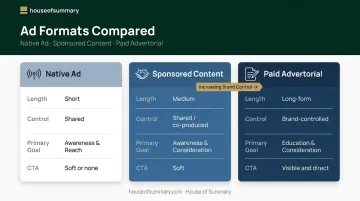
Native ads are algorithm-distributed paid placements that match a feed's look — think promoted content widgets or in-feed social ads. Sponsored content is typically co-produced with the publisher, leaning toward brand awareness rather than conversion. A paid advertorial is longer-form, written to the brand's agenda, and carries a visible call to action.
The Three Types
Most commercial advertorials fall into one category, but the format spans three:
- Image advertorials — position a brand through category-level storytelling or education (most common)
- Advocacy advertorials — present a brand's or executive's position on a topic or industry issue
- Journalism advertorials — designed to generate media attention or frame how a subject is covered
For most media buyers, image advertorials are the relevant type: content that connects a product to a problem the reader already recognizes — without announcing itself as an ad.
Why Brands Use Paid Advertorials
Banner blindness is real and well-documented. Display ads interrupt without permission and, increasingly, without being seen at all. Advertorials address this by offering something the reader actually wants before making a commercial case.
The Attention Problem
IPG Media Lab and Sharethrough found that consumers looked at native ads 53% more frequently than display ads, with 18% higher purchase-intent lift and 9% brand-affinity lift. That's a comparison between native ads broadly and display — advertorials, as longer-form, higher-investment content, are better suited to audiences who need context before they act.
What display can't do, advertorials can:
- Build the context that explains a complex product
- Demonstrate expertise before asking for trust
- Position a brand as the answer to a problem the reader already recognizes
- Hold attention long enough to shift a belief, not just register an impression
That engagement advantage extends beyond the read itself — it compounds through search visibility over time.
The SEO and Discoverability Angle
An advertorial placed on an authoritative publisher can rank independently for target keywords and drive referral traffic long after the campaign ends. Display ads disappear the moment the budget is paused.
One important clarification: Google requires that paid links use rel="sponsored" or nofollow attributes. Sponsored links don't pass PageRank. The SEO value of a well-placed advertorial comes from referral traffic, branded search increases, and discoverability — not domain authority transfer.
When Skipping the Format Hurts
A brand that needs to shift audience perception or explain a product with real nuance is working against the constraints of banner advertising. There is no room in a 300×250 display unit to change someone's mind. When the story is the sales mechanism, the format has to support it.
How a Paid Advertorial Works
The process has three distinct phases. Getting any one of them wrong undermines the others.
Step 1: Define the Objective, Audience, and Angle
Before any content is written, answer three questions:
- What belief or action should this advertorial produce? Awareness, lead generation, category education, and brand repositioning each require different content approaches.
- Who is the target reader? Be specific about seniority, industry, and the problem they're actively trying to solve.
- What's the angle? Find the hook that connects the reader's existing concern to the brand's solution — without opening on the product.
The angle is where most brands stumble. An advertorial that opens with "our product does X" reads like an ad. One that opens with a problem the reader recognizes reads like editorial content.
Step 2: Select the Publisher and Develop the Content
Publisher selection does most of the work. The right publisher:
- Transfers credibility: readers extend trust to content appearing in publications they already respect
- Delivers audience fit: the readership overlaps meaningfully with the brand's target buyer
- Sets editorial context: the publication's tone and format directly shape how the content lands
- Signals intent: appearing in a niche publication tells readers the brand understands their world
Content development should follow the IAB's framing: the true aspiration of branded content is storytelling, not product selling. A useful ratio to apply: approximately 70% genuine value (insight, narrative, data, practical tips) and 30% brand presence. The CTA should read as a natural next step, not a pivot into a sales pitch.
The content must be written in the publisher's voice — not the brand's marketing language. Study the publication before writing a word.
Step 3: Publish With Disclosure and Measure Performance
Once live, the advertorial must carry a clear disclosure label. In the US, the FTC recommends labels such as "Ad," "Advertisement," "Paid Advertisement," or "Sponsored Advertising Content," placed where readers will notice it — typically before or above the headline. In the UK, the ASA/CAP guidance supports labels including "Advertisement Feature," "Ad Feature," or "Advert."
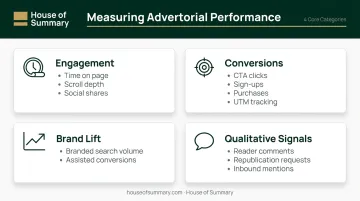
Track performance across three categories:
- Engagement: time on page, scroll depth, and social shares show whether the content resonated
- Conversions: CTA clicks, sign-ups, and purchases tracked via UTM parameters and unique links
- Brand lift: branded search volume increases and assisted conversions in multi-touch attribution reveal longer-term impact
- Qualitative signals: reader comments, republication requests, and inbound mentions from the publisher's audience
What Affects Paid Advertorial Performance
Audience Alignment
The single biggest variable is whether the publication's readership matches the brand's intended buyer. A high-traffic outlet with a misaligned audience will consistently underperform a smaller, precisely matched one.
Niche and specialized publishers often outperform general interest platforms for this reason. Newsletter-based advertorials are a strong example: readers have opted in, the inbox delivers content without algorithmic suppression or ad-blocker interference, and open rates reflect genuine intent rather than passive exposure.
House of Summary's network of specialized newsletters — covering global news, geopolitics, Dubai, and London — reaches 500,000+ subscribers with 254,866+ emails opened daily, drawing decision-makers, executives, and policy professionals concentrated in New York, Los Angeles, London, and Dubai. For brands targeting high-income professional audiences, that demographic precision is difficult to replicate through programmatic or social channels.
The BSH Hausgeräte campaign on Dubai Summary illustrates the difference: the CEO reported click-through rates 4x higher than Google AdWords, attributing the result to editorial tone alignment and audience quality.
Channel Format and Environment
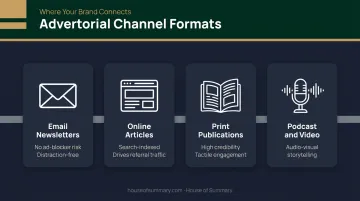
Advertorials appear across multiple formats, each performing differently depending on context and reader intent:
- Email newsletters — no visual clutter, no algorithmic suppression, no ad-blocker risk; the message arrives in a distraction-free environment
- Online articles — indexed by search engines, shareable, can drive long-term referral traffic
- Print publications — tactile engagement, high-credibility environments, no digital fatigue
- Podcast segments and video — audio and visual formats suited to demonstrating or narrating brand stories
Pricing Models
Advertorials are typically sold through one of three structures:
- Flat fee — one price per placement, regardless of performance
- CPM — cost per thousand impressions, common for larger publications
- CPA — cost per action, less common for editorial content
Pricing varies by publisher tier, niche, and audience size. Evaluate cost relative to audience fit and campaign objective — not raw reach alone.
Common Misconceptions and When to Reconsider
Misconception: Disclosure Destroys Effectiveness
Many brands resist labeling out of fear that readers will disengage. A 2020 meta-analysis found that disclosure does increase readers' persuasion awareness — but the stronger finding is that content quality determines whether readers continue after seeing the label. The label itself isn't the problem. Thin content is.
Misconception: Advertorials Work Like Display Ads
Some teams apply a one-week attribution window to advertorial campaigns and declare them underperforming. Advertorials build consideration over time. Measuring them against a direct-response timeline misapplies the format entirely.
Misconception: Any Publisher Will Do
Prioritizing audience size over audience relevance is one of the most common ways advertorial budgets get wasted. Publishers with misaligned audiences consistently underdeliver on conversions, regardless of reach.
Beyond these misunderstandings, there are specific situations where the format genuinely isn't the right choice.
When to Reconsider the Format
A paid advertorial is the wrong tool when:
- The campaign requires immediate, short-window direct-response results
- The product has no natural editorial angle or reader value to offer
- The brand budget doesn't support producing content that can hold up next to a publisher's editorial standards
- The publisher's audience demonstrably doesn't overlap with the target buyer
In these cases, search advertising, social paid placements, or direct-response campaigns are better suited to the objective.
Frequently Asked Questions
What is a paid advertorial?
A paid advertorial is content created or commissioned by a brand and placed on a third-party publication in exchange for payment, written to read like editorial content while promoting a product, service, or brand message. The "paid" element distinguishes it from coverage the publication chooses to run on its own editorial judgment.
What is an advertorial example?
One well-known example: The New York Times published a nearly 1,500-word paid post for Netflix's Orange Is the New Black in June 2014, titled "Women Inmates: Why the Male Model Doesn't Work." It read like investigative journalism while drawing readers into the show's themes. The piece was labeled "Paid Post by Netflix" and set the benchmark for editorial-quality branded content at publisher scale.
How is a paid advertorial different from native advertising?
Native advertising is the broader category — it covers any paid content that matches a platform's look and feel, including in-feed social ads and promoted listings. A paid advertorial is a specific type: full article format, longer in form, brand-controlled, and carrying a direct CTA. Every advertorial qualifies as native advertising, but native advertising includes many formats beyond the advertorial.
Do paid advertorials need to be labeled as advertisements?
Yes. In the US, the FTC requires clear labels such as "Ad," "Advertisement," or "Paid Advertisement," placed where readers will notice them. In the UK, the ASA/CAP accepts "Advertisement Feature," "Ad Feature," and "Advert." Failure to disclose can result in regulatory penalties for both the brand and the publisher — as the FTC's 2016 Lord & Taylor case demonstrated.
How much does a paid advertorial cost?
Costs vary widely. Smaller niche publications may charge a few hundred dollars per placement; premium outlets can run into the tens of thousands. Pricing is typically structured as a flat fee, CPM, or occasionally CPA — evaluate each against your audience fit and campaign objective.
How do you measure the success of a paid advertorial?
Track three layers: engagement metrics (time on page, scroll depth, shares), conversion metrics (CTA clicks, sign-ups, purchases via UTM links), and longer-term indicators like branded search volume or assisted conversions. Avoid judging performance against a one-week window — advertorials work on a consideration timeline, not a direct-response one.