Introduction
Most paid channels have a friction problem. Social algorithms throttle organic reach to around 1.2% on Facebook, paid placements compete for shrinking attention spans, and nearly 30% of internet users worldwide now run ad blockers — stripping display ads before they ever render.
Newsletter advertising sidesteps all of it. Ads land directly in inboxes, in front of readers who opted in and actually open the email. Algorithms don't decide whether your placement gets seen, and blockers can't touch it.
This post covers three real campaigns — Artisan AI, Intercom, and Growth Daily — each published as official case studies by beehiiv, the platform that ran their ad networks. The results across all three:
- $68K ARR generated from newsletter placements alone
- 2 million impressions delivered with tight niche targeting
- 30% drop in customer acquisition costs
If you're testing newsletter advertising, these results give you a concrete baseline to work from.
Key Takeaways
- Newsletter ads bypass ad blockers and platform algorithms entirely — they land directly in inboxes readers actually open
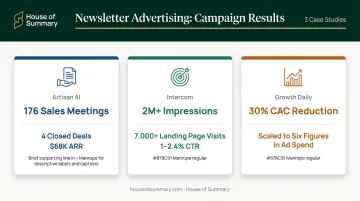
- Artisan AI booked 176 sales meetings and generated $68K ARR; Intercom hit 2M+ impressions with 1–2.4% CTR; Growth Daily cut CAC by 30%
- Niche newsletters consistently outperformed generalist placements across all three campaigns
- The highest-performing campaigns led with free offers, not hard product pitches
- Audience alignment — not list size — determined which campaigns succeeded
Why Newsletter Advertising Consistently Outperforms Other Channels
The Inbox Has No Competition
When a reader opens a newsletter, your ad isn't competing with fifteen other brands on the same page. There's no sidebar, no banner stack, no programmatic display running alongside it. One publication. One reader. The same structural advantage that House of Summary describes in its own advertiser positioning: "No algorithms, no ad blockers, no visual clutter. Just undivided attention."
Compare that to paid social, where Facebook's average organic reach sits at 1.2% per post, or display, where ad blockers now affect roughly 1.77 billion users globally. Budget poured into those channels is constantly fighting platform decisions you can't control.
The Warm Audience Effect
Newsletter subscribers are self-selected. They signed up, they open regularly, and they trust the publication enough to keep reading. That trust transfers directly to advertisers placed within the content — and the numbers back it up.
According to LiveIntent, newsletter subscribers are 16x more likely to engage with newsletter ads than traditional banner ads. The mechanism is straightforward: credibility borrowed from a trusted sender. Cold display and scroll-based social impressions carry no such relationship — and no such lift.
ROI You Can Actually Measure
Email as a channel delivers strong, documented returns. Litmus reports an average ROI of $36 for every $1 spent on email marketing — a figure that reflects the underlying quality of the inbox as a channel, even when applied to paid placements rather than owned lists.
For performance marketers, the more important point is attribution clarity:
- Clicks and CTR are captured at the placement level
- Landing page visits tie directly back to the send
- CAC can be calculated cleanly against newsletter spend
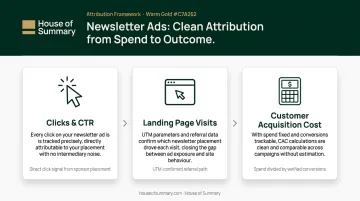
Few paid channels offer that kind of clean line between spend and outcome.
Case Study 1: How Artisan AI Booked 176 Sales Meetings and Generated $68K ARR
The Challenge
Artisan AI is an early-stage B2B startup selling an AI sales assistant product called Ava. The problem facing most early-stage companies is immediate: they need qualified leads fast, without the brand recognition that makes inbound reliable or the large team that makes high-volume outbound efficient.
Cold outreach is expensive when it's barely converting. Paid social can generate volume but rarely produces the decision-maker conversations a B2B company actually needs.
The Strategy
Artisan AI integrated the beehiiv Ad Network into a broader multi-channel approach, placing ads across multiple niche publications simultaneously. Rather than committing to a single placement or message, the campaign used A/B testing across different newsletters and copy variations. The goal: identify which combinations drove the most sales call conversions before committing budget at scale.
Testing at the placement level first let the team move quickly without burning spend on underperforming variables.
The Results
Per the official beehiiv case study published April 2025:
- 176 sales meetings booked
- 4 closed deals
- $68,000 in Annual Recurring Revenue generated
The Lesson
For B2B brands where a single closed deal can cover an entire campaign's cost, newsletter advertising flips the ROI math entirely. One deal worth $17,000 in ARR justifies nearly any reasonable placement budget — which means the real objective isn't minimizing spend, it's finding the audience-message combination that produces qualified conversations.
The key insight: A/B testing across placements lets you reach that answer faster — and with far less wasted budget than paid social or cold outreach typically requires.
Case Study 2: How Intercom Reached 2 Million Impressions Through Niche Targeting
The Challenge
Intercom is an established AI-driven customer service platform. For this campaign, the goal wasn't broad awareness — it was precision. The target audience was early-stage startups: companies with 1–5 employees and under $1 million in funding. That's a narrow slice of the market, and reaching it efficiently through broad placements would have generated enormous waste.
The Strategy
Rather than large generalist publications, Intercom placed ads in niche startup-focused newsletters including Confluence VC and Failory — publications chosen specifically because their readership matched the ICP. The targeting parameters also required newsletters with 10K–50K subscribers and open rates between 35–50%, filtering out low-engagement lists regardless of size.
The Results
Per the official beehiiv Intercom case study:
- 2+ million total ad impressions
- 7,000+ landing page visits
- 1–2.4% CTR on niche newsletter placements
John Roche from the Intercom team stated: "The beehiiv Ad Network has given us an easy and scalable way to reach startup founders and key decision-makers."
The Lesson
A smaller but precisely matched audience beats a massive mismatched list. Intercom's 1–2.4% CTR came from placing ads in front of startup founders reading newsletters built for startup founders. When the audience fit is that tight, the creative doesn't need to do the heavy lifting — relevance handles it.
Case Study 3: How Growth Daily Cut Customer Acquisition Costs by 30%
Case Study 3: How Growth Daily Cut Customer Acquisition Costs by 30%
The Challenge
Growth Daily is a daily marketing newsletter with 85,000+ subscribers, primarily marketers and CEOs. The challenge its founder (Marketing Max) faced was one that applies to any media brand monetizing through advertising: keeping advertiser CAC low enough that sponsors see consistent ROI — and return for future campaigns.
Advertiser churn is expensive. Retention depends on first campaigns actually performing.
The Strategy
Growth Daily advertised within other beehiiv newsletters through the beehiiv Ad Network, running ads across multiple placements simultaneously with ongoing optimization. The campaign scaled budget allocation toward what performed — going from 10% to 40% of budget on beehiiv ads as results improved — while continuously refining landing pages and placement combinations.
It was iterative by design, not a single burst of spend.
The Results
Per the official beehiiv Growth Daily case study:
- 30% reduction in Customer Acquisition Cost
- Scaled to nearly six figures in beehiiv ad spend as performance validated the channel
Marketing Max's own summary of the experience: "From a CAC and quality perspective, it's a no-brainer once you crack your landing page."
The Lesson
CAC reduction in newsletter advertising comes from two forces working together: niche audience targeting and iterative optimization. Tight audience fit reduces wasted impressions from the start. Iterative testing then compounds that efficiency — each round of refinement makes the next campaign cheaper to run and easier to scale.
Patterns Behind Every Successful Newsletter Ad Campaign
Across three campaigns in different industries, the same patterns drove results — regardless of budget, format, or audience size.
Audience Specificity Beats List Size
None of these campaigns succeeded by finding the biggest newsletter. They succeeded by finding the right one. Intercom filtered explicitly for open rates of 35–50% and subscriber counts of 10K–50K — rejecting larger lists that didn't meet the engagement threshold.
For B2B and career-oriented audiences, Paved's sponsorship benchmark data confirms that smaller targeted lists often command higher value per reader than large lifestyle categories.
Low-Friction Entry Points Outperformed Hard Pitches
Free trials, tools, and resources consistently appear in high-performing newsletter ad creative. Inbox audiences are in a reading mindset, not a browsing-and-buying one. An offer that asks for attention before asking for money aligns with how that environment works.
Structured Testing Was Built In from the Start
All three campaigns ran A/B tests across placements, creative, and messaging — then scaled budget toward what performed. Treating the first send as a data point, not a verdict, is what separated strong results from stalled ones. Key metrics to track: CTR, CAC, and revenue per send.
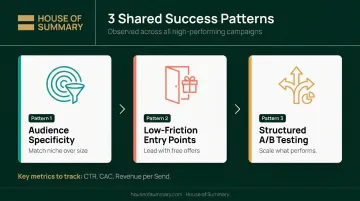
These patterns hold regardless of industry or offer type. The newsletter channel rewards specificity and patience — both of which compound over time.
What to Look for in a Newsletter Advertising Partner
Audience Quality Before List Size
Before looking at subscriber counts, ask whether the readership actually matches your ideal customer profile — their industry, seniority level, geographic location, and intent. Intercom's campaign demonstrated this precisely: newsletters with 10K–50K subscribers and 35–50% open rates outperformed what a larger, less targeted list would have produced.
For brands targeting executives, finance professionals, or global decision-makers, this matters more than volume. Seniority and income targeting through programmatic channels is unreliable — inbox placements in a relevant publication are not.
Editorial Quality as a Signal
The tone and reputation of the newsletter affect whether an ad placement feels credible or disruptive. Premium editorial environments — human-written, fact-checked, and produced by people with genuine subject-matter expertise — attract readers who trust the publication. In an inbox, that trust has direct commercial value: readers are more likely to engage with a brand that appears alongside content they've chosen to receive.
House of Summary's network — Presidential Summary, Geopolitical Summary, Dubai Summary, and London Summary — is built on exactly this model. Each newsletter is written by subject-matter experts for C-suite executives, founders, policy professionals, and high-net-worth individuals.
BSH Hausgeräte's CEO reported click-through rates four times higher than their Google AdWords campaigns on Dubai Summary placements, a result the company attributed directly to audience fit and editorial environment.
Transparency and Reporting
Any credible newsletter partner should provide clear data before you commit budget. At minimum, expect:
- Deliverability rates — what percentage of sends actually reach inboxes
- Open rate benchmarks — verified against your target audience segment
- CTR data — ideally broken down by placement type or issue
- Audience demographics — industry, seniority, geography
First-party data and clean reporting make it possible to assess campaign effectiveness and iterate on actual performance. If a publisher can't or won't share this upfront, that signals what post-campaign reporting will look like.
Frequently Asked Questions
What kind of results should I realistically expect from a newsletter ad campaign?
Based on the case studies covered, niche newsletter placements have produced CTRs of 1–2.4%, with outcomes ranging from lead generation to direct revenue. Results vary significantly based on audience match and offer type — treat your first campaign as a baseline to learn from, not a final verdict.
How do newsletter ads compare to Google or social media ads in terms of ROI?
Newsletter ads deliver directly to inboxes with no algorithm filtering and no ad blocker exposure. Email as a channel is benchmarked at roughly $36 return per $1 spent on average. For high-intent niche audiences, newsletter placements typically outperform broad paid social on a cost-per-lead basis.
Are newsletter ads effective for B2B brands?
Yes — the Artisan AI and Intercom campaigns confirm this. B2B campaigns in relevant niche newsletters can generate high-quality leads and closed deals when the readership matches your ICP. Low-friction offers — trials, tools, case studies — consistently outperform direct purchase asks.
How important is the newsletter's niche vs. its total subscriber count?
Audience specificity outperforms raw list size every time. A smaller, highly targeted newsletter typically delivers higher CTRs and lower CAC than a large generalist list where most readers don't match your ICP.
Should I pitch my product directly or use a lead magnet in my newsletter ad?
Lead with a free offer — a tool, trial, case study, or useful resource — to reduce friction and leverage the trust readers have with the newsletter. Direct product pitches work better for retargeting audiences who already know your brand.
How do I know if a newsletter's audience is the right fit before spending budget?
Request audience demographic data, average open rates, and CTR benchmarks from the publisher before committing. Check that the editorial tone and subject matter align with how your ideal customer already spends their attention — if the content doesn't match, neither will the ad.