The result: acquisition costs are up, performance data is less reliable, and the brands still running Meta-only strategies are paying more to learn less.
Newsletter advertising rarely gets treated as a primary acquisition channel. Most D2C marketers file it under "nice to test someday." That's a mistake. When matched to the right audience and measured correctly, newsletter ads deliver predictable reach, stronger conversion quality, and lower CAC than most paid social placements — without any algorithmic interference.
This article breaks down exactly why that's true, what the data actually supports, and how each advantage maps to the metrics D2C teams are held accountable for.
Key Takeaways
- Newsletter ads land directly in opted-in inboxes — no algorithm decides who sees them, no ad blocker strips them
- Readers trust the publishers they subscribe to — and that trust transfers directly to advertised brands
- CAC from newsletter placements regularly beats paid social, with D2C brands reporting stronger ROAS and lower cost-per-acquisition
- Attribution stays clean through UTM parameters, unaffected by iOS privacy restrictions
- Newsletter advertising gives D2C brands a low-competition, high-intent channel most competitors haven't touched yet
What Is Newsletter Advertising?
Newsletter advertising is the practice of placing a paid ad inside a curated email newsletter sent to a publisher's subscribed audience. Unlike email marketing — which works with subscribers you already own — this is a paid media channel that puts your brand in front of a new, verified audience that already trusts the publisher delivering it.
For D2C brands, that distinction changes everything about how the channel performs. Your ad isn't interrupting a scroll or entering a real-time auction against competitors. It's appearing inside a content habit — the moment a reader has chosen to sit down and consume information they actively sought out.
That context matters. A reader in that state is attentive, not distracted. Your message lands differently when it arrives alongside content someone wanted, not content they were forced to sit through.
Key Advantages of Newsletter Advertising for D2C Brands
Each of the following advantages connects directly to a metric D2C marketers track: acquisition cost, conversion rate, click-through rate, and ROAS. The case for newsletter advertising is built on numbers, not brand theory.
Advantage 1: Direct Inbox Access With No Algorithmic Gatekeeping
When you buy a newsletter placement, your ad reaches every subscriber on that send list. No feed algorithm decides your distribution. No bid fluctuation determines whether 20% or 80% of the audience sees it. The publisher sends — the subscriber receives.
Compare that to Meta, where your paid reach depends on auction dynamics that shift daily. Tinuiti's Q2 2025 benchmark report showed average Facebook CPMs up 12% year-over-year — the fifth consecutive quarter of double-digit increases. That's not a temporary anomaly. It's a structural cost trend for brands dependent on auction-based platforms.
Why this matters for D2C teams:
- You know exactly how many inboxes your ad enters before committing spend
- CAC modeling becomes more reliable — expected CTR × conversion rate × placement cost = projected acquisition cost
- No creative fatigue penalty, no audience saturation signal, no algorithm suppression
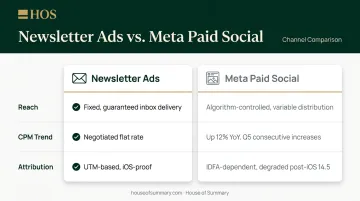
There's also the ad blocking factor. eMarketer projects that by 2026, 52% of consumers across 48 global markets will have installed or used an ad blocker. Newsletter placements sit inside the inbox, outside the browser environment where display blocking operates.
When this advantage is most valuable: During Q4 when social CPMs spike seasonally, when a brand is scaling beyond its initial Meta audiences, or when iOS attribution data has made social campaign decisions unreliable.
KPIs impacted: Reach predictability, CPM stability, CAC, ROAS consistency
Advantage 2: Trust Transfer That Social Ads Cannot Replicate
A newsletter subscriber has made a deliberate choice — they signed up, confirmed their address, and continue opening. That relationship creates something paid social cannot manufacture: earned trust between reader and publisher.
When a brand appears inside that newsletter, it inherits a share of that trust. That effect shows up in the click data.
LiveIntent's data on native newsletter ads found 44% higher CTR than display ads for publishers using native placements within newsletters. For D2C brands paying per click or per acquisition, that CTR gap has a direct impact on what each customer costs to acquire.
Why this matters for D2C brands specifically:
- Cold social traffic requires a brand to build credibility from zero within the ad itself — headline, image, copy, social proof all doing heavy lifting in two seconds
- A newsletter ad starts with a credibility base already established — the publisher's relationship with the reader creates a warmer entry point
- For products with a considered purchase cycle (supplements, skincare, wellness devices), trust is often the variable that separates a click from a conversion
For brands advertising in the right context, this effect compounds. A D2C supplement brand appearing in a health and wellness newsletter is not an intrusion — it's a logical extension of the content the reader came for.
When this advantage matters most: For brands entering crowded categories where consumer skepticism is high, for products that require explanation or context before purchase, and for brands that have exhausted warm lookalike audiences on social platforms.
KPIs impacted: CTR, on-site conversion rate from newsletter traffic, average order value, return customer rate
Advantage 3: Lower, Measurable CAC With Privacy-Durable Attribution
Newsletter advertising typically delivers competitive CAC relative to paid social — and through a measurement approach that survives the privacy changes that broke platform-reported ROAS.
The evidence is case-study based rather than a universal industry benchmark, but the pattern is consistent. Cozy Earth, a luxury home goods brand, sponsored newsletters in travel, food, and home categories through LiveIntent and achieved a 0.45% CTR and a 10% lift in ROAS. LiveIntent's case study hub also cites Aerosoles at 5x ROAS and eBags at 87% greater ROAS from newsletter-based campaigns.
These are not audited category averages — they are real campaign outcomes from D2C and ecommerce advertisers. The pattern holds because niche, opted-in audiences convert at rates that make smaller list sizes financially competitive with broad social audiences at scale.
On attribution: Apple's ATT framework targets app-based, cross-company tracking. A UTM-tagged link from a newsletter to a landing page is not IDFA-based tracking — it runs on URL-parameter tracking that iOS policy doesn't touch. That means the attribution data you collect from newsletter placements remains clean and actionable regardless of what iOS or platform policy changes happen next.
Practical measurement setup:
- Tag every newsletter link with UTM source, medium, and campaign parameters
- Track newsletter-sourced sessions separately in Google Analytics or your attribution tool
- Calculate CAC from newsletter placements independently
- Compare against blended CAC target across channels after 3–5 placements
When this advantage matters most: During paid social inflation periods, when testing a new product and needing qualified traffic at a predictable cost, or when targeting high-income professional demographics that niche newsletters serve particularly well.
KPIs impacted: CAC, ROAS, CTR, CPC, LTV:CAC ratio
What Happens When D2C Brands Skip Newsletter Advertising
The risk is not that paid social stops working. The risk is losing optionality when it underperforms.
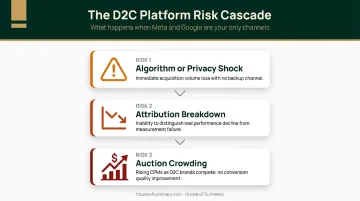
Brands concentrated entirely on Meta and Google face compounding exposure:
- Algorithm changes, CPM spikes, or privacy updates hit acquisition volume immediately — with no alternative channel to absorb the impact
- Post-iOS 14.5, CTC's dataset of 200+ ecommerce brands showed a nearly 40% drop in Facebook-reported ROAS. Brands with no channel alternatives couldn't tell whether performance had declined or measurement had simply broken
- As more D2C brands crowd Meta's auction, CPMs rise for everyone. Single-channel brands pay more per customer year over year, with no improvement in conversion quality
Newsletter advertising offers a directly negotiated ad channel with editorial targeting, engaged audiences, and measurement that doesn't depend on platform-reported data. It doesn't replace paid social. It reduces the risk of depending on it entirely.
How to Get the Most Value from Newsletter Advertising
Audience size is the wrong primary criterion when vetting a newsletter. A smaller publication whose readers match your buyer profile will consistently outperform a large general audience. Open rate and editorial topic alignment predict performance — not raw subscriber count.
Networks like House of Summary — covering global news, geopolitics, business, and city-specific content for decision-makers across the US, UK, and UAE — give D2C brands direct access to high-income, high-intent readers. No algorithm filters the message. No ad blocker strips it out.
That direct line only works if your creative fits the environment.
Newsletter readers respond to copy that feels informative, not promotional. Creative repurposed from Instagram or Facebook reads as out-of-place in an inbox built around trusted editorial content. Write to the publication's tone, not your standard ad template. One offer, one destination, one CTA — that structure produces far more reliable click behavior than split messaging.
A single drop rarely provides enough data to act on. Run at least 3–5 placements before making any scaling or pausing decisions. Track:
- UTM-tagged traffic from each send
- On-site conversion rate from newsletter sources
- CAC from newsletter-originated orders
That baseline gives you something real to optimize against.
Conclusion
Newsletter advertising works for D2C brands because it solves three specific problems at once: reach predictability when social auctions are volatile, trust transfer that cold traffic cannot replicate, and clean attribution that survives platform privacy changes.
The advantages compound. Each placement builds brand recognition with a high-intent audience, generates real performance data to improve creative, and deepens the relationship with publishers whose readers match the brand's customer profile. Treated as a managed acquisition channel rather than a one-off test, it gets more efficient over time.
For D2C teams watching CAC rise on Meta with no clear alternative, newsletter advertising is the channel gap worth closing first.
Frequently Asked Questions
How is newsletter advertising different from email marketing?
Email marketing uses your own subscriber list — people who already know your brand. Newsletter advertising is a paid placement inside someone else's newsletter, giving you access to a new opted-in audience that already trusts the publisher. You get the reach without having to build the relationship yourself.
What CTR should D2C brands expect from newsletter ads?
CTR varies by publication, offer, and placement quality. Platform case studies show results like 0.45% for Cozy Earth in home and lifestyle newsletters, while LiveIntent's native newsletter data shows CTRs running 44% higher than display ad benchmarks. Niche publications with engaged readerships consistently outperform broad display inventory.
How do newsletter ads hold up after iOS privacy changes?
Newsletter attribution relies on UTM-tagged links, not the app-level tracking Apple's privacy changes disrupted. That means your click and conversion data from newsletter placements stays accurate regardless of iOS updates.
How do I choose the right newsletter for my D2C brand?
Prioritize audience-product alignment over list size. A newsletter covering topics your buyers actively read will outperform a larger general audience. Vet publications on open rate, editorial topic fit, and reader profile — not just subscriber count. Ask for media kit data before committing spend.
Are newsletter ads better than social media ads for D2C brands?
They serve different functions, but for D2C brands dealing with rising CPMs and degraded attribution on social platforms, newsletter ads offer more predictable costs, higher audience trust, and cleaner performance data. The strongest acquisition strategies treat newsletter advertising as a complement to paid social, not a replacement.
How do I measure ROI from newsletter advertising?
Use UTM-tagged links to capture click traffic in your analytics platform. Track on-site conversion rate from newsletter sessions, calculate CAC from those orders, and compare it against your blended CAC target. Run at least 3–5 placements before making optimization decisions.