
Introduction
Most brands have heard the pitch: newsletter advertising outperforms social and search on engagement. A few have tested it. Fewer still understand how it actually works.
That gap creates real problems. Brands end up in the wrong newsletters, paying for list size instead of audience quality, submitting creative that gets rejected, or running placements with no measurement plan. The result is wasted spend and a false conclusion that the channel doesn't work.
The channel works — when the mechanics are right. According to beehiiv's 2025 data, media and creator newsletters averaged a 6.17% click-through rate, compared to 0.46% for Google Display Network and 1.71% for Facebook traffic campaigns. That performance gap is structural, not accidental.
This guide covers how premium newsletter advertising works in practice, including:
- What separates a premium newsletter from a commodity list
- How placements are structured and what ad formats to expect
- How pricing models work (CPM, flat-rate, and performance-based)
- How to measure campaign results without last-click attribution
Key Takeaways
- Premium newsletter ads are placements inside third-party, opted-in publications — not your own email list
- Readers arrive without algorithms filtering them, no ad blockers stripping your message, and no competing content on the page
- Every campaign follows a clear process: brief, editorial alignment, distribution, and performance measurement
- Pricing ranges from CPM to flat-fee sponsorships; niche and executive audiences command $30–$75+ CPM
- Finance, luxury, B2B, and executive-facing brands consistently get the strongest results
What Is Premium Newsletter Advertising?
Premium newsletter advertising means paying a third-party publisher to place your brand — as a display ad, native segment, or text placement — inside a newsletter they send to their own opted-in subscriber list. It is not the same as your brand sending emails to its own customers.
What Makes a Newsletter "Premium"
List size alone doesn't make a newsletter premium. The combination that matters:
- Editorial quality — consistent, credible content readers return to
- Audience specificity — a defined niche, not a broad general interest list
- Verified opt-in — subscribers chose this publication; they weren't scraped or bought
- Consistent open rates — reader behavior that proves ongoing engagement
A premium newsletter reader actively sought out the publication. That behavioral signal is what advertisers are actually paying to access.
What It Is Not
To be clear about the category:
- Not bulk cold email or rented lists
- Not programmatic display advertising served by a third-party network
- Not equivalent to buying a banner on a high-traffic website
The defining difference is the reader's pre-existing trust relationship with the publisher. That relationship is what commands premium pricing — and what makes the ad environment categorically different.
Why Niche Audiences Outperform Volume
Premium newsletters serve tightly defined audiences: global executives tracking geopolitics, finance professionals monitoring markets, high-income urban consumers making considered purchases. These readers are fewer in number than a mainstream website's monthly visitors. What they offer instead is sustained attention and genuine intent — two things mass-reach channels rarely deliver together.
The trade-off is volume for quality. For brands selling to decision-makers, that exchange consistently outperforms chasing raw impression counts.
How Premium Newsletter Advertising Works
Understanding each stage of the process — from brief to measurement — shows exactly where newsletter ads succeed or fail.
Stage 1: Setting the Campaign Brief
Every campaign starts with a clear objective:
- Awareness among a specific professional audience
- Direct response — clicks to a landing page or offer
- Lead generation — gated content, sign-ups, form completions
That KPI decision determines which newsletter fits, which ad format to use, and which pricing model makes sense. The second part of the brief is audience definition: geography, industry, seniority, or interest category. Mismatches here — placing a B2B enterprise software ad in a lifestyle newsletter, for example — are the single most common source of poor campaign performance.
Stage 2: Editorial Alignment and Creative Submission
Premium publishers review and approve all advertiser creative before anything goes live. This editorial gate is what brands are paying a premium to access: a trusted environment that has earned readers' attention. Submitting off-brand, misleading, or tone-deaf creative is the fastest way to get rejected.
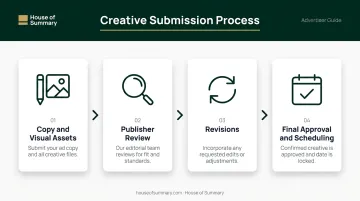
The submission process typically involves:
- Copy and visual assets — headline, body text, images, and destination URL
- Publisher review against tone and format guidelines
- Revisions if the creative doesn't align with the editorial voice
- Final approval before scheduling
Some publishers — including House of Summary, which writes branded sponsored segments in the natural voice of publications like Presidential Summary and Geopolitical Summary — will co-develop sponsored content with the advertiser. The result reads as part of the newsletter, not an interruption.
Stage 3: Distribution — The Inbox Advantage
Once approved, the ad is embedded into the newsletter issue and sent to subscribers on the publisher's regular cadence — daily, weekly, or otherwise. There's no algorithm filtering who sees it, no real-time auction competing for placement, and no ad blocker capable of stripping it out before delivery.
That's what the inbox advantage actually delivers: reach that doesn't depend on a platform's goodwill. The reader chose to open this publication. The ad lands in front of someone actively engaged with editorial content — not someone passively scrolling a feed.
Stage 4: Measurement and Optimization
Key metrics to track:
| Metric | What It Measures |
|---|---|
| Open rate | What share of subscribers opened the issue |
| Click-through rate (CTR) | What share clicked the ad |
| Downstream conversions | Purchases, sign-ups, or leads via UTM-tracked URLs |
UTM parameters are essential for newsletter ad measurement. A unique URL per placement, per issue, and per creative variant shows exactly what drove traffic — and what that traffic did after clicking. Without them, ROI is guesswork.
Campaign optimization happens between placements. Brands review which issues, which formats, and which newsletter audiences produced the strongest engagement — then adjust creative, frequency, or targeting for the next run.
Ad Formats in Premium Newsletter Advertising
Understanding the available formats helps match your campaign goals to the right placement. Three core formats cover most premium newsletter inventory:
Display Ads
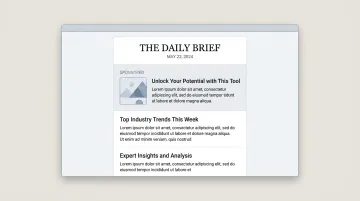
Banner-style visuals placed at the top, middle, or footer of the email body. Best for pure awareness campaigns where visual brand presence is the goal. Note that premium newsletter publishers use custom editorial templates — not standard IAB web display sizes — so creative assets often need to be adapted specifically for the publication.
Native / Sponsored Segments
Editorial-style content written to match the newsletter's voice, clearly labeled as sponsored. This format integrates with the reading experience rather than interrupting it. Because readers engage with native content the way they engage with editorial, these placements typically outperform display for trust-building and consideration.
Text-Based Placements
Hyperlinked sponsor mentions embedded within the copy. Low visual footprint, high contextual fit. Effective for brands that want subtle presence without standing out visually.
Placement position affects results as much as format choice. Top-of-newsletter inventory is more visible because readers don't need to scroll to reach it. According to Paved's placement guidance, above-the-fold units with larger images achieve higher CTRs. Before committing to a tier, ask publishers for placement-specific performance data — not just aggregate newsletter metrics.
What Sets Premium Newsletter Ads Apart from Generic Digital Ads
The Inbox Is a Focused Environment
When someone opens a newsletter, they're not navigating a feed full of competing content, autoplaying video, or pop-up overlays. The reader's attention is narrowed to a single publication. That environment is structurally unavailable in most digital advertising formats, which is why brands that have tested both consistently report stronger engagement from newsletter placements.
Editorial Trust Transfers to Advertisers
Premium newsletter readers develop genuine trust in publications that consistently deliver accurate, useful content. When that same publication carries a brand's ad, a portion of that trust carries over. This borrowed credibility is specific to publications with genuine editorial standards — it cannot be replicated by display networks or social platforms.
Ad Blocker Exposure Is Minimal
Blockthrough's 2023 ad-blocking report counted 912 million active ad-blocking users worldwide, with an estimated $54 billion in publisher revenue blocked in 2024 alone. Browser-based ad blockers work by intercepting network requests for third-party ad scripts — a mechanism that doesn't apply to native content embedded directly in the email body.
Newsletter ads embedded in editorial templates aren't served through external ad slots. House of Summary's placements, for instance, are integrated directly into verified, reader-requested issues — so they reach the inbox intact.
First-Party Data in a Post-Cookie World
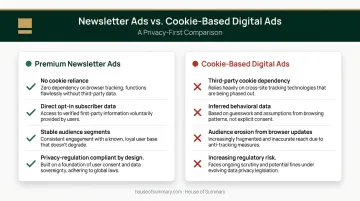
Ad blocking addresses one layer of signal loss. Cookie deprecation is another. Premium newsletter publishers hold a direct, consent-based relationship with every subscriber — audience data that's clean, opt-in, and built to last.
The IAB's 2024 State of Data report found 71% of brands and publishers increasing first-party data investment as third-party tracking erodes. Newsletter placements sit naturally within that strategy:
- No reliance on cookies or third-party tracking scripts
- Subscriber data collected through direct opt-in, not inferred behavior
- Audience segments that remain stable across browser and platform privacy updates
- Targeting that complies with evolving data regulations by design
Where Premium Newsletter Advertising Fits in a Brand's Strategy
Funnel Position
Newsletter advertising is strongest at the mid-to-upper funnel: building brand familiarity and credibility among a highly relevant, engaged audience. Native and performance-oriented placements can drive direct conversion, but the format rewards brands that pair placements with a destination worth visiting — a well-designed landing page, a compelling offer, or gated content that matches the audience's level of sophistication.
Which Brand Categories Get the Best Results
SmartBrief's research found that nearly 75% of executives rely on email newsletters as their primary information source, with pre-8 a.m. reading described as a key consumption window. That behavioral pattern makes newsletters uniquely suited for:
- Finance and fintech brands reaching professionals during their morning market intelligence routine
- Luxury brands connecting with high-income readers in a brand-safe editorial environment
- B2B services and enterprise software placing messages in front of decision-makers before the workday begins
- Executive-facing products finding C-suite leaders and senior professionals outside the noise of social platforms
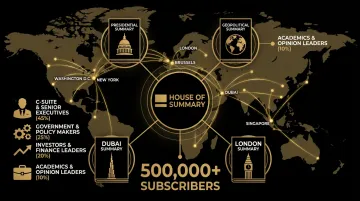
House of Summary's network — Presidential Summary, Geopolitical Summary, Dubai Summary, and London Summary — reaches 500,000+ subscribers, with 66% based in the US (concentrated in New York and Los Angeles) and significant readership in London and Dubai. The audience skews toward C-suite executives, high-net-worth individuals (HNWIs), policy professionals, and senior decision-makers — a concentration of buying power that consistently outperforms broader digital audiences on engagement metrics. Faik Serkan Ergun, CEO of BSH Hausgeräte, reported CTRs 4x higher than Google AdWords from a single Dubai Summary placement. He credited the editorial tone and audience quality as the deciding factors.
Starting Out
Those results don't require a large budget to replicate — they require the right match between audience and offer. For brands new to newsletter advertising:
- Run a single test placement in a newsletter matched tightly to your target audience
- Request open rate and CTR benchmarks from the publisher before committing budget
- Track performance with UTM-tagged URLs — not impressions or opens alone
- Judge cost against audience quality, not list size
Frequently Asked Questions
How do seven-figure newsletters make money?
At that revenue scale, newsletters typically combine premium advertising, paid subscription tiers, and affiliate revenue. Morning Brew topped $36M in first-half 2022 revenue primarily through email sponsorships — proof that a highly engaged, niche audience commands premium CPMs advertisers will pay for.
What is the difference between newsletter advertising and email marketing?
Email marketing means a brand sends emails to its own list. Newsletter advertising means a brand pays a third-party publisher to place an ad inside that publisher's newsletter. The distinction matters because you're buying access to someone else's established, trusted audience — not messaging your own contacts.
How much does it cost to advertise in a premium newsletter?
General consumer lists run roughly $3–$30 CPM, niche audiences $30–$75 CPM, and premium or executive audiences $75+ CPM, according to Paved's 2026 pricing guidance. Flat-fee sponsorships vary by publication. Evaluate cost relative to open rate and audience fit, not list size alone.
What ad formats work best in newsletter advertising?
Native and sponsored segments consistently outperform banner-style display ads because they match the editorial tone readers already trust. Text placements suit subtle brand mentions. Display works for pure awareness campaigns where visual presence is the primary goal.
Are newsletter ads immune to ad blockers?
Newsletter ads are embedded directly in the email body rather than served through external ad scripts, so standard browser-based ad blockers don't apply. That's a key reason premium advertisers are shifting budget toward newsletters as web display inventory becomes harder to reach reliably.
How do I know if a newsletter audience is the right fit?
Ask publishers for average open rates, CTRs, subscriber demographics, and examples from similar advertisers. How well the audience matches your offer predicts campaign ROI far better than raw subscriber count.