Introduction
D2C brands face mounting pressure as Meta CPMs climbed 5% year-over-year in 2024 to reach $8.19, while TikTok costs jumped 8% and algorithm changes continue eroding organic reach. Against this backdrop, 64% of marketers now use email newsletter sponsorships—up from 51% just a year ago—marking the first time newsletter ads have surpassed programmatic display as marketers' top display format.
Despite this rapid adoption, most D2C marketers struggle with the practical mechanics: How do you find the right newsletter? What does a good deal look like? How do you measure results that actually tie to revenue? This gap between awareness and execution translates into wasted budget and missed revenue.
Newsletter partnerships offer a direct channel to opted-in, high-intent audiences — but only when you understand how they actually work. This guide walks through the full operational sequence: finding the right newsletters, structuring deals, and measuring results that connect to real revenue.
Key Takeaways
- Newsletter partnerships place D2C brands directly in front of engaged, opt-in subscribers through trusted editorial environments
- Success follows four stages: audience vetting, deal negotiation, creative execution, and performance tracking
- Click rates average 2.09%–2.62% in newsletter placements — nearly 5x the Google Display Network's 0.46%
- Deal structures range from flat-fee sponsorships to CPM pricing and multi-issue discounts
- Email marketing returns $36–$45 for every $1 spent — but alignment between brand and audience matters more than list size
What Are Newsletter Partnerships for D2C Companies?
Newsletter partnerships are commercial arrangements where a D2C brand pays (or exchanges value) to feature its message, product, or offer inside a third-party newsletter with an engaged subscriber base. Unlike display advertising that interrupts browsing sessions or influencer posts that compete in crowded social feeds, newsletter partnerships leverage the existing trust relationship between publisher and reader.
What newsletter partnerships are not:
They differ from email list rentals, where brands send to purchased contact lists with no editorial context. They're not influencer marketing—the publisher maintains editorial control and voice. And they're not display advertising subject to ad blockers, which now affect 32.5% of internet users globally (912 million people).
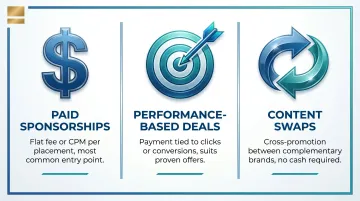
Three commercial models dominate:
- Paid sponsorships — flat fee or CPM (cost per thousand impressions) per placement; the most common entry point
- Performance-based deals — payment tied to clicks or conversions, which suits offers with proven demand
- Content swaps — two complementary brands cross-promote to each other's audiences at no cash cost
What makes this channel different is the inbox context: no algorithm controls delivery, no ad blocker strips your placement, and the reader chose to be there. That combination is rare in paid media today.
How Newsletter Partnerships Work
Newsletter partnerships follow four operational stages. Understanding each prevents the most common failure points: mismatched audiences, weak creative integration, and attribution gaps that make ROI invisible.
Initiation: Finding and Vetting the Right Newsletter
D2C brands identify newsletter partners through five evaluation criteria:
Demographic fit: Age, income, interest vertical, and geographic concentration must align with your ideal customer profile. A premium skincare brand targeting affluent women 35–55 belongs in lifestyle or wellness newsletters—not broad news digests.
Engagement over size: A 10,000-subscriber newsletter with 40% open rates and 4% CTR outperforms a 100,000-subscriber list at 20% opens and 0.5% CTR. Request CTR data specifically — open rates are inflated by Apple Mail Privacy Protection.
Tone alignment: The newsletter's voice must match your brand positioning. House of Summary's publications — Presidential Summary, Geopolitical Summary, Dubai Summary, and London Summary — attract executives who expect factual, no-nonsense content. Brands with similar values resonate; brands relying on hype clash.
Publisher transparency: Ask for media kits with historical performance data, audience breakdowns, and advertiser case studies. Established newsletters with formal sales processes provide detailed rate cards.
The outreach process:
Cold outreach via email requesting media kits works for smaller publishers. For established networks, use newsletter ad marketplaces like Paved (3,000+ newsletters), beehiiv Ad Network (75,000+ newsletters reaching 350 million monthly readers), or SparkLoop Partner Network. These platforms provide filtering by niche, pricing, and engagement benchmarks.
With a shortlist of vetted partners in hand, the next step is negotiating terms and deciding how your ad will actually appear.
Core Operation: How the Ad Actually Runs
Execution centers on three main formats:
Sponsored blurb (50–150 words): A short paragraph with headline, body copy, and CTA embedded within a regular newsletter issue. Best for consistent reach over time with minimal creative lift. Works well for awareness and retargeting known audiences.
Dedicated send: The entire issue belongs to your brand — no competing content. You control design, messaging, and CTAs. Higher cost but maximum share of voice. Ideal for product launches, major promotions, or list-building campaigns with lead magnets.
Native editorial placement: Your product or story woven into editorial content by the newsletter writer rather than appearing as labeled advertising. More expensive and requires publisher trust, but drives higher engagement because it reads as recommendation rather than promotion. House of Summary's network excels at this format — their specialized editorial voices covering global news, geopolitics, and regional city summaries make native integrations feel organic, not interruptive.
Creative submission process:
D2C brands typically provide core assets: headline, body copy (75–150 words for sponsored blurbs), CTA with destination URL, and optional image. The publisher adapts these to match their editorial voice — this authenticity drives clicks. A wellness newsletter might soften hard-sell language; a finance publication might add data context.
This is the fundamental difference from display advertising. There's no bidding system, no algorithm deciding who sees your ad, no ad blockers intercepting delivery. Your message lands in a real inbox, beside content the subscriber actively chose to read.
Tracking and Control: Measuring What Happened
Performance measurement splits into publisher-side and brand-side metrics:
Publisher-side metrics:
- Click-through rate (CTR): Percentage of recipients who clicked your link
- Sponsorship clicks: Total raw click count
- Click-to-open rate (CTOR): Clicks divided by opens (averages 5.63%–10.5% across industries)
Brand-side metrics:
- Landing page conversion rate
- Customer acquisition cost (CAC): Total sponsorship spend divided by new customers acquired
- Return on ad spend (ROAS): Revenue attributed to the placement divided by spend
Tracking implementation:
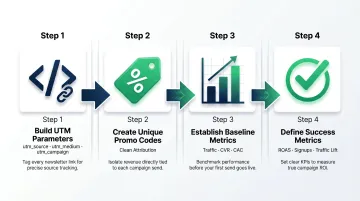
Before the send date, append UTM parameters to every destination URL (utm_source=newsletter_name, utm_medium=email, utm_campaign=campaign_id). This enables Google Analytics to attribute traffic and conversions. Create unique promo codes if offering discounts — this provides clean attribution independent of click tracking.
For advanced measurement, use tracking pixels on your landing page to capture post-click behavior. Some platforms like Paved offer proprietary tracking pixels that close the attribution loop automatically.
A successful deal tracks both sides. A 5% CTR means nothing if landing page conversion is 0.2%. Conversely, a 15% landing page conversion rate with only 0.5% CTR suggests audience mismatch, not offer weakness.
Output: What D2C Brands Get
Newsletter partnerships deliver four core outcomes:
Net new customer acquisition at known CAC: Unlike brand awareness plays with fuzzy attribution, newsletter placements with proper tracking provide cost-per-acquisition data. Retail and ecommerce brands using email marketing report average ROI of 45:1 ($45 in revenue for every dollar spent).
Email list growth: If using a lead magnet (free guide, discount code requiring email signup), newsletter placements can build your owned list. This extends value well past the initial send.
Brand awareness in premium context: Appearing alongside trusted editorial content in newsletters like House of Summary's Presidential Summary or Geopolitical Summary positions your brand with executives and professionals — a halo effect impossible to achieve through display ads.
Repeat exposure for sustained campaigns: Multi-issue placements build frequency. Subscribers seeing your brand three times across three weeks develop familiarity that one-off display impressions can't match.
Types of Newsletter Partnerships D2C Companies Should Know
Sponsored Placement (Most Common)
A D2C brand pays for a defined ad slot—usually 50-150 words plus CTA link—inside a regularly published newsletter issue. Pricing typically ranges from $10-$75 CPM for consumer newsletters and $50-$100+ for B2B specialized content, according to beehiiv benchmarks. Paved platform data shows the most-rebooked newsletters charge $6.53-$23.01 CPM depending on targeting precision.
Best for: Testing new audiences, building consistent brand presence, and reaching niche communities without full creative control requirements.
Example: A D2C supplement brand sponsors a weekly health newsletter with a 100-word blurb highlighting third-party research supporting their key ingredient, plus a 15% discount code for first-time buyers.
Dedicated Send or Solo Newsletter
The publisher sends an entire issue devoted to your brand. You control design, messaging, and all CTAs. The subscriber's full attention focuses on your content with zero competing messages. Higher cost—often 2-3x a standard sponsorship—but maximum share of voice. Casper has successfully used this format for mattress launches.
Best for: Product launches, major sales events, lead generation campaigns with robust lead magnets, and brands confident in their audience fit.
Risk factor: No editorial cushion means weak offers or mismatched messaging will underperform dramatically. Test with sponsored placements first.
Newsletter Content Swap
Two non-competing D2C brands or a D2C brand and complementary newsletter cross-promote to their respective audiences at no cash cost. This works when both parties have similar list sizes (ideally within 30% of each other) and comparable engagement rates.
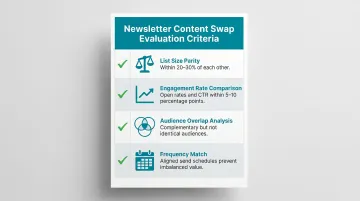
Evaluation criteria for equitable swaps:
- List size parity (within 20-30%)
- Engagement rate comparison (open rates and CTR within 5-10 percentage points)
- Audience overlap analysis (complementary but not identical—a yoga apparel brand and meditation app newsletter make sense; two competing skincare brands don't)
- Frequency match (both send weekly, or both monthly—mismatched send schedules create imbalanced value)
Best for: Early-stage D2C brands building reach without cash outlay, and established brands entering adjacent categories where audience crossover is high.
Native or Editorial Integration
Native integration means your product or story appears inside editorial content, written by the newsletter author rather than labeled as an ad. The brand pays premium rates—often 50-100% above standard sponsorships—but the placement reads as a recommendation, not a promotion.
This format requires brand-publisher trust and commands higher budgets, but engagement rates run notably higher because subscribers treat it as editorial endorsement rather than advertising. It performs best in specialized, opinion-driven newsletters.
House of Summary's publications—Presidential Summary (global news), Geopolitical Summary (international politics), Dubai Summary (UAE lifestyle and business), and London Summary (London-focused content)—are built around trusted, specialized editorial voices. Native integrations in these environments feel organic to readers rather than interruptive, making them particularly effective for luxury goods, fintech products, and premium services requiring context and storytelling.
Why Newsletter Partnerships Work for D2C Brands
The Inbox Advantage
Newsletter ads reach audiences in a fundamentally different attention environment than social or display advertising. While display ads compete with infinite scroll and get blocked by 32.5% of internet users globally, newsletter ads land directly in inboxes where subscribers have already demonstrated intent by opening the email.
Engagement comparison:
Email achieves average open rates of 35.63%-43.46% across industries (Mailchimp and MailerLite 2023-2025 data), with ecommerce specifically seeing 29.81%-32.67% opens. Average email click rates run 2.09%-2.62%, roughly 4.5-5.7x higher than the Google Display Network's 0.46% CTR.
Newsletter ads also bypass ad-blocking entirely. Approximately 912 million users worldwide use ad blockers, with 62.9% citing "too many ads" as their reason. Because your placement is part of the email content itself, browser extensions have nothing to intercept.
The low-distraction environment matters. When someone opens their inbox to read a newsletter they subscribed to, they're in active reading mode, not scrolling past content to get to messages from friends. Your ad appears alongside content they chose, creating an implied endorsement that display ads lack.
That attention quality compounds when you factor in who is actually reading. ### Audience Quality: Self-Selection Creates Targeting
Newsletters with specialized editorial focus attract self-selected, high-intent readers. Targeting is built into the editorial identity itself, reducing wasted impressions.
A newsletter covering geopolitical analysis and international business, like House of Summary's Geopolitical Summary, naturally attracts executives, policy professionals, and globally mobile business leaders. A D2C brand selling premium business travel accessories or financial services doesn't need to layer behavioral targeting on top; the audience has already filtered itself through subscription choice.
ROI data supports this:
Email marketing delivers average ROI of $36 for every dollar spent, according to Litmus's 2025 State of Email report. For retail, ecommerce, and consumer goods specifically, that figure reaches 45:1. This nearly doubles returns from paid social, where rising CPMs and degraded targeting precision (post-iOS 14 ATT framework) have hurt returns per dollar spent.
House of Summary's network demonstrates this advantage clearly. With 500,000+ combined subscribers and 254,866+ emails opened daily, the platform reaches affluent decision-makers in wealth-dense markets: 66% US (concentrated in New York and Los Angeles), UK (London), and UAE (Dubai).
When BSH Hausgeräte ran a placement in Dubai Summary, CEO Faik Serkan Ergun reported click-through rates 4x higher than Google AdWords — a result he attributed directly to editorial tone alignment with high-intent readers.
That cost efficiency extends beyond audience quality into the mechanics of how newsletter partnerships are priced.
Cost Efficiency vs. Paid Social
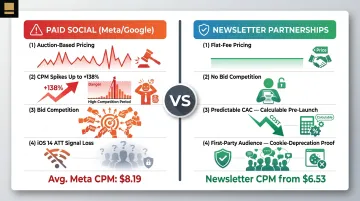
As auction-based platforms have grown more expensive and less predictable, newsletter partnerships offer structural cost advantages:
- Flat-fee pricing eliminates auction volatility. Meta CPMs can spike 138% during high-competition periods like Cyber Monday (per Gupta Media 2024 data); newsletter rates are negotiated once and fixed.
- No bid competition means your cost doesn't shift because a competitor increased spend or political ads saturated inventory.
- Predictable CAC is calculable before you commit. A $2,000 placement generating 800 clicks with a 5% landing page conversion rate yields ~40 customers at $50 CAC — before the campaign runs.
- First-party audience data is unaffected by third-party cookie deprecation or Apple's ATT signal loss, both of which have increased costs and reduced precision on Meta and Google.
Cost comparison:
Meta CPMs average $8.19 (2025), while newsletter CPMs range from $6.53 for broad-audience newsletters to $66 for highly targeted niche publications (Paved platform data). The higher end reflects premium audience quality. But when you factor in 4.5-5.7x higher click rates, cost-per-click often favors newsletters even at higher CPMs.
How to Find, Pitch, and Measure Newsletter Partnership Success
Finding the Right Newsletter Partner
Begin by defining exactly who you're trying to reach. Map your D2C brand's ideal customer profile — demographics (age, income, location), psychographics (values, interests), and behavioral patterns. Then search for newsletters whose editorial topic, reader demographic, and geographic reach align with that profile.
Three discovery methods:
- Newsletter ad marketplaces — Platforms like Paved, beehiiv Ad Network, and SparkLoop Partner Network let you filter by category, list size, engagement, and pricing. Media kits include historical performance data.
- Direct outreach — If your team already reads newsletters that match your ICP, email the publisher for a media kit. Premium newsletters often have formal rate cards and audience breakdowns.
- Competitive intelligence — Track where competitors advertise. Manual monitoring (subscribe to their emails, watch send patterns) or tools like Similarweb's email tracking reveal which newsletters deliver repeat investment.
Evaluation criteria when reviewing media kits:
- Click-through rate (not just open rate, which Apple MPP inflates)
- Audience breakdown by demographics and geography
- Send frequency and consistency
- Advertiser testimonials or case studies
- Exclusivity policies (will they run competing brands in the same issue?)
Pitching and Structuring the Deal
Once you've identified a promising newsletter, your initial outreach sets the tone for the partnership. Keep it concise and specific.
Your initial outreach should include:
- Brand introduction and target customer description
- Requested format (sponsored blurb, dedicated send, native placement)
- Proposed dates or timeframe
- Request for media kit, rate card, and audience data
Key negotiation points once the publisher responds:
- Placement and creative specs — Confirm word count, image requirements, CTA format, and whether the publisher adapts your copy or runs it as submitted.
- Send timing — Align with your campaign calendar. Avoid competing with major holidays unless the timing is seasonally relevant.
- Number of sends — Multi-issue campaigns often carry discounts. House of Summary, for example, offers multi-week and multi-issue packages that sustain brand presence at lower per-issue costs.
- Exclusivity — Negotiate whether the publisher will hold off on competing D2C brands in the same issue or within a defined window (for example, no other skincare brands for 30 days).
- Reporting access — Specify which metrics you'll receive (clicks, CTR, CTOR), delivery timing, and whether you'll get raw data or aggregated reports.
Setting Up for Measurement
Negotiating the deal is only half the work. Before the send date, put the right tracking infrastructure in place so results are attributable and actionable.
Before the send date:
Build UTM parameters into every destination URL. Use consistent naming conventions:
- utm_source=newsletter_name
- utm_medium=email_sponsorship
- utm_campaign=campaign_identifier
Create unique promo codes if using discounts. This provides clean attribution independent of click tracking — critical if users share links or access your site through multiple touchpoints.
Establish baseline metrics so you can measure lift. What's your current daily traffic, conversion rate, and CAC from other channels? Without a baseline, you can't isolate the newsletter's impact.
Define success metrics upfront based on campaign goals:
- Direct sales: Revenue attributed, ROAS, CAC
- Lead generation: Email signups, lead magnet downloads
- Brand awareness: Traffic lift, time on site, branded search volume increase
Evaluating Results and Deciding on Renewal
After the send, pull performance data within 48-72 hours (some conversions lag):
| Metric Type | What to Track |
|---|---|
| Publisher metrics | CTR, CTOR, total clicks delivered |
| Brand metrics | Landing page conversion rate, CAC (total spend ÷ new customers), revenue attributed via UTM or promo code, ROAS |

Compare against your blended CAC target. If your business model supports $75 CAC and the newsletter delivered customers at $52, that's a strong placement worth renewing or scaling. If CAC came in at $120, analyze before dismissing:
- Was the audience match wrong?
- Did the creative or offer underperform?
- Was landing page conversion the bottleneck (good CTR but poor on-site conversion suggests audience fit was right but offer execution weak)?
A weak placement isn't always a bad partner — it might be a fixable execution issue. Test creative variants or offers before abandoning the channel.
Frequently Asked Questions
What is a brand partnership?
A brand partnership is a collaboration between two or more companies to achieve shared marketing or commercial goals. In the newsletter context, this means a D2C brand paying or exchanging value to reach a publisher's subscriber audience through sponsored placements, content integrations, or dedicated sends.
What are the benefits of brand partnerships?
Newsletter partnerships offer several advantages over traditional paid channels:
- Access to opted-in audiences that already trust the publisher
- Shared credibility through association with editorial content
- Lower cost compared to rising paid social CPMs
- Clear attribution via UTM tracking and promo code revenue data
What are the three types of strategic partnerships?
The three most relevant to newsletter advertising are:
- Paid sponsorships — cash payment for a placement in a publisher's send
- Content or audience swaps — value exchange between complementary brands, no cash required
- Performance-based deals — payment per click or acquisition rather than a flat fee or CPM
What are the 4 types of partnerships in business?
The four primary models are affiliation/sponsorship, content partnerships, distribution partnerships, and product/licensing partnerships. Newsletter partnerships most closely map to content and distribution models.
What is an example of a brand partnership?
A D2C skincare brand sponsors a weekly wellness newsletter reaching 50,000 health-conscious readers. Their 100-word sponsored blurb appears below the main editorial content, citing a clinical study behind their hero ingredient and offering a 20% discount code. The format keeps the placement native to the newsletter while giving the brand direct access to an aligned, opted-in audience.