Introduction
Customer acquisition has gotten expensive — and unpredictable. According to L.E.K. Consulting, social media CPMs rose 22% year-over-year and search CPC climbed 23% YoY by Q4 2021.
Pair that with Apple's iOS 14.5 privacy update — which covered 57% of US mobile users, with only 25% opting into tracking — and the paid acquisition playbook that drove DTC growth through the 2010s starts looking unreliable.
Brands can't keep scaling on paid social alone. The ones finding sustainable growth are doing it through partnerships: shared audiences, co-created products, and direct-access media channels that bypass the algorithmic gatekeepers entirely.
That's what this guide is for. It covers the main partnership types, how to find and vet the right partner, how to structure the relationship, how to measure what matters, and what mistakes to avoid.
Key Takeaways
- Rising ad costs and privacy changes have made DTC partnerships a core growth channel — one brands can no longer ignore
- The four main partnership types are cross-brand collaborations, retail/wholesale, creator/affiliate, and newsletter media
- Audience intent drives conversions — a smaller, high-intent list consistently outperforms a large, disengaged one
- Define KPIs, roles, and communication cadence before launch to avoid misalignment mid-campaign
- Newsletter advertising delivers inbox-direct access to engaged readers without algorithms or ad blockers
What Is a DTC Brand Partnership and Why Does It Matter?
A DTC brand partnership is a mutual, value-sharing arrangement between two or more brands — involving shared audiences, co-created products, or joint distribution — where both parties contribute resources and share benefits. It's structurally different from a vendor or supplier relationship, where one party pays for a service.
The distinction matters. A transaction produces a single campaign spike and stops there. A partnership compounds over time — shared audiences grow, repeated exposure builds brand familiarity, and co-created content stays usable long after the original campaign ends.
Three structural pressures have pushed partnerships from a nice-to-have to a strategic necessity:
- Paid acquisition inflation — CPMs and CPCs rising 20%+ year-over-year erode margin on every paid campaign
- Privacy-driven tracking loss — iOS opt-out rates and third-party cookie deprecation make attribution on paid channels increasingly unreliable
- Platform volatility — algorithm changes on any major social platform can wipe out organic reach overnight
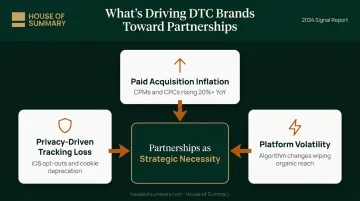
Partnerships address all three by giving brands direct access to audiences that are built, engaged, and reachable — no auction, no algorithm, no bidding against competitors for the same eyeballs.
Types of DTC Brand Partnerships
Cross-Brand Collaborations
Cross-brand collaborations (joint product launches, bundled offers, co-hosted giveaways, co-marketing campaigns) work best when two brands share overlapping customer demographics but don't compete directly.
Bombas partnering with Sesame Street for exclusive releases, DTC beauty brands pairing with meal kit companies, and food brands building campaigns with celebrity chefs are all documented examples of this format in practice. The common thread: one brand's audience becomes a warm introduction channel for the other. Neither brand has to pay to acquire those customers through an ad auction.
What makes this format work:
- Complementary categories (skincare + wellness supplements, fitness gear + nutrition)
- Comparable audience size so promotional effort feels balanced
- Genuine product or value overlap — not just a logo swap
Retail and Wholesale Partnerships
Physical retail solves a specific problem: digital-only acquisition has a ceiling. Warby Parker opened 41 new stores in 2024 — its highest annual count — and ended the year with 276 retail locations across the US and Canada, with mature stores generating over $2M in revenue at approximately 35% four-wall margins. Casper expanded through Target, Nordstrom, and Raymour & Flanigan alongside its own 66 retail stores.
Wholesale channels take a cut of revenue, but they deliver foot traffic and retailer trust that DTC brands spend years building on their own. For brands at scale, that exchange often makes sense. Key considerations when evaluating a retail partnership:
- Margin impact relative to projected volume lift
- Retailer audience overlap with existing customer base
- Operational readiness for wholesale fulfillment requirements
Creator and Influencer Partnerships
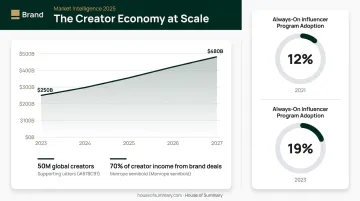
Goldman Sachs estimates the creator economy at roughly $250B in 2023, projected to reach $480B by 2027, with approximately 50 million global creators. Brand deals account for about 70% of creator income, making them the dominant revenue source — which means creators are highly motivated to make brand partnerships perform.
The distinction worth drawing: one-off influencer deals versus sustained affiliate creator relationships. One-off deals generate a spike. Long-term partnerships build creator familiarity with the product, produce reusable content assets, and generate deepening audience trust. Linqia found that 19% of enterprise marketers ran always-on influencer programs in 2023, up from 12% in 2021 — a clear directional shift toward sustained relationships.
For creator partnerships, effective structures include:
- Performance-based commission with milestone bonuses for consistent output
- Shared KPIs that align creator incentives with brand growth
- Ongoing content rights so assets can be repurposed in paid channels
Newsletter and Media Partnerships
Newsletter advertising gives DTC brands something paid social cannot: direct inbox access with no algorithm between the brand and the reader, no ad blockers filtering the message, and no visual clutter competing for attention. Mailchimp's 2023 benchmark data shows ecommerce email click rates averaging 1.74% — significantly above standard web display benchmarks.
Premium newsletter networks like House of Summary deliver this to engaged, high-intent audiences who have actively opted into the content they're reading.
House of Summary operates four specialized publications reaching 500,000+ subscribers, with 254,866+ emails opened daily. The audience profile — executives, policy professionals, and high-income consumers, with 66% US-based and concentrated in New York and Los Angeles — is difficult to reach through ad auctions at comparable intent levels.
For DTC brands targeting premium buyers, that concentration matters.
The advertising formats available span the full campaign spectrum:
- Native editorial placements embedded in the reading flow
- Display ads within the email body
- Full-issue takeovers for high-impact launches
- Multi-week packages for sustained brand exposure
Unlike display inventory, these placements reach readers who are already paying attention — not scrolling past.
How to Find and Evaluate the Right Partner
The Audience Alignment Test
The right partner's customer base should overlap with your target buyer in demographics and values, without the partner brand being a direct competitor. Classic complementary pairings: skincare + wellness supplements, fitness apparel + performance nutrition, productivity tools + premium coffee.
The deeper filter is shared intent: your target customer is trying to accomplish something specific, and the right partner brand serves that same goal from a different angle.
What to Vet Before You Reach Out
Run through this checklist before any outreach:
- Audience size and composition — raw numbers matter less than who those readers or followers are
- Engagement rate — Rival IQ's 2024 benchmark puts median Instagram engagement at 0.43% industry-wide, with retail averaging 0.226% — always benchmark against their category, not a universal number
- Content quality and brand voice consistency — review 60-90 days of content to see whether the tone and quality are stable
- Past partnership history — brands with a track record of short-term transactional deals rarely develop into sustained partners
- Audience intent signals — open rates and click-throughs signal real newsletter engagement; on social, saved posts and comment quality tell you more than likes
Once you've built your evaluation criteria, the next step is knowing where to find candidates worth vetting.
Where to Look
- DTC brand communities and Slack groups (e.g., DTC-focused founder communities)
- Industry trade events and conferences
- Shared agency or tech partner networks
- Media kits from newsletter publishers like House of Summary
Red Flags to Avoid
- Mismatched brand positioning (a budget brand partnering with a premium brand confuses both audiences)
- Vague or unverifiable audience data — any partner worth working with can show you real metrics
- History of frequent one-off campaigns with no sustained relationships
- Inconsistent messaging that suggests the brand hasn't defined its own identity
How to Structure a Partnership for Success
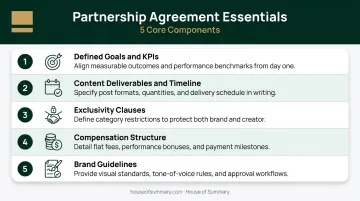
Getting the terms right before launch prevents 90% of partnership friction. Every partnership agreement should cover:
- Defined goals and KPIs: What does success look like for each party, and how will it be measured?
- Content deliverables and timeline: What gets produced, by whom, and when?
- Exclusivity clauses: Whether either party is restricted from working with competitors during the campaign window
- Compensation structure: Flat fee, revenue share, equity arrangement, or hybrid
- Brand guidelines: Approved tone, visual standards, pricing presentation, and messaging boundaries
Incentive Design for Long-Term Motivation
For creator and affiliate partnerships, a performance ladder maintains engagement beyond the launch campaign:
- Base commission for all qualifying conversions
- Milestone bonuses when hitting agreed targets
- Retainer rate for consistent, ongoing output
For co-marketing deals, define each party's promotional responsibilities explicitly — channel commitments, audience size guarantees, posting frequency — so neither side carries a disproportionate load.
Communication Structure
Strong incentive design only works if both parties stay aligned. Partnerships stall when communication is informal and infrequent, so build the cadence directly into the agreement:
- Set regular check-in intervals (weekly during campaign, monthly during sustained partnership)
- Share campaign performance data openly — both parties should see the same numbers
- Establish a feedback turnaround expectation so approvals don't become bottlenecks
- Acknowledge wins explicitly — partners who feel recognized are far more likely to renew and deepen the relationship
Measuring Partnership Performance
Core Metrics to Track
| Metric | What It Tells You |
|---|---|
| New customer acquisition volume | Raw growth from the partnership |
| Referral revenue | Direct revenue attributable to the partner channel |
| Cost per acquired customer vs. baseline | Whether the partnership beats your existing CAC |
| Engagement rate on co-branded content | Audience receptivity to the collaboration |
| Repeat purchase rate from partner-sourced customers | Long-term value of acquired customers |
Research from Wharton/GfK MIR found referred customers show 16% higher lifetime value and are 18% less likely to churn than non-referred customers, with a 25% higher contribution margin — though this data comes from banking, not DTC specifically, so treat it as directional, not a DTC benchmark.
Short-Term Signals vs. Long-Term Value
Impressions and clicks tell you the campaign ran. Lifetime value and sustained brand awareness tell you whether the partnership was worth doing.
The most effective partnerships build on themselves — audiences grow more familiar with your brand, content assets accumulate, and trust deepens across touchpoints.
Attribution Setup
None of that measurement is possible without clean attribution from the start. Before any campaign launches, put these basics in place:
- Create UTM parameters for all partner-sourced traffic (utm_source, utm_medium, utm_campaign at minimum)
- Use unique discount codes specific to the partnership
- Set up dedicated landing pages where possible so traffic isn't blended with other channels
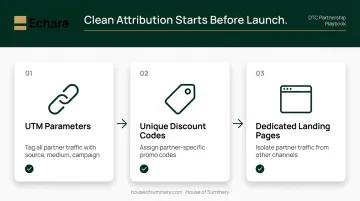
Without this baseline, you can't cleanly evaluate the partnership's contribution or compare it against other acquisition channels.
Common Mistakes DTC Brands Make with Partnerships
Most partnership failures trace back to three recurring errors — and all three are avoidable with better planning upfront.
Prioritizing Reach Over Fit
A large follower count or subscriber list means little if the audience doesn't match your buyer persona. A smaller, engaged audience with clear intent — like a curated newsletter readership — will consistently outperform a massive but passive following. Linqia's 2023 research found that 55.86% of marketers struggled with selecting the right partners, which explains why so many partnerships underdeliver.
Treating Partnerships as One-Off Transactions
A single campaign generates a spike. Sustained partnerships generate compounding returns:
- Repeated audience exposure that builds recognition over time
- Deepening brand familiarity across multiple touchpoints
- Reusable content assets that reduce future production costs
- Relationship capital that makes subsequent campaigns faster to launch
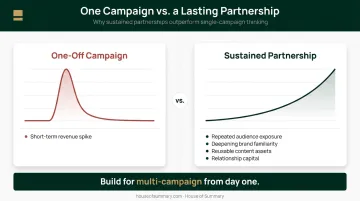
Build for multi-campaign agreements from the first conversation, not after the first results come in.
Skipping the Metrics Conversation
Linqia's 2023 data shows 60% of enterprise marketers cite measuring ROI as their top challenge with partnerships. The fix is straightforward: agree on KPIs before the partnership begins. Without defined success criteria, neither party can evaluate performance, resolve disputes, or improve future campaigns.
Frequently Asked Questions
What is a DTC brand?
A DTC (direct-to-consumer) brand sells products directly to end customers without relying on traditional retail intermediaries. These brands use owned channels — websites, email, apps — to control the full customer experience from discovery to purchase.
What are the biggest DTC brands?
Well-known examples include Warby Parker, Allbirds, Glossier, Dollar Shave Club, and Casper. Many have since expanded into retail partnerships — Warby Parker now operates 276 locations — while maintaining strong DTC foundations.
What types of partnerships work best for DTC brands?
Growth stage determines the best fit. Early-stage brands benefit most from cross-brand collaborations and newsletter media placements for cost-efficient reach. Scaling brands typically pursue retail wholesale expansion or long-term creator affiliate programs.
How do DTC brands find and approach potential partners?
Key sourcing channels include DTC brand communities, industry events, shared agency networks, and media platforms. A strong outreach pitch leads with shared audience value, not a generic promotional request.
How do you measure the success of a DTC brand partnership?
Track new customer acquisition, referral revenue, engagement on co-branded content, and lifetime value of partner-sourced customers. The critical step is setting a clean baseline — with UTM parameters and unique codes — before the campaign launches.
What is the difference between a brand partnership and influencer marketing?
Influencer marketing is typically a paid, transactional arrangement: compensation in exchange for content. A brand partnership is a mutual collaboration where both parties contribute resources and share benefits. The two overlap in long-term creator affiliate models, where performance-based incentives replace flat fees.