

Introduction
Brand partnerships are everywhere—from Nike + Apple creating Nike+ to Starbucks collaborating with Stanley on viral tumblers. Yet despite the surge in co-branded launches, sponsored content, and media collaborations, most fail to deliver meaningful business results.
The difference between a partnership that performs and one that just "looks good in a deck" comes down to strategy and execution.
This guide breaks down the types of strategic brand partnerships, why they succeed or fail, how to build one from scratch, and how to measure real impact.
What Is a Strategic Brand Partnership?
A strategic brand partnership is a deliberate, goal-oriented collaboration between two complementary brands designed to achieve shared outcomes—such as entering new markets, expanding audience reach, or strengthening brand credibility—that neither brand could accomplish as efficiently alone.
More Than a Logo Swap
What distinguishes a strategic partnership from a simple promotional deal? Strategy. A true partnership includes:
- Defined objectives tied to business outcomes
- Aligned audiences with measurable overlap
- Shared resources and mutual investment
- Clear KPIs established before launch
Logo placement or a one-off campaign doesn't constitute strategic partnership. Strategy requires planning, measurement, and accountability.
Why Partnerships Have Accelerated
Strategic partnerships have become a preferred growth lever for three reasons:
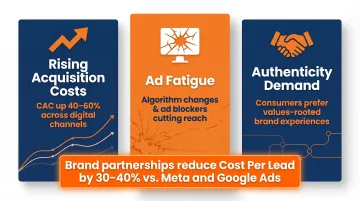
- Rising acquisition costs: Customer acquisition costs jumped 40-60% across digital channels between 2023 and 2025, making paid media increasingly expensive.
- Ad fatigue: Consumers scroll past traditional ads. Algorithm changes and ad blockers cut reach further — brands need channels where audiences are genuinely attentive.
- Demand for authenticity: Modern consumers value experiences that feel natural, not transactional. Partnerships rooted in shared values resonate more than interruptive advertising.
The numbers support this shift. Long-term brand partnerships reduce Cost Per Lead by 30-40% compared to Meta and Google ads — making partnerships one of the few high-ROI channels left as organic reach shrinks.
The 4 Main Types of Strategic Brand Partnerships
The type of partnership you choose should be driven by your growth objective, not by what looks impressive on paper. Understanding the differences between these four types helps you pick the right structure before committing resources.
Co-Branding Partnerships
Co-branding combines two brands' identities—names, logos, or products—to create a unified offering. This works best for limited-edition launches or campaigns rooted in a shared value.
Example: Nike + Apple created Nike+, combining athletic expertise with technology to build an entirely new product category. The collaboration succeeded because both brands brought complementary strengths (athletic credibility + digital innovation) to a shared audience (fitness-minded tech users).
When it works:
- Both brands have strong individual equity
- The product or campaign solves a real problem
- Cultural timing aligns with consumer values
- Audiences overlap but aren't identical
Content and Media Partnerships
Content and media partnerships involve brands co-creating or sponsoring content to reach overlapping, high-intent audiences. This approach has grown as brands look for channels where readers are actively engaged, not passively scrolling.
Newsletters and specialized publications offer a direct, algorithm-free path to those readers. Platforms like House of Summary provide access to verified, topic-specific audiences, with click-through rates up to 4x higher than standard digital ads — making them a high-signal channel for reaching executives, finance professionals, and business decision-makers who consume content with intent.
Why this works:
- Readers opt in and actively engage
- Content appears in a trusted editorial context
- No ad blockers or visual clutter
- Measurable engagement through click-through and conversion tracking
Distribution Partnerships
Distribution partnerships allow one brand to tap into another's established network or retail presence to reach new customer segments. This approach works especially well for market entry and audience expansion.
Example: A direct-to-consumer brand partnering with a major retailer to expand into physical stores and tap into gifting occasions. The DTC brand gains shelf space and credibility; the retailer gains exclusive product differentiation.
Best for:
- Geographic expansion
- New demographic targeting
- Entering new sales channels
- Building credibility through association
Cause-Related and Sponsorship Partnerships
Cause-related partnerships align a brand with a nonprofit on a shared social or environmental mission. Sponsorship partnerships provide financial or promotional support in exchange for visibility and association.
Critical requirement: These must be executed with transparency and genuine commitment. Consumers quickly identify opportunistic partnerships that lack authentic values alignment. When done well, cause partnerships build brand goodwill and emotional resonance.
Warning signs of performative partnerships:
- No long-term commitment beyond a single campaign
- Misalignment between brand actions and stated cause
- Lack of measurable impact or accountability
Why Strategic Brand Partnerships Work: Key Benefits
Audience Expansion
Partnerships give brands direct access to an established, trust-primed audience they would otherwise take years to build. The best partnerships offer qualified audience reach—not just impressions.
A luxury watch brand partnering with a financial newsletter reaches finance professionals already interested in premium products. That's not just reach; it's relevance.
Shared Resources and Credibility Transfer
Two brands pooling budgets, creative talent, and distribution capabilities can achieve campaign scale that neither could afford alone. Association with a trusted or complementary brand also accelerates credibility in new segments.
Research shows that brand image fit drives partnership success more significantly than product category fit. When consumers perceive compatibility between partner brands, credibility transfers asymmetrically — a lesser-known brand gains a meaningful lift from the reputation of a stronger partner.
Cost Efficiency and Market Acceleration
That credibility lift compounds with direct financial benefits. Co-marketing delivers measurable ROI advantages:
- Shore reduced customer acquisition costs by 35% through co-marketing and inbound partnership strategies
- G2 decreased cost per lead by 25% using LinkedIn ads combined with HubSpot marketing partnerships
- Partnerize platform users achieved 330% ROI through partnership automation and revenue growth

Partnerships function as a force multiplier, compressing the time and budget it takes to reach new markets when organic reach is shrinking and paid media costs keep climbing.
How to Build a Successful Brand Partnership: Step by Step
Most partnerships fail at the planning stage—not execution—because brands skip goal-setting and rush to creative. Follow this process framework to avoid that mistake.
Step 1: Define Goals and KPIs Upfront
Every partnership needs a clear primary objective before partner outreach begins:
- Audience growth
- Revenue generation
- Market expansion
- Brand credibility
Tie goals to measurable KPIs so both parties have accountability from day one:
- Referral conversions
- Email signups or subscriber growth
- Social reach and engagement
- Co-branded product revenue
- Media coverage and earned impressions
Without defined metrics, you can't optimize during the campaign or justify renewal afterward.
Step 2: Identify and Vet the Right Partner
Evaluate potential partners on core compatibility criteria:
- Shared or complementary audience demographics — do your audiences overlap in meaningful ways?
- Aligned brand values — do both brands stand for compatible principles?
- Non-competing positioning — are you complements, not substitutes?
- Proven execution history — has the partner delivered on past collaborations?
Warning: Don't select partners based on prestige alone. Brand name recognition doesn't guarantee audience overlap or strategic fit.
For brands targeting executives or decision-makers, specialized media partners — such as niche newsletters with verified, high-intent readerships — consistently outperform broad platforms on conversion. A newsletter with 50,000 engaged finance professionals delivers stronger ROI than a general platform with 500,000 passive followers. House of Summary's network, for example, reaches global executives across business, geopolitics, and finance with click-through rates 4x higher than Google AdWords.
Step 3: Develop a Shared Strategy and Messaging Framework
Both brands must co-develop campaign messaging, brand voice guidelines, visual standards, and a distribution plan before launch. Agree upfront on who creates content, who approves assets, how conflicts get resolved, and what the timeline looks like for each deliverable. Settling these details before launch prevents execution friction and ensures both parties understand expectations.
Step 4: Launch with an Omni-Channel Distribution Plan
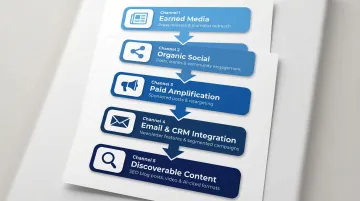
A partnership confined to a single channel leaves most of its potential value unrealized. A strong distribution plan spans multiple channels:
- Earned media — press releases, journalist outreach, and industry publications
- Organic social — posts, stories, and community engagement across platforms
- Paid amplification — sponsored posts, retargeting, and paid search
- Email and CRM integration — newsletter features, segmented campaigns, automated workflows
- Discoverable content — SEO-optimized blog posts, video, and formats built for AI citations
Each channel reinforces the others and extends campaign lifespan beyond a single moment.
Step 5: Review, Optimize, and Decide on Longevity
Schedule regular check-ins to review performance against pre-set KPIs. Use data to optimize creative, messaging, and distribution tactics mid-campaign.
After the campaign, decide whether to renew, expand, or conclude the partnership. The strongest partnerships evolve over time. Red Bull and GoPro, for instance, expanded from a single co-branded event into a multi-year content and distribution alliance — because both sides kept re-evaluating what was working and where to go next.
Why Brand Partnerships Fail (And How to Avoid the Pitfalls)
More partnerships are being launched than ever, yet failure rates remain high. The root causes are predictable and preventable.
Pitfall 1: No Audience Strategy
The most common failure mode is treating partnership reach as additive rather than qualified. Two brands sharing followers doesn't mean those followers are the right audience for either brand.
The fix: Conduct audience analysis before any partnership is agreed upon. Evaluate overlap, intent, and psychographics. A partnership should reach qualified prospects, not just inflate vanity metrics.
Pitfall 2: Forced or Misaligned Brand Values
Consumers quickly identify partnerships that feel transactional rather than authentic. When a collaboration doesn't naturally align with both brands' values, customer lifestyle, and product experience, it reads as opportunistic.
Brand image compatibility is a vital success driver. Partnerships that lack authentic values alignment can damage trust rather than build it.
What to do instead: Vet partners on cultural and values fit, not just audience size. If the partnership requires elaborate justification to make sense, it probably doesn't.
Pitfall 3: Single-Channel Execution Without Amplification
The "logo swap" and "mono-channel sweepstakes" failure modes are common: partnerships that live in one place — a single Instagram giveaway, a one-off pop-up event, a shared graphic — without earned media, CRM integration, or content built for lasting discoverability.
A campaign moment that isn't amplified across channels creates a short-term spike with no lasting value.
The fix: Build distribution across email, social, media coverage, and CRM into the partnership plan from day one. Every campaign should create assets (content, backlinks, media coverage, CRM data) that continue delivering value after the campaign ends.
Pitfall 4: No Measurement Plan
Partnerships without defined metrics from the start can't be optimized and are difficult to renew with confidence. Brands that skip KPI-setting often end up with anecdotal results, no clear data to justify continued investment, and no baseline to learn from.
The fix: Establish baseline benchmarks before launch. Agree on what success looks like numerically, and commit to regular performance reviews.
Measuring the Success of Your Brand Partnership
Measure brand partnerships across three primary categories:
Revenue Impact:
- Referral sales and attributed revenue
- Co-branded product sales
- Affiliate conversions and commission tracking
Audience Engagement:
- Email signups and subscriber growth
- Social interactions (shares, comments, saves)
- Content performance (page views, time on page, video completion)
Market Expansion:
- New demographics reached
- New geographies entered
- Media coverage and brand mentions in new verticals
Set baseline benchmarks before launch so post-campaign data is meaningful. Compare performance against solo campaigns to isolate partnership lift. That data only holds up if you review it consistently.
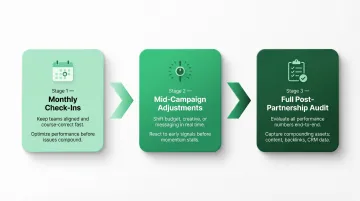
Implement a Practical Review Cadence
- Check in monthly — partner teams stay aligned and can optimize quickly before small misalignments become costly.
- Adjust mid-campaign — shift budget, creative, or messaging based on early performance signals rather than waiting for the final report.
- Run a full post-partnership audit — evaluate not just the numbers, but whether the partnership generated compounding assets (content, backlinks, media coverage, CRM data) that keep delivering after the campaign ends.
The Importance of Multi-Touch Attribution
Traditional last-click attribution undervalues partnerships. Because modern customer journeys span multiple touchpoints over extended timeframes, last-click models miss the crucial influence partners have during discovery and research phases.
When Zenni Optical refined its measurement approach beyond last-click attribution, it uncovered $1.5 million in previously hidden partnership value. Similarly, Rugs Direct experienced 600% year-over-year revenue growth after shifting to a multi-touch model that rewarded partners at both the top and bottom of the sales funnel.
The most durable partnerships are those where both sides can clearly point to measurable gains. If a partnership cannot demonstrate audience growth, credibility lift, or pipeline impact after a fair evaluation period, restructure or exit — don't renew out of inertia.
Frequently Asked Questions
What is a strategic brand partnership?
A strategic brand partnership is a deliberate collaboration between two complementary brands with shared goals, aligned audiences, and defined KPIs. Unlike a simple promotional deal or logo placement, it involves mutual investment, resource sharing, and measurable business outcomes.
What are the 4 types of partnerships?
The four main types are co-branding (combined identity or product), content and media partnerships (co-created or sponsored content), distribution partnerships (leveraging a partner's network), and cause-related or sponsorship partnerships. Each serves a different growth objective depending on your goals.
What are the 3 C's of partnership?
The 3 C's framework covers three predictors of partnership success:
- Compatibility — aligned values and overlapping audience profiles
- Complementarity — each partner brings distinct resources the other lacks
- Commitment — both sides invest resources and share accountability for outcomes
What are the effects of strategic brand partnerships?
Strategic partnerships expand audience reach, strengthen brand credibility through association, and reduce customer acquisition costs through shared marketing investment. When executed well, they also create compounding digital assets — media coverage, co-created content, and backlinks — that keep delivering value long after the campaign ends.
What is an example of a strategic partnership?
Nike and Apple's Nike+ collaboration is a classic example. It combined Nike's athletic credibility with Apple's technology expertise to build an entirely new product category — one neither brand could have created alone. Both brands served the same audience and integrated at the product level, not just through logo placement.