This is where newsletters become essential. Unlike social posts buried by algorithms or banner ads that consumers actively ignore, newsletters land directly in the inbox of people who opted in. They create repeated brand exposure in a focused environment, making them one of the most effective awareness tools available to D2C companies. Newsletters aren't just sales channels — they're content vehicles that build familiarity, trust, and recognition before asking for a purchase.
This article explores why newsletters work so well for D2C brand awareness, what types of content perform best, how to build a strategic approach, and how to measure results.
Key Takeaways
- D2C brands own their subscriber lists outright, making newsletters immune to algorithm changes, ad blockers, and platform volatility
- Educational content and brand storytelling build trust before any promotion — newsletters reward patience
- Brands can grow their own lists organically or reach engaged audiences by sponsoring established newsletters
- Open rates, click behavior, subscriber growth, and branded search trends are the clearest signals that newsletter awareness is working
- The inbox delivers undivided attention — something no social feed or display ad can reliably promise
Why D2C Brands Depend on Newsletter Marketing More Than Most
D2C companies face a fundamental awareness problem: without physical retail presence or third-party endorsement, they must build their own audience and create brand recognition from scratch. Awareness isn't a nice-to-have — it's the foundation of survival.
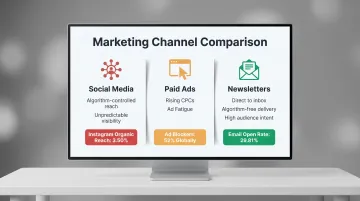
This makes newsletters uniquely valuable. While social media platforms limit organic reach through algorithmic controls, newsletters deliver directly to the inbox without interference. Mailchimp reports ecommerce email open rates average 29.81%, while Instagram organic reach averages just 3.50% and Facebook hovers between 1.20-1.65%. That's an 8-25x reach advantage for email.
Key differences between channels:
- Social media: Algorithm-dependent, unpredictable reach, cluttered environment
- Paid ads: Subject to ad blockers (used by 52% of consumers globally), banner blindness, high competition
- Newsletters: Direct inbox delivery, no algorithmic suppression, undivided reader attention
Beyond reach, newsletters represent an owned asset. A subscriber list can't be de-platformed or algorithmically throttled, making it a strategic long-term investment. Ad Age describes newsletter lists as "digital gold," noting that 86% of marketers prioritize first-party data for audience targeting.
That ownership advantage is compounded by attention quality. When someone opens a newsletter, they're in a focused environment — not competing with dozens of posts scrolling past simultaneously. Brand messages land in a space readers chose to be in, which is a different kind of reach entirely.
Real-world example: Glossier demonstrates this model perfectly. Emily Weiss launched Into The Gloss in 2010 as a beauty editorial blog, building a loyal content audience years before launching Glossier as a product brand in 2014. The editorial-first approach generated awareness that supported a billion-dollar valuation, built entirely on content before a single product hit shelves.
The Types of Newsletter Content D2C Brands Use to Build Awareness
Educational and Category Content
D2C brands often lead with education rather than promotion. Content that helps readers understand a problem — whether it's ingredient transparency in skincare, sustainable materials in fashion, or nutrition science — establishes the brand as a credible source before a product is ever mentioned.
The Glossier model exemplifies this well: Into The Gloss built authority in beauty through deep ingredient dives and personal routine coverage — long before a single product launched. Readers associated the brand with expertise, which drove both trust and recall across touchpoints.
Educational content works because it delivers value independent of the purchase decision, making readers more receptive when promotional content appears.
Founder and Brand Storytelling
D2C brands lean heavily on founder stories, origin narratives, and behind-the-scenes content to create emotional resonance. This level of authentic storytelling is rarely matched by traditional retail brands operating at scale.
Consistent storytelling across newsletter issues creates cumulative brand identity. Readers begin to feel like they know the brand personally — who started it, why it exists, what it stands for — and that familiarity drives both recall and word-of-mouth. For D2C companies, the founder's vision often is the brand's positioning.
Curated Roundups and Cultural Commentary
Some D2C brands publish curated industry news, trend roundups, or cultural commentary relevant to their audience. Content like this holds value independent of the brand's own products, positioning the newsletter as a resource worth keeping rather than just a sales vehicle.
The brand awareness benefit is powerful: when readers forward or share a newsletter for its standalone content value, it introduces the brand to net-new audiences without paid distribution costs. Litmus research shows that targeted messages sent to smaller, niche audiences are at least 90% more viral than untargeted messages, and forwarding occurs in high-trust, personal environments.
Social Proof and Community Highlights
Newsletters featuring customer reviews, user-generated content, community milestones, or subscriber spotlights build trust with prospective customers who are still forming their opinion of the brand.
Peer validation matters more for D2C brands because there's no in-store experience or retailer recommendation to substitute for it. The data backs this up:
- Consumers trust "a person like yourself" 2-3x more than a CEO or brand spokesperson
- Brands using user-generated content see an average 29% increase in web conversions
How to Build a Newsletter Content Strategy for D2C Brand Awareness
Define Editorial Identity First
Before planning any content, establish what the newsletter stands for: its tone, frequency, content pillars, and the value it delivers beyond product promotion. Without this foundation, newsletters become inconsistent and readers disengage.
Ask yourself:
- What problem does this newsletter solve for the reader?
- What unique perspective or expertise does our brand bring?
- What would readers miss if this newsletter disappeared?
Use the 70-20-10 Content Mix
Originally championed by Coca-Cola and Google, the 70-20-10 framework provides a practical content balance:
- 70% value-driven: Education, stories, and curation that help readers without asking for anything in return
- 20% brand-adjacent: Behind-the-scenes content, community highlights, and partnerships that build affinity without direct promotion
- 10% promotional: Product launches, sales, and product education
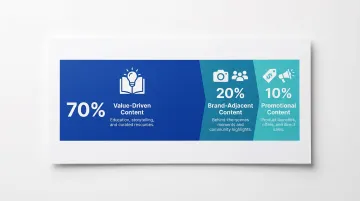
When 90% of content genuinely helps readers, the 10% that promotes earns its place — it doesn't feel like an interruption.
Establish Cadence and Consistency
Frequency matters for brand recall. Approximately 65% of email senders use a weekly cadence, and brands sending 2-4 campaigns per month report the strongest ROI. Weekly newsletters create anticipation — readers start looking for them, which is brand recall working exactly as intended.
Consistency outweighs volume every time. A dependable weekly send builds more recognition than an erratic mix of twice-weekly bursts followed by monthly gaps and sporadic sends.
Optimize Subject Lines and Preview Text
Even an unopened newsletter with a memorable subject line reinforces brand recognition in the inbox. 64% of recipients decide to open based on the subject line alone, and personalized subject lines increase open rates by 26%.
Subject line best practices:
- Reflect brand voice, not just clickbait tactics
- Keep to 2-4 words for maximum impact (these generate 46% open rates)
- Test personalization and urgency language where appropriate
- Avoid over-promising or sensationalism that damages trust
Growing Your Newsletter Audience: Building vs. Borrowing Attention
Organic List-Building Tactics
D2C brands use several organic tactics to grow subscriber lists:
- Gated content: Guides, quizzes, lookbooks that require email signup
- Referral programs: Incentivizing existing subscribers to share
- Pop-ups at checkout: Capturing email at point of purchase
- Social media cross-promotion: Driving followers to newsletter signup
Organic growth is slower but produces highly engaged subscribers. Average monthly email list growth rates hover around 2.5%, with an average annual churn rate of 22.5% from unsubscribes, bounces, and inactive accounts.
Advertising in Established Newsletters
D2C brands looking for faster awareness at scale can advertise within established, high-engagement newsletters whose audiences already match their target customer profile. This avoids the cold-start problem of building an audience from zero.
Compared to display ads and social media, newsletter advertising offers measurable performance advantages:
- Higher engagement: Newsletter sponsorships achieve click-through rates ranging from 1.3% to 12.5% by category, compared to 0.46% for Google Display ads
- Ad blocker immunity: Email/newsletter ads bypass browser-based ad blockers entirely
- Contextual trust: Ads appear within trusted editorial environments readers already value
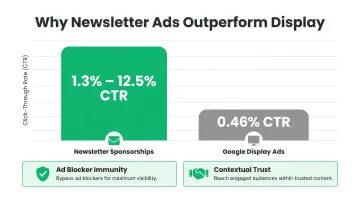
That contextual trust is what makes specialized newsletter networks a practical option for D2C brands targeting specific audience profiles. House of Summary, for example, publishes across geopolitics, global news, and city-focused content — reaching readers in the USA, UK, and UAE. Its network generates over 254,866 daily email opens, giving advertisers direct inbox access to decision-makers without competing against social feeds or search algorithms.
Measuring Newsletter Effectiveness for Brand Awareness
Primary Newsletter Metrics
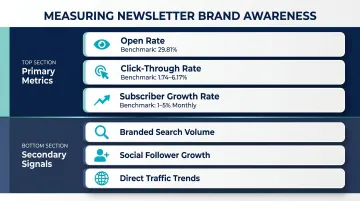
Track these core metrics specifically for awareness goals:
Open rate: Ecommerce newsletters average 29.81% open rates, though Apple's Mail Privacy Protection (introduced in 2021) inflates these figures — treat them as directional signals rather than hard benchmarks.
Click-through rate: Ecommerce newsletters average 1.74% CTR, while media and creator newsletters average 6.17% — a meaningful gap that reflects audience depth and content relevance.
Subscriber growth rate: Healthy growth benchmarks fall in the 1–5% net monthly range. Sustained growth signals that awareness-building efforts are translating into real audience expansion.
These differ from conversion metrics — conversion rate, revenue per email, subscriber lifetime value — so evaluate them separately when measuring awareness rather than sales. They answer a different question: not "did subscribers buy?" but "are they paying attention?"
Secondary Brand Awareness Indicators
Primary metrics tell you whether subscribers engage with content. These secondary signals tell you whether that engagement is moving the needle on actual brand recognition:
- Branded search volume increases: Spikes in searches for your brand name after newsletter sends
- Social media follower growth: Correlated with newsletter cadence
- Direct traffic trends: Increases in direct website visits following issue distribution
Qualitative Brand Awareness Measurement
Litmus research shows 45% of brands fail to track email through to conversions, and only 17% measure ROI. That gap is significant — quantitative metrics alone can't tell you what readers actually think of your brand.
Implement periodic subscriber surveys asking:
- What do you associate our brand with?
- Have you recommended us to others?
- Where did you first hear about us?
- What content topics are most valuable?
Run these surveys quarterly. The answers give you a baseline to track over time — and often surface the brand associations you're building without realizing it.
Frequently Asked Questions
What is the role of content marketing in brand awareness?
Content marketing builds awareness by consistently putting a brand in front of its target audience through valuable, non-interruptive content. For D2C brands specifically, this replaces the shelf presence or word-of-mouth that traditional retail provides, creating repeated exposure that drives recognition and recall.
What are the 5 pillars of brand awareness?
The five pillars are brand recognition, brand recall, brand identity, brand trust, and brand association. Newsletters reinforce all five by delivering consistent, credible content directly to subscribers in a trusted environment.
What is the 70-20-10 rule in content marketing?
The 70-20-10 rule suggests allocating 70% of content to deliver direct value to the audience, 20% to brand-related but non-promotional content, and 10% to direct promotion. This ratio prevents subscriber fatigue by ensuring most content serves the reader first.
How often should D2C brands send newsletters for awareness building?
Weekly is the most recommended cadence for awareness-building, as it balances consistency with reader tolerance. Brands should establish a predictable rhythm rather than sending irregularly, which undermines awareness efforts.
How do newsletters compare to social media for building D2C brand awareness?
Newsletters deliver to the inbox without algorithmic suppression, while social media reach is subject to platform controls that cap organic visibility. For D2C brands, newsletters are an owned channel — immune to throttling — making them more reliable for long-term awareness building.
How do you measure brand awareness from a newsletter campaign?
Track open rates, click-through rates, subscriber growth, branded search lift, and direct traffic trends. Supplement these with periodic subscriber surveys to capture brand recall that quantitative metrics won't show.