
Introduction
Without the credibility transfer of a retail partner or physical storefront, D2C brands face a distinct challenge: every customer touchpoint must independently build trust. Most channels make this harder, not easier — algorithms suppress organic reach, and ad fatigue means even well-funded campaigns struggle to make a lasting impression.
Newsletters cut through both problems. Subscribers actively opt in, messages land directly in the inbox without algorithmic filtering, and the format creates a recurring relationship rather than a fleeting impression. According to EmailToolTester's 2025 analysis, email open rates average 15-25% while organic social reach languishes at just 2-4%.
That gap explains why more D2C brands are treating newsletters as their primary authority-building channel. This article breaks down the specific mechanics: which content types work, what editorial standards matter, and how to measure whether it's actually moving the needle.
Key Takeaways
- Newsletters reach opted-in audiences directly — the most reliable D2C trust channel available
- Authority builds through editorial credibility and consistent cadence, not promotional volume
- Original insights, curated expertise, and founder voice outperform promotional copy
- Track reply rates, forward rates, and content click-throughs — not follower counts
- Consistency compounds: reliable newsletters become trusted reference points over time
Why Newsletters Are the Highest-Trust Channel for D2C Authority
The Structural Advantage of Direct Inbox Access
Unlike social media feeds or search results, newsletters land in a space readers have personally curated — no algorithmic suppression, no ad blockers, no competing posts fighting for the same eyeballs.
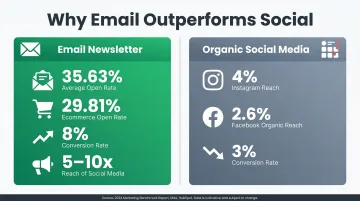
Mailchimp's 2023 benchmark data shows the average email open rate across industries is 35.63%, with ecommerce averaging 29.81%. Compare that to social media: Instagram posts reach just 4% of followers, while Facebook organic reach has dropped to 2.6%.
The gap is massive — email delivers roughly 5-10x the reach of organic social media. More importantly, email conversion rates average 8% versus social media's 3%, according to EmailToolTester.
The D2C Credibility Gap
Traditional retail brands benefit from borrowed authority: when a product sits on a retailer's shelf, the retailer's reputation transfers to the brand by association. D2C brands have no such proxy. Every brand perception, every trust signal, must be built directly through owned channels.
For D2C brands, content marketing in newsletters is the primary mechanism for earning that trust. Without a retail intermediary, the brand must show up consistently — demonstrating real expertise and delivering genuine value — until it earns the credibility that shelf placement once handed over for free.
Opt-In as a Trust Accelerator
A newsletter subscriber has already taken action — they've provided their email address and expressed interest. This opt-in dynamic differs sharply from interruption-based advertising. Research from EmailOpShop demonstrates the power of permission: opt-in lists achieved 2x higher open rates, 8x more clicks, and 15x better conversion rates compared to non-opt-in lists in a controlled head-to-head test.
Each newsletter issue either deepens or erodes that initial trust. The subscriber has given you permission to show up in their inbox. Keeping it means earning that right, issue after issue.
Inbox Undivided Attention
When someone opens a newsletter, they're typically focused on that content alone, unlike the fragmented attention of social scrolling. Litmus research from 2022 found that 29% of opened emails were read for more than 8 seconds, with 41% skimmed for 2-8 seconds. While the average read time is just 9 seconds, that focused attention window is yours alone — no sidebar ads, no viral video pulling attention away mid-sentence.
House of Summary operates within this model at scale: a network of specialized newsletters delivering verified, factual content to over 500,000 subscribers, with 254,866 emails opened daily. With no algorithms standing between brand message and audience, the inbox-direct model gives editorial content the space to build genuine authority — something no social feed can reliably replicate.
The Content Types That Build Real Authority in D2C Newsletters
Original Insight and Proprietary Data
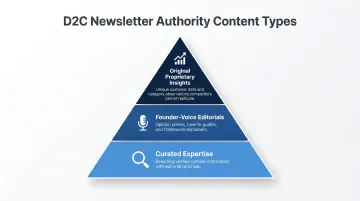
D2C brands sit on a continuous stream of proprietary customer data: purchase patterns, product usage trends, feedback signals. When synthesized and shared thoughtfully, this positions the brand as an industry knowledge source rather than just a seller.
Don't recycle generic industry news — publish original observations drawn from your unique vantage point. If you're a skincare D2C brand, share aggregated customer skin concern data, seasonal purchase patterns, or ingredient efficacy insights from your customer feedback loop. This proprietary perspective is impossible for competitors to replicate and signals deep category expertise.
Curated Expertise
Original data earns attention; what you do with outside information earns trust. High-quality curation demonstrates editorial judgment — and editorial judgment is a form of authority. Curation is not aggregation. The difference:
- Aggregation: Reposting links with no commentary or context
- Curation: Selecting the most relevant, verified information with clear editorial rationale and brief commentary
Effective curation requires:
- A point of view and selection criteria
- Context or brief editorial take on why this matters
- Consistent quality standards and verification before sharing
House of Summary's approach exemplifies this: verifying everything before it reaches the inbox, filtering out noise, and focusing only on what matters. This editorial standard separates trusted newsletters from link dumps.
Founder-Voice and Brand-Perspective Editorials
Strong curation shows you know the landscape. A direct editorial voice shows you have a position in it. Readers connect with perspective and conviction — not corporate-neutral copy. A founder's or editor's voice builds authority faster because it reveals what the brand believes about its category, not just what it sells.
Effective editorial content includes:
- How-to guides tied to your product category
- Framework explainers that demonstrate domain expertise
- Opinion pieces that take a clear stance on industry issues
- Behind-the-scenes product development narratives
Balance is critical. The principle: keep the ratio heavily educational. CMI guidance emphasizes delivering "information and answers your audience wants—not your brand's messages and self-promotional gimmicks."
Exclusive Content as a Loyalty Signal
Voice and perspective earn subscribers. Exclusivity keeps them. Reward the relationship with:
- Early access to product launches or sales
- Subscriber-only data or insights
- Behind-the-scenes updates
- Content not available on social media
This signals that the newsletter is a primary channel, not a repurposed social feed. Exclusivity reinforces the value of staying subscribed and reduces churn.
Editorial Standards That Separate Authority Newsletters from Noise
Accuracy and Verification: Non-Negotiable
Readers are getting better at detecting unreliable sources — and they remember which newsletters burned them. A D2C newsletter that fact-checks, cites sources, and publicly corrects errors builds a reputation that compounds over time. Research from Cardiff University (2023) found that misinformation can influence consumer decision-making even when consumers aren't aware of it.
One misleading or inaccurate piece can significantly damage subscriber trust. Conversely, consistently accurate content compounds into a reputation for reliability.
Verification practices that build authority:
- Cite sources for statistics and claims
- Confirm dates, data, and context before publishing
- Exclude claims that cannot be verified
- Issue public corrections when errors occur
Specialization Over Breadth
A D2C skincare brand's newsletter that goes deep on skin science will always outperform one that drifts into general wellness. Readers come back to sources that know their subject — not sources that cover everything loosely.
The more precisely a newsletter is defined by topic and audience, the more it becomes the go-to reference for that specific reader. Focused newsletters with tightly defined audiences consistently outperform broad ones on engagement — because readers recognize when content was written specifically for them.
Apply specialization strategically:
- Define your niche clearly and stick to it
- Go deep rather than wide on your core topic
- Resist the temptation to cover tangential subjects just because they're trending
- Build expertise in one area before expanding
Consistency of Editorial Voice
Readers develop a relationship with a newsletter's tone and perspective. Erratic shifts—from educational to promotional to casual without transition—signal inconsistency that undermines authority.
Develop and maintain editorial voice by:
- Choosing one tone (formal, conversational, educational) and sticking to it
- Creating a simple style guide for your writers
- Reading drafts aloud to catch tone shifts
- Reviewing several issues together to ensure consistency
Transparency and Corrections Culture
Brands that acknowledge mistakes, update outdated information, and show their reasoning earn more trust than those projecting infallibility. A "we got this wrong" editorial note—handled well—strengthens subscriber trust.
Transparency doesn't require airing every internal debate. It means being honest about what you know, what you've updated, and why.
- Publicly correct errors in the next issue
- Explain why you changed a previous position when circumstances warrant
- Share your editorial process or selection criteria occasionally
- Admit knowledge gaps rather than speculating
Consistency, Cadence, and the Compounding Authority Effect
The Compounding Dynamic
Authority isn't built by a single outstanding issue but by the accumulation of reliable, useful content over time. Readers who receive 52 issues per year of consistently strong content build a mental model of the brand as an authoritative source.
CMI's 2025 B2B research found that 87% of marketers report content marketing successfully created brand awareness, and top performers attribute success to understanding their audience (82%) and producing high-quality content (77%).
The implication is clear: no single brilliant issue builds authority. Sustained, reliable publishing does.
Choosing Your Cadence
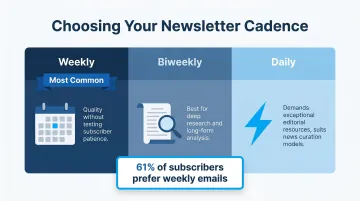
Beehiiv research analyzing billions of emails found that approximately 65% of email senders use a weekly cadence, while 16% send daily. Subscriber preferences show 86% want marketing emails at least monthly, 61% prefer weekly, and 15% want daily communication.
The right cadence is the one you can maintain at your quality standard. A weekly newsletter delivered with editorial rigor will outperform a daily newsletter that becomes thin and repetitive.
Guidance by frequency:
- Weekly — Most common for D2C brands; gives enough runway for quality without testing subscriber patience
- Biweekly — A stronger fit when deep research or long-form analysis is your baseline standard
- Daily — Demands exceptional editorial resources; works best for news curation models built for speed
Erratic publishing patterns — weekly for a month, then silence for three weeks, then twice in one week — signal unreliability and erode trust faster than any drop in quality.
Newsletter Fatigue vs. Genuine Authority
Subscriber fatigue is usually a relevance problem, not a volume problem. A newsletter with tight topic focus and high editorial standards rarely feels like fatigue to its target reader — each issue earns its place in the inbox.
Epsilon research cited by CMI found that 64% of people unsubscribe because content was irrelevant, not because they received too many emails. Relevance and value matter more than volume.
How D2C Brands Measure Authority Growth Through Newsletters
Vanity Metrics vs. Authority Metrics
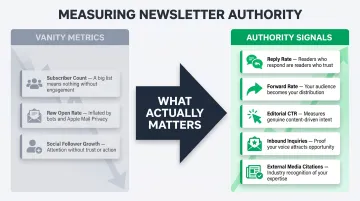
Subscriber count and open rate matter, but they don't directly measure authority. Authority-specific signals include:
- Reply rate: Readers replying directly signals your content prompts genuine thought and action — not just consumption
- Forward rate: Readers recommending your newsletter to others is a strong authority indicator; track it inside your email platform since no standard benchmark exists
- Inbound inquiry quality: Press mentions, partnership requests, or speaking invitations that cite your newsletter show authority reaching beyond your own list
These three metrics work together. Once you have a baseline on each, click-through behavior on your editorial content adds another layer of measurement.
Engagement Depth: Click-Through on Editorial Content
In newsletters, click-through rate on editorial content (as opposed to promotional links) signals that readers trust your judgment enough to act on your recommendations.
- Mailchimp reports ecommerce email click rates average 1.74%
- Campaign Monitor data shows retail at 0.7% CTR, while media/publishing reaches 2.9%
- Higher CTR on curated links or educational resources indicates editorial authority
Tracking editorial CTR separately from product links tells you whether readers follow your judgment — not just your promotions.
Quantitative metrics like these capture behavior. What they can't capture is how your newsletter registers outside your own subscriber base.
Qualitative Authority Signals
Beyond platform metrics, watch for:
- Brand mentions in external media that reference your newsletter
- Newsletter content cited by other publications or newsletters
- Subscriber-sourced referrals to your D2C products
- Requests for expert commentary or partnership
When these signals appear consistently, your newsletter has become a source others cite — not just a channel you own.
Frequently Asked Questions
What is the role of content marketing in building brand authority?
Content marketing builds authority by consistently demonstrating expertise through useful, accurate information. Over time, this creates a reliable reference point that readers return to, translating into brand preference and purchase intent as trust deepens.
Why are newsletters more effective than social media for D2C brand authority?
Newsletters reach an opted-in audience directly in the inbox without algorithmic filtering. Readers who sign up have already expressed interest, creating a higher-trust environment than social feeds where attention is fragmented and organic reach is cut to 2-4%.
How often should a D2C brand send newsletters to build authority?
Weekly is the most common and effective cadence for most D2C brands. Daily or biweekly can work if editorial standards hold, but inconsistency damages authority more than lower frequency. Reliability is what readers actually remember.
What type of content works best in D2C newsletters for building authority?
Three content types consistently perform well:
- Original insights or data tied to your category that competitors can't replicate
- Curated industry information with a clear editorial perspective
- Educational content that helps readers make better decisions without overt promotion
How do D2C brands measure whether their newsletter is building authority?
Focus on reply rates, forward rates, and content-driven click-through rates as core engagement signals. External indicators like media citations, newsletter mentions, or partnership inquiries are the clearest signs that authority is actually taking hold.
Can a small D2C brand build real authority through a newsletter without a large budget?
Yes. A small brand with genuine domain knowledge and a consistent editorial voice can build real authority through a newsletter. Authority is earned through quality and consistency over time, not spending power.