](https://file-host.link/website/houseofsummary-bjb54o/assets/blog-images/1234d441-d648-4637-a690-e922ecf4720f/1778527982856846_e21aeacb7eb243cb8651a9e7d89d88ae/360.webp)
The catch? Results vary dramatically. Audience selection, campaign sequencing, ad creative, and timing relative to launch phases determine whether your campaign drives meaningful conversions or wastes budget on misaligned placements.
This guide walks through the exact steps to plan a product launch campaign alongside newsletter advertising: when this approach fits, what inputs are required, which variables drive results, and the common mistakes that derail campaigns before they start.
Key Takeaways
- Start by matching your product to the right newsletter audiences, then sequence ads across pre-launch, launch day, and post-launch phases
- Newsletter advertising bypasses ad blockers and reaches readers directly in their inbox — no algorithms, no distractions, no competing banner ads
- Before your first ad runs: set launch goals, write phase-specific copy, align on audience fit, and build your tracking infrastructure
- The most common failures: single-placement buys, mismatched audiences, and copy that clashes with editorial tone
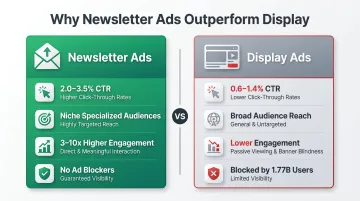
- Newsletter advertising delivers 2–5% click-through rates — compared to 0.6–1.4% for display ads
How to Plan a Product Launch Campaign Using Newsletter Advertising
Step 1: Define Your Launch Goals and Match Them to Newsletter Audience Categories
Clarify your primary objective before selecting any newsletters. Are you driving pre-orders, generating waitlist sign-ups, building brand awareness in a new market, or converting high-intent buyers on launch day? Each goal dictates different placement strategies and ad formats.
Audience categories matter more than raw subscriber count. A finance executive reading a geopolitics-focused newsletter represents a fundamentally different prospect than a casual social media scroller.
Niche, segmented audiences significantly outperform broad lists: a newsletter with 20,000 highly engaged subscribers often outperforms a list of 200,000 with low open rates.
Evaluate newsletter demographics against your target customer:
- Look for specialized newsletter networks serving verified, niche readerships
- Business and global affairs publications attract media buyers, executives, and decision-makers
- Platforms like House of Summary operate networks of specialized newsletters covering global news, UAE, London, and geopolitical topics, reaching high-intent readers primed for substantive content
- Upper-income adults are 40% more likely to read newsletters than lower-income adults
Set measurable KPIs for each launch phase:
- Pre-launch: Impressions, open-rate reach (awareness metrics)
- Launch day: CTR, sign-ups, purchases (conversion metrics)
- Post-launch: Repeat visits, follow-through purchases (retention metrics)
Step 2: Structure Your Newsletter Ad Sequence Across Launch Phases
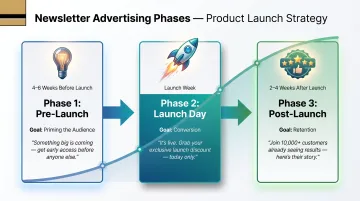
Plan newsletter placements across three distinct phases rather than booking a single ad. Each phase serves a different role in the buyer's journey.
Pre-launch placements (4-6 weeks before launch):
- Introduce the product category and tease a key benefit
- Direct readers to a waitlist or landing page
- The goal is priming, not selling so that launch day content lands on familiar ground
- Example: "We're solving [specific problem]. Join 2,000+ on the waitlist."
Launch-phase placements (launch week):
- Carry a clear CTA and highlight your most compelling differentiator
- Create urgency through limited offers or launch-day exclusives
- This is your highest-spend phase ; coordinate timing with your announcement across other channels
- Example: "Now live: [Product] delivers [specific outcome] in [timeframe]. First 100 orders get [bonus]."
Post-launch placements (2-4 weeks after launch):
- Feature social proof: early customer results, press coverage, testimonials
- Extend limited offers or re-engage readers who saw earlier ads but didn't convert
- Example: "500+ customers are already using [Product] to [achieve result]. Here's what they're saying."
Research shows potential customers need at least seven brand exposures before making a purchase decision. A properly sequenced campaign lets each ad build on the last, so by launch day readers already recognize the brand and are primed to act.
Step 3: Create Newsletter Ad Copy That Works Within an Editorial Environment
Newsletter readers engage differently than social media audiences. Ads placed in premium editorial environments should respect reader intelligence and match editorial tone. Disruptive or overtly promotional copy consistently underperforms.
Structure each ad with three elements:
- Sharp opening line acknowledging a real reader pain point or context
- Concise value statement explaining what the product does and why it matters now
- Single, direct CTA with one clear action
Tailor messaging to each launch phase:
- Pre-launch: Build curiosity without revealing the full picture
- Launch: Be direct and conversion-focused
- Post-launch: Lead with outcomes and what early adopters actually experienced
Native ads receive 52% more views than display ads and achieve 4x higher CTRs because they read as natural extensions of surrounding content. Applying that logic to newsletter copy means:
- Write in the same style as the publication's editorial voice
- Include exactly one link per placement
- Avoid jargon-heavy language that alienates readers
- Test 2-3 copy variants per phase using unique tracking links
Step 4: Set Up Tracking, Measure Performance, and Optimize Mid-Campaign
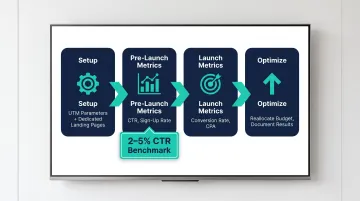
Before the first ad runs, set up three tracking fundamentals:
- UTM parameters for every placement
- Dedicated landing page (or unique URL slug) per newsletter publication
- Conversion goal configured in your analytics tool
Define phase-specific metrics:
- Pre-launch: Click-through rate and landing page sign-up rate (audience fit)
- Launch week: Conversion rate and cost-per-acquisition
- Post-launch: Return visit rate and downstream purchase behavior
Newsletter advertising benchmarks show good performance as 2-5% CTR and 10-15% click-to-open rate (CTOR). Compare your results against these standards.
Optimize during the campaign window:
- Identify which audience categories convert at the highest rate
- Reallocate budget from underperforming placements to high-performers
- Document which newsletters delivered the best CTR, which copy angles performed, and optimal timing for your next launch
When Should You Use Newsletter Advertising for a Product Launch?
Newsletter advertising isn't the right fit for every launch. It works best when your product has a defined, high-intent audience that overlaps with established newsletter readership — and when you have enough lead time to run a phased sequence.
Ideal use cases:
- B2B product launches targeting executives, finance professionals, or business decision-makers
- Luxury or premium consumer products seeking brand-safe, distraction-free environments
- International or regional launches where publications serve region-focused but globally oriented readerships (House of Summary's Dubai Summary reaches UAE professionals; London Summary targets UK decision-makers)
- Products requiring context or explanation before purchase, since editorial newsletters provide surrounding content that puts your product in the right frame of mind before they click
Not every launch is a match, though. When it's not the right fit:
- Products with extremely broad mass-market appeal requiring high-frequency impressions at low cost
- Launches with zero lead time that cannot support a phased ad sequence
- Categories where newsletter audiences don't closely match your target customer profile
What You Need Before Running Newsletter Ads for Your Launch
Most launch campaigns that underperform in newsletter channels share the same root cause: the ads were booked before the fundamentals were locked. Getting these three areas right before you spend a dollar ensures your placements reach the right readers at the right moment.
Audience and Publication Research
- Identify newsletter categories aligning with your buyer persona by industry, geography, or content interest
- Request audience demographics, average open rates, and advertiser case studies
- Verify subscriber bases are organically grown, not incentivized
- Specialist vertical newsletters command $20-$50 CPMs versus $5-$12 for generalist B2B, because their readers are decision-makers with specific purchase intent — not passive browsers
Campaign Assets and Infrastructure
- Live, tested landing page with tracking links and conversion goals configured
- Finalized ad copy for each launch phase, with at least two headline variants per placement for A/B testing
- Creative meeting publication format specs (character limits, image requirements, CTA guidelines)
- UTM parameters defined for each placement
Budget and Timeline Planning
- Allocate spend across all three launch phases (typically heavier weighting on launch phase)
- Book placements 3-4 weeks in advance — premium newsletters typically require this lead time
- Confirm publication send dates map to your launch calendar — pre-launch placements must drop before your announcement, not after it
Key Parameters That Affect Newsletter Ad Results During a Launch
Understanding these variables allows you to make intentional trade-offs when planning your campaign. Each parameter below can amplify or limit your results depending on how deliberately you manage it.
Audience Specificity and Engagement Quality
Narrowly defined, niche readership puts your message in front of people who are more likely to recognize your product's relevance — reducing wasted impressions and improving CTR. According to research from ReachEffect, email and newsletter advertising delivers 2.0–3.5% CTR compared to display ads at 0.6–1.4%. Specialized newsletters focused on business news, global affairs, or regional markets consistently outperform generic email lists, with newsletter ads delivering 3–10x higher CTRs than display or social equivalents.
Ad Placement Position Within the Newsletter
Where your ad appears — top of issue, mid-issue, standalone, or native integration — determines how much attention it captures before reader fatigue sets in. Consider these placement tiers when negotiating:
- Top-of-issue placements grab the most attention and typically yield the highest engagement
- Native-style integrations outperform standard banner slots by blending with editorial content
- Mid- or bottom-of-issue placements cost less but show diminishing returns
Ask publishers for placement-level performance data and weigh the cost difference against expected uplift before committing.
Message Progression Across the Launch Sequence
Readers who see a coherent narrative unfold across pre-launch, launch, and post-launch ads respond better than those encountering a single isolated message. Sequence continuity builds familiarity before asking for conversion.
Marketers need at least three sends to establish a reliable performance baseline. Recognition compounds by the 3rd or 4th placement — one-off campaigns miss this effect entirely and leave conversion potential on the table.
Timing Relative to Launch Day and Publication Schedule
Newsletter ads run on the publication's send calendar, not yours. Misalignment between your launch announcement and a newsletter's send schedule can result in pre-launch ads landing after your product is already public — undermining the entire sequencing strategy.
Book placements with confirmed send dates first, then build your launch calendar around them.
Common Mistakes When Running Newsletter Ads for a Product Launch
- Applying short, punchy social media creative to a newsletter context — readers here expect substance, and a one-liner with a stock image reads as out of place
- Relying on a single placement to carry the entire launch: one touchpoint won't convert readers who've never heard of your product
- Waiting until launch week to book, only to find premium publications are sold out or require 3-4 week lead times
- Writing ad copy without reading the newsletter first — ads that clash with the publication's voice feel intrusive and underperform regardless of how precise the audience targeting is
- Running placements without UTM parameters, unique links per placement, or conversion goals configured, making it impossible to trace which newsletters actually drove results

Conclusion
Planning a product launch campaign alongside newsletter advertising works best when audience alignment is verified upfront, placements are sequenced across all three launch phases, and ad creative respects the editorial environment readers trust.
Most newsletter ad campaign failures trace back to two root causes:
- Insufficient preparation — unverified audiences, late booking, or no tracking infrastructure in place before launch
- Single-placement thinking — treating newsletter advertising as a one-time broadcast rather than a sequenced engagement strategy
When inputs are right and execution is phased, newsletter advertising gives product launches a channel with no ad blockers, no competing visual noise, and a direct path to readers who are already paying attention. With 1.77 billion internet users blocking ads globally, that's a combination few other digital channels can match.
Frequently Asked Questions
How to promote a product launch?
Newsletter advertising anchors an effective launch strategy by reaching high-intent, opted-in audiences directly in the inbox — no algorithms, no ad blockers. Combined with social media, PR, and paid search, it delivers ROI of $36-$42 for every dollar spent.
What are the 7 steps of product launch?
The core sequence: (1) define goals and target audience, (2) plan pre-launch content, (3) select channels and book placements, (4) build assets and tracking, (5) run pre-launch awareness, (6) execute launch-day conversion push, and (7) analyze post-launch performance.
What are the 5 P's of product marketing?
The 5 P's are Product, Price, Place, Promotion, and People. Newsletter advertising serves the Promotion pillar directly, delivering targeted, contextually relevant messaging to specific audience segments.
What is newsletter advertising and why use it for a product launch?
Newsletter advertising places sponsored content inside a publisher's email, reaching subscribers who chose to be there. It's a high-trust channel that's particularly effective at launch — when brand credibility matters most and attention is scarce on every other platform.
How far in advance should you start newsletter advertising before a launch?
Pre-launch newsletter placements should ideally begin 4-6 weeks before launch day, with booking confirmed at least 3-4 weeks ahead given typical premium newsletter lead times. Book early — high-demand publications sell out inventory fast.
How do you measure the success of newsletter ads in a product launch?
Key metrics include click-through rate per placement (benchmark: 2-5%), conversion rate on the linked landing page, cost-per-acquisition across the campaign, and qualitative indicators like audience feedback or downstream sales lift attributable to newsletter-driven traffic tracked via UTM parameters and dedicated landing pages.