Introduction
Most new products fight for scraps of attention across crowded digital channels—social feeds where users scroll past in seconds, display banners killed by ad blockers, search results buried under better-funded competitors. One channel cuts through all of it: the inbox.
Newsletter readers are subscribers who opted in — a self-selected audience with genuine interest in what lands in their inbox. That's a fundamentally different relationship than a retargeted banner chasing someone across the web.
Unlike social ads competing against infinite scroll, newsletter placements appear in an environment readers deliberately return to. No algorithms. No ad blockers. No visual clutter competing for the same eyeball.
For brands launching a new product, that attention is the asset. This article covers the most effective paid strategies for newsletter-based launches, how to choose the right newsletter partner beyond raw list size, and which metrics actually signal success — not just clicks.
Key Takeaways
- Newsletter ads reach readers directly in the inbox — no algorithms, no ad blockers, no competing visual noise
- Sponsored placements, dedicated sends, sequenced campaigns, and native editorial ads consistently outperform standard display formats at launch
- Choose newsletters by audience fit and open rates, not subscriber count
- Ad creative must be concise and benefit-focused with one clear call to action
- Track new customer acquisition, promo code redemptions, and traffic spikes — not just clicks
Why Newsletter Advertising Works for New Product Launches
Newsletter advertising occupies a uniquely attentive moment. A reader opens an email they specifically requested, in a focused environment far less chaotic than their social feed.
The numbers reflect that attention. Average newsletter open rates hover between 15-25%, while social media organic reach barely reaches 2-4% on platforms like Facebook and Instagram. 88% of email users check their inbox multiple times daily, with 39% checking 3-5 times per day.
The performance gap widens when measuring engagement. At a glance, the channel comparison tells the story:
- Email newsletters: 2.90% average click-through rate
- Social media ads: 1.36% click-through rate
- Display advertising: 0.05-0.10% click-through rate
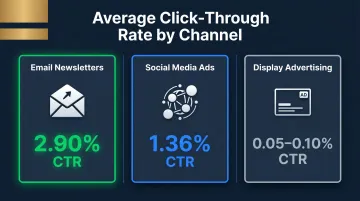
That gap directly impacts how many people actually see a new product launch — not just how many were theoretically served an impression.
Newsletter ads don't compete in real-time bidding auctions for feed placement. Once the newsletter sends, every subscriber sees the ad. No algorithm decides whether your launch announcement deserves visibility based on engagement history or paid boost spend.
Ad blockers can't touch newsletter advertising either. Email-based ads bypass ad blocker browser extensions entirely because they're delivered as content within the email itself, not served through ad networks. By contrast, only 36% of programmatic ad budgets reach valid, viewable, non-fraudulent impressions.
That reach problem doesn't exist with specialized newsletters, because the audience self-selects. A reader who subscribes to a fintech newsletter actively wants fintech content. A new product advertised there reaches genuinely interested prospects — not cold audiences assembled through broad demographic targeting.
Best Paid Advertising Strategies for a New Product Launch in Newsletters
Choosing the wrong newsletter ad format for a product launch doesn't just underperform — it wastes budget during the window that matters most. Each format below serves a distinct launch goal, whether that's building early awareness, driving day-one conversions, or sustaining momentum after launch week.
Strategy 1: Sponsored Placement (Single-Issue In-Newsletter Ad)
A sponsored placement embeds your branded ad block within a regular newsletter issue. The product appears alongside editorial content readers already trust, creating first-touch awareness with minimal commitment required from the reader.
Why this works for launches:
- Reaches readers who weren't actively looking — discovery happens in the flow of their normal reading
- Borrows the newsletter's established credibility, which carries over to your product by association
- Low barrier to entry for testing newsletter advertising before committing to larger spends
Effective sponsored placements follow a tight formula:
- Strong product headline (under 10 words)
- One to two benefit-focused sentences, not feature lists
- Product image where format permits
- Single clear CTA ("See what's launching →" or "Get early access")
Title sponsorships placed at the top of newsletters typically generate the best engagement compared to mid-roll or classified placements. Standard pricing ranges $1,000–$5,000 USD per placement depending on list size and focus.
Strategy 2: Dedicated Send (Solo Newsletter Blast)
A dedicated send devotes an entire newsletter issue exclusively to one advertiser's message. You control 100% of the reader's attention with no competing editorial content or other sponsors.
Why this suits high-consideration launches:
- More space to tell the product story, demonstrate benefits, and include social proof
- Complete narrative control for complex products requiring education
- Direct path from inbox to landing page without distraction
Dedicated sends cost significantly more than embedded placements, so timing matters. Reserve them for peak launch week and pair with sponsored placements in the weeks before to build awareness first.
One practical note: healthy CTR requires a maximum of 2 sponsors per issue. Newsletters running 5+ sponsors dilute results for every advertiser in that issue.
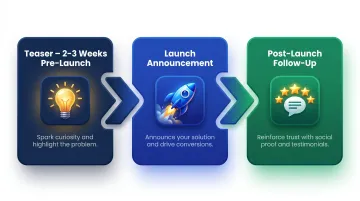
Strategy 3: Sequenced Multi-Issue Campaign (Pre-Launch → Launch → Post-Launch)
Single ad placements rarely drive successful launches alone. The most effective newsletter advertisers run sequenced campaigns mirroring a classic awareness-to-conversion funnel.
Campaign structure:
- Teaser ad (2-3 weeks pre-launch): Build curiosity without full product reveal. Focus on the problem your product solves rather than features.
- Launch announcement ad: Drive immediate traffic and conversions with full product details, pricing, and limited-time offer.
- Post-launch follow-up: Capture readers who didn't act initially. Highlight early reviews, social proof, or scarcity messaging.
Automated email sequences generate 320% more revenue than non-automated campaigns, and the same principle applies to sequenced newsletter advertising. House of Summary offers multi-week packages at meaningful discounts compared to single-issue placements, making this approach both effective and cost-efficient for sustained launch visibility.
Strategy 4: Native Editorial-Style Ad
Native newsletter ads appear as advertiser-written content formatted to match the newsletter's editorial voice. Instead of a traditional ad block, readers encounter a short article, product explainer, or "why we're excited about this" framing.
Performance advantage:
Native ads generate 53% more engagement than traditional display ads and increase purchase intent by 18%. Readers engage with content that educates or informs, reducing resistance to what feels like an interruption.
Transparency remains essential. Native ads must be clearly labeled as "Sponsored" or "Partner Content" to maintain trust. Written in the newsletter's natural tone with genuine value for the reader, native formats consistently outperform standard placements — especially for products that need context before a purchase decision makes sense.
Strategy 5: Audience Segment Targeting by Newsletter Vertical
Many newsletter networks publish multiple specialized titles across different verticals. Smart advertisers don't just buy any newsletter — they map their product's core buyer persona to the newsletter's editorial focus.
Strategic matching:
- Fintech product → Finance or business executive newsletters
- Luxury lifestyle product → Premium regional newsletters (e.g., Dubai Summary for UAE affluent audience)
- B2B enterprise tool → Geopolitical or executive briefings (e.g., Presidential Summary for US decision-makers)
- City-specific service → Regional publications (e.g., London Summary for London professionals)
The tighter the match between product category and newsletter focus, the higher the conversion rate. A reader already in business mode while reading a business newsletter is far more receptive to a business tool ad than someone scrolling a general interest feed — context does the pre-selling.
For advertisers targeting global business professionals without compromising audience quality, House of Summary's network — including Presidential Summary, Geopolitical Summary, Dubai Summary, and London Summary — reaches verified, engaged readers across wealth-dense metros in the US, UK, and UAE.
How to Choose the Right Newsletter for Your Launch Campaign
Newsletter selection can determine campaign success more than creative or offer alone. Three criteria matter most:
Audience Composition Over List Size
Who reads the newsletter matters far more than how many people subscribe. Request detailed demographics: profession, income level, geographic concentration, decision-making authority. A newsletter reaching 50,000 CFOs delivers more value for a fintech launch than one reaching 500,000 general consumers.
Engagement Metrics, Not Vanity Metrics
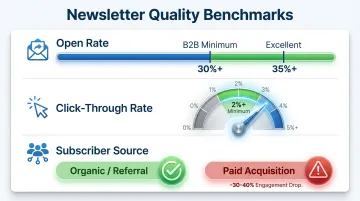
A newsletter with 80,000 subscribers and 45% open rate delivers more real impressions than one with 500,000 subscribers and 5% open rate. Industry benchmarks for quality newsletters:
- Look for 30%+ open rates in B2B newsletters; 35%+ signals excellent engagement
- Treat 2%+ click-through rate as the minimum bar for strong newsletter ads
- Prioritize organic or referral-grown subscriber bases — paid acquisition lists show 30-40% less engagement
Editorial Alignment and Context
The newsletter's tone and subject matter must align with your product's value proposition. A premium business tool advertised in an executive newsletter benefits from contextual relevance—the reader's mindset already matches your product category.
Always request a media kit before committing budget. Credible publishers provide:
- Open and click-through rates (not just subscriber count)
- Subscriber demographics and geographic distribution
- Past advertiser categories
- Placement options and pricing (CPM typically ranges around $40 for standard placements)
Publishers serious about advertiser success offer dedicated brand consultations and transparent reporting. House of Summary, for example, shares geographic breakdowns (66% USA, 18% UAE, 10% UK), daily open counts, and monthly click data upfront — the kind of transparency that lets you make informed decisions before you spend a dollar.
Crafting High-Converting Newsletter Ad Creative
Newsletter ads operate under constraints: limited space, primarily text-forward format, readers moving quickly through their inbox. Every element must work harder than in other channels.
Headline Carries Everything
Your headline creates the entire first impression. Subject lines with 20 characters or fewer achieve 37.6% open rates, while those exceeding 80 characters drop to 28.68%. For in-newsletter ad headlines, communicate your product's primary benefit in under 10 words.
Avoid clever wordplay that requires interpretation. State the value directly: "Automate your expense reports in 5 minutes" beats "The future of expense management."
Body Copy: Benefit-Led, Not Feature-Dumped
Follow your headline with one to two lines providing supporting proof or specificity. Don't list features—explain outcomes. The ideal newsletter ad body length hovers around 50-125 words total.
Readers scan newsletter ads fast — which is exactly why a single, focused call to action outperforms multiple competing options.
Single Call to Action
Emails with a single CTA receive 371% more clicks than those with multiple calls to action. That gap holds across industries, making CTA focus one of the highest-leverage decisions in newsletter ad creative.
Direct readers to one destination: your launch page, pre-order link, or product detail page. The CTA text should be action-oriented and launch-specific:
- "Be first to try it"
- "Get launch-day pricing"
- "Reserve your spot"
Avoid generic phrases like "Learn more" or "Click here" that fail to communicate value or urgency.
Match the Newsletter's Editorial Voice
Copy written by newsletter publishers typically outperforms brand-provided copy by 20-40% because it mirrors the trusted editorial tone readers expect. A factual business newsletter requires different language than a lifestyle publication.

Study several issues before writing your ad. Match sentence structure, vocabulary level, and tone. Readers should feel the ad fits naturally within the content they're already engaged with.
Measuring Your Newsletter Launch Campaign's Success
Newsletter advertising delivers faster feedback than most digital channels. A single send event produces measurable traffic and conversion impact within 24-48 hours, enabling rapid iteration during critical launch windows.
Track Beyond Click Rates
Standard email metrics (opens, clicks) matter, but launch-specific metrics reveal true impact:
- Promo code redemptions: Newsletter-exclusive codes provide clean attribution
- Direct traffic spikes: Correlate traffic surges with newsletter send dates using UTM parameters
- Landing page conversion rate: Segment by newsletter referral source to compare quality across publications
- New customer acquisition rate: What percentage of newsletter-driven purchases are first-time buyers?
For B2B launches, attribution windows of 30-90 days provide more honest conversion data than last-click attribution. Decision cycles extend beyond immediate clicks.
Benchmark Your Results
Performance expectations vary by product type and newsletter audience:
- B2B SaaS trial signup rate: 0.3-1% from newsletter ad clicks
- Demo request rate: 0.2-0.5%
- Cost per lead: $50-$200 for B2B newsletter advertising
- Net ROI: 3-8x over 12 months for mid-market B2B SaaS
Newsletter traffic typically shows 2x higher engagement (time on page, scroll depth) compared to LinkedIn traffic, indicating better-qualified visitors.
Demand Transparent Reporting
Negotiate post-campaign reporting with publishers before committing budget. Request:
- Total impressions (unique opens)
- Click-through rate
- Geographic breakdown of clicks
- Conversion data if tracking integration exists
Most publishers stop at open rates. House of Summary goes further — post-campaign reports include subscriber engagement metrics, ad click activity by placement, and geographic breakdowns, giving advertisers a clear picture of what actually moved the needle.
Frequently Asked Questions
How to advertise a new product launch?
A new product launch needs a multi-channel approach covering paid social, search, and newsletter placements. Newsletter advertising stands out because it reaches opted-in audiences in a distraction-free inbox — no algorithms to fight, no ad blockers to bypass.
Which type of advertising is used for new product launch?
Product launches typically employ social media ads, PPC search campaigns, display advertising, and sponsored newsletter placements. The best choice depends on whether the goal is mass awareness or reaching a specific, high-intent audience. Newsletter ads excel at the latter—reaching readers who already demonstrated interest in a relevant topic by subscribing.
What is an example of a product launch campaign?
Xembly, an AI productivity platform, used newsletter advertising through the beehiiv Ad Network to generate 109 qualified leads and 6,134 unique visitors. The campaign used sequenced placements across relevant business newsletters — multiple touchpoints that built familiarity and pushed readers toward conversion.
What are the 4 P's of product launch?
The 4 P's—Product, Price, Place, and Promotion—form the foundation of marketing strategy. Paid newsletter advertising fits squarely within the Promotion pillar, driving awareness and conversion at the right moment in the launch window by reaching opted-in audiences when they're actively engaged with relevant content.
What are the 5 C's of advertising?
The 5 C's — Company, Customers, Competitors, Collaborators, and Climate — frame how a brand positions its advertising decisions. Newsletter advertising maps directly to Customers (self-selected, high-intent subscribers) and Collaborators (publishers whose editorial credibility extends to the ads they carry).
Why are newsletter ads more effective than social media ads for a product launch?
Newsletter ads reach readers in a focused, algorithm-free inbox where the audience actively opted in. Social ads compete against infinite scroll and can be blocked or buried; newsletter placements cannot. Readers already trust the publisher, which extends naturally to the brands that appear alongside their content.