Introduction
According to Microsoft WorkLab, the average worker receives 117 emails daily. Most get skimmed in under a minute, deleted, or ignored entirely. Yet somehow, newsletters have carved out a different relationship with readers — one built on trust and a consistent reason to open.
Newsletters stand apart because of intent. A good one is written by someone who has already done the filtering — no algorithm decides what reaches you, no engagement bait crowds the feed. Just a focused digest from someone who knows the subject and respects your time.
This list covers 10 newsletters selected for editorial quality, credibility, and relevance to professionals who care about business, finance, technology, and global affairs. Each entry gives you enough to decide whether it belongs in your inbox.
Key Takeaways
- Newsletter open rates average 23.9% in media and publishing — Facebook's median post engagement sits at 0.063%
- The best newsletters share four traits: editorial independence, consistent publishing, high signal-to-noise ratio, and respect for reader intelligence
- Coverage spans business news, geopolitics, finance, technology, and long-form ideas
- Every entry includes publishing frequency, focus area, and the right reader for it
- Start with two or three — not all ten at once
What to Look for in a Newsletter Worth Your Time
Not all newsletters are created equal. Many are marketing emails dressed up as editorial content. The simplest test: would this still be valuable if it never linked to a product or service?
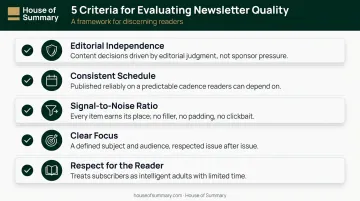
Apply these filters before subscribing:
- Editorial independence — does it have a clear point of view not shaped by advertisers?
- Consistent schedule — does it show up when promised, week after week?
- Signal-to-noise ratio — does every issue earn its place in your inbox?
- Clear focus — does it know exactly who it's writing for?
- Respect for the reader — does it explain without condescending?
One practical rule: if you haven't opened a newsletter in three consecutive sends, it doesn't belong in your inbox. The newsletters below were evaluated against every one of these criteria — here's what made the cut.
10 Best Newsletters to Subscribe To
Selection was based on editorial quality, reader trust, longevity, and relevance to globally minded professionals — not subscriber count alone.
Morning Brew
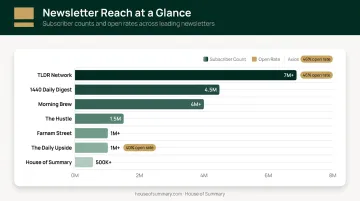
Founded in 2015 by Alex Lieberman and Austin Rief at the University of Michigan, Morning Brew has grown to 4M+ subscribers and remains one of the most recognized business newsletters in the world. What keeps readers coming back isn't just coverage — it's the tone. Dense financial and market content is made genuinely readable without being dumbed down. Each issue ends with a trivia question, which sounds small but actually resets the read from obligation to something closer to enjoyment.
| Frequency | Daily (weekdays) |
| Focus Area | Business, markets, tech, finance |
| Best For | Professionals who want a fast, readable business briefing each morning |
The Hustle
The Hustle covers entrepreneurship, tech, and business trends with writing that's deliberately human and occasionally irreverent. With 1.5M+ subscribers, it earned a 2024 Webby Award in the Business, News & Technology email newsletter category. HubSpot acquired it in 2021, though the editorial voice has remained distinct from its parent company's marketing-focused content. The writing treats readers as intelligent adults — informed without being dense, entertaining without sacrificing substance.
| Frequency | Daily (weekdays + Sunday Story) |
| Focus Area | Entrepreneurship, tech, business trends |
| Best For | Founders, startup operators, and professionals tracking fast-moving industries |
Axios AM
Axios AM launched in 2017 around a proprietary format called Smart Brevity — every story is structured around what happened, why it matters, and what's next. No filler, no throat-clearing. Axios-wide, newsletters average a 46% open rate, with 74% of subscribers interacting with email newsletters daily. For executives who need the day's most important stories in under ten minutes, the format is hard to beat.
| Frequency | Daily (seven days a week) |
| Focus Area | Politics, business, world news |
| Best For | Executives and decision-makers who need fast, structured morning briefings |
Politico Playbook
Politico Playbook is Washington's go-to morning briefing. The New York Times called original author Mike Allen "the Man the White House Wakes Up To" — and that framing has stuck because it's accurate. Playbook operates with sourcing and proximity to power that most outlets can't match, regularly surfacing context that mainstream news picks up hours later. For anyone tracking U.S. policy, regulatory risk, or political dynamics, it's essential reading.
| Frequency | Daily (weekdays) |
| Focus Area | U.S. politics, policy, government |
| Best For | Policy professionals, executives in regulated industries, political observers |
The Economist Espresso
Launched in 2014, The Economist Espresso delivers five short stories daily from The Economist's editorial team. The Guardian described it at launch as a "daily bite-size digital briefing" — that framing still holds, but undersells the analytical depth. Unlike most news digests that report events, Espresso frames each story with economic or geopolitical context. You leave knowing not just what happened, but why it matters and what comes next. Available as a standalone subscription or bundled with full Economist access.
| Frequency | Daily |
| Focus Area | Global economics, geopolitics, business |
| Best For | Global executives, investors, and professionals with international exposure |
Farnam Street (Brain Food)
Brain Food doesn't chase the news cycle. Sent every Sunday, Farnam Street's free weekly newsletter reaches over 1M readers and focuses entirely on mental models, decision-making, and the kind of thinking that compounds over time. It's the only newsletter on this list that asks not what happened this week, but how to think more clearly about what's always happening. For leaders already drowning in daily news, that distinction is the point.
| Frequency | Weekly (Sundays) |
| Focus Area | Mental models, decision-making, philosophy, ideas |
| Best For | Leaders and strategists focused on long-term thinking over short-term noise |

TLDR Newsletter
TLDR is a free daily newsletter covering technology, AI, science, and developer tools in five minutes. Its advertising network reports reaching over 7M tech professionals across 12 interest-based newsletters, with flagship TLDR Tech at 1.6M subscribers and a 46% open rate (publisher-reported). The real value is timing — TLDR consistently surfaces AI developments, startup funding rounds, and research papers before they hit mainstream coverage. For tech-adjacent professionals who need early signal, it's a reliable daily habit.
| Frequency | Daily (weekdays) |
| Focus Area | Technology, AI, science, developer tools |
| Best For | Tech professionals, investors, and business leaders monitoring the technology landscape |
1440 Daily Digest
1440 aggregates news from across the political spectrum and presents it without opinion or editorializing. With 4.5M subscribers according to Digiday's 2025 reporting, it's built its audience on a strict neutrality commitment — covering science, politics, culture, business, and sports from 100+ sources without telling readers what to think. For professionals who want a broad daily picture without calibrating for any outlet's editorial slant, 1440 solves the problem cleanly.
| Frequency | Daily |
| Focus Area | Multi-topic news (politics, science, business, culture, sports) |
| Best For | Readers who want balanced, fact-first news coverage without ideological framing |
The Daily Upside
Founded by Patrick Trousdale after stints at Guggenheim Securities and Bank of America Merrill Lynch, The Daily Upside covers markets, deals, and economic trends with the depth that financial wire services often lack. It crossed 1M subscribers in 2023 according to Business Insider, with publisher-reported engagement metrics of a 40% open rate. The Wall Street background of its editorial team shows in the coverage: writers understand deal structure, capital flows, and market mechanics rather than just reporting what moved.
| Frequency | Daily (weekdays) |
| Focus Area | Finance, markets, business strategy |
| Best For | Finance professionals, investors, and executives tracking capital markets and deal activity |
Geopolitical Summary by House of Summary
Geopolitical Summary covers international politics, conflicts, alliances, elections, and power shifts with a singular focus on what actually matters for global stability and trade. Published Monday through Saturday, the newsletter is part of the House of Summary network — which reaches 500,000+ subscribers with over 254,000 emails opened daily, with 66% of readers based in the U.S. and significant audiences in the UK and UAE.
What sets it apart from general news digests comes down to two things:
- Verification before publication — if a claim can't be confirmed, it doesn't run
- Analytical framing — each story is reported with cause and consequence, not just the event itself
It's built for readers who track geopolitics as a professional input, not background noise.
| Frequency | Monday–Saturday |
| Focus Area | Geopolitics, international relations, global power dynamics |
| Best For | Global executives, policy professionals, and readers who need to understand the world beyond borders |
How We Selected These Newsletters
Every newsletter on this list was evaluated against four consistent criteria:
- Editorial independence — does it maintain a clear, consistent point of view not driven by advertisers?
- Publish reliability — does it show up on schedule, consistently?
- Signal-to-noise ratio — does every issue earn its place in the inbox?
- Audience fit — is it written for people who take information seriously?
What was deliberately excluded: newsletters that exist primarily to drive product sales, publications with inconsistent publishing histories, and generic aggregators that pull headlines without adding editorial judgment.
The best newsletter stack depends on your role. A tech investor's reading list looks different from a policy analyst's, so this list is built for range. Use it as a starting point, not a mandate.
Conclusion
The inbox is one of the last communication channels you actually control — no algorithm, no ad blocker, no feed curating content based on your click history. The newsletters on this list have earned that space.
Start with two or three rather than subscribing to all ten. Give each one a month before deciding, and cut without guilt if it stops earning a read. The goal is a set of newsletters you actually look forward to opening, not a pile of unread tabs in your inbox.
For readers who want clear, verified coverage of global news and geopolitics delivered directly to their inbox, House of Summary's network of specialized newsletters — including Presidential Summary and Geopolitical Summary — is built exactly for that. Human-written, fact-checked, and published six days a week.
Frequently Asked Questions
What are the most successful newsletters?
By subscriber scale, the largest verified names include 1440 (4.5M), Morning Brew (4M+), and TLDR's network (7M+ across 12 newsletters). Success in newsletters is better measured by engagement than raw numbers — Axios reports a 46% average open rate, which matters more than headcount.
How do I choose the best newsletter to subscribe to?
Start with your professional role and information needs, then apply a simple test: does this newsletter consistently tell you something you didn't know and needed to? If yes after a month, keep it. If not, cut it and try something else.
Are newsletters worth subscribing to?
Email engagement outpaces organic social media across every available benchmark: media newsletters average 23.9% open rates versus Facebook's 0.063% median engagement. Newsletters arrive on a predictable schedule, written for a specific audience, bypassing algorithmic filtering.
What is the difference between a free and paid newsletter?
Free newsletters are typically ad-supported and cover broader audiences. Paid newsletters often offer deeper analysis, exclusive reporting, or direct writer access. Both can be high quality — The Economist Espresso charges a subscription fee; Morning Brew and 1440 are free and excellent.
How many newsletters should I subscribe to?
Keep the active list to five or fewer. Inbox fatigue is real, and consistent reading beats maximum subscription count.
What makes a newsletter different from a news website?
A newsletter is curated and delivered on schedule — the editor has already filtered for relevance before it reaches your inbox. A news website requires you to navigate, search, and decide what matters. Newsletters remove that friction at the source.