The Reuters Institute Digital News Report 2025 found that 40% of people across major markets now actively avoid the news — up from 29% in 2017. That's not apathy. That's exhaustion.
The inbox has quietly become the cleaner alternative. No algorithm deciding what you see. No infinite scroll. Just curated, edited content that arrives on a schedule and respects your time.
This guide cuts through the options and lists the top news newsletters worth subscribing to in 2026 — with a breakdown of what each does well and who each is best suited for.
Key Takeaways
- News newsletters bypass algorithmic feeds and deliver curated, verified content directly to your inbox
- The best options in 2026 stand out through editorial quality, clear topical focus, and consistent delivery
- Options span broad daily briefings (Morning Brew, The Skimm) to niche coverage in finance, tech, and geopolitics
- House of Summary's Presidential Summary and Geopolitical Summary are top picks for global political coverage without spin
- Start with 2–3 newsletters that match your specific reading goals — not everything at once
Why News Newsletters Are Worth Your Inbox in 2026
Social platforms have become genuinely unreliable news sources. Reuters Institute data shows Facebook referrals to news publishers dropped 48% in a single year, with X/Twitter down 27%. Meanwhile, 58% of people globally say they struggle to distinguish true information from false online — and national politicians and online influencers are each cited by 47% of respondents as the biggest sources of misinformation.
Newsletters solve three problems at once:
- Your subscription is a direct line to the editor — no algorithm decides what you see
- Inbox delivery doesn't shift based on a platform's product update or policy change
- Engagement dwarfs social: Morning Brew averaged a 40% open rate, The Daily Upside hit 45% at one million subscribers — versus Facebook's average news engagement rate of 0.15%
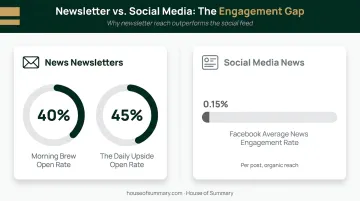
That engagement gap is why the newsletters below were selected on four criteria: editorial quality, defined topical focus, delivery consistency, and demonstrated reader trust.
Top News Newsletters to Subscribe to in 2026
Most news newsletters aggregate headlines. The ones below do something harder: they provide context, maintain a clear editorial standard, and respect the reader's time. These six were selected for editorial rigor, focused coverage, audience trust, and the ability to deliver clarity over volume — consistently.
Morning Brew
Founded in March 2015 as a college side project, Morning Brew has grown into one of the most widely read business news newsletters globally. As of July 2025, it reports over 4 million subscribers — making it one of the few newsletters that achieved genuine scale without sacrificing its editorial voice.
Its tone is what sets it apart. Morning Brew covers markets, economy, technology, and politics in under 10 minutes — brief analysis, substantive takeaways, and a writing style with personality but not flippancy.
| Detail | Info |
|---|---|
| Coverage Focus | Business news, markets, economy, politics, and technology — daily digest with headlines and brief analysis |
| Frequency | Daily (weekdays), with additional vertical newsletters for finance, tech, and HR |
| Best For | Business professionals and early-career readers who want a broad, well-curated morning briefing |
| Cost | Free |
The Skimm
Launched in 2012 by Carly Zakin and Danielle Weisberg, The Skimm built its audience — reported at more than 7 million subscribers as of 2022 — by doing one thing exceptionally well: translating complex news into clear, conversational language.
It covers politics, world events, health, finance, and culture without requiring readers to already be following a story. That contextualizing function is what distinguishes it from simple headline aggregation. If someone you know says they "don't follow the news," The Skimm is often the right starting point.
| Detail | Info |
|---|---|
| Coverage Focus | General news across politics, world events, health, finance, and culture — written in accessible prose |
| Frequency | Daily (weekdays), plus a weekend edition |
| Best For | General audiences building a news habit; readers who want clarity without jargon |
| Cost | Free tier available |
Tangle
Tangle launched on August 5, 2019 with a specific mission: cover U.S. politics without partisan framing. Each issue picks one major political story and presents the strongest arguments from across the ideological spectrum — left, right, and center — before founder Isaac Saul offers his own view.
Nieman Reports described Tangle in June 2025 as independent, non-partisan, and subscriber-supported, with readership across 55+ countries. Both Ad Fontes and AllSides rate it at "Center" bias. For anyone who wants to understand U.S. politics rather than have a predetermined conclusion delivered to them, Tangle is hard to replace.
| Detail | Info |
|---|---|
| Coverage Focus | U.S. political news with structured multi-perspective analysis — one story per issue, with left, right, center views and the author's own assessment |
| Frequency | Weekdays, with a weekend edition for paid subscribers |
| Best For | Civically engaged readers who want political coverage without ideological bias baked in |
| Cost | Free and paid tiers available |
House of Summary — Presidential Summary & Geopolitical Summary
House of Summary is an independent media company built around a clear editorial principle: verify everything before it reaches the inbox, or don't publish it. That standard applies across its network of four specialized newsletters, but Presidential Summary and Geopolitical Summary are the ones built for readers who need global and international political coverage done properly.
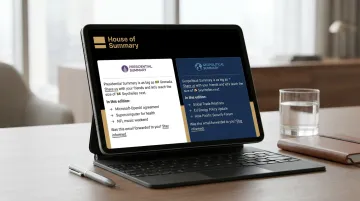
Presidential Summary (Monday–Saturday) delivers a morning briefing on key world events — politics, business, culture, and significant global developments — in a format that surfaces what matters without drowning readers in headlines. Geopolitical Summary (Monday–Saturday) takes a narrower, more specialized focus: international politics, how countries influence each other, diplomatic developments, and power shifts. It's the newsletter for readers who need to understand not just what happened, but what it means for the countries involved.
What distinguishes both newsletters is editorial discipline. As the company states: "We don't publish until every claim is confirmed. Our editors validate sources, check dates, trace data, and ensure context so you never get half-truths or headlines without substance."
That standard shows in the numbers. The network reaches 500,000+ subscribers with over 254,000 emails opened daily — an audience that skews toward executives, policy professionals, and finance decision-makers in the US, UK, and UAE. There's no sensationalism, no filler, and no algorithm standing between the editor's judgment and your inbox.
| Detail | Info |
|---|---|
| Coverage Focus | Presidential Summary: global current events, politics, business, culture. Geopolitical Summary: international politics, power dynamics, diplomatic affairs — both human-written and verified |
| Frequency | Monday–Saturday, direct to inbox |
| Best For | Executives, finance professionals, policy readers, and globally-minded readers who need accurate international coverage without noise |
| Cost | Free and paid tiers available |
The Daily Upside
Founded in 2019 by Patrick Trousdale, The Daily Upside fills a gap that most financial newsletters leave open: business and financial news with actual analytical context. Each issue covers markets, corporate developments, and macroeconomic policy in a way that explains causality, not just chronology.
Business Insider reported that The Daily Upside hit 1 million subscribers in August 2023 with a 45% open rate — and reached that milestone without raising institutional capital. It regularly surfaces stories that mainstream financial media underreports, which makes it a useful complement to broader news briefings.
| Detail | Info |
|---|---|
| Coverage Focus | Financial markets, business strategy, corporate news, and macroeconomic policy — with original analysis, not headline aggregation |
| Frequency | Daily (weekdays), delivered early morning |
| Best For | Finance professionals, investors, and business executives who need substantive market intelligence |
| Cost | Free |
POLITICO Playbook
POLITICO describes itself as the outlet used by Cabinet secretaries, ministers, and CEOs — and Playbook is its flagship daily newsletter. Columbia Journalism Review reported that Playbook generates roughly $20 million in annual ad sales, primarily from lobbyists and organizations trying to reach Washington insiders. That tells you something about who reads it and why.
Playbook's advantage is access. Its reporters are embedded in the political ecosystem and regularly break news before it reaches mainstream outlets. POLITICO employs 1,100+ publishing professionals and was acquired by Axel Springer in a deal valued at over $1 billion — an ownership structure that provides significant institutional backing.
| Detail | Info |
|---|---|
| Coverage Focus | U.S. political news, congressional developments, White House updates, and policy analysis |
| Frequency | Daily (weekdays), with regional editions for select U.S. states |
| Best For | Policy professionals, political operatives, lobbyists, journalists, and anyone tracking U.S. political developments |
| Cost | Free |
How These Newsletters Were Selected
The selection came down to four criteria: editorial quality and fact-checking standards, format clarity and consistency, a defined topical focus, and demonstrated reader trust reflected in either subscriber scale or editorial reputation.
A common mistake is subscribing to too many broad newsletters and ending up with inbox overload — leaving you less informed than before. The newsletters on this list were chosen because each one does something specific well, not because it tries to cover everything.
A few additional factors were weighted heavily:
- Frequency and reliability — does it show up when it says it will?
- Accessibility — is there a free tier, or is it paywalled behind a subscription?
- Respect for reading time — is it designed to be finished, not skimmed and archived?
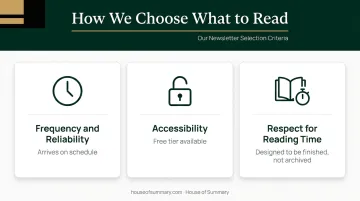
Brand size alone wasn't a deciding factor. Tangle and House of Summary made this list because they consistently hit all three criteria above — newsletters that arrive on schedule, offer free access, and are short enough to actually finish.
Conclusion
A well-chosen set of news newsletters is one of the more effective habits a professional can build. The right ones save time, cut through noise, and consistently surface what matters — without requiring extra effort on your end.
Start with one or two from this list that match your specific needs:
- Daily business coverage: Morning Brew or The Daily Upside
- U.S. political balance: Tangle
- Global and international politics (verified, specialist-written, no noise): House of Summary's Presidential Summary and Geopolitical Summary
Visit House of Summary to subscribe and see what clear, honest news looks like in your inbox.
Frequently Asked Questions
What are the most successful news newsletters?
Morning Brew (4M+ subscribers), The Skimm (7M+), and The Daily Upside (1M+) rank among the most widely subscribed. Subscriber volume, open rates, and editorial influence each tell a different story — the newsletter that "wins" on one metric often ranks lower on another.
Are news newsletters better than social media for staying informed?
For accuracy and focus, yes. Newsletters deliver curated, edited content directly without feed algorithms deciding what you see or trending topics drowning out substance. Newsletter open rates of 40–45% compare favorably to Facebook's average news engagement rate of 0.15%.
What should I look for when choosing a news newsletter?
Four things worth checking before you subscribe:
- Topical focus — does it cover exactly what you need, not everything at once?
- Editorial standards — is there visible fact-checking or named editorial oversight?
- Delivery frequency — daily, weekly, or as-needed should match your reading habits
- Format length — a 5-minute brief and a 20-minute deep-dive serve different purposes
A newsletter covering politics is not the same as one covering finance. Specificity matters.
How many news newsletters should I subscribe to?
Start with 2–3 focused newsletters rather than over-subscribing. A small, well-chosen set you actually read consistently delivers more value than a crowded inbox you skim and ignore.
Are the best news newsletters free or paid?
Many top newsletters — Morning Brew, The Daily Upside, POLITICO Playbook — are free. Paid tiers typically offer deeper analysis, ad-free reading, or exclusive content. A free newsletter with strong editorial standards will outperform a paid one with thin reporting every time.
What is the difference between a news newsletter and a news aggregator?
Aggregators pull headlines automatically with minimal editorial judgment. A quality newsletter applies human curation to select, contextualize, and often analyze stories — making it more reliable for readers who value accuracy over volume.