
For anyone tracking capital flows, making investment decisions, or simply trying to understand where this market is heading, the data is now too significant to ignore. This article breaks down what the numbers actually show, where demand is concentrating, and what structural forces are sustaining — and occasionally testing — the momentum.
Key Takeaways
- AED 252 billion in total real estate transactions in Q1 2026 — a 31% year-on-year rise in value, 6% rise in volume
- Off-plan apartments dominate residential demand, with Jumeirah Village Circle leading by volume
- Luxury real estate hit AED 87.71 billion in Q1 2026, up 26% year-on-year
- Foreign investment reached AED 148.35 billion, with 29,312 new investors entering the market — up 14%
- Dubai's D33 and Real Estate Strategy 2033 anchor long-term market confidence
Dubai Real Estate by the Numbers: Q1 2026 Transaction Snapshot
Dubai's Q1 2026 data released by the Dubai Land Department tells a clear story: AED 252 billion across 60,303 deals, representing a 31% increase in value and 6% increase in volume compared to Q1 2025.
Investment Activity
The investment component is particularly striking:
- 57,744 investment transactions totalling AED 173 billion — a 22% value rise
- 15,540 investments made by women, valued at AED 32 billion
- 48,448 total investors, of whom 29,312 were new to the market — up 14% year-on-year
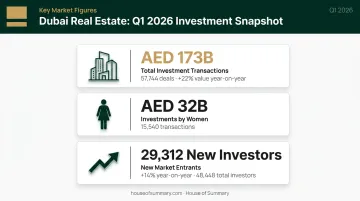
That last figure matters more than it might seem. New investor growth signals market accessibility, not just wealth concentration. That breadth shows up directly in daily deal volumes.
Single-Day and Landmark Deal Activity
The pace of transactions in early 2026 reflects that momentum. In March 2026, a single Monday recorded Dh3.8 billion across 1,194 deals, with sales reaching Dh2.93 billion and mortgage transactions at Dh718.3 million across 243 deals.
Individual deals from that period illustrate the range of transaction sizes:
- Dh377 million — Naïa Island beachfront residential plot
- Dh400 million — three Jumeirah beachfront plots (113,000+ sq ft, 160m of private beachfront), registered through DLD in March 2026
- Dh425 million — the Marble Palace in Emirates Hills (H1 2025's highest-value residential transaction, included here as a scale reference)
How Q1 2026 Compares to Full-Year 2025
The Dubai Government reported AED 917 billion in total 2025 real estate market activity across 270,000+ transactions. Separately, sales-only activity for 2025 totalled AED 682.5 billion across 214,912 transactions.
With Q1 2026 alone at AED 252 billion in total transactions, the market is pacing well ahead of 2025's already-record trajectory.
The Off-Plan and Residential Property Surge
Off-plan sales remain the dominant force in Dubai's residential market — though the mix has shifted since 2025's peak.
Where Demand Is Concentrated
In Q1 2025, off-plan sales accounted for 68.9% of sales transactions (29,100 transactions, AED 77.5 billion in value), according to Cavendish Maxwell's Q1 2025 residential report. By Q1 2026, that share had adjusted to 59% by volume and 49% by value — still dominant, but with more secondary market activity entering the mix.
Apartment transactions make up the largest share of Dubai's residential deals by volume. In Q1 2025, the property-type breakdown was:
- 76% apartments
- 16.9% townhouses
- 7.1% villas
Jumeirah Village Circle (JVC) leads residential activity overall — it recorded 18,773 sales in 2025 totalling AED 24.5 billion, and led off-plan apartment activity in Q1 2025 with 2,198 transactions. Business Bay, Dubai Marina, and Downtown Dubai remain active in the secondary apartment market.
The Villa and Townhouse Pipeline
While apartments dominate by volume, villa and townhouse off-plan demand is concentrated in master-planned communities:
| Community | Q1 2025 Off-Plan Transactions |
|---|---|
| DAMAC Islands | 1,430 |
| The Valley | 1,379 |
| DAMAC Hills 2 | 858 |
Full-year 2025 villa sales reached approximately 32,870 transactions, up 5.27% from 2024. The steady growth points to sustained demand for larger, family-oriented homes in communities like Dubai South and Dubailand.
The Off-Plan Investment Case
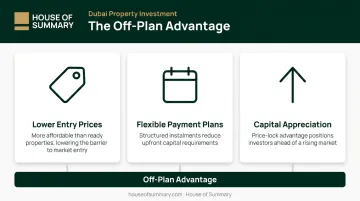
Three factors drive continued off-plan demand:
- Lower entry prices relative to ready properties in the same area
- Flexible developer payment plans that reduce upfront capital requirements
- Capital appreciation potential — buyers lock in at today's prices in a market that has moved consistently higher
The trade-off is delivery risk. Timelines slip, developer track records vary, and community completion quality isn't guaranteed until handover — all of which can erode returns on paper-strong deals.
Luxury Real Estate and Record Land Deals
Dubai's premium segment has decoupled from the price sensitivity affecting mid-market buyers elsewhere — and the data makes the case clearly.
Q1 2026 Luxury Performance
DLD data shows luxury real estate investment reached AED 87.71 billion in Q1 2026 — up 26% year-on-year. The H1 2025 data adds context: more than 3,700 properties priced above AED 10 million transacted in that period, up 62.7% year-on-year.
Trophy deals from the period illustrate the tier of buyer activity:
- Dh425 million — Marble Palace, Emirates Hills (Dubai's most expensive residential deal in H1 2025)
- Dh400 million — three Jumeirah Coastline freehold plots with 160m of private beachfront
- Dh377 million — single Naïa Island beachfront residential plot
Taken together, these transactions form a consistent pattern — developer capital and HNWI buying moving in the same direction at the same time.
The Wealth Migration Engine
Henley & Partners' 2025 Wealthiest Cities report counted 81,200 resident millionaires in Dubai — up 102% between 2014 and 2024. The UAE overall was projected to receive a net inflow of 9,800 millionaires in 2025 alone.
This sustained wealth migration creates structural demand for premium real estate that sits outside short-term price cycles. Buyers at this level are driven by residency access, tax environment, and lifestyle — not quarterly yield tables.
Foreign Investment and the Expanding Investor Base
Dubai's international investor pool is expanding — and the diversity of that base is widening, not just the total volume.
The Q1 2026 Foreign Investment Picture
- AED 148.35 billion in foreign investment — up 26% year-on-year
- 48,445 foreign investment transactions — up 11%
- GCC national investments: AED 12.23 billion across 3,228 investments (up 14% by value)
- Arab investments: AED 12.11 billion across 6,071 transactions
The regional diversity of this investor base matters. A market drawing from GCC nationals, Arab investors across the region, and a broader international pool is more resilient than one dependent on a single nationality or economic bloc. If one source of demand softens, others can absorb the gap.
New Investors: The Most Important Metric
Of the 48,448 total investors recorded in Q1 2026, 29,312 were new to Dubai's real estate market — a 14% increase in first-time entrants year-on-year.
New entrants at this scale point to a market reaching investors who hadn't previously considered Dubai — attracted by:
- Visa liberalisation (the Golden Visa property threshold sits at AED 2 million)
- Tax-free ownership structure with no capital gains or inheritance taxes
- Transparent regulatory environment and digital DLD infrastructure
- Competitive yields — Q1 2025 citywide gross yields were 7.3% for apartments and 5.0% for villas/townhouses
Reuters' March 2026 reporting flagged that Dubai's safe-haven status was being tested in the wake of regional geopolitical events. The market held up — but the episode is a reminder that international buyer behaviour is sensitive to regional instability, even when Dubai itself is not directly affected.
What's Fueling the Boom — and What Could Disrupt It
Structural Drivers
The policy foundation is unusually solid for an emerging market:
- Dubai Economic Agenda D33 — launched January 2023, targets AED 32 trillion in total economic output and a doubling of Dubai's economy by 2033, with FDI targets above AED 650 billion
- Dubai Real Estate Strategy 2033 — targets a 70% increase in transactions to reach AED 1 trillion by 2033
- Infrastructure investment — Palm Jebel Ali construction is underway, with Nakheel awarding contracts worth more than AED 3.5 billion for 544 villas across a development planned for 35,000 families
Rental growth is also pushing tenants toward ownership decisions. Q1 2025 rents rose 14.4% year-on-year, making the rent-vs-buy calculation look different than it did two years ago.
Risks to Monitor
No market running this hot is without risk. The three factors most worth watching:
- Supply absorption — roughly 300,000 residential units are projected by 2028, with JVC alone expecting 27,082 new units between 2025 and 2028. Compressed delivery timelines or softening demand could pressure prices in specific sub-markets.
- Geopolitical sensitivity — off-plan deals made up 65% of Dubai transactions in 2025, per Reuters. That forward-looking demand is more exposed to external shocks than completed-unit sales.
- Prime area affordability — several premium submarkets have appreciated sharply enough to price out entry-level buyers, even where mid-market pricing stays accessible.
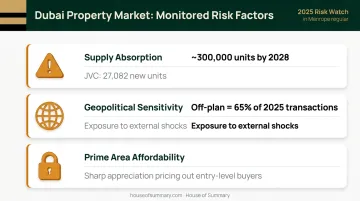
Watch these indicators in combination — individually, each is manageable; together, they could shift sentiment faster than transaction volumes suggest.
What to Watch: Dubai Real Estate Outlook Through 2026 and Beyond
With Q1 2026 at AED 252 billion, the market is tracking to comfortably exceed 2025's AED 917 billion total — if activity holds through the year. That caveat matters: no official full-year 2026 forecast has been published by DLD or Dubai Government, and any specific projection beyond what the data shows is speculative.
Key Indicators to Track
- Monthly DLD transaction data — the most reliable leading indicator of market direction
- New investor counts — a sustained drop here would signal softening international confidence before it shows up in transaction values
- Off-plan launch rates — the pace at which new master-planned projects enter the market affects both sentiment and future supply
- Palm Jebel Ali delivery progress — Nakheel's AED 3.5 billion+ in construction contracts signal serious commitment; actual handover timelines will shape buyer confidence across the broader waterfront off-plan market
- Visa and ownership policy changes — the Golden Visa AED 2 million threshold has been a meaningful demand driver; any expansion of eligibility would further widen the buyer pool
For readers who want clear, verified updates on Dubai's real estate market as conditions develop, the Dubai Summary newsletter (by House of Summary) covers UAE market developments with the same factual rigour applied here — verified reporting, no noise, straight to your inbox on weekdays.
Frequently Asked Questions
What is happening in Dubai's property market?
Dubai's property market is at record activity levels in 2026. Q1 alone recorded AED 252 billion in transactions — a 31% year-on-year rise — driven by strong foreign investment, sustained off-plan demand, and a 14% increase in new investors entering the market.
Is now the right time to buy property in Dubai?
The data points toward a strong market in 2026: transaction volumes are rising, rental yields remain competitive, and infrastructure is expanding. Timing still depends on your purpose (end-use versus investment), budget, and tolerance for off-plan versus ready-property risk.
Which areas in Dubai had the highest property transaction activity in Q1 2026?
Jumeirah Village Circle led by total sales volume, while landmark transactions were concentrated around Palm Jebel Ali, Naïa Island, Jumeirah Coastline, and Emirates Hills. Business Bay and Dubai Marina remained active in the secondary apartment segment.
What is driving the off-plan property boom in Dubai?
Off-plan properties attract buyers through lower entry pricing, flexible payment plans, and projected capital appreciation in new communities. A steady pipeline from developers like Nakheel, Emaar, and DAMAC keeps supply and buyer interest aligned.
How has foreign investment in Dubai real estate changed in 2026?
Foreign investment reached AED 148.35 billion in Q1 2026 — up 26% — with international investors drawn by Dubai's tax-free ownership structure, transparent regulatory environment, competitive gross yields, and safe-haven positioning relative to other global markets.