

The reality sits somewhere more nuanced — and more useful — than either camp admits.
This guide draws on verified data from the Dubai Land Department, Knight Frank, ValuStrat, and Bayut to give you a clear, factual picture: the genuine financial case for Dubai property, the rules governing foreign ownership, the step-by-step purchase process, and the risks you need to take seriously before committing capital.
Dubai Summary, House of Summary's UAE-focused daily newsletter, covers developments in this market as they happen — applying the same verification standards you'll find throughout this article.
TL;DR: Key Takeaways
- Foreigners, including US citizens, can own property outright in Dubai, though ownership is restricted to government-designated freehold zones
- No annual property tax, no capital gains tax, no income tax on rental earnings — the primary transaction cost is a one-time 4% DLD transfer fee
- Rental yields average 7.6% for apartments (Knight Frank, 2024), with some areas like International City reaching 10.4%
- The AED 2 million property threshold qualifies buyers for a 10-year UAE Golden Visa
- Off-plan delays, unregistered developers, and neighborhood-specific overpricing are genuine risks — verify developer registration and price history before committing
Why Dubai Real Estate Attracts Global Investors
The Tax Advantage Is Structural, Not Incidental
Dubai's tax position isn't a loophole or a promotional incentive — it's built into the UAE's legal framework. There is no annual property tax on residential holdings, no capital gains tax on appreciation, and no income tax on rental earnings.
Compare that to what investors face in other markets:
| Market | Annual Property Tax | Rental Income Tax | Capital Gains Tax | Transfer Costs |
|---|---|---|---|---|
| Dubai | None | None | None | 4% DLD fee (one-time) |
| United States | 0.29%–1.88% of value annually (Tax Foundation) | Ordinary income rates | 0%, 15%, or 20% (IRS) | Varies by state |
| United Kingdom | Council tax (varies) | Taxable as income | 18%–24% residential | SDLT + 2% non-resident surcharge |
| Australia | State-based land tax; NSW charges foreign owners 5% surcharge | Assessable income | CGT applies; 50% discount after 12 months | Victoria charges 8% foreign purchaser duty |
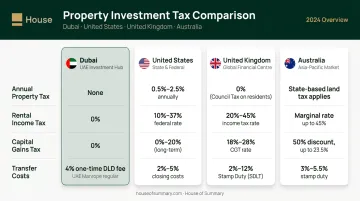
For an investor comparing equivalent properties across these markets, the difference in holding costs over five to ten years is substantial.
Rental Yields That Hold Up Against Global Benchmarks
Gross rental yield measures annual rental income as a percentage of the purchase price — before expenses. According to Knight Frank's Dubai Residential Market Review Q3 2024, Dubai apartments averaged 7.6% gross yield in 2024, with villas averaging 5.5%. Bayut's H1 2025 data shows notable variation by area:
| Area | Gross Yield (H1 2025) | Avg. Price per sq.ft. |
|---|---|---|
| International City | 10.4% | — |
| Business Bay | 6.72% | AED 2,076 |
| Dubai Marina | 6.39% | AED 2,004 |
| Downtown Dubai | 5.79% | AED 3,149 |
| Dubai Hills Estate (villas) | 4.39% | AED 2,737 |
| Arabian Ranches (villas) | 3.94% | AED 2,183 |
For context, most major Western cities produce gross apartment yields of 3%–5%. Dubai's apartment average sits meaningfully above that range.
Tourism, Short-Term Rentals, and Capital Appreciation
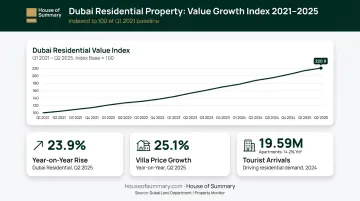
Tourism drives short-term rental demand. Dubai's Department of Economy and Tourism recorded 19.59 million international overnight visitors in 2025, up 5% year-on-year. AirDNA's Dubai data shows roughly 49,400 active vacation rental listings, with 58% average occupancy and a $233 average daily rate. Those figures point to real end-user demand, not a market propped up by speculative listings.
That demand feeds into capital values. ValuStrat's Q2 2025 report recorded Dubai residential values up 23.9% year-on-year, reaching 220.8 on a Q1 2021 base of 100. By December 2025, annual growth was running at 19.8% — villas at 25.1%, apartments at 14.2%. Buyers entering at these price levels should weigh whether current yields still justify the entry cost relative to more modestly priced periods.
The Golden Visa Dimension
A property purchase in Dubai can do more than generate yield — it can secure long-term UAE residency. The 10-year Golden Visa requires a minimum property investment of AED 2 million, verified by a Real Estate Registration Department letter confirming ownership. Mortgaged and off-plan properties from approved developers may qualify.
For many international buyers, particularly those weighing Dubai as a second base, this transforms a financial decision into a lifestyle one. The visa is typically processed within two to four weeks once ownership documentation is confirmed — a relatively fast pathway compared to residency programmes in other jurisdictions.
Who Can Invest in Dubai Real Estate
The Legal Foundation
Foreign nationals — including those without a UAE visa or local sponsor — can purchase property in Dubai. The legal basis is Regulation No. 3 of 2006, which designated specific freehold zones where non-UAE nationals may acquire outright ownership without time restriction. Outside those zones, foreign ownership is not available.
Freehold Zones: Where You Can Buy
Confirmed freehold areas under DLD-sourced material include:
- Palm Jumeirah
- Downtown Dubai / Burj Khalifa area
- Dubai Marina
- Business Bay
- Jumeirah Lakes Towers (JLT)
- Emirates Hills
- International City
Working with a RERA-registered agent can confirm the current full list, which has expanded over time.
Ownership Structures Available to Foreign Buyers
| Type | What It Means |
|---|---|
| Freehold | Full, unlimited ownership of the property and land |
| Leasehold | Right to use the property for up to 99 years |
| Usufruct | Right to use and derive benefit from the property for a defined period |
| Off-plan | Purchase of a unit before construction completion, registered provisionally with DLD |
US Citizens: No Special Restrictions
American buyers follow the same rules as all non-UAE nationals — no additional restrictions, no local sponsor required, and no UAE visa needed at the point of purchase. A passport is sufficient to initiate a transaction. Ownership can be held personally or through a corporate structure.
US tax obligations follow you across borders. Key reporting requirements to know before closing:
- Foreign rental income: The IRS requires full reporting regardless of where it's earned
- FBAR: Aggregate foreign bank balances exceeding $10,000 trigger filing requirements
- FATCA Form 8938: May apply depending on your filing status and total foreign asset value
Consult a US tax advisor before completing any purchase.
Mortgages for Non-Residents
Financing is available through UAE banks, but the terms differ from US market norms:
- Loan-to-value: Non-residents typically capped at 50% LTV; residents up to 75–80% on first properties under AED 5 million
- Tenure: Maximum 25 years (not 30), with age-at-maturity limits of 65 for employees
- Cash transactions: Common, particularly for off-plan purchases
Many investors (especially those buying off-plan) transact entirely in cash, paying in installments tied to construction milestones.
How to Buy Property in Dubai
Two Purchase Paths
Dubai buyers choose between two routes, each with a distinct risk-reward profile.
Resale (ready property): You purchase an existing, completed unit. Full payment — cash or mortgage — settles at closing. You get immediate access, immediate rental income potential, and no construction risk.
Off-plan (pre-construction): You buy directly from a developer before the building is complete. Initial deposits typically range from 10–25%, with remaining payments spread across a construction-linked schedule. Entry prices are generally lower, and capital appreciation between purchase and handover can be significant — but so is the completion risk.
Buying a Resale Property: Key Steps
- Agree on price and sign the MOU (Form F) — the standard sale agreement used in Dubai transactions
- Pay a deposit — typically around 10%, held until transfer
- Seller obtains NOC — the developer issues a No Objection Certificate (AED 500 administrative fee) confirming no outstanding service charges or encumbrances
- Attend transfer at DLD Trustee Office — both parties present; DLD processes the registration
- Receive title deed — DLD issues the new title deed (AED 250 fee) upon completion
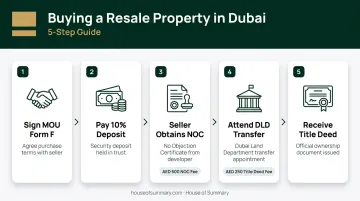
Note: DLD requires registration within 60 days of contract signature. Dubai law doesn't require an attorney, but foreign buyers should get independent legal review regardless.
Buying Off-Plan: Critical Checks
Before committing any funds to an off-plan purchase:
- Verify RERA registration — confirm the developer and agent are both registered with the Real Estate Regulatory Authority
- Check Oqood registration — under Law No. 8 of 2007, each off-plan project must maintain a separate DLD-accredited escrow account; your payments should go there, not to the developer directly
- Register the initial sale — off-plan disposals must be recorded on the DLD interim register under Law No. 13 of 2008; unregistered transfers are legally void
- Review the developer's track record — completed project history matters more than marketing brochures
Transaction Costs at a Glance
| Cost Item | Verified Amount |
|---|---|
| DLD Sale Registration | 4% of purchase price |
| Title Deed Certificate | AED 250 |
| Developer NOC | AED 500 |
| Agent Commission | Typically 2% (confirm before signing) |
Risks Every Investor Should Know
The Three Most Common Pitfalls
RERA registration is mandatory for both developers and agents — no exceptions. The DLD's online verification tools and the Dubai REST app let you confirm registration status before signing anything. If either party can't be verified, walk away.
Fake listings targeting overseas buyers are a documented problem in Dubai. Treat these as red flags: prices that look too good, agents who won't meet in person, and wire transfer requests before any DLD registration.
Off-plan projects carry real completion risk. Delays happen, and some projects have stalled or failed entirely. The Oqood escrow system provides legal protection, but it isn't absolute — a developer's track record of on-time delivery is the most reliable signal you have.
Ongoing Costs That Affect Your Returns
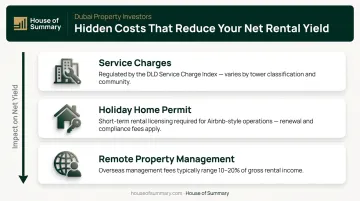
These risks are the headline concerns, but your actual returns depend just as heavily on costs that don't show up until after the purchase. Net yield is shaped by several expenses beyond the mortgage:
- Service charges: Annual building maintenance fees vary widely by property type and location. Use the DLD Service Charge Index to look up fees for specific buildings before purchasing
- Holiday home permit: Listing on Airbnb or similar platforms requires a permit from Dubai's Department of Economy and Tourism — budget for this if short-term rental is your strategy
- Remote management: If you're buying from overseas, factor in property management fees; running a Dubai rental from another country without local support is difficult to sustain
Dubai Summary covers regulatory changes affecting property management and licensing as they happen — useful for investors tracking policy shifts that affect rental operations.
Frequently Asked Questions
Is Dubai a good real estate investment?
For investors who research the market carefully, Dubai's combination of zero annual property tax, strong rental yields (averaging 7.6% for apartments in 2024), and sustained capital growth makes a compelling case. The risks are real but manageable: location selection, developer vetting, and a clear exit strategy matter significantly.
What is the 7% rule in real estate?
The 7% rule is an informal industry benchmark suggesting a property should generate at least 7% gross rental yield to be financially sound. Dubai's apartment average of 7.6% (Knight Frank, 2024) clears that mark at the city level, though villa yields at 5.5% and prime areas like Downtown Dubai at 5.79% fall below it.
Can I buy a house in Dubai for $50,000?
No. Entry-level studios in affordable areas like International City average around AED 343,000–353,000 (approximately $93,000–$96,000 USD). A $50,000 figure might function as a deposit on some off-plan developments, but it won't cover a full purchase anywhere in the city.
Can US citizens invest in Dubai?
Yes. US citizens follow the same rules as all foreign nationals, with no visa or sponsor required. The key additional consideration is US tax reporting: foreign rental income must be reported to the IRS, and related foreign bank accounts may trigger FBAR requirements — consult a US tax advisor before proceeding.
What is the Dubai Golden Visa and how does it relate to property investment?
The Golden Visa grants long-term UAE residency (up to 10 years, renewable) to property buyers who meet a minimum investment threshold of AED 2 million. It applies to completed and certain off-plan purchases from approved developers, making Dubai one of the few markets where buying property directly translates to residency rights.
Is off-plan real estate in Dubai risky?
Yes. Construction delays and developer failures are documented risks, but off-plan also offers lower entry prices, flexible payment schedules, and capital appreciation potential during the build period. Before signing, verify RERA registration, confirm DLD escrow account existence, and review the developer's completed project history.