

This briefing cuts through the noise. It delivers the facts executives, founders, and professionals need when evaluating UAE business setup—no filler, no promotional fluff. Dubai Summary tracks developments like these regularly for readers who want to stay ahead of regulatory shifts, policy updates, and market opportunities in the region.
Key Takeaways
- UAE charges 0% personal income tax and 9% corporate tax on profits above AED 375,000 — with 100% foreign ownership now permitted in most sectors
- Three setup routes exist—Mainland, Free Zone, Offshore—each suited to different business models and client geographies
- Expect first-year costs between AED 9,000 (basic Free Zone) and AED 45,000+ for full Mainland incorporation with visas
- 2026 introduces AI-powered approvals, remote onboarding, and new SME incentives cutting setup fees and fast-tracking licenses
What Makes the UAE Stand Out for Business in 2026
The UAE's appeal is structural. It sits at the crossroads of Europe, Asia, and Africa, offers zero personal income tax, and maintains a 9% corporate tax rate that applies only to profits exceeding AED 375,000. Capital repatriation is unrestricted. The IMD World Competitiveness Ranking 2025 placed the UAE 5th globally, driven by strong economic performance and government efficiency.
What sets 2026 apart is operational speed. AI-assisted licensing approvals, remote onboarding options, and platforms like Invest in Dubai (issuing licenses in 5-10 minutes) mean founders no longer need to be physically present for every step.
Key sector growth indicators:
- E-commerce hit $8.8 billion in 2024, projected to reach $13.8 billion by 2029
- DIFC now hosts 1,677 fintech and AI organizations — a 35% year-on-year increase
- Masdar expanded green energy capacity to 51GW in 2024
That growth reflects who the UAE is built for. With approximately 88-89% of the population being expatriate, the country's legal and administrative frameworks were designed from the ground up to accommodate foreign founders — not as an afterthought, but as the default.
Mainland, Free Zone, or Offshore: Which Structure Fits Your Business?
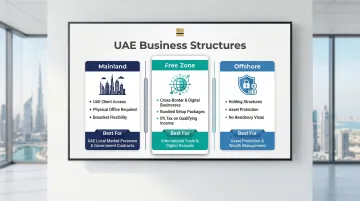
This is the foundational decision every founder must make before anything else. Activity selection, cost planning, visa eligibility, and banking all flow from this choice. Get it wrong, and you'll face costly restructuring later.
Mainland
Mainland companies are licensed by the Department of Economic Development (or its emirate equivalent) and allow unrestricted trading across the UAE, direct government contracts, and the broadest operational flexibility. 100% foreign ownership is now available for most commercial and industrial activities—a significant reform from earlier sponsorship requirements.
Key considerations:
- Requires a registered physical office (not just a flexi-desk)
- Best suited to businesses serving UAE-based clients, requiring local invoicing, or running physical operations
- Direct access to mainland market without intermediaries
Exception: Cabinet Resolution No. 55 of 2021 restricts 100% ownership in "Strategic Impact Activities" (security, defence, banking, telecoms, fisheries). These sectors may still require special approvals or local partners.
Free Zone
Free Zones are designed for international founders, startups, and digital businesses primarily serving clients outside the UAE. They offer 100% foreign ownership, bundled packages (licence + flexi-desk + visa quota), and faster, more predictable setup processes.
The UAE operates more than 40 active free zones (from DMCC and IFZA in Dubai to RAKEZ and SAIF Zone in other emirates), each serving different sectors and price points. That variety comes with an important caveat for founders targeting UAE customers.
Key limitation: Free Zone companies traditionally required a local service agent or distributor to trade directly with UAE mainland customers.
However, Dubai Executive Council Resolution No. 11 of 2025 now permits non-financial Free Zone companies to operate directly on the mainland via a branch license (one year) or temporary permit (up to six months).
That means a Free Zone entity can now combine 0% corporate tax on qualifying income with direct onshore market access, without duplicating corporate structures.
Offshore
Offshore entities (RAK ICC, JAFZA Offshore) are primarily used for holding structures, asset protection, and international ownership arrangements—not day-to-day UAE operations.
Key characteristics:
- Do not typically support residency visas
- Banking access is limited and requires thorough documentation
- Clear purpose for founders managing multi-entity international structures
- RAK ICC offers one-day incorporation with 100% foreign ownership and no office requirement
Decision prompt: If revenue comes primarily from UAE clients, choose Mainland. If the business is cross-border or digital, choose Free Zone. If the goal is holding or international structuring, choose Offshore.
What Does It Actually Cost to Set Up in the UAE?
Cost varies by jurisdiction, activity category, office type, and visa quota. The figures below are current 2024-2026 estimates from official sources:
Free Zone Setup Costs:
- Basic package (licence + flexi-desk, no visas): AED 9,000–15,000
- With 1-2 visas and banking support: AED 18,000–30,000
- DMCC 1-Year Jumpstart Package: AED 43,780 (includes company license, standard flexi-desk, 1 residency visa, establishment card)
- RAKEZ All-Inclusive SME Package: AED 14,000/year (trade license, 1 UAE visa, shared workstation)
- RAKEZ Instant Licence: AED 6,000 (1 shareholder, 1 activity, co-working access)
Mainland costs run higher, partly due to office requirements and government fee layers.
Mainland Setup Costs:
- Licence only: AED 15,000–30,000
- Full setup with office, visas, and banking: AED 25,000–45,000+
- Core government fees include:
For holding structures, offshore options offer the lightest cost footprint.
Offshore Setup Costs:
- Holding structure: AED 10,000–18,000
- JAFZA Offshore: AED 10,000 registration + AED 50 per specimen signature
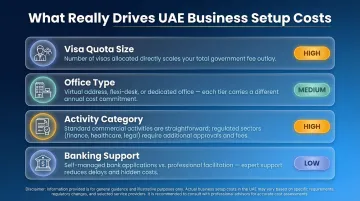
What Drives Cost Variation
Beyond the headline licence fee, several factors impact total cost:
- Visa quota size: Each visa adds processing fees, Emirates ID, medical screening, and potentially typing center charges
- Office type: Virtual offices are cheapest; flexi-desks mid-range; dedicated physical offices significantly higher
- Activity category: Standard commercial activities are straightforward; regulated or high-risk activities (financial services, healthcare) require additional approvals and higher fees
- Banking support: DIY banking applications are free but time-consuming; professional banking support packages range from AED 5,000–15,000
Choosing the cheapest option without full-year cost visibility routinely triggers mid-year restructuring fees that wipe out the initial saving. Always model total 12-month spend before committing.
Timelines
- Basic Free Zone company: 5-15 working days
- Full setup including visas and banking: 2-6 weeks
- Regulated or high-risk activities with banking: 1-3 months
Banking is consistently the most time-sensitive step — plan it from day one, not as an afterthought. Banks conduct due diligence, request extensive documentation, and often require in-person meetings.
Ongoing Annual Costs
Year two brings its own bill. Recurring obligations include:
- Licence renewal (typically same as initial licence fee)
- Office or flexi-desk renewal
- Visa renewals (approximately AED 3,000–5,000 per visa annually)
- VAT registration and filing (if applicable)
- UBO filings and updates
- ESR notifications (for relevant activities)
- Accounting and auditing (if required)
Key Regulatory and Compliance Updates for 2026
Corporate Tax Landscape
The 9% corporate tax applies to taxable profits above AED 375,000. Profits below this threshold attract 0%.
Free Zone entities may qualify for 0% on qualifying income, but only if they:
- Meet substance requirements (core income-generating activities, assets, and employees physically in the zone)
- Prepare audited financial statements
- Do not trade on the UAE mainland (unless using the new branch/permit structure introduced in 2025)
Small business relief is available for companies with revenue at or below AED 3 million. Eligible businesses can elect to be treated as having no taxable income through tax periods ending on or before December 31, 2026.
VAT: The standard rate is 5%. Mandatory registration applies when taxable supplies and imports exceed AED 375,000 over the previous 12 months.
UBO and ESR Obligations
Tax obligations are only part of the compliance picture. Ownership transparency and economic substance rules carry their own filing deadlines and penalty structures.
Ultimate Beneficial Owner (UBO) Disclosure:
- All UAE-registered entities must disclose beneficial ownership within 60 days of licensing
- Changes must be updated within 15 days
- Administrative sanctions escalate with repeated violations
Economic Substance Regulations (ESR):
- Companies conducting specific relevant activities (banking, insurance, IP, shipping, holding, etc.) must file annual ESR notifications and reports
- Reports must demonstrate real economic substance (adequate employees, assets, operating expenditure in the UAE)
- Reports due within 12 months from end of financial year
- Penalties: AED 50,000 for failure to submit or inaccurate information; AED 400,000 for failing to meet substance requirements for a second consecutive year
Employment and Emiratisation
Compliance extends to the workforce itself. Federal Decree-Law No. 33 of 2021 modernized the labor market:
- All employment contracts are now limited-term (no unlimited contracts)
- Flexible working models are legally recognized
- Part-time and temporary work patterns formalized
Emiratisation for growing companies: MoHRE expanded targets to private companies with 20-49 employees in 14 key sectors (tech, real estate, healthcare, construction, and others). These companies must hire at least one UAE national in 2024 and another in 2025.
Non-compliance carries escalating costs: AED 96,000 for 2024 shortfalls, rising to AED 108,000 for 2025. A company missing both years faces over AED 200,000 in penalties before accounting for back-hiring costs — making Emiratisation a financial planning item, not just an HR one.
How the UAE Government Supports New Businesses
SMEs account for approximately 94% of businesses operating in the UAE and contribute 63.5% to the non-oil GDP. The government has made SME support a stated national priority.
Federal and Emirate-Level Programs
| Program | Location | What It Offers |
|---|---|---|
| Entrepreneurial Nation 2.0 | Federal | Targets 8,000 startups by 2031; aims to produce 20+ unicorns via public-private partnerships and global expansion support |
| NextGenFDI | Federal | Rapid incorporation, bulk visa issuances, and lease incentives for tech firms (software, AI, data science); targets 300 global companies |
| Hub71 | Abu Dhabi | VC access, corporate partnerships, and mentorship; specialized tracks for Web3, ClimateTech, and AI |
| Area 2071 | Dubai | AED 1,000 annual licensing for startups, overseen by Dubai Future Foundation |
| in5 | Dubai | Subsidized setup, prototyping labs, and creative spaces for tech, media, and design startups |

Funding and Financial Support
Beyond program-level support, the UAE offers direct financial mechanisms for eligible founders:
- Khalifa Fund — Abu Dhabi government fund for Emirati entrepreneurs, providing capital, capability building, and procurement access through the SME Champions Program
- Dubai SME — Supports GCC nationals with business planning, five-year licensing fee exemptions, and seed capital up to AED 1 million
The momentum is reflected in private investment too. In 2024, the UAE led the MENA region in startup funding, raising $1.1 billion across 207 startups.
Founders who engage with government support programs early gain credibility that improves banking approval chances and accelerates market access.
Frequently Asked Questions
How much does it cost to set up a business in the UAE?
Free Zone basics start around AED 9,000–15,000 for a licence and flexi-desk. Full Mainland setups with visas can reach AED 45,000+. The final number depends on jurisdiction, office type, visa count, and activity category.
What types of businesses can you start in Dubai with AED 50,000?
AED 50,000 comfortably covers a Free Zone setup with 1-2 visas, a flexi-desk, and banking support — suitable for consultancies, service businesses, e-commerce operations, and digital agencies. Regulated or physical-retail activities typically require higher budgets.
Can you own 100% of a company in the UAE?
Yes. 100% foreign ownership is available for most commercial and industrial activities across both Mainland and Free Zone setups. A limited list of strategic sectors (defence, banking, telecoms) may still require special approvals or a local partner.
Does the UAE government provide assistance for setting up a business?
Yes. Key programmes include Entrepreneurial Nation 2.0, NextGenFDI, Hub71, Khalifa Fund, and Dubai SME — covering funding, advisory services, accelerator access, and market entry support for startups and SMEs.
How long does it take to register a company in the UAE?
A basic Free Zone incorporation takes 5–15 working days. A complete setup with visas and banking typically takes 2–6 weeks. Regulated or complex activities can take 1–3 months, with banking timelines varying most by institution and activity type.