

This tension matters because D2C brands have no retail intermediaries to absorb marketing waste. Every dirham spent on Meta, Google, or OOH must connect to a trackable customer action. In the UAE's competitive, multicultural, and seasonally volatile market, standard analytics setups break down fast.
This guide covers what makes UAE audience measurement distinct, which metrics drive D2C growth, how to measure each channel properly, and how to avoid the most costly measurement mistakes.
Key Takeaways
- UAE's 88% expatriate population requires multi-language, multi-cohort segmentation that most standard analytics tools don't handle out of the box
- Platform-native analytics inflate attribution by up to 300% — Meta and Google routinely double-count the same conversions
- Build first-party data now (email, WhatsApp, post-purchase surveys) — cookie-based tracking is phases out faster than most D2C brands have prepared for
- Seasonal spending spikes during Ramadan and DSF distort baseline measurement—attribution models must adjust for volatility
- Newsletter advertising delivers deterministic measurement — verified open rates, CTR, and audience data with no algorithms filtering your reach
Why the UAE Creates Unique Audience Measurement Challenges for D2C Brands
The Expatriate Majority Fragments Your Audience
88-89% of UAE residents are expatriates, spanning over 200 nationalities. This means your "UAE audience" is actually dozens of overlapping cultural, linguistic, and behavioral segments.
A D2C beauty brand running Instagram ads in English, Arabic, and Hindi isn't managing one campaign; it's managing three separate measurement environments on a single platform. Standard demographic proxies (age, gender, location) miss that nuance entirely. A 35-year-old professional in Dubai might be Indian, British, Filipino, or Emirati, each with different purchase triggers and media habits.
Most analytics dashboards don't segment performance by language or nationality, which means you may be misreading which creative actually drives conversions.
Mobile-First Behaviour Compresses the Purchase Journey
The UAE has 23 million mobile connections (202% of population) and 100% broadband mobile coverage. Mobile phones are the most popular internet access device.
This mobile dominance compresses the customer journey: discovery, consideration, and conversion often happen in a single session on one device. Cross-device attribution becomes less relevant, but in-session drop-off becomes critical.
If your mobile landing page loads slowly or your checkout flow has payment friction, you'll lose customers before attribution tools even register the problem.
Bilingual Content Performance Isn't Tracked Separately
UAE audiences engage differently with Arabic versus English content, yet most analytics platforms don't automatically segment campaign performance by language.
You might run parallel campaigns in both languages and see strong overall engagement. Without language-level breakdowns, though, you won't know if your Arabic creative is driving results while your English ads burn budget — or the reverse. Two signals worth tracking separately:
- Language-level CTR: Which language variant generates clicks, not just impressions
- Conversion rate by language: Where drop-off actually occurs in the funnel
Seasonal Volatility Distorts Baseline Measurement
UAE consumers spent approximately $10 billion during Ramadan 2025 (up 9% year-over-year), while Dubai Shopping Festival 2025 drove a 144% retail spending surge.
Swings of this magnitude make non-peak baseline data nearly useless for planning. If you calibrate attribution models in February, they'll systematically misjudge channel effectiveness during Ramadan or DSF.
Meta CPMs in the UAE swing from AED 47 in June to AED 94 in September, a 101% range roughly 2.5× more volatile than global averages.
Regulatory Constraints Limit Data Collection
UAE Federal Decree-Law No. 45 of 2021 requires specific, unambiguous, freely revocable opt-in consent for personal data processing. Fines range from AED 50,000 to AED 5 million.
This opt-in model (similar to GDPR) means you cannot:
- Use pre-ticked consent boxes
- Assume silence equals consent
- Keep personal data beyond the collection purpose without anonymizing it
- Process data for profiling or automated decision-making without explicit consent
D2C brands must implement compliant consent management before collecting audience data, which constrains retargeting and cross-site tracking.
The Metrics That Actually Matter for D2C Audience Measurement in the UAE
D2C Measurement Hierarchy: Every Metric Must Connect to Revenue
Brand awareness campaigns optimize for reach and engagement. D2C campaigns must optimize for purchase, repeat purchase, and customer lifetime value.
The hierarchy:
- Bottom: Vanity metrics (followers, impressions, likes)
- Middle: Engagement-to-conversion rate (clicks, add-to-cart, checkout initiated)
- Top: Revenue metrics (CAC, ROAS, LTV, repurchase rate)
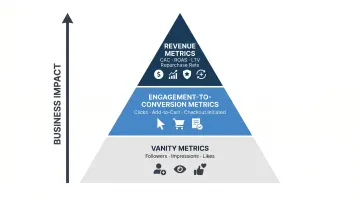
Any metric that can't trace a line back to revenue is noise — track it only if it informs something that does.
Customer Acquisition Cost (CAC)
Formula: Total marketing spend ÷ number of new customers acquired
UAE's competitive paid social environment pushes CAC higher than other markets. Meta CPMs in Dubai run 15-30% above global averages, with Facebook averaging AED 10-25 and Instagram AED 15-40.
Healthy benchmark: Your CAC should be ≤33% of customer lifetime value (3:1 LTV:CAC ratio minimum). UAE agency benchmarks put average ROAS at 2-3×, with top performers reaching 5×+.
Return on Ad Spend (ROAS)
Blended ROAS: Total revenue ÷ total ad spend across all channels
Channel-level ROAS: Revenue attributed to a specific channel ÷ spend on that channel
Most D2C brands confuse the two, leading to poor budget allocation. If your blended ROAS is 4× but your Meta ROAS is 2× and your Google ROAS is 7×, treating them equally wastes money.
Engagement-to-Conversion Rate
ROAS tells you where to put budget — but engagement-to-conversion rate tells you why a channel is underperforming. Low conversion despite strong engagement usually signals an audience-offer mismatch.
In the UAE context, this often points to pricing friction or payment method gaps.
Your TikTok content might drive strong engagement, but if you don't offer cash-on-delivery — still accounting for roughly 30% of UAE e-commerce orders — you'll lose those conversions at checkout.
Diagnostic questions:
- Are users bouncing at the landing page? (Check mobile load speed)
- Are they abandoning carts? (Check payment options—COD, Apple Pay, Tabby/Tamara BNPL)
- Are conversion rates different for Arabic vs. English traffic?
Audience Quality Metrics
For D2C brands building purchase intent, these matter more than raw impressions:
- Frequency: How many times does someone see your ad before converting? (Optimal: 3-7 exposures)
- Attention time: How long do users spend engaging with content? (Video completion rate, scroll depth)
- Scroll depth: Are users reading product details or bouncing after the hero image?
Strong impression counts paired with shallow attention time is a signal to audit creative — not increase budget.
The D2C Channel Mix in the UAE: What to Measure and Where
Social Media: Instagram, TikTok, Snapchat
Reach: Instagram reaches 8.05 million UAE users (67.8% of population), TikTok reaches 12.5 million adults (134.6% penetration—the highest globally), and Snapchat reaches 5.13 million.
The measurement problem: Native analytics (Meta Insights, TikTok Analytics) are self-reported and optimized to make platforms look effective. Research shows brands overvalue social display by up to 300% when relying on platform-native attribution.
What to do:
- Layer third-party attribution tools (UTM parameters, server-side tracking)
- Install Meta Pixel and TikTok Pixel but cross-reference conversions against Google Analytics 4
- Track engagement-to-conversion rate separately from platform-reported conversions
Paid Search: Google
Search intent is one of the strongest audience signals in digital advertising — users are actively looking for a product category, not passively scrolling past one.
Measurement strategy:
- Use Google Analytics 4's data-driven attribution alongside platform reporting
- Combine GA4 attribution reports with Search Console data to understand which UAE search queries drive qualified traffic vs. low-intent browsers
- Track query-level conversion rates—generic searches ("running shoes Dubai") convert differently than specific ones ("Nike Pegasus 40 buy online UAE")
Out-of-Home and Digital OOH
The Middle East & Africa DOOH market generated $695 million in 2024 and is growing at 7.8% annually. Ipsos's acquisition of UAE-based Seventh Decimal in January 2026 signals institutional investment in OOH measurement.
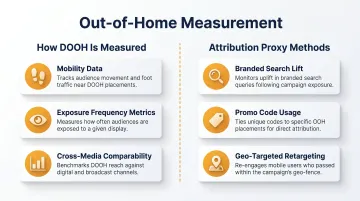
How DOOH is measured now:
- Mobility data: Tracks how many people passed by a billboard and how frequently
- Exposure frequency metrics: Estimates reach based on foot traffic patterns
- Cross-media comparability: Lets you compare OOH exposure to digital impressions
The hard problem: Linking OOH exposure directly to online purchase remains difficult. You can estimate reach and frequency, but attribution requires proxy methods (branded search lift, promo code usage, geo-targeted digital retargeting).
Email and Newsletter Advertising
That attribution gap is exactly where email stands apart. It is one of the few digital channels where measurement is transparent, deterministic, and not subject to algorithm changes.
What makes it measurable:
- Open rates: Directly reported by the publisher
- Click-through rates: Deterministic (no modeled attribution)
- Subscriber demographics: Known and verified
- No ad blockers: Ads embedded in email content bypass ad-blocking software
For D2C brands targeting UAE professionals and high-intent consumers, newsletter placements—such as those offered through Dubai Summary by House of Summary—provide measurable access to a verified UAE audience. BSH Hausgeräte's CEO reported click-through rates 4× higher than Google AdWords, citing strong alignment between editorial tone and purchase intent — a result that probabilistic social attribution rarely produces cleanly.
Building a First-Party Data Strategy for D2C Brands in the UAE
Why First-Party Data Matters Now
The shift away from third-party cookies means D2C brands can no longer rely on cross-site behavioral data. Ad platforms once handled audience targeting automatically; now you must build your own customer data infrastructure.
First-party data includes:
- Email addresses
- Purchase histories
- Loyalty program data
- Post-purchase survey responses
- WhatsApp opt-in lists
Three Practical Collection Methods for UAE D2C Brands
1. Post-Purchase Surveys
Ask customers: "How did you first hear about us?"
This self-reported attribution data reveals which channels initiated the journey, even if the final conversion came through direct traffic or branded search.
2. Email Capture at Checkout with Permission-Based Profiling
Offer a 10% discount or free shipping in exchange for email opt-in. Include optional profile fields (product interests, preferred language, location) to enable segmentation.
Under UAE PDPL, this requires clear, specific consent with easy withdrawal.
3. WhatsApp Opt-In Flows
WhatsApp has 90% penetration in the UAE—the highest messaging app usage in the country.
Offer order updates, exclusive deals, or customer service via WhatsApp. Each opt-in becomes a first-party data point you own, independent of ad platform changes.
Connecting First-Party Data to Measurement
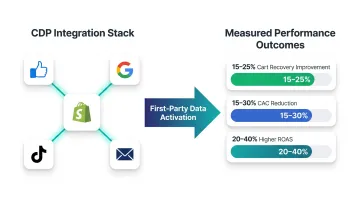
A Customer Data Platform (CDP) or well-structured CRM links purchase history to ad exposure by consolidating every customer signal into a single profile — making true LTV-by-channel analysis possible.
For a mid-sized D2C brand, that integration typically looks like this:
- CDP connects with Shopify (or Magento/BigCommerce), Meta, Google, TikTok, and email tools
- Each customer profile consolidates behavioral data (site visits, ad clicks), transactional data (orders, AOV), and identity data (email, phone, consent status)
- Predictive LTV scores identify which acquisition channels bring repeat buyers vs. one-time purchasers
Brands that have implemented CDP-driven measurement report measurable returns across core performance metrics:
- 15–25% improvement in cart recovery
- 15–30% CAC reduction
- 20–40% higher ROAS from LTV-optimized prospecting
Common Audience Measurement Mistakes D2C Brands Make in the UAE
Over-Relying on Platform-Native Analytics
Every ad platform reports metrics to make itself look effective. Meta will credit conversions that Google also credits, leading to double-counting.
When multiple platforms install tracking pixels, each counts the same conversion independently. Your aggregate reported conversions can exceed actual conversions by 200-300% — that's the credit inflation problem in practice.
The fix is a neutral source of truth. Google Analytics 4 with data-driven attribution compares paths of customers who converted against those who didn't, assigning fractional credit based on statistical contribution rather than arbitrary rules.
Ignoring the Post-Click Experience
Platform-native analytics only compound another blind spot: most UAE D2C brands measure ad performance up to the click, then assume the rest is "marketing's job done."
What you're missing:
- Cart abandonment rates: Are users adding products but not checking out?
- Payment method friction: Are you losing customers who want COD or Tabby/Tamara BNPL?
- Mobile page speed: A 100-millisecond delay reduces e-commerce conversion rates by 8.5%
These are measurement problems, not just UX problems. If your landing page loads slowly, your attribution data will show high traffic with low conversions—making the acquisition channel look ineffective when the real issue is technical.
Measuring Campaigns in Isolation Rather Than Across the Full Customer Journey
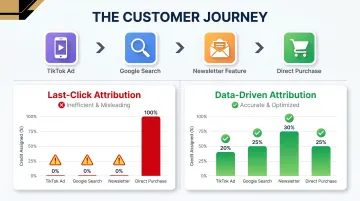
A UAE consumer might:
- See a TikTok ad
- Search "brand name + Dubai" on Google
- Read a sponsored feature in Dubai Summary
- Convert via direct traffic
Last-click attribution gives 100% credit to direct traffic, causing you to underinvest in TikTok and the newsletter—the channels that actually initiated the journey.
Data-driven attribution distributes credit across all touchpoints proportionally, so you stop penalizing the channels that build awareness and start funding the full funnel that actually drives revenue.
Frequently Asked Questions
What is audience measurement analytics and why does it matter for D2C brands in the UAE?
Audience measurement analytics identifies who sees, engages with, and acts on your advertising. For D2C brands with no retail intermediaries, every dirham must connect directly to purchase data—and in the UAE's fragmented, competitive market, inaccurate measurement means wasted budget with no visibility into why.
Which metrics should D2C advertisers in the UAE prioritize beyond vanity metrics?
Focus on CAC (Customer Acquisition Cost), ROAS (Return on Ad Spend), LTV (Lifetime Value), and conversion rate. Engagement rate is useful only when tied to purchase intent. Followers and impressions are decorative unless they lead to revenue.
How does UAE's multicultural audience affect D2C audience segmentation?
The UAE's 200+ nationality makeup means you must segment by language preference, cultural behavior, and resident category (tourist vs. long-term expat vs. national) rather than treating "UAE audience" as monolithic. Standard age/gender demographics miss critical nuance that affects purchase behavior.
What tools are most effective for audience measurement analytics in the UAE?
The right stack depends on your channel mix and data maturity, but a solid foundation typically includes:
- Google Analytics 4 for cross-channel attribution with data-driven modeling
- Meta and TikTok Pixels for social conversion tracking
- CDP or CRM tools (Segment, Klaviyo, or HubSpot) for first-party data consolidation
How can D2C brands in the UAE avoid double-counting conversions across channels?
Use a single neutral attribution source—Google Analytics 4 with data-driven attribution—rather than relying on each platform's self-reported numbers. Regularly reconcile platform data against actual sales records. Accept that no attribution model is perfect, but GA4's statistical approach is less biased than platform-native reporting.
Is newsletter or email advertising measurable enough to be worth budget for D2C brands in the UAE?
Yes. Newsletter advertising offers deterministic reporting—open rates, CTR, and verified audience demographics are reported directly rather than modeled. For D2C brands that need attribution clarity over approximation, that's a meaningful advantage over algorithmic platforms.