Introduction
Executive newsletters have become a serious advertising channel. Brands are increasingly placing sponsored content inside curated newsletters read by business professionals, executives, and decision-makers who have actively chosen to receive them. Publishers on beehiiv alone sent 28 billion emails in 2025, reaching 255 million unique readers, with open rates exceeding 41%. Meanwhile, email marketing drives an average ROI of $36 for every $1 spent — higher than most digital channels.
Yet most branded content in newsletters still reads like an ad — a product claim dropped into an editorial environment. Readers who opted in for editorial clarity recognize the mismatch immediately, and that recognition kills both attention and trust. Storytelling is how brands close it.
What follows is a practical look at how storytelling functions inside executive newsletters — why the inbox environment demands a different approach than social or display, and what that looks like in execution.
Key Takeaways
- Branded storytelling in executive newsletters uses narrative structure to make brand messages land with readers who have high editorial standards
- It works in stages: a hook that earns attention, a story arc that builds context, a brand integration that feels earned, and voluntary reader response
- Story-driven branded content works with executive readers because it leads with value — not a sales pitch
- The inbox delivers undivided attention — no algorithms, no ad blockers — something social and display placements can't reliably offer
- Newsletter format — linear, text-heavy, editorial — makes storytelling a structural requirement, not an option
What Is Branded Storytelling in Executive Newsletters?
Branded storytelling in the newsletter context is the use of a structured narrative — with a character, a tension, and a resolution — to carry a brand message inside editorial content, rather than relying on product claims or visual branding alone. Content Marketing Institute defines brand storytelling as "using a narrative to connect your brand to customers, with a focus on linking what you stand for to the values you share with your customers."
What It Is Not
Branded storytelling in a newsletter is not:
- A case study formatted as advertising
- A sponsored paragraph describing a product feature
- A native ad that mimics editorial headlines without substance
These formats prioritize the brand's self-interest over the reader's time. They fail because they ask for attention without earning it first.
Why Executive Newsletters Require This Approach
The readership has opted in, holds content to high standards, and engages in a focused, sequential reading session. Unlike scrolling social feeds, newsletters are read top to bottom.
Reuters Institute research shows that newsletter users are significantly more likely to be highly educated and in higher income brackets — exactly the audience that detects and dismisses poorly integrated brand content instantly.
When a sponsored placement disrupts that flow with a jarring shift in tone or purpose, readers mentally filter it out. The premium environment that made the placement valuable in the first place works against the brand.
How Does Storytelling Work Inside an Executive Newsletter?
Branded storytelling in this format moves through four identifiable stages, each serving a distinct function. Skipping or compressing any stage is what causes branded newsletter content to feel forced or promotional.
The Entry Point
The story must begin before any brand mention appears. The opening sentence needs to establish:
- A scene the reader recognizes from their professional world
- A surprising fact that reframes a familiar challenge
- A character tension that mirrors the reader's own experience
The brand's relevance is established through the story's subject matter, not through a logo or claim.
In the newsletter format, the hook carries disproportionate weight. Litmus data shows that average email reading time declined from 13.4 seconds in 2018 to just 8.97 seconds in 2022. Readers decide within the first two sentences whether the content is worth their time. A weak hook doesn't reduce engagement gradually — it cuts it off at the first sentence.
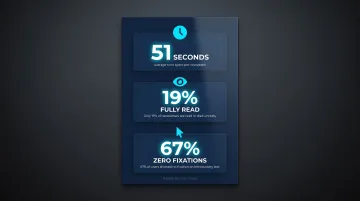
Nielsen Norman Group research found that users spend an average of 51 seconds on a newsletter after opening it, only 19% of newsletters are fully read, and 67% of users had zero fixations on introductory text — even when intros were just three lines long. Users focus most heavily on the first two words of headlines. The entry point must deliver immediate professional relevance, not preamble.
The Narrative Arc
In the compressed space of a newsletter sponsorship — typically 150 to 300 words of branded copy — a narrative arc must include:
- Tension: A problem, a gap, or a turning point
- Development: Context that makes the tension meaningful
- Resolution or implication: An outcome or insight
The customer should function as the implied protagonist, not the brand. The arc describes a situation the reader faces or cares about, positioning the brand as the element that resolves or improves it — without making that positioning explicit or sales-driven.
For example, a fintech brand might open with a compliance officer realizing that manual reporting processes expose the company to regulatory risk. The arc develops by quantifying the hidden costs of that risk. The resolution positions the brand's automated solution not as a product feature, but as the logical answer to the question the story has made the reader ask: "How do I eliminate this exposure without adding headcount?"
The Brand Integration
The brand enters the story at the point of resolution — not at the beginning, and not as the subject of the arc itself. Effective integration means the brand is the answer to a question the story has already made the reader ask.
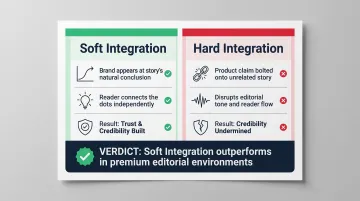
| Integration Type | What It Looks Like | Effect |
|---|---|---|
| Soft | Brand appears at the story's natural conclusion; reader connects the dots | Builds trust, feels earned |
| Hard | Product claim bolted onto an unrelated story | Undermines credibility in a premium editorial environment |
The IAB Native Advertising Playbook 2.0 defines native branded content as "paid content from a brand that is published in the same format as full editorial on a publisher's site." The key principle: "A reasonable consumer should be able to distinguish between what is a paid native ad vs. what is editorial content," but the content must still deliver editorial value.
The Reader Response
A successful story-driven branded piece produces a moment of recognition — the reader connects the story's resolution to their own situation and acts because the relevance is self-evident, not because pressure was applied.
Research from IPG Media Lab and Sharethrough found that consumers looked at native ads 53% more frequently than display ads, with native ads registering an 18% higher lift in purchase intent. More tellingly, 32% of respondents said they would share a native ad with friends or family, versus 19% for display.
Mailchimp data shows that business and finance newsletters see a 31.35% open rate and 2.78% CTR on average. However, story-integrated branded content in premium newsletter environments can perform substantially higher. For context, House of Summary has documented advertiser performance at 4x Google AdWords CTR benchmarks when branded content aligns with editorial tone and audience intent.
Why the Executive Newsletter Context Changes Everything
The executive newsletter environment is categorically different from social media, display advertising, and even general email marketing. Three structural factors create this difference:
Opt-in + sequential reading + editorial standards
Unlike passive ad exposure, these three factors combine to create an audience that actively chooses to engage — and judges branded content by the same standard as the editorial content surrounding it.
The Inbox Advantage
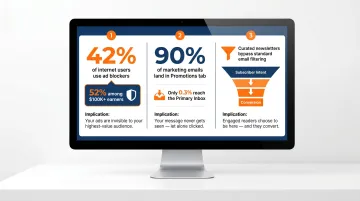
Newsletter ads are not blocked by ad blockers, are not pushed down by algorithms, and are not surrounded by competing visual noise. B2.ai research shows that 42% of internet users worldwide use ad blocking, with usage rising to 52% among those earning over $100,000 and 47% among postgraduate degree holders. The exact demographic targeted by executive newsletters is also the most likely to block display ads.
This makes newsletter content ads one of the few reliable ways to reach this audience with undivided attention.
Gmail Promotions tab statistics show that 90% of emails land in the Promotions tab, while only 0.3% reach the Primary inbox. Curated newsletters that readers have explicitly subscribed to are more likely to land in the Primary inbox or be actively sought out, bypassing the filtering that suppresses standard marketing emails.
The Tone Constraint
Executive newsletter readers are typically time-scarce and have high professional literacy. They respond to concise, credible narratives grounded in real-world context, not aspirational lifestyle copy or consumer-style emotional appeals. The story needs to be intellectually relevant, not emotionally manipulative.
In practice, this means branded stories that open with a business problem, ground the narrative in data or observable context, and resolve within two to three paragraphs consistently outperform those built on aspiration or abstraction.
The Trust Signal
Specialized newsletter networks — such as House of Summary, which serves executives across global news, geopolitics, business, and lifestyle verticals — provide advertisers with pre-qualified, high-intent audiences where story-driven branded content consistently delivers click-through rates that run 4x higher than Google AdWords benchmarks. The editorial voice of the publication itself becomes a trust signal that extends to well-integrated branded content.
What Types of Branded Stories Work Best in Executive Newsletters?
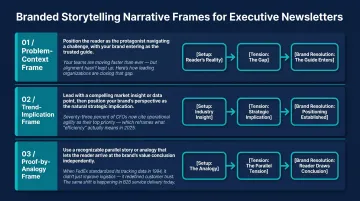
Three narrative frames consistently perform in executive newsletter branded content:
1. The Problem-Context Frame
A professional challenge the reader faces, resolved by the brand's approach. This frame works because it positions the reader as the protagonist and the brand as the guide.
Example: A wealth manager struggles to deliver personalized portfolio insights at scale. The story develops by showing the trade-off between customization and efficiency. The brand enters as the solution that eliminates that trade-off.
2. The Trend-Implication Frame
An emerging development in the reader's world that the brand is positioned to help navigate. Insight comes first; brand positioning follows.
Example: New SEC disclosure requirements create compliance complexity for CFOs. The story explains what's changing and why it matters — then the brand appears as the platform that automates compliance. Readers absorb the insight before they register the pitch.
3. The Proof-by-Analogy Frame
A real-world situation that mirrors the reader's circumstances and demonstrates the brand's value without stating it directly. This frame works because it lets the reader draw their own conclusions.
Example: A logistics company cut delivery times by 40% by replacing manual routing with predictive analytics. The story focuses on the operational transformation. The brand is mentioned as the platform that enabled it.
What Does Not Work
Three formats consistently underperform:
- Origin stories centered on the brand's own history
- Testimonial-style quotes with no narrative context around them
- Product feature lists dressed up in a thin story shell
Each fails for the same reason: it prioritizes the brand's self-interest over the reader's time.
The length and structural constraints of newsletter branded content — typically 100 to 300 words of sponsored copy — make story selection critical. The best-performing stories have a single, clear tension and a single resolution. Multiple characters or subplots rarely survive the 150-word edit.
Conclusion
Storytelling works in executive newsletters not because readers enjoy stories more than facts, but because the format demands that branded content earn its place in an editorial environment. Narrative structure is the mechanism that makes that possible.
Brands that approach executive newsletter placements with a story-first brief — defining the reader's tension before defining the brand message — consistently produce content that reads as editorial value rather than advertising intrusion.
The inbox holds a unique position in digital media: it reaches readers without algorithms filtering the message or ad blockers stripping it out. But that access only has value when the content respects the contract between the publisher and the reader.
When storytelling is executed correctly, the brief changes. The question shifts from "what do we want to say?" to "what does this reader need to understand?" That shift — small in framing, significant in outcome — is what separates branded content that performs from branded content that gets ignored.
Frequently Asked Questions
How is storytelling used in branding and content marketing?
Brand storytelling uses narrative — character, tension, and resolution — to create emotional or intellectual relevance between a brand and its audience. It replaces product claims with experiences the audience can recognize, making the brand's value self-evident rather than asserted.
What are the 5 C's of storytelling?
The 5 C's are Character, Context, Conflict, Climax, and Closure. In a newsletter sponsorship, Character becomes the reader, Context is their professional reality, Conflict is the tension they face, Climax is the insight or turning point, and Closure is the resolution — which is where the brand naturally appears.
What are the 7 elements of StoryBrand?
Donald Miller's StoryBrand framework maps seven narrative roles: Character, Problem, Guide (the brand), Plan, Action, Success, and Failure. In executive newsletters, the Guide and Plan elements matter most — the brand enters as a credible authority with a clear path forward.
What makes branded content in newsletters different from display advertising?
Newsletter branded content sits inside a reader-initiated, sequential reading experience with no visual competition or algorithmic interference. Tone, relevance, and narrative integration matter far more than format or frequency — the reader's full attention is on the text, so the story either earns its place or fails conspicuously.
How do you integrate a brand into a newsletter story without it feeling like an ad?
The brand should enter at the point of narrative resolution — after the reader has already engaged with the tension. This makes the brand feel like a natural answer to a question the story has made them ask, rather than a claim inserted into editorial content. When done well, the reader connects the dots on their own.
What types of brands benefit most from storytelling in executive newsletters?
Brands with complex or high-consideration products — finance, technology, professional services, luxury — benefit most. Story-driven copy gives them space to establish context and credibility that a banner ad or short-form display placement cannot provide. The format rewards nuance and depth over frequency and volume.