Introduction
Most B2B brands treat executive newsletter sponsorships like display ads. That's a mistake — email advertising delivers an average ROI of $36 for every $1 spent, far outpacing display and paid search.
Yet the majority of marketers still approach these placements with performance-only tactics rather than narrative-driven strategy.
The disconnect runs deeper than tactics. Marketers understand B2B storytelling in theory but rarely apply its principles to newsletter sponsorships — and that gap is costing them. Only 5% of B2B buyers are actively in-market at any given time, and the inbox is one of the few channels capable of building brand memory with the 95% who will buy later.
This guide breaks down how B2B storytelling actually operates within executive newsletter sponsorships: the mechanics, the environment, and what separates placements that build trust from those that get ignored.
Key Takeaways
- Newsletter sponsorships embed your brand narrative inside existing reader trust — not on top of it
- The inbox delivers undivided attention: no algorithms, no ad blockers, no visual clutter
- Effective sponsorships follow a clear sequence: pick the right editorial context, build a reader-first narrative, match the newsletter's voice
- The 95/5 rule drives the strategy: most B2B buyers aren't ready yet, so newsletter placements build the familiarity that wins when they are
What Is B2B Storytelling Through Executive Newsletter Sponsorships?
B2B storytelling through newsletter sponsorships is the practice of embedding a brand's narrative inside a trusted editorial publication that reaches a specific, high-intent professional audience. The goal is perception-building, not just click-generation. Unlike standalone ads that fight for attention, newsletter sponsorships inherit the editorial credibility readers have already extended to the publication.
This is not a banner ad dropped into an email, nor a product announcement repurposed as content. A well-executed sponsorship fits the reader's world, speaks their language, and respects the context they chose to be in.
As social feeds grow noisier and web ads face blocking and fatigue, the inbox has become one of the few channels where a B2B brand can hold a reader's full attention inside a trusted editorial relationship.
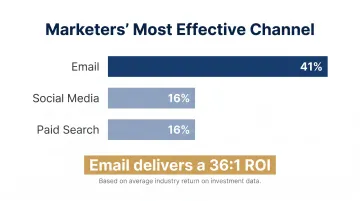
The numbers reflect this. Email marketing delivers an ROI of $36 per $1 spent, and marketers rank their channel effectiveness as follows:
- Email: 41% name it their most effective channel
- Social media: 16%
- Paid search: 16%
That engagement gap comes down to a structural difference: newsletter sponsorships appear inside content the reader actively opened, not alongside content they might scroll past. The IAB and Media Rating Council drew this line formally in their November 2025 attention framework, separating viewability (rendering on screen) from attention (actually being processed). Newsletter placements operate in the second category.
How B2B Storytelling Works in a Newsletter Sponsorship
The storytelling process in newsletter sponsorships operates through a defined sequence. Each stage builds on the last to move the reader from awareness to emotional resonance to action.
Audience and Editorial Context Selection
The storytelling process begins before a single word is written—by choosing an executive newsletter whose audience already holds the mindset, role, and intent that aligns with the brand's message. A finance-focused brand sponsoring a newsletter read by CFOs and investment professionals signals immediate relevance to the reader.
Research from the IAB and Edelman Berland found that relevancy to the reader is the top driver of sponsored content effectiveness, rated important by 90% of online news users. Subject matter expertise of the sponsor (82%) and brand familiarity (81%) follow closely.
The common failure at this stage: brands select newsletters based on volume alone and miss the editorial fit that makes the message resonate. Signals of true audience alignment include:
- Reader role concentration (e.g., 60%+ C-suite or director-level)
- Industry vertical specificity (not just "business professionals")
- Geographic targeting precision (wealth-dense metros like New York, London, Dubai)
- Content relevance overlap between the newsletter's editorial focus and the brand's category
For example, House of Summary's Presidential Summary reaches decision-makers and executives who consume daily U.S. politics, business, and culture summaries—an ideal match for brands whose value propositions tie to market dynamics, policy shifts, or executive decision-making.
Crafting the Brand Narrative
The core storytelling work is building a message that puts the reader, not the brand, at the center. The reader should see themselves in the story: their challenge, their goal, their professional pressure, with the brand positioned as the guide that helps them succeed.
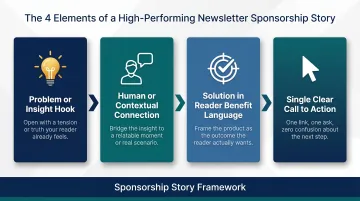
Structural elements of a high-performing newsletter sponsorship story include:
- A specific problem or insight hook — not a generic industry trend, but a concrete professional pain point or surprising data point
- A human or contextual connection — a brief scenario, case, or observation that mirrors the reader's experience
- A solution framed in reader benefit language — what changes for them, not just what the product does
- A single clear call to action — one next step that feels earned rather than forced
According to the same IAB research, 60% of online news visitors are more open to advertising that focuses on a story rather than selling a product. Narrative-driven sponsorship creative outperforms product-centric ad copy because it aligns with how readers process editorial content—they're looking for insight, not interruption.
Editorial Alignment and Trust Transfer
Readers extend credibility to sponsoring brands Brands should align their tone, vocabulary, and narrative approach with the newsletter's existing voice. Tone mismatches break the trust transfer—readers immediately feel the message doesn't belong. Practical alignment looks like:
- Matching sentence style (short and declarative vs. editorial and expansive)
- Mirroring jargon density (technical where the audience expects it, plain where they don't)
- Adopting first-person commentary when the newsletter's editorial voice uses it
House of Summary's newsletters are human-written and fact-checked, providing editorial environments where sponsored content appears alongside verified, balanced reporting. This editorial quality elevates the brand message by association.
Why the Inbox Creates the Right Conditions for B2B Storytelling
The inbox is structurally different from social media and web environments. There is no competing content visible on the same screen, no algorithmic feed disrupting sequence, and no ad blocker filtering the message before it reaches the reader. The brand story gets full-page, sequential attention.
Attention Without Algorithmic Interference
Eye-tracking research by the Nielsen Norman Group found that ad-designated areas of a webpage may receive as little as 0.8% of user fixations, even when those ads occupy 25% of available content space. Banner blindness is described as a "conditioned neurological response" where the brain recognizes visual ad patterns and routes around them before conscious attention engages.
Newsletter sponsorships bypass this entirely. The inbox delivers the message inside the reading flow itself, where attention is already engaged. There are no sidebar distractions, no autoplaying videos, no infinite scroll mechanics competing for focus.
Professional Reader Psychology
Professionals who subscribe to curated newsletters are in an active information-seeking mode, which means they are more receptive to substantive messages than passive scrollers. The average professional spends 28% of the work day reading and answering email, amounting to approximately 2.6 hours and 120 messages received per day.
B2B email marketing delivers an average click-through rate of 3.18%, compared to display advertising's average CTR of just 0.46%. The inbox outperforms web display ads by nearly 7x on engagement.
Immunity to Ad Blocking
That engagement advantage only holds if the message actually arrives. Ad blocker usage reached 763 million users worldwide, with the highest adoption among men aged 25-34 at 36.9%—a demographic that overlaps heavily with professional and executive B2B audiences. Newsletter sponsorships are immune to this entirely: the sponsored content is part of the message body itself, not a browser element that extensions can filter.
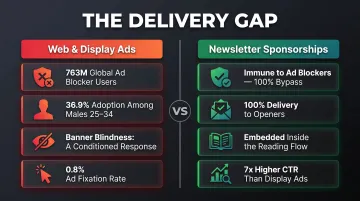
While web and social ads face both ad blockers and banner blindness, newsletter sponsorships reach 100% of subscribers who open the email.
Trust and Psychological Safety
B2B buyers need to feel a brand understands them before they trust it. The newsletter sponsorship delivers this at scale by meeting the reader in a context they already value and trust. Research from the IAB found that 84% of news consumers feel that advertising within news content either increases or maintains brand trust.
One advertiser running through House of Summary's network reported click-through rates four times higher than Google AdWords. That result isn't accidental — it follows from the context: verified content, no sensationalism, and direct inbox delivery to readers who showed up looking for exactly this kind of information.
Where Executive Newsletter Sponsorships Fit in a B2B Storytelling Strategy
Newsletter sponsorships are most strategically valuable as a top-of-funnel and mid-funnel tool under the 95/5 rule. Professor John Dawes of the Ehrenberg-Bass Institute found that only 5% of B2B buyers are in-market at any given time; 95% are out-of-market and will not buy for months or years.
The sponsorship builds brand familiarity and trust with the 95% who will be in-market later. Marketing does not work by pushing buyers down a funnel through persuasion—it works by making a brand memorable so it comes to mind when a buyer eventually enters the market.
Audience Profiles for Peak Performance
Newsletter sponsorships perform strongest for:
- Senior decision-makers and buying committee members with high content consumption habits
- Global executives navigating multi-stakeholder purchases — the average B2B buying timeline reached 379 days in 2024, with 6–10 stakeholders involved
- Luxury and finance brand marketers targeting high-intent readers who are largely unreachable through performance channels
Specialized newsletter networks like House of Summary — which publish Presidential Summary, Geopolitical Summary, Dubai Summary, and London Summary — serve these professional reader segments. The combined network reaches 500,000+ subscribers, with 254,866+ emails opened daily, and an audience that skews toward decision-makers, executives, and high-income consumers across the USA (66%), UK, and UAE.
Strategic Sequencing with Other Channels
Newsletter sponsorships should not be treated as a direct-response replacement. They build brand recall and prime future purchase decisions, feeding conversion through other channels over time.
They work well alongside:
- Thought leadership content — whitepapers, webinars, and case studies that reinforce credibility
- Earned media placements through PR and contributed articles
- Account-based marketing campaigns targeting known high-value accounts
- Retargeting and conversion channels that capture demand the newsletter sponsorship generates
Research by Les Binet and Peter Field analyzing 996 IPA campaigns concluded that for maximum combined short-term and long-term profit, companies should allocate approximately 60% of budget to brand building and 40% to performance/activation. Moving from performance-only to a brand-plus-performance strategy yields an average +90% ROI uplift.
Despite this evidence, 70% of marketers plan to increase performance marketing spend at the expense of brand building. For those brands, newsletter sponsorships offer a concrete path back toward balance — measurable reach into a defined professional audience, without abandoning the brand-building work that makes performance spend pay off.
Conclusion
B2B storytelling through executive newsletter sponsorships works because it combines the emotional mechanics of effective narrative with the structural advantages of the inbox—trusted context, undivided attention, and editorial credibility that algorithmic channels rarely match.
Brands that treat newsletter sponsorships as storytelling investments—choosing the right editorial environment, writing for readers first, and matching the publication's voice—build the kind of presence readers remember long before they reach a purchase decision. Only 5% of buyers are ready to act at any given moment. The brands already occupying mental space when that moment arrives are the ones that win the deal.
Frequently Asked Questions
What are the 5 C's of business storytelling?
The 5 C's are Character, Context, Conflict, Climax, and Conclusion. In a B2B newsletter sponsorship, Character is your reader (not your brand), Context is the professional challenge they face, Conflict is the barrier preventing success, Climax is the insight or solution your brand provides, and Conclusion is the clear action they should take next.
What is the 95/5 rule for B2B?
The 95/5 rule states that only roughly 5% of a B2B market is actively buying at any given time, while 95% are out-of-market. Newsletter sponsorships build brand familiarity with that 95% so your name is already known when their buying intent arrives.
What are the 4 C's of B2B marketing?
The 4 C's are Customer (wants and needs), Cost (to satisfy), Convenience (to buy), and Communication. Newsletter sponsorships are strongest on three: they target the right Customer by audience, deliver Communication inside a trusted editorial context, and offer Convenience by reaching readers in the inbox they already open daily.
Why do executive newsletters outperform other B2B ad channels for storytelling?
The inbox delivers undivided, sequential attention without competing visuals or algorithmic interference. Editorial trust transfers to sponsoring brands in ways that social or display placements cannot replicate, and newsletter ads are immune to the ad blockers that cut into web and display ad performance.
How do you measure the success of B2B storytelling in newsletter sponsorships?
Start with click-through rate, brand recall surveys, and audience quality indicators like subscriber role and industry. Over time, track whether sponsored placements correspond to increased inbound interest or faster movement through the sales cycle among target accounts.
What makes a B2B newsletter sponsorship different from a traditional display ad?
A newsletter sponsorship is embedded in a trusted editorial context, is not subject to ad blockers, and reaches a reader who chose to subscribe to that publication. The reader is already engaged and in a focused reading mindset — which is why sponsorships tend to generate stronger recall and higher click-through rates than display formats.