Introduction
Most tech deals don't die because the product is weak. They die in the boardroom, during the pitch. The reason is almost always the same: companies communicate like engineers speaking to engineers, leading with specs, architecture diagrams, and feature lists when the C-suite needs something entirely different. A Harvard Business School study found that CEOs spend only 24% of their work time on electronic communications, with an average of 37 meetings per week fighting for a slot. Your vendor pitch gets seconds, not minutes, in an executive's day.
This is a failure of translation, not product quality. Executives filter everything through one lens: strategic relevance to board-level priorities. Revenue impact, competitive risk, operational efficiency, outcomes they can defend to shareholders — that's what lands. Not your platform's distributed ledger architecture.
This guide provides a practical framework for building tech narratives that reach decision-makers, structured for boardroom audiences who make million-dollar calls.
Key Takeaways
- Executives decide based on outcomes, risk mitigation, and strategic fit—not feature lists or technical specifications
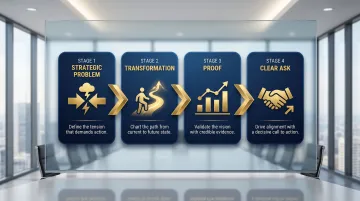
- Effective executive stories follow a tight four-part structure: Strategic Problem → Transformation → Proof → Clear Ask
- Translate technical complexity into business outcomes—executives need to see impact, not product mechanics
- The inbox dominates executive attention: 94% rely on email newsletters for daily news, compared to 35% for social media
- Leading with your product instead of their problem instantly signals vendor noise and kills credibility
Why Executives Are a Different Storytelling Audience
Executive decision-makers operate in a fundamentally different reality than general audiences. They work 62.5-hour weeks on average, spending 61% of that time in face-to-face interactions and managing 37 meetings weekly. Electronic communications receive just 24% of their attention, meaning your content competes for razor-thin attention windows measured in seconds, not minutes.
This scarcity creates an aggressive filtering mechanism. Greentarget research found that 71% of C-suite executives say utility and usefulness are what attract them to content—not clever headlines or emotional appeals. Executives are trained skeptics who've been pitched thousands of times, and credibility must come before emotion can play any role. The story has to answer one question before anything else: "Does this person understand my world, or are they just selling?"
The Executive's Hierarchy of Concerns
Executives don't think about your product's features. They think about:
- Revenue impact and growth acceleration
- Competitive positioning and market risk
- Operational efficiency and cost reduction
- Board-level accountability and regulatory exposure
Storytelling that doesn't map directly to these concerns gets mentally filed under "vendor noise" and ignored. Gartner research shows that 67% of B2B buyers prefer a rep-free purchasing experience — most seller interactions simply don't deliver strategic value worth the executive's time.
How Executives Process Tech Narratives Differently
General audiences can be moved by aspiration alone: the promise of transformation. Executives need that aspiration anchored in evidence. Bain & Company's B2B Elements of Value framework identifies 40 distinct value elements in business purchasing decisions, finding that "subjective concerns often play a surprisingly large role" — including whether a product can "enhance the buyer's reputation or reduce anxiety."
Emotion still matters. The ratio of emotion to proof just shifts dramatically the higher you go on the org chart.
The voice and tone must signal peer-level confidence, not sales energy. Executives respond to people who understand their world — who speak in outcomes, not outputs. Feature-led communication signals a fundamental misread of the executive's job. When tech companies lead with capabilities instead of consequences, they've already lost the room.
The Anatomy of a Compelling Executive Tech Story
A four-part narrative framework works because it mirrors how executives evaluate decisions: identify the gap, envision the solution, validate with data, determine next steps.
Strategic Problem: Open With Their Tension
Start with a problem the executive has personally felt or is currently facing—not a generic industry pain point. This must be a specific operational, financial, or competitive tension that has board-level visibility.
When Steve Jobs introduced the iPhone at Macworld 2007, he didn't lead with specs. He opened with the problem: "The most advanced phones are called smart phones, so they say... And the problem is that they're not so smart and they're not so easy to use." He used a business school graph showing that smartphones were harder to use despite being "smarter." Only after establishing this tension did he introduce the iPhone as the solution.
Your problem statement must:
- Reference a pain point the executive owns (not their team's technical challenges)
- Quantify the cost of inaction when possible
- Connect to strategic priorities, not operational details
- Feel familiar, not educational
Transformation: Position the Customer as the Hero
The executive is not the hero—they are the decision-maker who enables transformation. Position the customer organization or the end user as the hero, and frame your technology as the enabling force. Describe the "before and after" clearly: What does the world look like when this problem is solved at scale?
Avoid making your product the center of the story. Instead, describe the organizational transformation that becomes possible: what new capabilities emerge, what risks disappear, what competitive doors open.
Proof: Executives Trust Numbers, Peers, and Outcomes
The 2024 Edelman-LinkedIn B2B Thought Leadership Impact Report found that 73% of decision-makers say an organization's thought leadership is a more trustworthy basis for assessing capabilities than marketing materials. They weight evidence in this order:
- Specific metrics from named implementations (not vague "increased efficiency")
- Peer company references in similar industries or at similar scale
- Industry benchmarks and third-party validation
- Research-backed insights, not vendor claims
Build proof into the story—but let it serve the narrative, not interrupt it. Lead with one strong case study with concrete outcomes: "A multinational manufacturer reduced compliance audit prep time by 67%, cutting legal risk exposure and freeing 240 hours per quarter for strategic work."
That kind of specificity does more than a page of claims.
The Ask: Frame the Next Step for Their Position
Every executive story needs a clear, low-friction next step that respects their buying journey stage. Don't default to "schedule a demo" as the first ask when they're still in problem exploration. Offer a decision-framed invitation:
- A strategic briefing on category trends
- A benchmarking conversation with peer data
- A pilot proposal with defined success metrics
- An analyst-led validation session
The ask should match where they are in their evaluation. Forrester's research shows that 92% of B2B buyers begin with at least one vendor already in mind, and 47% of C-suite buyers show early loyalty to a specific vendor. Offer something that aids their comparison—not just something that advances your sale.
Turning Technical Complexity Into Strategic Clarity
Most tech companies default to technical depth out of pride in their innovation — and that instinct alienates the executives they most need to convince. The solution is an "altitude shift"—speaking at the level of business outcomes (30,000 feet) rather than product mechanics at the implementation level.
The Altitude Shift Technique
Instead of: "Our platform uses distributed ledger architecture with cryptographic validation"
Say: "Your compliance team can cut audit preparation time by 40% because every transaction is immutably recorded and instantly verifiable by regulators"
The first statement describes what the product does. The second describes what the customer achieves.
Deb Liu, former VP at Meta and current CEO of Ancestry, describes the altitude framework: executives spend only 1-5% of their mindshare on your specific area. Communicating too low (in the weeds) or too high (lacking specifics) causes disengagement.
Use Analogy to Make Complexity Accessible
Complex tech concepts become accessible when grounded in familiar business experiences. IBM's quantum computing page uses a maze analogy: "A traditional computing approach would 'brute force' the problem, trying every possible path. A quantum computer might derive the correct path without testing all the bad paths, as if it has a bird's-eye view of the maze."
Stripe takes a similar approach, translating payment infrastructure into an economic narrative — "increasing the GDP of the internet" — rather than explaining API architecture. The numbers back it up: an IDC study commissioned by Stripe found a 59% increase in developer productivity and an 81% reduction in unplanned outages. But the messaging led with freeing "increasingly precious developer resources" from homegrown systems. Outcomes first, mechanics second.
Build a Layered Narrative
Design stories that work on two levels simultaneously:
| Layer | Audience | What It Delivers |
|---|---|---|
| Layer 1 — Executive | C-suite, board, budget holders | Strategic problem, business outcome, risk mitigation |
| Layer 2 — Validation | Technical leads, specialists, legal | Deeper detail that expert teams can verify and endorse |
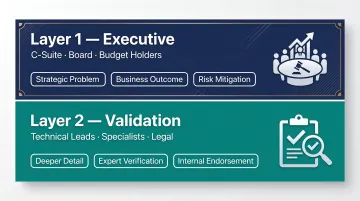
This respects the executive's intelligence without overwhelming them and allows the story to travel through an organization. Gartner research shows that the average B2B buying group includes 6-10 decision-makers, and Forrester reports an average of 13 individuals involved. Your narrative must equip internal champions to advocate across departments.
Avoid Two Failure Modes
Over-simplifying signals you don't understand the problem deeply. Executives can smell condescension.
Over-complicating signals you can't communicate value clearly. If you can't explain it simply, you don't understand it well enough.
The target is confident clarity: authority in your position, economy in your language.
Choosing the Right Channels to Reach Executive Decision-Makers
Channel selection is the overlooked variable in executive storytelling. The best narrative in the wrong environment never lands.
The Inbox Is the Primary Executive Channel
Executives are largely absent from the social media environments where most tech marketing concentrates. Research from SmartBrief and Greentarget reveals the gap:
- 55% of C-suite executives use email daily for business content
- 35% use social media daily for business content
- 94% of executives use email newsletters for daily news
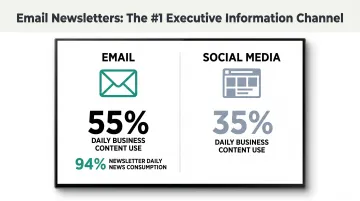
That's a 20-percentage-point advantage for email over social media, and email newsletters specifically dominate executive information consumption. Unlike social feeds governed by algorithms, newsletter content arrives directly in the inbox with voluntary attention. Readers have opted in, creating an undistracted reading moment.
Executive newsletter networks like House of Summary place brand messages inside trusted editorial environments read by global executives and business professionals. These placements bypass ad blockers entirely (which affect 52% of consumers globally) and avoid banner blindness. The editorial context delivers messaging to decision-makers during focused reading sessions, not mid-scroll on a crowded feed.
House of Summary's newsletter network reaches over 500,000 subscribers with 254,866+ daily email opens, concentrated in key markets: 66% in the USA (primarily New York and Los Angeles), plus London and Dubai. The audience includes C-suite executives, founders, senior professionals, and policy experts.
Native ads, sponsored features, and email sponsorships fit naturally into editorial content covering global news, geopolitics, and business developments — reaching the decision-makers tech companies most need to influence.
Peer-to-Peer Channels and Retellable Stories
The inbox channel sets the stage — but executive decisions rarely happen in isolation. Stories that land in the inbox still need to travel through referrals, analyst briefings, and boardroom conversations to drive action. The Edelman-LinkedIn report found that 75% of decision-makers say thought leadership led them to research a product they weren't previously considering. A further 25% ended or reduced a supplier relationship after a competitor's thought leadership raised doubts.
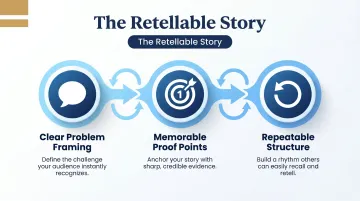
Build stories that are "retellable" — simple enough for an internal champion to relay accurately to peers or superiors. Retellable stories share three traits:
- Clear problem framing — the challenge is stated in terms the audience already recognizes
- Memorable proof points — one or two specific numbers or outcomes, not a laundry list
- Repeatable structure — a narrative arc that holds its shape when passed along
Forrester's data shows that 86% of B2B purchases stall during the buying process. Stories that can't travel intact through buying committees are a direct contributor to that number.
Common Mistakes to Avoid When Storytelling to the C-Suite
Mistake 1: Leading With the Product, Not the Problem
Starting with "We are [Company X] and we built [Product Y]" instantly signals vendor mindset. Executives aren't looking for vendors; they're looking for strategic partners who understand their challenges.
Challenger Inc. research (originally from CEB, now part of Gartner) found that top-performing sellers avoid the stale "What keeps you up at night?" question. Instead, they "tell customers what should be keeping them up"—leading with a Reframe that reveals an unrecognized, underappreciated, or misunderstood problem. The story must begin in the executive's world, not the brand's world.
Mistake 2: Burying the Outcome in Technical Detail
Tech companies often include business impact as an afterthought, after feature-heavy explanations. Executives read differently—they start at the end. The outcome, the ROI signal, the strategic relevance must appear early or the rest never gets read.
According to RAIN Group research, only 20% of sellers meet executive expectations. Worse, Challenger data shows the ability to demonstrate unique insight dropped 52% in buyer evaluations between 2019 and 2020. Leading with technical detail instead of strategic insight is a primary driver of both numbers.
Mistake 3: Inconsistency Across Touchpoints
Executive decision cycles are long and involve multiple stakeholders. Gartner found that 69% of B2B buyers report inconsistencies between a selling organization's website and what sellers communicate directly.
When the story in a sales deck contradicts the tone in a white paper or the claims in an ad, trust breaks down fast. Buying groups of 6–13 people are already navigating purchases that 77% describe as "very complex or difficult"—message fragmentation across those voices directly feeds the 86% purchase stall rate Forrester documented.
Each touchpoint is a vote for or against your credibility. Make sure they're all casting the same one.
Frequently Asked Questions
What makes tech storytelling for executives different from storytelling for general audiences?
Executives filter for credibility and strategic relevance before emotion, requiring a tighter proof-to-narrative balance. They have far less tolerance for ambiguity about business outcomes and weight evidence—peer references, metrics, and research—more heavily than aspirational messaging alone.
How do you translate complex technical features into language executives understand?
Use the "altitude shift" technique: lead with business outcomes rather than product mechanics, and ground technical concepts in familiar analogies. Instead of explaining distributed architecture, describe how compliance teams cut audit prep time by 40% because transactions are immutably recorded.
What narrative structure works best when presenting tech solutions to C-suite decision-makers?
The four-part executive framework: Strategic Problem (tension they personally feel), Transformation (customer as the hero of the story), Proof (specific metrics and peer validation), and a Clear Ask (a direct next step that matches where they are in the buying process).
Which channels are most effective for reaching executive decision-makers with tech storytelling?
Curated inbox environments—newsletters and executive briefings—outperform algorithmic social channels. 94% of executives use email newsletters for daily news, compared to 35% who use social media daily. Decision-makers read in their inbox with full attention—no algorithm, no competing content.
How long should a tech story aimed at an executive actually be?
Format should match the channel: a newsletter placement or executive summary may be 150-300 words, while a strategic white paper can run longer. The key principle is that the value signal must appear in the first two sentences regardless of length—executives decide whether to continue reading within seconds.