Introduction
C-level executives are the most valuable audience in B2B marketing — and the hardest to reach. Traditional digital advertising fails to break through to this segment: 52% of professionals earning over $100,000 use ad blockers, executives spend minimal time scrolling social feeds, and programmatic display ads deliver a click-through rate of just 0.046%. Meanwhile, C-suite inboxes receive 150+ emails per day, yet 75% of executives say email newsletters are their primary information source.
The disconnect is structural: executives actively choose where to spend attention, and they've chosen the inbox over banner ads, social media, and cold outreach.
That doesn't mean newsletter advertising is easy to get right. Results vary dramatically based on newsletter selection, ad creative, targeting alignment, and campaign setup. Many advertisers see poor returns because they treat newsletter placements like any other ad buy — repurposing existing creative, choosing publications by subscriber count alone, and measuring success by click volume rather than downstream impact.
What follows is a practical guide to doing it correctly — from audience dynamics and channel fit to campaign execution and creative strategy.
Key Takeaways
- C-level executives ignore display and social ads — their attention is reserved for curated newsletters they already trust
- Newsletter ads bypass ad blockers and algorithms, reaching executives in a distraction-free reading environment
- Choose publications with verified executive readership, write outcome-first headlines, and measure pipeline influence — not clicks
- Avoid generic creative and chasing subscriber volume; qualified lead quality outweighs raw list size every time
What Is a C-Level Audience and Why Are They So Hard to Reach?
Defining the C-Suite
The C-level audience includes CEOs, CFOs, CMOs, CTOs, COOs, and other chief officers who hold final budget authority and strategic decision-making power in their organizations. This group is often lumped together, but priorities differ meaningfully by title: a CFO responds to risk mitigation and ROI, a CMO to brand positioning and market share, a CTO to innovation and technical infrastructure.
The Access Problem
C-suite executives are protected by executive assistants, ignore unsolicited outreach, and use premium ad-blocking tools at rates significantly higher than the general population. High-income professionals adopt ad blockers at a 52% rate compared to 42.7% for all internet users. They spend limited time on social feeds, are conditioned to filter noise, and prefer trusted sources over algorithm-driven feeds.
Cold email outreach to executives generates approximately 6.4% response rates — better than non-executives but still inefficient. On top of that, 67% of B2B buyers now prefer a rep-free experience, which makes direct outreach to senior decision-makers even harder to justify as a primary channel.
Where Executive Attention Lives
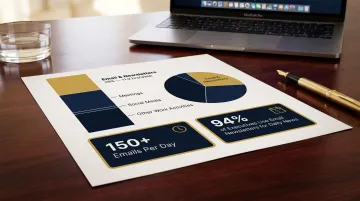
So where do executives actually pay attention? The inbox — specifically before 8 AM, before meetings and social feeds take over. According to McKinsey Global Institute research, professionals spend 28% of their workweek — roughly 11.2 hours — on email. C-suite executives receive 150+ emails daily, and a 2018 SmartBrief study found that 94% of executives use email newsletters for their daily news.
That's the channel. The remaining question is which newsletters they actually open — and why.
Why Executive Newsletters Are the Most Effective Channel to Reach the C-Suite
The Inbox Advantage
The inbox is the one place C-suite executives choose to spend focused time. They opt in, read consistently, and no algorithms control delivery. Contrast this with:
- LinkedIn sponsored content: Feed-dependent, increasingly filtered, easy to scroll past
- Programmatic display: 52% blocked by high-income professionals, average CTR of 0.046%
- Cold email outreach: Low trust, response rates around 6.4%
Newsletter advertising isn't subject to ad blockers, doesn't compete with algorithmic feeds, and appears in a controlled reading environment the subscriber has actively chosen to open.
Engagement Rate Superiority
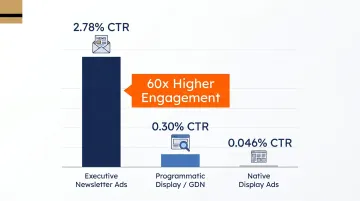
Business and finance email newsletters average a 2.78% click rate, while Google Display Network ads average just 0.046% — a difference of approximately 60x. Even compared to native display ads (0.30%), newsletters deliver roughly 9x the click engagement.
House of Summary's own performance data illustrates this: advertisers see click-through rates 4x higher than Google AdWords, according to BSH Hausgeräte CEO Faik Serkan Ergun's experience with the Dubai Summary newsletter.
Undivided Attention Dynamic
Unlike social media where your ad competes with dozens of competing distractions, a newsletter ad appears in a single-focus reading environment. The subscriber has opened the email deliberately, often during a dedicated reading window before the workday begins. The result is straightforward: higher visibility and a reader who is already in a receptive state when your message lands.
Editorial Trust Transfer
When a respected newsletter carries an advertiser's message, the credibility of the publication extends partially to the brand. News consumers are 2.5 times more likely to pay attention to ads in trusted editorial content versus social media, and advertisers using news brands see up to 52% higher ad effectiveness.
Skeptical C-suite readers — who instinctively filter out overt advertising — respond to brands that appear in editorial environments they already trust. That association carries real weight.
Targeting Precision
Specialized executive newsletters self-select audiences by interest, seniority, and geography. A geopolitics-focused newsletter attracts global business leaders and policy-aware executives; a finance-focused publication draws CFOs and investment decision-makers. Programmatic tools try to approximate this through behavioral data, but cookie decay, contextual mismatch, and third-party data gaps mean they're working with proxies. Newsletter audiences self-declare their interests by subscribing.
House of Summary publishes four specialized titles — Presidential Summary (global affairs), Geopolitical Summary (international politics), Dubai Summary (UAE business and culture), and London Summary (UK-focused content). Each attracts senior readers who seek strategic intelligence, not headlines — the kind of audience that reads with intent and acts on what they learn.
How to Reach a C-Level Audience Through Executive Newsletter Advertising: Step by Step
Step 1: Define Your Target Executive Profile and Campaign Objective
C-suite is not a monolithic audience. Define:
- Which executive title(s) matter: CEO, CFO, CMO, CTO, COO
- Geography or industry sector: US-based SaaS executives, EMEA financial services leaders, global manufacturing CEOs
- Campaign objective: Brand awareness among decision-makers, lead generation, event registration, product launch visibility
Establish whether the objective is upper-funnel (executive awareness, brand positioning) or lower-funnel (driving a specific action like demo requests). This determines creative format, call-to-action type, and which newsletter publications to prioritize.
Step 2: Identify and Vet the Right Executive Newsletter Publications
What to Evaluate:
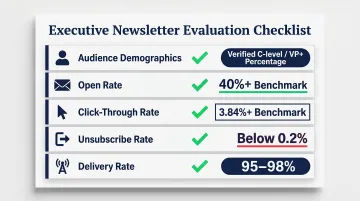
- Verified audience demographics — not just subscriber count
- Open rate consistency — ask for recent performance data
- Editorial quality and niche relevance — does the content align with your target executive's daily priorities?
- Readership profile match — does the publication reach the specific executive titles and industries you're targeting?
Volume vs. Quality:
A 50,000-subscriber general business newsletter often underperforms a 10,000-subscriber specialized executive publication in C-suite engagement. Niche newsletters deliver 16% higher open rates, 21% higher click-through rates, and 2.3x higher ad revenue compared to general-interest publications.
Key Metrics to Request:
| Metric | Target Benchmark |
|---|---|
| Open Rate | 40%+ |
| Click-Through Rate (CTR) | 3.84%+ |
| Click-to-Open Rate (CTOR) | 10-20% |
| Unsubscribe Rate | Below 0.2% |
| Delivery Rate | 95-98% |
Premium specialized newsletter networks provide detailed analytics on geographic distribution, professional seniority, and engagement patterns. House of Summary, for example, reaches over 500,000 subscribers with 254,866+ daily opens, concentrated in the USA (66%), UAE (18.2%), and UK (10.5%) — all wealth-dense metropolitan areas with high executive density.
Step 3: Develop Ad Creative That Matches the C-Suite Mindset
Lead with outcomes, not features:
C-level readers respond to business results, strategic relevance, and brevity. Ad copy should open with a specific outcome or concrete claim — not a product description or feature list.
Format Requirements:
- Character limits: Typically 50-150 words of copy maximum
- Headline constraint: Must communicate outcome in under 10 words
- Image specifications: Follow publisher guidelines (vary by network)
- Call to action: Single, clear CTA requiring minimal cognitive load ("See the case study," "Request a briefing" — not generic "Learn more")
Detailed creative best practices are covered in the next section.
Step 4: Launch, Monitor, and Optimize the Campaign
What to Track:
Activity Metrics:
- Open rate context (newsletter-level, not ad-level)
- Click-through rate on the ad unit
- Downstream behavior (landing page visits, time on site)
Outcome Metrics:
- Form completions
- Qualified leads
- Demo requests
- Pipeline influence
The Optimization Cycle:
Review performance after the first 2-3 placements — that's typically enough data to spot what's working. A/B test headline variations, adjust the CTA based on actual click behavior, and test across multiple newsletters in the same network before drawing conclusions.
Multi-placement packages allow sustained presence and frequency, which is critical for executive audiences who may not click immediately but remember the brand when a purchasing decision surfaces.
What Makes C-Suite Newsletter Ad Creative Actually Work
Lead with the Headline
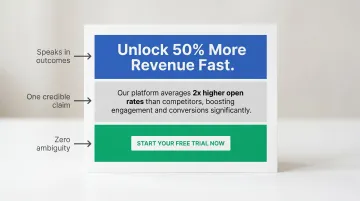
C-level readers skim — the headline is often the only text they read. It must communicate a specific, compelling outcome or insight in under 10 words.
Good: "Cut Time-to-Revenue by 35%"
Bad: "Introducing Our New Procurement Platform"
The first headline speaks in outcomes, the second speaks in features. Executives value content that highlights headline conclusions and quantified business impacts — they want the "what" and "why it matters" immediately.
Outcome-First Copy Structure
After the headline, body copy should move directly to a business result or bold strategic claim:
- Not background information or company history
- Not product feature lists
- Not generic brand statements
C-suite readers operate in outcome space, not feature space. Include one concrete, credible claim — a statistic, a client result, or a research finding — that gives the reader a reason to click.
Example Structure:
Headline: Reduce CFO Reporting Time by 40%
Body: Finance teams at mid-market firms spend 12+ hours weekly on manual reconciliation. [Company] automates ledger consolidation, cutting monthly close cycles from 10 days to 6. See how [Client] saved 320 hours per quarter.
CTA: View the case study
Brevity and Format Discipline
Newsletter ad placements are constrained environments — typically 50-150 words maximum. That constraint works in your favor: it forces you to communicate only what matters.
Emails with a single call-to-action generate 371% more clicks and 1,617% more sales than multi-CTA emails. Simplicity signals confidence to executive readers.
Brand Alignment with Editorial Voice
The tone, vocabulary, and visual style of your ad must match the editorial sophistication of the newsletter. An ad that feels generic or mass-market creates cognitive dissonance in an executive reader who expects precise, high-quality communication from that publication.
Match the register of the publication:
- Data-driven editorial voice → lead with stats and specific claims
- Understated authority → drop the hype and superlatives
- Analytical, long-form tone → avoid punchy ad-speak and urgency triggers
Common Mistakes Advertisers Make When Targeting C-Level Audiences via Newsletters
Choosing Newsletters by Subscriber Count Instead of Audience Quality
Advertisers frequently select placements based on raw list size without verifying that the audience actually includes the executive seniority they're targeting. A newsletter with a large general audience may deliver fewer actual C-suite impressions than a smaller, specialized publication with verified senior readership.
Before committing to a placement, request demographic data. Key questions to ask:
- What percentage of subscribers are C-level or VP+?
- Which industries and geographies are represented?
- What are the open and engagement rates for recent issues?
Writing Ad Copy Designed for a General Audience
Most advertisers repurpose existing brand ads into newsletter placements without rewriting for the executive mindset — and it shows. C-level readers immediately recognize and dismiss messaging written for a mass audience.
The copy needs to be written specifically for the executive reading context: outcome-focused, brief, and free of jargon or superlatives. 71% of decision-makers feel that less than half of the thought leadership they consume provides meaningful insight — your ad must be in the valuable 29%.
Measuring Success by Click Volume Instead of Downstream Impact
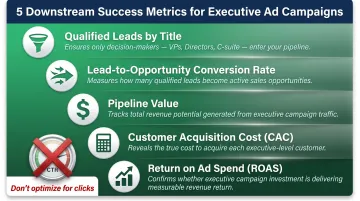
Executive audiences click less frequently but convert at significantly higher rates when they do. Measuring a C-suite campaign by raw CTR is misleading.
52% of marketers focus primarily on reach and frequency, and 42% of lead-gen marketers use cost-per-click as their primary ROI metric — neither reflects how executive-level decisions actually move through the pipeline.
Instead, track metrics that reflect actual pipeline impact:
- Qualified leads (by title and company fit)
- Conversion rate (lead to opportunity)
- Pipeline value
- Customer acquisition cost (CAC)
- Return on ad spend
Advertisers who abandon campaigns after low click counts miss two things: the brand awareness that compounds across multiple placements, and the delayed pipeline influence that executive-level advertising creates over time.
Frequently Asked Questions
What is a C-level audience?
C-level refers to senior corporate executives whose titles begin with "Chief" — CEO, CFO, CMO, CTO, COO, and similar roles. These individuals hold strategic decision-making authority, control significant budgets, and set company-wide policy. They are distinguished by high-stakes responsibility and influence over organizational direction.
Why is email the best channel for reaching C-suite executives?
Email — specifically curated newsletters — is where C-level executives actively choose to spend focused reading time. Unlike social feeds or display ads, newsletter placements are not filtered by algorithms or blocked by ad blockers, and they reach executives in a high-attention, distraction-free environment they've deliberately opted into.
How do I choose the right executive newsletter for my advertising campaign?
Start with audience quality, not subscriber count. Key evaluation criteria:
- Verified demographics matching your target executive profile
- Editorial quality and niche relevance to your sector
- Consistent open rates (40%+ is a strong benchmark)
- Geographic or industry alignment with your campaign
A smaller, specialized publication with verified senior readership often outperforms a large general-audience newsletter.
What type of ad creative works best in executive newsletter placements?
Lead with business results, not features. C-suite readers respond to:
- Outcome-led headlines (under 10 words)
- Minimal copy anchored by a single bold claim or relevant statistic
- One clear call to action — nothing more
Brevity and specificity consistently outperform detailed product descriptions for this audience.
How do I measure the ROI of executive newsletter advertising?
Look beyond click-through rate. The most reliable downstream indicators are landing page behavior, form completions, qualified leads by title, pipeline influence, and deal attribution. C-suite audiences engage at lower frequency but higher intent. Track conversion quality, not just click volume.
How is executive newsletter advertising different from LinkedIn advertising for C-suite targeting?
Newsletter ads are delivered in a controlled reading environment the subscriber has opted into — no algorithm filtering, no ad-blocking risk, and measurably higher engagement rates (2.78% vs. 0.046% for display). LinkedIn placements are feed-based and algorithm-dependent, making them increasingly competitive and easy to scroll past. For C-suite targeting, the attention quality difference is significant.