This article explains when executive newsletter advertising makes sense for local UK businesses, what's required to get started, the exact steps to run a campaign, the key variables that affect performance, and the common mistakes to avoid. For businesses targeting decision-makers, high-intent professionals, or affluent local audiences, newsletter advertising delivers engagement that traditional channels often can't match.
Key Takeaways
- Executive newsletters place your ad directly into a professional audience's inbox with no algorithms, no ad blockers, and no competing visual clutter
- Newsletter ads deliver click-through rates averaging 2.3–3%, outperforming Google Display (0.46%) by up to 6x and LinkedIn ads (0.28%) by nearly 10x
- Results depend on matching the right newsletter audience to your local market, then measuring performance with UTM-tracked links — not just open rates
- The channel works best for B2B services, premium consumer products, and brands seeking credibility through association with trusted editorial content
- This guide walks you through five steps — from audience definition to placement negotiation — so your first campaign is built on more than guesswork
Step 1: Define Your Local Audience and Campaign Goal
Clarify whether you're targeting a specific city (London, Manchester), a professional sector (finance, law, property), or a decision-maker type (C-suite, media buyers, SME owners). This determines which newsletters are worth approaching. A financial services firm targeting London-based CFOs requires a different publication than a property developer seeking Manchester SME owners.
Once your audience is clear, your campaign goal determines the format, call to action, and metrics that matter. Decide before spending:
- Brand awareness — introducing your company to a new professional audience
- Lead generation — driving enquiries or sign-ups
- Event promotion — filling seats at a webinar, conference, or launch
- Direct sales — converting readers to customers
Each goal requires a different measure of success. A brand awareness campaign accepts a higher cost per click; a lead generation campaign demands conversion tracking from first click to final enquiry. Get that alignment wrong at the start and even a well-placed ad will look like it underperformed.
Step 2: Identify and Evaluate UK Executive Newsletters Relevant to Your Market
Research UK-focused executive newsletters by looking for publications with a defined niche audience, consistent send schedules, editorial credibility, and transparent audience data. Check subscriber count, open rates, geographic reach, and professional demographics.
Newsletters like London Summary, published by House of Summary, serve London-based professionals and represent the type of channel worth evaluating when targeting local UK executives. Sent five times weekly to 500,000 subscribers across the network, it reaches decision-makers, executives, and affluent consumers who prioritise clarity and verified information.
Before approaching any newsletter, confirm its editorial focus aligns with your brand's positioning.
Assess Audience Quality Indicators
Look for newsletters that:
- Verify content through fact-checking (editors confirm sources, check dates, trace data, ensure context)
- Maintain a strong editorial voice that readers trust
- Share audience demographic data (job titles, seniority, industries)
- Achieve open rates above 35% and click rates above 2%
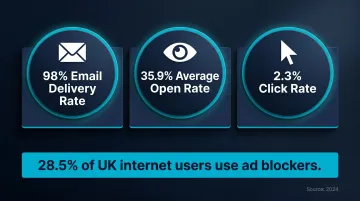
A smaller, highly engaged list often outperforms a large but unengaged one. That principle is backed by data: UK email delivery rates reached 98% in 2024, with open rates climbing to 35.9% and click rates rising to 2.3% — signalling that engaged newsletter audiences are genuinely reading, not skimming. Add to that the fact that 28.5% of UK internet users now use ad blockers, and newsletters become one of the few channels that reliably lands in front of your audience.
Step 3: Choose Your Ad Format and Write Your Message
Available Ad Formats
Executive newsletters offer several placement types:
- Sponsored placements (native ads) — Text ads written in the newsletter's voice, integrated into editorial flow
- Display-style image banners — Visual ads with fixed dimensions (300×250, 728×90)
- Dedicated send sponsorships — Full email devoted to one advertiser with no competing messages
- Classified-style listings — Compact text placements near the newsletter's end
Your choice depends on budget and goal. Native ads are viewed 53% more frequently than banner ads and produce an 18% increase in purchase intent compared to standard display — making them the stronger default for most local advertisers.
Write for the Audience, Not the Algorithm
The best-performing newsletter ads match the publication's editorial tone. Generic banner copy stands out for the wrong reasons. Strong ads include:
- A single clear call to action
- A specific value proposition relevant to the local UK audience
- Language that fits naturally within the newsletter's editorial voice
Avoid promotional language that clashes with the publication's style. If the newsletter uses direct, factual language, your ad should too. If the tone is conversational, match that approach.
Compliance Requirements
UK ASA/CAP Code Section 2 requires marketing communications to be "obviously identifiable as such." Key requirements include:
- Use labels like "Ad," "Advert," "Advertising," or "Advertisement Feature" — the ASA discourages "sponsored" as ambiguous
- Place labels upfront in a prominent position, not buried at the end
- Both the marketer and publisher share compliance responsibility
- All claims must be substantiated before the ad runs
Step 4: Negotiate Placement and Set Your Budget
Pricing Structures
UK newsletter ad placements typically follow one of these models:
- CPM (cost per thousand impressions) — Benchmark rates vary by niche: HR newsletters tend to command the highest premiums (around £40–£45 CPM), followed by Business (£15), Tech (£13), and Finance (£11). Figures reflect market-rate estimates; always request a publisher's own rate card.
- Flat-rate per issue — Common formula: 2.5–5% of total subscriber count (e.g., £125–£250 for 5,000 subscribers)
- Performance-based — Payment tied to clicks or conversions
Executive and decision-maker audiences command higher premiums than general consumer lists — expect to pay more, but also expect higher conversion rates.
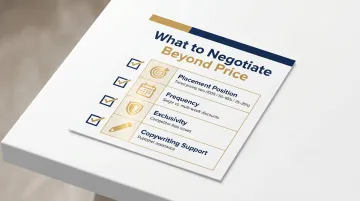
What to Negotiate Beyond Price
- Placement position — Top-of-newsletter ads receive more attention than bottom placements; some newsletters charge tiered pricing (primary placement 100%, mid-newsletter 50–65%, footer 25–35%)
- Frequency — Single issue vs. multi-week run (discounts available for 2–12 week campaigns)
- Exclusivity — No competitor ads in the same issue (available as full-newsletter takeover)
- Copywriting support — Some newsletter teams will draft or refine your ad copy; confirm this upfront, as it affects turnaround time and creative quality
Before committing, request three things: audience demographic breakdowns, recent campaign performance data, and confirmation of UTM-tracked link support for attribution.
Step 5: Launch, Track, and Optimise
Set Up Tracking Before Launch
Before your first placement goes live, set up:
- UTM parameters on your landing page URL (utm_source=londonsummary&utm_medium=email&utm_campaign=q1launch)
- Dedicated landing page specific to the newsletter campaign
- Baseline metrics of current lead volume to measure lift
Evaluate Performance Against Your Goal
After the campaign runs, look beyond open rates:
- Click-through rate (CTR) — Newsletter ads average 2.3-3%, outperforming Google Display (0.46%) by 5-6.5x and LinkedIn EMEA ads (0.28%) by nearly 10x
- Conversion rate — What proportion of those clicks turn into actual leads or sales — the number that ties ad spend to revenue
- Cost per acquisition — Total spend divided by conversions; this is the figure to benchmark against your other channels
A well-targeted newsletter campaign reaching London-based executives can realistically achieve 3-4% CTR with a 5-10% conversion rate on a relevant B2B offer. B2B services achieve 3.2% email CTR compared to retail at 1.9% — a 68% performance gap driven by audience intent.
Use Results to Inform Decisions
Did cost per lead beat your other channels? Did newsletter-driven site traffic engage more deeply than paid social visitors? These are the comparisons that reveal whether the channel earns its place in your mix.
Test variables across subsequent issues:
- Different headline approaches
- Alternative calls to action
- Placement position changes
- Varied ad formats
Each variable tells you something different, but a single placement rarely gives you enough data to judge the channel fairly. Plan for at least 2-3 issues before deciding whether newsletter advertising works for your business.
When Should You Advertise Through Executive Newsletters?
This channel is not suited to every local UK business. It works best when your product or service is relevant to professionals, decision-makers, or high-income readers rather than a general consumer audience.
Best-Fit Scenarios
Executive newsletter advertising makes sense when:
- You're launching a B2B service in a specific UK city — think accounting firms targeting Manchester SMEs or legal services for London startups
- Your offer is a premium consumer product aimed at affluent professionals (luxury property, wealth management, executive education)
- You're promoting an industry event, webinar, or sector-specific workshop to a relevant professional audience
- Building credibility within a local business community matters — placement alongside trusted editorial content reinforces legitimacy
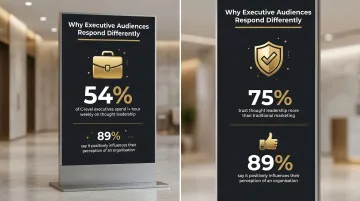
The audience engagement data supports this. According to research, 54% of C-level executives and 52% of global B2B decision-makers spend at least one hour weekly engaging with thought leadership content. 75% say they trust high-quality thought leadership more than traditional marketing. And 89% report that strong thought leadership positively influences their perception of an organisation.
Poor-Fit Scenarios
This method isn't the right fit when:
- Your business serves a hyper-local walk-in audience (neighbourhood café, local gym, convenience shop)
- Your offer requires mass reach to work economically (low-margin consumer products needing volume)
- You cannot articulate a value proposition that resonates with professional readers in a few lines
The fit between your audience and the newsletter's readership is what determines results — the execution matters far less than that alignment.
What You Need Before Getting Started
Getting your inputs right before you book a placement saves budget and produces cleaner performance data from your first issue.
Audience and Offer Readiness
You need:
- Define your local target audience by location, profession, seniority, and purchasing authority before approaching any newsletter
- A specific, time-bound offer — name the action you want readers to take and give them a reason to act now
- A relevant landing page — functional, fast-loading, and aligned with the ad's promise
Mismatched landing pages are one of the most common causes of poor newsletter ad performance. If your ad promises "free executive briefing on London property trends" but lands on a generic homepage, conversions will suffer.
Budget and Timeline
Typical UK newsletter placement costs by list size:
- Under 5,000 subscribers — £75–£150 per placement
- 5,000–20,000 subscribers — £125–£500 per placement
- Premium executive newsletters (London-focused) — higher rates reflecting audience quality and engagement
Once you know your cost-per-placement, plan your run length accordingly. A single issue rarely generates enough data to judge performance. Budget for at least 2–3 issues when testing a new channel — most newsletters offer discounted multi-week pricing (typically 2–12 weeks) that makes this worthwhile.
Creative and Compliance Materials
Prepare:
- Ad copy and creative assets in the format the newsletter specifies — confirm character limits, image dimensions, and accepted file types
- ASA/CAP compliant claims — substantiate any performance or comparative statements before submission
- Clear advertiser disclosure — sponsored content must be labelled as such
Key Parameters That Affect Newsletter Ad Performance
Even a well-funded campaign placed in a credible newsletter can underperform if the wrong variables are ignored. Four variables consistently separate high-performing placements from wasted spend.
Audience-to-Offer Alignment
The more precisely a newsletter's readership matches your ideal customer profile — location, profession, seniority — the higher the response rate. Better copy or higher frequency won't save a mismatched placement.
Industry data shows CTR varies from 1.19% (Vitamin Supplements) to 4.58% (Government) — a 3.85x difference driven primarily by audience-to-content alignment. B2B services achieve 3.2% CTR versus retail at 1.9%, a 68% performance gap attributable to audience intent.
Placement Position Within the Newsletter
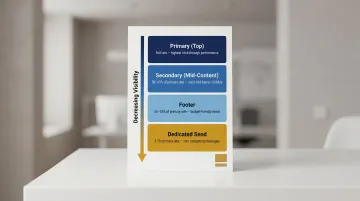
Ads placed near the top of a newsletter — before the main editorial content — typically receive more attention than those buried at the bottom. Most newsletters offer tiered pricing to reflect this. Placement position is one of the easiest variables to optimise before a campaign launches.
Here's how the tiers typically compare:
- Primary (top of newsletter): Full rate; delivers highest CTR
- Secondary (mid-content): Worth 50–65% of primary rate
- Footer: Worth 25–35% of primary rate
- Dedicated send (full email, one advertiser): Commands 2–5x primary rate due to zero competing messages
Not every reader scrolls to the bottom. Premium placement is usually worth the additional cost for time-sensitive campaigns, particularly when targeting senior decision-makers with limited reading time.
Send Frequency and Audience Fatigue
Running the same ad creative across too many consecutive issues reduces response rates as readers become desensitised. Variety in copy across placements maintains engagement.
Email frequency has risen roughly 10% annually since 2006, but most brands have now reached the point where more emails produce diminishing returns. Email marketers recommend capping frequency at 2–4 emails per week for marketing communications.
Monitor CTR trends across issues. If performance drops 30–40% after three consecutive placements with identical creative, refresh your message or pause briefly before resuming.
Newsletter Credibility and Editorial Trust
Readers extend trust to advertisers who appear in newsletters they respect. A placement in a credible, well-edited executive newsletter carries an implicit endorsement that a banner ad on a generic website does not.
Newsletters that verify content, maintain objectivity, and hold a consistent editorial voice tend to produce higher advertiser engagement — readers are in an active, attentive reading mode rather than scrolling passively. 75% of executives trust high-quality thought leadership more than traditional marketing materials, and 89% say it positively influences their perception of an organisation.
Subscribers opt in and expect to receive these newsletters. That makes the environment receptive rather than interruptive — a meaningful distinction for brands trying to reach senior decision-makers.
Common Mistakes When Advertising Through Executive Newsletters
Even well-resourced advertisers make avoidable errors when entering the newsletter channel. These four mistakes account for most underperforming campaigns.
Writing in a Promotional Tone That Clashes With Editorial Voice
Native-style copy that matches the publication's language and format performs significantly better than repurposed banner ad text. If the newsletter uses concise, factual language without hyperbole, your ad should too. Generic phrases like "world-class," "cutting-edge," or "revolutionise your business" stand out negatively in editorial environments built on credibility.
Choosing Based on Subscriber Count Alone
Verify engagement data (open rates, CTR) and confirm the audience is geographically and professionally relevant to the UK local market you're targeting. A 50,000-subscriber newsletter with 15% open rate and 0.5% CTR will underperform a 5,000-subscriber newsletter with 40% open rate and 3% CTR. Engagement quality trumps list size.
Running a Single Placement and Drawing Conclusions
One issue is rarely enough to establish statistical confidence. Newsletter advertising requires frequency to build familiarity. Test across at least 2-3 issues with small creative variations before drawing conclusions about the channel's effectiveness — performance typically improves by issues 2 and 3 as readers recognise your brand.
Failing to Set Up Proper Tracking Before Launch
Without the right tracking in place, you can't attribute results to the newsletter channel. Set up the following before your first placement goes live:
- UTM parameters on all links to track source and campaign in your analytics
- A dedicated landing page to isolate newsletter-driven traffic from other sources
- Call tracking if phone enquiries are part of your conversion path
Budget decisions made without this data are guesswork. Track from day one.
Conclusion
Advertising locally in the UK through executive newsletters is a high-intent channel that works best when the audience, offer, and editorial environment are tightly aligned. It is not a mass-market tool, but for the right business and message, it delivers results that broad digital placements rarely match — newsletter click-through rates run roughly 4x higher than Google AdWords, and that gap reflects the difference in audience intent.
Most underperforming newsletter campaigns trace back to poor preparation: mismatched audiences, weak calls to action, and absent tracking — not a flaw in the channel itself. The combination of inbox exclusivity, editorial trust, and engaged professional readership makes executive newsletters one of the most underused local advertising channels for UK businesses.
For businesses targeting London-based professionals, publications like London Summary — sent weekdays to decision-makers, executives, and affluent consumers — offer a direct path to readers who value clarity and verified information. The channel's immunity to ad blockers, algorithm-free delivery, and premium editorial environment mean your message lands in a distraction-free environment, read by people who chose to be there. For local advertisers willing to put in the preparation, that's a meaningful advantage worth acting on.
Frequently Asked Questions
How to advertise a small business locally in the UK?
Small businesses can advertise locally through Google Business Profile, local SEO, social media pages, community Facebook groups, postcode-targeted paid ads, and newsletter placements. The best channel depends on your audience — social media and local SEO suit consumer brands, while newsletters and LinkedIn reach professionals and decision-makers more directly.
Where can I advertise my business for free in the UK?
Free advertising options include Google Business Profile, social media business pages (Facebook, LinkedIn, Instagram), local business directories like Yell.com and Yelp, community notice boards, and local Facebook groups. While these channels cost nothing, they require time investment and typically deliver slower results than paid placements.
How much does a TV advert cost for 30 seconds in the UK?
TV advertising in the UK costs £3,700-£4,700 for daytime ITV spots and £10,500-£34,000 for prime time, plus production costs of £5,000-£500,000+. This makes TV inaccessible for most small businesses, which is why targeted channels like executive newsletters offer a cost-effective alternative for reaching professional audiences at a fraction of the cost.
What are the 7 methods of promotion?
The classic promotional mix covers seven methods: advertising, sales promotion, personal selling, public relations, direct marketing, digital/social media marketing, and sponsorship. Newsletter advertising sits within direct marketing and sponsorship — combining precise audience targeting with the credibility of editorial content.
Are executive newsletter ads effective for B2B local advertising in the UK?
Yes, executive newsletters are particularly effective for B2B local advertising because they reach professionals in their inboxes, away from social feeds and banner ads. Newsletter CTRs of 2.3-3% consistently outperform Google Display (0.46%) and LinkedIn ads (0.28%). The channel works best when your audience matches the newsletter's readership demographics and your offer provides clear value to decision-makers.
How do I measure the ROI of advertising in an executive newsletter?
Start with UTM-tracked links and a dedicated landing page so you can isolate campaign traffic in Google Analytics. Beyond open and click rates, your primary metric should be cost per acquisition — total spend divided by conversions. Comparing lead volume before and after the campaign gives you the clearest measure of overall lift.