Introduction
The average professional encounters thousands of advertisements daily — across social feeds, news sites, mobile apps, and search results. Most are ignored within a fraction of a second. Many never load at all, blocked by browser extensions or buried beneath layers of competing content. Yet inside a well-curated executive newsletter, a single sponsored message can command genuine, sustained attention.
The difference isn't just placement. It's context, intent, and environment. When a reader opens an email newsletter, they've already made an active decision to engage. They're not passively scrolling; they're reading. That shift means ads land in front of a focused mind, not a distracted one.
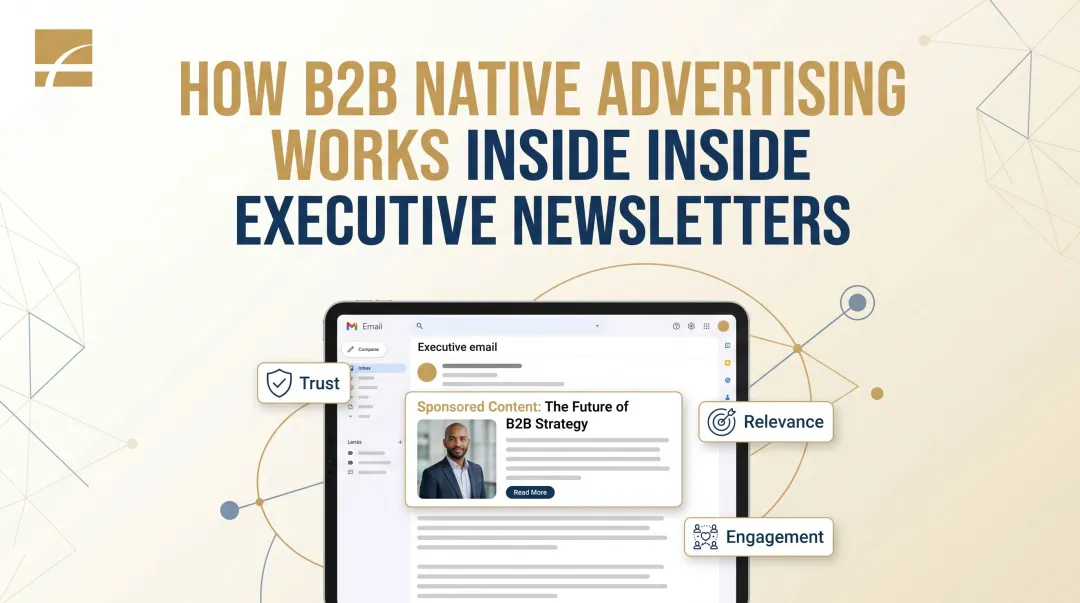
This article explains the psychological and structural mechanics that make newsletter advertising fundamentally different from other digital channels. If you're a media buyer, brand marketer, or business professional trying to understand where premium ad attention actually lives today, you'll find a direct answer here — including why newsletter ads consistently outperform display and social placements.
Key Takeaways
- Newsletter readers are actively reading, not passively scrolling — ads get more cognitive bandwidth
- No algorithms, ad blockers, or visual clutter; ads reach the inbox with guaranteed visibility
- Contextual fit, emotional tone alignment, and relevance drive attention and recall
- Strong headlines paired with a single, direct call to action are non-negotiable for performance
- Specialized newsletters put brands in front of decision-makers who hold purchasing authority
Why Inbox Attention Is Different From Social and Display Attention
The medium determines how much attention your message actually gets. On social media, users scroll passively, fragmenting focus across dozens of competing stimuli. Inside a newsletter, they've deliberately opened an email to read — meaning they're already in focused consumption mode before your ad appears.
The structural difference is measurable. A typical display ad receives just 1.3 seconds of actual attention, and only 8% of served impressions are actually looked at. Compare that to email newsletters, where the average time spent reading is 51 seconds — nearly 40 times longer than a display ad. For advertisers, that gap isn't a rounding error — it's the difference between a message that registers and one that disappears.
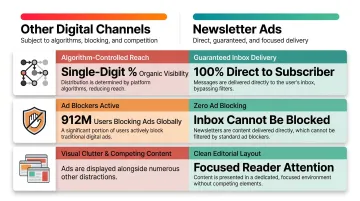
Newsletters also eliminate three major attention killers present in other channels:
- Algorithmic feed interruptions that break context and reduce reach to single-digit percentages
- Ad blockers that prevent ads from loading (912 million users worldwide block ads, costing publishers $54 billion annually)
- Visual clutter from competing content, sidebars, and overlapping elements
Email ads arrive directly in the inbox, bypass ad blockers entirely, and sit inside a clean editorial layout where attention is already present. The result: your message reaches a reader who chose to be there, in a format built for reading — not skimming.
The Executive Newsletter Reader: Who's Actually Opening These Emails
An executive newsletter subscriber isn't a passive display network user who never opted into seeing ads. They're a time-scarce, high-intent professional who chose to subscribe because the publication delivers relevant, curated information. That act of subscription signals trust — and that trust extends to what appears inside the newsletter.
30% of U.S. adults get news from email newsletters, with readership skewing toward higher education (35% of college graduates) and higher income (38% of upper-income adults). These aren't casual browsers. They're decision-makers, executives, founders, and professionals whose attention has commercial value.
That credibility carries over to advertisers. When a newsletter maintains a strong editorial voice and consistent quality, readers associate that trust with the brands appearing inside it — what researchers call the contextual halo effect. Ads on high-quality sites are perceived 74% more favorably than the same ads on low-quality sites, producing 20% higher engagement and 30% greater memorability.
House of Summary's newsletter network — spanning global news, geopolitics, and regional titles like Dubai Summary and London Summary — puts ads in front of that kind of audience at scale. The network reaches over 500,000 subscribers, with 254,866+ emails opened daily. Readers include:
- C-suite executives and senior professionals across finance, business, and tech
- High-net-worth individuals in wealth-dense metros: New York, Los Angeles, London, and Dubai
- Decision-makers with direct purchasing authority over products, services, and partnerships
When this audience's attention is captured, it translates directly to business outcomes.
The Key Mechanisms Behind Ad Attention in Executive Newsletters
Relevance as the primary trigger
In a newsletter covering geopolitics or global business, an ad for a service that solves a professional problem feels native rather than intrusive. Relevance triggers automatic cognitive engagement — the brain allocates more attention to stimuli that connect to existing goals or interests.
Daniel Kahneman's capacity theory of attention establishes that attention is a limited resource, and that goal-relevant stimuli receive priority processing. An ad aligned with a reader's professional goals (as in a curated executive newsletter) will receive more voluntary attention than an interruptive ad in an unrelated context.
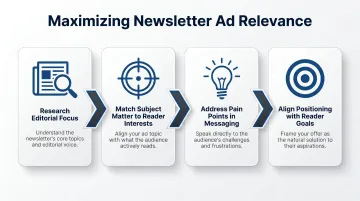
To maximize relevance:
- Research the newsletter's editorial focus and audience profile
- Match ad subject matter to the topics readers already care about
- Address known pain points or professional challenges in your messaging
- Align product positioning with the reader's goals
Emotional resonance and tone alignment
Executive readers respond to ads that match the tone of the content they're reading — professional, direct, substantive. Ads that feel sensational or hyperbolic create cognitive dissonance and lose attention quickly.
74% of consumers are more likely to remember ads whose message relates to the surrounding content. Contextual alignment produces a 107% increase in brand favorability. In a high-trust editorial environment, a mismatched tone costs more than a weak offer.
Emotional triggers that perform well with executive audiences:
- Aspiration and professional advancement
- Efficiency and time savings
- Authority and credibility
- Exclusivity and premium positioning
Humor and shock value work in entertainment contexts. Inside a serious editorial environment, they break trust and reduce engagement.
Headline as the attention gateway
The subject line gets the newsletter opened. The ad headline determines whether the reader pauses or scrolls past. In a text-heavy email environment, the headline is the single most important creative element.
Subject lines of 20 characters or fewer achieve a 29.9% open rate — the highest of any length bracket. Subject lines of 21-124 characters drop to 17.3%. Mobile inboxes display only the first 33-43 characters, so brevity matters.
A strong newsletter ad headline:
- Addresses a known pain point or professional need
- Signals a specific benefit (not vague value)
- Creates a curiosity gap aligned with what the reader cares about
- Uses clear, direct language — not clever wordplay
Visual simplicity and cognitive ease
Newsletter ads sit in a clean text environment. Even a simple visual treatment — a logo, a bold line of copy, a minimal image — stands out precisely because nothing else is competing for space.
The brain rewards simple, clear stimuli with more sustained attention. Excessive cognitive load — caused by visual clutter, redundant links, or irrelevant images — degrades performance. Users take longer to process information, miss important details, and may abandon tasks entirely.
Newsletter ads benefit from cognitive ease. A clean layout reduces extraneous load, making it easier for readers to process the message and take action. That cognitive advantage only holds, though, if the ad appears where readers are still paying attention.
Placement within the newsletter
Where the ad sits matters. Ads placed after a compelling editorial section benefit from the reader's engaged state. Ads buried at the bottom suffer from attention drop-off.
Above-the-fold content — visible immediately without scrolling — generally receives the highest initial engagement in email layouts. Advertisers should prioritize placements that appear early in the reading flow, before reader attention begins to taper off.
How to Craft a Newsletter Ad That Actually Gets Noticed
Lead with one clear message
The most common reason newsletter ads fail is that they try to say too many things at once. Effective newsletter ads follow a single-idea structure: one audience problem, one solution, one action.
Reader attention is finite — even for engaged subscribers. Emails with a single call to action can increase clicks by 371% and sales by 1,617%. Every extra message you add competes with the one that matters.
Write for skimmers first
Executive readers skim before they commit. Your ad needs to communicate its full value proposition in three elements — even if nothing else is read:
- Headline: Name the benefit or pain point directly
- Body copy: Connect it to something the reader already cares about
- CTA: State exactly what happens when they click
Match the publication's editorial voice
An ad that feels tonally mismatched signals "advertisement" before the reader has engaged with a single word. Advertisers who adapt their copy to fit a newsletter's established voice — while keeping brand identity intact — see meaningfully higher click-through rates.
House of Summary's newsletters are written in a clear, factual, and professional tone. Ads that echo that voice feel like a natural part of the reading experience, not an interruption.
Use a single, specific call to action
Vague CTAs like "learn more" or "visit us" underperform. Specific CTAs that set clear expectations — "Read the 3-minute briefing," "Download the Q1 report," "See the case study" — drive higher click-through rates.
Personalized CTAs perform 202% better than generic ones. Tell the reader exactly what they'll get when they click — that specificity is what converts.
Why Executive Newsletter Advertising Delivers Results for Brands
Newsletter ads have a structural performance advantage. They bypass ad blockers entirely, land directly in the reader's primary inbox, and aren't subject to algorithm changes that limit reach. No competing content feed. No viewability gamble.
Performance benchmarks:
- Average email CTR: 2.3-2.6%
- Average display ad CTR: 0.46%
- Email open rates: 21.5-35.6%
Email ads generate click-through rates roughly 5-6 times higher than display ads. House of Summary's newsletter network reports click-through rates 4 times higher than Google AdWords — illustrating what's possible when ads reach genuinely engaged, opted-in executive readers.
Delivery and reach:
- Email inbox placement rate: 87.2%
- Facebook organic reach: 1.37%
- LinkedIn organic reach: declining 70-80%
Email delivers reliably. Social platforms do not. That consistency matters for media buyers who need predictable reach and performance.
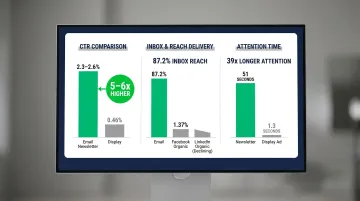
Sustained attention leads to better brand recall, higher purchase intent, and stronger conversion — outcomes that viewability-only metrics never capture. Ads in high-quality content environments produce 30% greater long-term memory encoding compared to low-quality environments.
Media buyers increasingly measure attention, not just impressions. Executive newsletters deliver both — and the data above shows the gap between the two.
Frequently Asked Questions
How do advertisements attract attention?
Ads attract attention through relevance (matching what the audience cares about), salience (standing out visually or contextually), and emotional resonance. The medium matters as much as the creative — high-attention environments like executive newsletters give ads a structural advantage over display or social placements, where distractions and blockers reduce visibility.
How does advertising context affect whether an ad gets noticed?
Even a well-crafted ad fails if it lands in the wrong environment. Context shapes whether readers are mentally present, receptive, or simply scrolling past. Placement in a trusted, low-clutter channel — like a curated executive newsletter — significantly increases the chance an ad registers and drives action.
Why do newsletter ads outperform display and social media ads for attention?
Newsletter readers are in an active, opted-in reading state. Three structural factors explain the gap:
- Ads cannot be blocked or skipped by algorithms
- No visual clutter means each ad receives more focused attention
- Click-through rates run 4-6 times higher than display or social placements
What makes executive newsletter readers different from general online audiences?
Executive readers are self-selected, high-intent subscribers who chose to receive specific content. They bring focused attention and often have purchasing authority, making each impression more commercially valuable than a passive display audience.
What should a good ad inside an executive newsletter include to drive clicks?
Three elements matter most: a specific headline that addresses a known reader need, one line of body copy that delivers the value proposition, and a direct call to action. Tone should match the newsletter's editorial voice — ads that feel native to the reading experience consistently outperform those that don't.