Introduction
LinkedIn campaigns burning through budget. Google Ads generating clicks from the wrong people. Programmatic display ads that may never even load for a significant share of professional internet users.
Many B2B brands targeting the UAE market face the same frustration: the executives who actually sign contracts are almost impossible to reach through conventional digital channels. They scroll past sponsored posts. They have ad blockers. Cold outreach goes unanswered.
What they do, consistently, is open their newsletters.
UAE executives are inbox-first. Curated news digests are how senior professionals stay informed about the markets, policies, and business developments that affect their decisions. Newsletter sponsorship puts your brand message directly inside that reading habit — no algorithm, no ad blocker, no competition from the rest of the internet.
This guide gives you a practical framework for evaluating UAE executive newsletter sponsorships — covering how they work, why this audience commands a premium, how to select the right publication, and which metrics actually indicate success.
Key Takeaways
- Newsletter sponsorship places your brand inside a publisher's opted-in, actively engaged subscriber base — bypassing ad blockers and algorithm interference entirely
- The UAE has one of the highest concentrations of C-suite executives and founders globally, making local executive newsletters a premium B2B targeting environment
- beehiiv's 2026 State of Newsletters report puts B2B/SaaS newsletter CTR at 1.67% vs. 0.66% for paid social — more than double the clickthrough rate
- Audience quality and editorial credibility matter more than subscriber count when evaluating a newsletter partner
- Multi-issue commitments outperform single placements for awareness and conversion, and typically come with better pricing
What Is Newsletter Sponsorship?
Newsletter sponsorship is straightforward: a brand pays a publisher to include a sponsored message within an issue sent to the publisher's opted-in subscriber list. You are not buying an email list. You are not running your own email campaign. You are borrowing the publisher's audience — and, crucially, their editorial credibility.
That distinction matters more than it sounds. Readers trust the newsletters they subscribe to. When your brand appears inside that trusted context, some of that credibility transfers. A banner on a webpage competes with a dozen other distractions. A sponsored placement in an inbox arrives because the reader chose to be there.
The Four Core Ad Formats
Most premium newsletters offer sponsors a choice of placement types:
- Dedicated sponsored issue — the entire newsletter is sent on behalf of one brand; maximum visibility, ideal for launches or major campaigns
- Inline banner or display ad — a branded image or headline within a regular issue, blended into the reading flow
- Native/sponsored content — a written segment that reads like editorial, clearly labeled as sponsored; particularly effective for brands that need narrative or context to explain their value
- Brief product mention — a short callout woven into the editor's regular content, lower footprint but still in-context
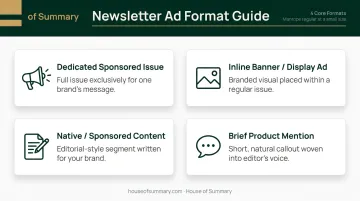
For B2B executive newsletters, native content and inline placements consistently generate stronger engagement than banner formats. Readers are there for the writing, not the visuals.
Why This Beats Display Advertising Structurally
The inbox is a different environment from a webpage. Three structural advantages explain why:
- No ad blockers. Research from Blockthrough/PageFair measuring 10 billion+ pageviews across 9,453 websites found a 21% average ad blocking rate on the web. Inbox ads don't face this reach erosion.
- No algorithm gatekeeping. Your ad goes to every subscriber in the agreed distribution, every time.
- Voluntary attention. The reader has chosen to open this email. They are reading actively, not scrolling passively.
That third point — voluntary attention — is where format decisions make or break a sponsorship. House of Summary takes it further with a strict one advertisement per edition policy across Presidential Summary, Geopolitical Summary, Dubai Summary, and London Summary. No competing brands, no cluttered ad section. One sponsor holds the reader's full attention for the entire issue.
Why the UAE Executive Audience Is a Premium B2B Target
The UAE is not a typical market for B2B advertising. The professional density is exceptional.
According to official UAE Federal Competitiveness and Statistics Centre data, managers account for 9.4% of the employed population, with professionals representing a further 14.9% — a combined high-skilled workforce share that reflects the country's role as a regional headquarters destination rather than a standard consumer market.
The corporate infrastructure backing that workforce is substantial. DIFC reported 6,920 active companies at end-2024, up 25% from the prior year, with a workforce of over 46,000 professionals operating within a single financial district. The Dubai International Chamber attracted 64 multinational companies to Dubai in 2025 — a 25.5% increase year-on-year — alongside 309 SMEs, nearly double the previous year's figure.
What This Means for B2B Advertisers
A senior decision-maker based in Dubai or Abu Dhabi is rarely making local-only purchasing decisions. The UAE functions as a regional command center. A CFO, CMO, or Managing Director based here is overseeing operations that span the Middle East, Africa, and South Asia. Reaching them is reaching a multiplier, not just an individual buyer.
Relationships and reputation carry genuine weight in UAE B2B sales. Association with a credible publication signals seriousness and quality — attributes that matter when a prospect is evaluating an unfamiliar brand in a considered, high-value category.
The Intent Gap vs. Social Media
Executive newsletter readers differ fundamentally from passive social media users. They opted in deliberately, they open consistently, and they read with purpose — because their work requires staying current on business, market, and policy developments. No algorithm curated what they're reading. No ad blocker filtered what they saw.
Dubai Summary, part of the House of Summary network, is purpose-built for this audience: a weekday publication covering Dubai's business, policy, and culture. Its readership includes:
- Business operators running companies with regional footprints
- Policy professionals tracking regulatory and government developments
- Real estate investors active in the UAE market
- Senior executives with direct purchasing authority
The UAE represents 18.20% of the House of Summary network's geographic distribution. The broader network reaches 500,000+ subscribers, with 254,866+ emails opened daily — in inboxes, not on feeds.
How UAE Executive Newsletter Sponsorships Work
The Standard Workflow
The process is less complicated than most digital advertising channels, but it requires more lead time:
- Submit your creative brief — ad copy, creative assets, landing page URL, and campaign objective
- Publisher review — the editorial team checks for compliance, brand fit, and creative quality; premium newsletters decline ads that clash with their voice or content standards
- Placement confirmation — you receive a confirmed send date and the ad unit as it will appear in the issue
- Issue send — the newsletter goes to subscribers on the agreed date
- Post-send reporting — reputable publishers share open rate, click activity, and ideally a performance summary
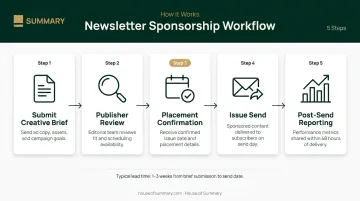
Lead times typically run one to three weeks for premium newsletters. Vague or withheld performance data after a campaign is a clear warning sign — any publisher worth partnering with should share results without prompting.
Pricing Models
| Model | How It Works | Best For |
|---|---|---|
| Flat fee per issue | Fixed cost regardless of performance | Premium executive newsletters with smaller, high-quality lists |
| CPM-based | Cost per thousand estimated impressions (opens × subscribers) | Larger, mass-market newsletters |
| Multi-issue packages | Discounted rate for 3–12 consecutive issues | Brand-building campaigns requiring frequency |
Executive newsletters with tighter, more qualified lists often command higher CPM rates than mass-market alternatives. The premium is justified: you are paying for a harder-to-reach audience, not just volume.
House of Summary operates on a custom rate card model — pricing is tailored to placement type, newsletter selection, frequency, and campaign scope. Multi-issue packages are priced at meaningful discounts versus single-issue rates.
What Effective B2B Newsletter Ad Creative Looks Like
The best-performing placements share three traits:
- State the outcome the reader gets — not the product specification
- Use one CTA only; multiple calls-to-action split attention and reduce conversions
- Mirror the newsletter's editorial tone; native placements that feel like a natural extension of the issue consistently outperform hard-sell formats
How to Choose the Right UAE Executive Newsletter
Not all newsletters are equal. Subscriber count is the least important number on the media kit.
Prioritise Audience Quality
Ask each potential publisher these questions before committing:
- What percentage of subscribers are in management, C-suite, or senior professional roles?
- What industries and job functions does the list skew toward?
- What is the average open rate per issue, and how has it trended over the past six months?
- How many sponsor slots exist per issue?
A newsletter with 10,000 highly engaged UAE executives is more valuable to most B2B brands than one with 100,000 loosely opted-in general readers. Any publisher who won't share engagement data is not a publisher worth sponsoring.
Evaluate Topical Alignment
The editorial focus of the newsletter should intersect naturally with your buyer's professional interests. A fintech brand sponsoring a newsletter covering UAE business intelligence, global markets, and geopolitical developments reaches executives in exactly the right information-gathering mindset. The same brand sponsoring a lifestyle newsletter reaches the same person in a completely different context, and the results will reflect that.
House of Summary is one example of this alignment done well: its newsletters cover global news, geopolitics, Dubai business and policy, and London city content — topics UAE executives actually use to make decisions.
Check Editorial Credibility
Topical fit matters, but editorial credibility is what makes that fit stick. The trust readers place in a newsletter transfers directly to sponsors. Evaluate:
- Does the publication have a consistent, verifiable sending schedule?
- Is the editorial voice independent, or does it read like promotional content?
- How long has the publication been operating, and what does subscriber growth look like?
A stagnant or declining list means your sponsorship investment is reaching fewer engaged readers with every send.
Measuring What Matters: ROI on Your UAE Newsletter Sponsorship
Set Up Attribution Before the Campaign Launches
Attribution setup should happen before your ad goes live — not after. Without it, you can't tie results back to the campaign:
- Create UTM-tagged URLs for every link in your placement
- Direct traffic to a dedicated landing page where possible (not your homepage)
- Ensure conversion tracking is live in your analytics platform
Without these in place, newsletter-driven traffic blends into your other sources and you lose the ability to calculate a reliable cost-per-lead or cost-per-conversion.
Which Metrics to Watch
| Metric | What It Tells You |
|---|---|
| Open rate | Whether the newsletter has an actively engaged audience |
| Click-through rate | Whether your creative is compelling |
| Conversions (demo requests, form fills, downloads) | Actual business impact |
| Branded search volume trends | Awareness lift over the campaign period |
| Direct traffic trends | Secondary awareness indicator |
For context on what strong looks like: beehiiv's 2026 State of Newsletters report, covering 28 billion emails sent to 255 million unique readers, recorded an average open rate of 41.24% across all newsletters on the platform — up from 37.98% the prior year. B2B/SaaS newsletters specifically achieved a 1.67% CTR. These are platform-level benchmarks, not executive newsletter guarantees, but they offer useful context for evaluating what a publisher tells you about their own numbers.
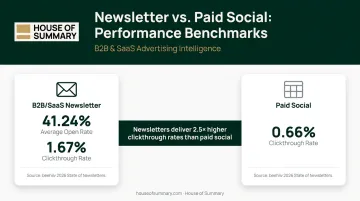
When reviewing a publisher's claimed open rate, be specific: ask for the trailing six-month average, not a cherry-picked peak issue.
Make the Case for Multi-Issue Commitments
A single newsletter sponsorship functions more like a brand impression than a demand-generation tactic. Most B2B buyers in high-consideration categories need several exposures before they act. Consistent presence across three to six issues builds recognition among readers who are not ready to convert on first contact but are moving toward familiarity with your brand.
Multi-issue packages also come with practical advantages beyond frequency:
- Lower cost-per-placement — House of Summary's 2–12 week campaigns are priced at discounts versus single-issue rates
- Creative testing — iterate on headlines, CTAs, and offers between issues based on actual click data
- Compounding recognition — each issue builds on the last for readers who weren't ready to act the first time
Frequently Asked Questions
What is newsletter sponsorship?
Newsletter sponsorship is a paid placement within a publisher's curated email newsletter sent to opted-in subscribers. Unlike buying an email list or running your own campaigns, you are borrowing the publisher's audience and their editorial credibility.
How much does it cost to sponsor a UAE executive newsletter?
Pricing varies based on list size, audience quality, format, and campaign length. Flat fees per issue are standard for premium newsletters, while CPM-based pricing is more common for larger, mass-market publications. Request a media kit and demographic breakdown before evaluating cost — the audience quality determines whether the price is justified.
Which B2B industries benefit most from newsletter sponsorship in the UAE?
Industries with high-value, considered purchasing cycles get the most from this channel: fintech, professional services, SaaS, wealth management, premium real estate, management consulting, and luxury B2B products.
How is newsletter sponsorship different from display advertising?
Three differences matter most: newsletter ads land inside opted-in inboxes (no ad blockers), they appear within trusted editorial content rather than a cluttered webpage, and they reach readers who are actively engaged rather than passively scrolling past an interruption.
What open rates should I expect from UAE executive newsletters?
Ask publishers for their trailing six-month average open rate, not a single peak issue. Top executive newsletters regularly exceed 40–50% open rates, compared to the ~20% average for B2B email — but results vary, and any publisher unwilling to share historical data is a red flag.
How do I get started with newsletter sponsorship in the UAE?
Identify newsletters your target executives actually read, request a media kit, and evaluate audience demographics and engagement metrics before committing. Start with a multi-issue package for meaningful results — single placements rarely generate enough repetition to build recognition or drive action. The team at House of Summary (sales@houseofsummary.com) offers sponsorship options for brands targeting UAE and global executives across their Dubai Summary, Presidential Summary, Geopolitical Summary, and London Summary newsletters.