
Introduction
The inbox has become one of the most valuable advertising environments available. 52% of consumers globally use ad blockers, and even when display ads make it through, they're frequently ignored. Banner blindness is now reflexive for most digital users, and social media ads disappear into feeds within seconds.
For advertisers targeting senior decision-makers, that problem compounds fast. Reaching C-suite audiences through traditional channels means paying $10–$15+ per click on LinkedIn for basic targeting access, according to Postiv.ai's 2025 benchmarks. That's two to three times the cost of reaching mid-level professionals — and the targeting is still imprecise.
Key Takeaways
- Sponsored editorial content matches a publisher's voice and format but is paid for by an advertiser
- Executive newsletters deliver 4–6x higher engagement than standard display advertising
- Email ads bypass ad blockers, reaching readers without algorithmic interference
- Effective sponsored placements lead with reader value, not brand features
- Clear disclosure builds trust when the content itself delivers genuine insight
What Is Sponsored Editorial Content?
Sponsored editorial content is material that matches the format, tone, and quality of a publisher's regular editorial output but is produced on behalf of and paid for by an advertiser. The FTC defines native advertising as "content that bears a similarity to the news, feature articles, product reviews, entertainment, and other material that surrounds it online." Sponsored editorial is the highest-fidelity version of that concept.
How It Differs From Adjacent Formats
Sponsored editorial sits on a spectrum between pure advertising and pure editorial. To clarify where it fits:
| Format | Creator | Purpose | Tone | Disclosure |
|---|---|---|---|---|
| Display Ad | Advertiser | Direct promotion | Sales-focused | Clearly an ad |
| Native Ad | Advertiser | Soft promotion | Promotional but blended | "Sponsored" label |
| Sponsored Editorial | Publisher + Advertiser | Value + positioning | Editorial voice | "Sponsored" / "Partner Content" |
| Editorial Content | Publisher | Information | Independent | None needed |
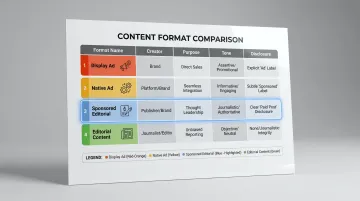
Unlike advertorials that disguise sales copy in article format, sponsored editorial delivers genuine value. The brand directs the story and key messages, but the publisher shapes format, structure, and voice to protect the reader experience.
The Editorial-Advertising Spectrum
Advertising formats fall along a control spectrum. Traditional display sits at one end, giving advertisers full creative control. Pure editorial sits at the other, giving the publisher total independence. Sponsored editorial occupies the middle: the advertiser provides direction, objectives, and messaging; the publisher applies editorial judgment to ensure the content serves the audience.
When publishers retain editorial control, readers stay engaged — because the content still reads like something worth their time. That's precisely what makes the format work.
Disclosure Is Non-Negotiable (and Good for Performance)
Sponsored content must be clearly labelled — "Sponsored," "Partner Content," "Paid Post," or similar. This is required by regulators including the FTC in the US, the ASA/CAP in the UK, and the EU Unfair Commercial Practices Directive.
Clear disclosure actually builds trust. Research published in the Journal of Interactive Advertising found that labeling sponsored content increases perceived transparency and reduces feelings of deception — even as readers recognize it as paid placement.
When readers trust the placement is legitimate, they engage with the content on its merits rather than dismissing it outright.
Why Executive Newsletters Are a Premium Environment for Advertisers
Executive newsletters operate differently from web and social advertising channels. The audience self-selects by subscribing, signaling intent to stay informed. Readers open newsletters with purpose — often first thing in the morning, before the day's noise sets in.
The Inbox Is Distraction-Free
Newsletters arrive in the most private screen space your audience uses: their email inbox. There's no algorithm filtering your message. No ad blockers. No visual clutter competing for attention. Your sponsored placement sits alongside the editorial content readers actively chose to receive.
Compare this to display advertising, where average click-through rates across all industries are just 0.46%, and B2B service display ads average 0.22%. Email newsletters, by contrast, consistently deliver CTRs between 2% and 3% — a 4–6x engagement advantage that translates directly to lower cost-per-click and better campaign ROI.
House of Summary's own client data confirms this advantage. BSH Hausgeräte, running campaigns in the Dubai Summary newsletter, achieved CTRs 4x higher than Google AdWords, according to CEO Faik Serkan Ergun.
Trust Transfer From Publisher to Advertiser
When a newsletter with strong editorial credibility publishes sponsored content, some of that trust extends to the advertiser. Research from Comscore (2016) found that ads on premium publishers see 67% higher brand lift than non-premium environments. For advertisers, that "halo effect" means higher recall, stronger purchase intent, and a brand association built on credibility rather than interruption.
Access to Hard-to-Reach Audiences
Specialized executive newsletters reach senior, globally mobile readers that generic B2B channels rarely access in meaningful numbers. Publications covering geopolitics, global business, and regional markets — like the House of Summary network — reach decision-makers who control budgets and influence purchasing. The portfolio spans Presidential Summary, Geopolitical Summary, Dubai Summary, and London Summary, each built around a distinct reader with specific professional context.
How Sponsored Editorial Content Works in a Newsletter
The production process for sponsored editorial follows a clear workflow designed to balance advertiser goals with editorial quality:
- Advertiser briefs the publisher on campaign objectives, key messages, and target outcomes
- Publisher's editorial team shapes the content to fit the newsletter's voice, format, and audience expectations
- Advertiser reviews and approves the draft, ensuring accuracy and alignment with brand positioning
- Content is disclosed and published to the subscriber list with clear sponsorship labelling
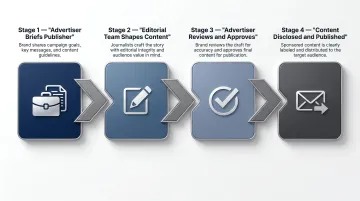
That editorial control is what preserves reader trust and makes the placement valuable. Without it, sponsored content becomes indistinguishable from poorly disguised sales copy, and readers disengage.
Formats Sponsored Editorial Takes in Newsletters
The most effective formats mirror the newsletter's regular editorial style:
- Narrative features that explore a topic relevant to both the audience and the advertiser's expertise
- Q&A or interview formats with company experts or thought leaders
- Data-led insight pieces drawing on trends or research findings
- Short briefings that mirror the newsletter's summary style
The format should feel native to how the newsletter normally reads, not like a product page. For example, Morning Brew uses multiple sponsorship formats, including primary sponsor slots at the top of the newsletter, mid-email secondary sponsor placements, and "Recs" links integrated into editorial recommendation lists. Axios embeds "Smart Posts" — short-form native content nestled between news items, written in the publication's signature style.
The Role of the Call-to-Action
Unlike display ads, the CTA should emerge naturally from the content. A link to a report, product demo, or landing page works best when the reader has already received genuine value from the piece. Best practice: use a single, clear call to action per placement. Asking readers to do three things at once dilutes all of them.
What Advertisers Can (and Cannot) Control
Set realistic expectations. Advertisers can and should provide:
- Accurate product or service information
- Key messages and brand positioning guidance
- Links to resources or landing pages
- Examples and case studies
Strong publishers retain the right to shape tone, structure, and framing. That's not a limitation — it's what makes the placement worth buying.
Best Practices for Advertisers
Choose Publishers Whose Audience Matches Your Target Customer
Reach and open rates matter, but audience quality and relevance matter more. Before committing, research the publication's subscriber profile. Are these the decision-makers you need to reach? House of Summary's network, for example, reaches 500,000+ subscribers, including senior executives, policy professionals, and high-net-worth individuals concentrated in wealth-dense metros like New York, Los Angeles, London, and Dubai.
Lead With the Reader's Interests, Not Your Brand's Features
The most effective sponsored editorial pieces answer a question the audience already has. Strong pieces do at least one of the following:
- Give readers a framework they can apply immediately
- Surface a trend or shift they need to understand
- Clarify a complex topic with authority and specificity
When the content teaches something useful, the brand association follows on its own.
Align Content Topics With the Newsletter's Editorial Calendar
Sponsored content that fits alongside the newsletter's current editorial focus feels less like an interruption and more like a contribution. If the publication is covering regulatory changes in your industry, a sponsored piece exploring implications for decision-makers will feel timely and relevant.
Disclosure, Trust, and Editorial Integrity
Clear disclosure is non-negotiable. Most markets require it by law:
- FTC (US): Disclosures must be "clear and prominent," placed immediately before or above the headline, using terms like "Ad," "Sponsored," or "Sponsored Advertising Content." Terms like "Promoted" are considered ambiguous.
- ASA/CAP (UK): Native ads must be "obviously identifiable" as marketing. Recommended labels include "paid-for ad," "ad," or "ad link."
- EU Unfair Commercial Practices Directive: Requires identification of commercial intent. Using editorial content to promote a product without disclosure is blacklisted under Annex I, Item 11.
What Happens When Disclosure Is Weak or Absent
Readers who later realize they were reading undisclosed paid content lose trust in both the publisher and the advertiser. Research shows this damages brand perception more than the short-term gain of disguising the placement.
That trust damage compounds quickly. Transparency, on the other hand, reduces skepticism — and when the sponsored content actually delivers value, it builds credibility that paid display ads rarely achieve.
The Mutual Interest in Maintaining Standards
Publishers and advertisers share a direct stake in maintaining editorial standards. A newsletter that loses reader trust becomes worthless as an advertising vehicle — and that loss hurts the advertiser as much as the publisher.
Advertisers benefit when publishers hold the editorial line. The credibility of the environment is precisely what makes the placement valuable. Choosing a newsletter with a strict editorial process isn't a constraint on your message; it's what gives your message weight.
Measuring the ROI of Your Newsletter Sponsorship
Track these key metrics beyond open rates:
- Click-through rate: Measure CTA performance directly inside the sponsored piece
- Direct traffic: Use UTM tags on your landing page URL to isolate newsletter-sourced visits
- Lead capture and conversion rates: Track form fills, demo requests, or purchases from the campaign
- Pipeline attribution: For B2B, apply 90–180 day attribution windows to catch downstream deals
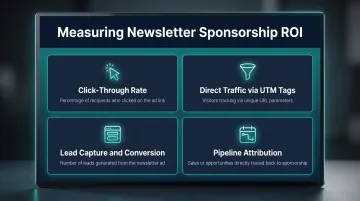
Benchmark expectations: Email newsletter CTRs typically range from 2% to 3% across business and professional audiences, far outpacing display advertising's 0.46% average.
Brand Lift and Audience Quality Metrics
Direct-response numbers only capture part of the picture. Brand lift metrics reveal how your sponsorship shifts perception over time — and the data is compelling. Research from IPG Media Lab, Forbes, and Syracuse University found brand recall was 59 percentage points higher for branded content than for display ads. Purchase consideration rose 9 points, and intent to seek more information climbed 14 points.
To measure these outcomes:
- Monitor branded search volume during and after the campaign window (10–30% lift is typical for newsletter sponsorships)
- Survey brand recall and favorability among exposed audiences
- Track time-on-page and scroll depth on landing pages to gauge content engagement quality
- Cross-reference corporate email domains of clickers against CRM target account lists to measure influenced pipeline
Frequently Asked Questions
What is sponsored editorial content?
Sponsored editorial content is paid content produced or co-produced to match the editorial format, tone, and quality of a publisher's regular output. It's disclosed to readers and delivers genuine value while serving the advertiser's brand awareness or lead generation goals.
What does it mean if an article is sponsored?
A sponsored article has been paid for by a brand but published in a format that resembles the outlet's regular editorial content. It should always be labelled clearly so readers understand the commercial relationship.
What's the difference between editorial and advertising?
Editorial is independently produced with no advertiser payment or control, while advertising is paid for and directed by the brand. Sponsored editorial sits between the two — paid for by the advertiser but shaped by the publisher to fit editorial standards.
What is editorial sponsorship?
Editorial sponsorship is when a brand funds a piece of content but the publisher retains editorial control over how it is written, framed, and presented. This keeps the content trustworthy for readers and preserves the outlet's credibility.
What counts as editorial content?
Editorial content is articles, analysis, or news produced by the publication's own team without brand payment directing its creation. It's subject to journalistic standards of accuracy and independence.
What is an example of sponsored content?
A fintech company partners with a business newsletter to publish an insight piece on digital payment trends in emerging markets, clearly labelled as sponsored, with a link to the company's white paper at the end. The format informs readers while establishing the brand as a credible voice in the space.