Introduction
Executives deploy ad blockers at rates exceeding 30%, skim social feeds filtered to near-invisibility by algorithms, and maintain inboxes protected by multiple gatekeeping layers. Reaching them through sponsored content requires a completely different approach than reaching general consumers — and the wrong partner means wasted budget before a single executive ever sees your message.
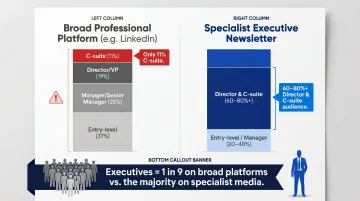
Many companies claim to reach "business professionals" or "decision-makers," yet few can verify their audience is genuinely executive-level. A platform might boast millions of subscribers, but if only 11% hold C-suite or equivalent titles — LinkedIn's actual seniority distribution — your effective reach collapses fast.
That gap shows up directly in performance: the difference between the right and wrong partner can mean the difference between a 2% click-through rate and 0.2%.
This guide covers how to find, evaluate, and select sponsored content partners whose audiences are genuinely executive-level — including how to read a media kit, what audience verification actually looks like, and the red flags that separate credible platforms from those just claiming executive reach.
Key Takeaways
- Choose partners with verifiable audience data showing actual executive seniority, not generic "professional" claims
- Editorial newsletter sponsorships, premium B2B publications, and specialist media outperform social platforms for executive reach
- Define your precise executive profile first: industry, seniority, geography, and decision-making authority
- Evaluate partners on four signals: subscriber verification, editorial positioning, engagement quality, and format fit for executive habits
- Avoid conflating a large professional audience with an executive one — the two are not interchangeable
How to Find Sponsored Content Companies That Reach Executive Audiences
Step 1: Define the Executive Audience You Actually Need
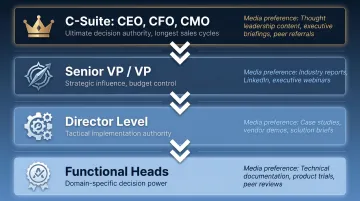
Clarify exactly who counts as an "executive" for your campaign. The term encompasses vastly different professional tiers:
- C-suite (CEO, CFO, CMO): Ultimate decision authority, longest sales cycles
- Senior VP/VP: Strategic influence, budget control
- Director level: Tactical implementation authority
- Functional heads (Head of Marketing, Head of Procurement): Domain-specific decision power
Different sponsored content companies specialize in different seniority tiers. A newsletter targeting "senior business leaders" might reach mostly director-level professionals, while a premium geopolitical briefing attracts C-suite readers who need macro context for strategic decisions.
Specify the verticals, geographies, and professional contexts that matter. A finance executive in Dubai consumes different media than a tech executive in London. City-focused newsletters and vertical trade publications serve fundamentally different content needs — the right partner depends on getting this specificity right before you start outreach.
Step 2: Map the Media These Executives Actually Consume
Research where your target executives spend their limited attention. Nearly 75% of C-suite leaders identify email newsletters as their primary information source, compared to just 35% who use social media daily. Executives favor formats that respect their time:
Primary channels to investigate:
- Editorial newsletters: Curated daily or weekly briefings (Morning Brew, Presidential Summary, SmartBrief verticals)
- Trade publications: Industry-specific media with verified circulation
- Premium news briefings: Financial Times, Wall Street Journal, Economist
- Professional podcasts: Long-form interviews consumed during commutes
- Industry associations: Membership-based content platforms
Executives consume content in micro-moments — commutes, early mornings before meetings, breaks between calls. Ideal reading time is 3-7 minutes, with key messages absorbed within two minutes. They skip past long lead-gen forms, heavy paywalls, and obvious sales pitches.
This time-constrained behavior eliminates most social media and display-heavy websites from consideration. Curated briefings, verified news summaries, and focused editorial pieces are where executive attention actually lives.
Step 3: Identify and Shortlist Sponsored Content Companies in Those Channels
Search for media companies and newsletter networks serving the channels identified in Step 2. Practical research tactics:
- Review media kits of publications executives actually read
- Check advertiser pages of premium business publications
- Ask industry peers which platforms deliver results
- Search "[industry] executive newsletter" or "C-suite briefing [vertical]"
- Investigate publishers behind newsletters you receive
What to look for:
- Companies offering sponsored content as a distinct product, not just banner ads
- Clear articulation of editorial fit between sponsored placements and audience expectations
- Examples of sponsored content that maintains editorial integrity
- Advertiser rosters featuring premium B2B brands, financial institutions, or enterprise technology companies
Named examples to investigate:
- SmartBrief: Serves 6+ million senior executives across 200+ industry categories
- Industry Dive (Informa): Vertical newsletters like CFO Dive, CIO Dive targeting functional executives
- Harvard Business Review: Premium audience of senior business strategists
- House of Summary: Network of editorial newsletters reaching 500,000+ decision-makers across global news, geopolitics, Dubai, and London verticals with click-through rates 4x higher than Google AdWords
Step 4: Request and Scrutinize Audience Verification Data
Contact shortlisted companies and request specific audience data:
Essential data points:
- Job title breakdowns by percentage
- Subscriber verification methodology
- Open rates and click-through rates
- Third-party audience audits (AAM/BPA Worldwide certification)
- Geographic distribution
- Industry/vertical composition
What strong signals look like:
- First-party registration data tied to professional email addresses (not purchased lists)
- Double opt-in confirmation showing subscribers actively chose to receive the content
- Regular list hygiene with inactive subscribers removed
- Publisher-owned lists with a direct reader relationship, not aggregated from third parties
Strong signals narrow your list quickly. Watch for the opposite on the other side:
Red flags:
- Purchased or aggregated email lists
- Estimated reach based on third-party panels
- Vague descriptions like "business professionals" without seniority breakdown
- Refusal to share engagement benchmarks
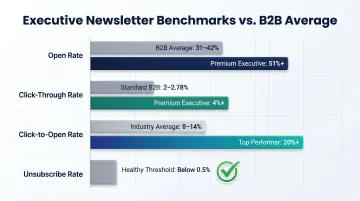
B2B newsletter benchmarks show average open rates of 31-42% and click rates of 2-2.78%. Premium executive-audience newsletters typically exceed these benchmarks — 40%+ open rates justify premium pricing. Networks like House of Summary demonstrate this with 254,866+ daily opens from 500,000 subscribers (approximately 51% open rate), indicating genuine engagement.
When Does Sponsored Content for Executive Audiences Make Sense?
Sponsored content targeting executives delivers strong results when the goal is brand credibility, thought leadership positioning, or awareness of premium or complex products. 73% of decision-makers say thought leadership is more trustworthy than marketing materials, and 90% are more receptive to sales outreach from companies that produce it — which makes channel fit critical.
Most effective scenarios:
- Builds brand awareness in markets where decision-makers don't yet know you
- Supports complex product launches that need context to land — enterprise SaaS, financial instruments, healthcare innovations
- Works well across long B2B sales cycles of 90-270 days, where early exposure shapes later decisions
- Establishes authority in premium market segments where credibility drives selection
- Enables account-based marketing by reaching specific companies' decision-makers through publications they already read
Poor fit scenarios:
- Requires premium budget commitment — B2B newsletter CPMs run £50-£150+ versus £2-£5 for general display, so tight budgets expecting immediate ROAS will struggle
- Doesn't suit consumer impulse purchases or products with no professional decision-making angle
- Isn't designed for high-volume conversion campaigns — executive audiences are deliberately small and targeted
- Attribution can be difficult; most organizations still can't reliably connect specific content to downstream leads
What You Need Before Approaching Sponsored Content Companies
Unprepared buyers waste budget, lose credibility with premium publishers, and end up in campaigns built for the wrong audience. Getting these three things right before your first conversation changes the outcome.
Budget and Value Expectations
Executive-audience channels command higher CPMs than general interest media. Budget accordingly:
Current market rates:
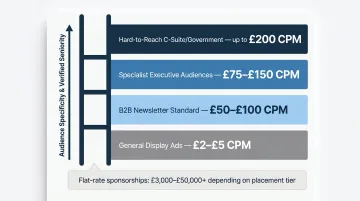
- B2B newsletters: £50-£100 CPM standard, £75-£150 for specialist audiences
- Hard-to-reach audiences (government, C-suite): Up to £200 CPM
- Flat-rate sponsorships: £3,000-£10,000 mid-sized newsletters, £10,000-£50,000+ premium placements
- Full-network takeovers: Custom pricing based on reach and exclusivity
General digital display runs £2-£5 CPM. The 10-30x premium for executive newsletters reflects audience specificity, opt-in engagement, and verified seniority — not list size. A B2B newsletter with 8,000 subscribers can command £2,000 per placement, while a general lifestyle newsletter with 50,000 subscribers struggles to charge £800.
Creative and Messaging Readiness
Executive readers are skeptical of anything that reads like an ad. Your messaging needs to earn its place alongside editorial content — which means it has to be genuinely useful, not promotional.
71% of C-suite executives cite "utility/usefulness" as the primary factor attracting them to content. Executive audiences respond to:
- Credibility over hype
- Specificity over generic claims
- Relevance to professional concerns
- Data and evidence
Avoid promotional language and consumer-style creative.
Measurement Framework
Define success beyond clicks. For executive audiences, meaningful metrics include:
- Brand recall and awareness shifts
- Direct inquiry volume from senior stakeholders
- Long-term pipeline attribution (6-12 months)
- Quality of leads generated
- Influence on existing accounts
Average enterprise B2B sales cycles range 90-270 days depending on deal size and complexity. Build that window into your measurement framework from day one — don't judge a campaign at 30 days that's designed to influence a 6-month decision.
Key Signals That a Sponsored Content Partner Actually Reaches Executive Audiences
Claims of "executive readership" are easy to make and hard to verify. Choosing the wrong partner means budget spent reaching mid-level managers instead of the decision-makers you need — so these five signals separate genuine executive-audience media from overstated claims.
Signal 1: Subscriber Verification Method
Ask how the company builds and maintains its subscriber list. Strong indicators:
- First-party registration with professional email addresses and explicit consent
- Double opt-in confirming active interest (not passive collection)
- Regular list hygiene — inactive subscribers removed on a set schedule
- Corporate email domains: majority of addresses are company accounts, not personal Gmail or Yahoo
Red flags: purchased lists, third-party aggregation, vague descriptions of "business professionals."
Signal 2: Editorial Positioning and Tone
Review the content itself. Publications genuinely attracting executives maintain:
- High editorial standards without sensationalism
- Coverage of geopolitics, business strategy, finance, leadership themes
- Fact-checked, human-written content (not AI-generated summaries)
- Respect for reader time with curated, digestible formats
The editorial voice predicts the reader's professional profile. A newsletter covering global power dynamics and policy shifts naturally attracts executives needing macro context for strategic decisions. A publication focused on tactics and how-to guides attracts mid-level implementers.
Signal 3: Engagement Rate Over Reach
A smaller list with high performance beats a large list with passive subscribers. Ask for the following metrics:
| Metric | Benchmark | What It Tells You |
|---|---|---|
| Open rate | 40%+ (B2B avg: 31–42%) | Active readers vs. passive subscribers |
| Click-through rate | 2–4% typical; premium audiences exceed this | Content relevance and reader intent |
| Click-to-open rate | Varies; look for consistency over time | How many openers actually take action |
| Unsubscribe rate | Below 0.5% monthly | Audience satisfaction and list health |
Note: 63% of email clicks come from bots and anti-spam software, so scrutinize raw click numbers and ask how the publisher filters bot traffic.
Signal 4: Advertiser History and Brand Fit
Review which brands have previously advertised. If the publication attracts:
- Premium B2B brands
- Financial institutions and fintech
- Luxury businesses (watches, fashion, hospitality)
- Enterprise technology companies
- Professional services (consulting, legal, accounting)
This indicates an executive audience. Consumer brands advertising in the same space may signal the audience skews less senior.
Signal 5: Format Alignment with Executive Habits
Advertiser history confirms who reads the publication — but format determines whether your message actually reaches them. Confirm sponsored content appears inside the editorial product itself rather than as peripheral display advertising. Executives read the editorial, not the banner. Newsletter ads bypass ad blockers and algorithmic feeds, landing directly in the inbox alongside content the reader sought out.
Effective formats include:
- In-newsletter sponsored placements
- Sponsored editorial articles within the reading flow
- Full-issue takeovers
- Native ads inline with content
Ineffective formats: sidebar banners, interstitials, pre-roll video ads that executives skip.
Common Mistakes When Searching for Executive-Audience Sponsored Content Partners
Conflating "Professional Audience" with "Executive Audience"
LinkedIn's seniority breakdown: Entry-level 37%, Manager/Senior Manager 28%, Director/VP 19%, C-suite only 11%. On broad professional platforms, executives represent roughly 1 in 9 members.
Specialist executive newsletters concentrate this ratio dramatically. Always verify seniority distribution before committing budget.
Prioritizing Reach Over Relevance
A media company with millions of subscribers but diffuse audience composition delivers fewer executive impressions than a tightly focused newsletter with 50,000 verified C-suite readers. House of Summary's networkshows this dynamic in practice: a focused executive audience commands premium CPMs and delivers stronger engagement than a broad platform at ten times the subscriber count. Knowing a publisher's seniority mix tells you far more than their total reach figure.
Skipping the Media Kit Review
Verifying audience quality starts with the media kit — the document that separates serious publishers from inflated subscriber counts. It contains:
- Audience demographics and seniority breakdowns
- Format specifications and placement options
- Editorial calendar and content themes
- Pricing and package structures
- Third-party audit certifications
Review this before any conversation to evaluate fit and prepare intelligent questions.
Neglecting Format-Audience Alignment
Sponsoring the right publication but choosing the wrong format wastes the investment. Peripheral banners and interstitials get blocked or ignored. Sponsored content must appear within the editorial experience executives are already engaging with.
Format must match consumption habits:
- Newsletter audiences: inbox-based placements, read without ad blockers
- Publication readers: in-article sponsored content within editorial flow
- Digital platforms: inline placements integrated into the reading experience
Frequently Asked Questions
What types of companies offer sponsored content that reaches executive audiences?
The primary categories are premium newsletter networks (SmartBrief, House of Summary, Morning Brew), trade publications (Industry Dive verticals, Harvard Business Review), specialist B2B media (Financial Times, Economist), and executive briefing services. Each serves different industry verticals and executive profiles—the right type depends on your target seniority, industry, and geography.
How do I verify that a media company's audience is actually executive-level?
Request job title breakdowns from the company's subscriber data, ask about list acquisition methodology (first-party registration vs. third-party aggregation), and look for independent audits from organizations like Alliance for Audited Media. First-party data with professional email verification is the strongest signal.
What is a reasonable budget for sponsored content targeting executives?
Current market rates range from £50-£150 CPM for B2B newsletters, with hard-to-reach executive audiences commanding up to £200 CPM. Flat-rate sponsorships range £3,000-£10,000 for mid-sized newsletters and £10,000-£50,000+ for premium placements. Premium executive channels cost 10-30x more per impression than general digital advertising but often deliver superior engagement and conversion quality.
Is newsletter sponsorship effective for reaching C-suite decision-makers?
Yes—75% of executives identify email newsletters as their primary information source. The inbox bypasses algorithmic interference and ad blockers, landing directly where executives consume trusted information. Sponsored placements within these newsletters consistently outperform social and display formats on engagement.
What is the difference between sponsored content and native advertising for executive audiences?
Sponsored content is a named brand-publisher partnership that creates editorial-style content, while native advertising refers more broadly to the paid distribution mechanism. For executive readers, sponsored content is more credible because it carries the publisher's editorial voice and trust rather than appearing as an external ad.
How long does it take to see results from sponsored content targeting executives?
Results take longer than consumer campaigns because executive buying cycles are complex. Enterprise B2B sales cycles average 90-270 days depending on deal size, so brand awareness shifts, direct inquiries, and pipeline influence are best measured over 6-12 months.