Introduction
Hospital CEOs, health system CFOs, payer VPs, and procurement decision-makers don't read healthcare content the same way patients or clinicians do. They're not searching for health information. They're scanning for strategic intelligence, regulatory risk signals, competitive moves, and ROI evidence.
Reaching this audience requires a completely different playbook — one most healthcare marketers haven't built.
The content formats, channels, and messages that work for patient education fail when the reader is evaluating a $500,000 enterprise purchase with nine stakeholders and a 12-month decision cycle.
This article explains how healthcare executives consume content differently, which formats and channels earn their attention, and how to build a content strategy that maps to their actual decision-making process.
Key Takeaways
- Healthcare executives respond to business case framing, not clinical education
- Thought leadership and original research outperform promotional content by wide margins
- LinkedIn executive advocacy generates 7x more impressions than brand pages
- ABM-aligned content programs deliver 81% higher ROI than traditional approaches
- Newsletter placements reach executives directly in their inbox, with 2-4% click-through rates
Why Healthcare Executives Are a Fundamentally Different Audience
Healthcare executives are not searching for health information — they are scanning for strategic intelligence, regulatory risk signals, competitive moves, and ROI evidence. Generic educational content designed for patients or even clinicians will not hold their attention. This behavioral difference defines everything about how content must be created, formatted, and distributed.
Time scarcity defines the executive content experience. 54% of C-suite executives spend one hour or more per week reading thought leadership, yet 85% rate what they encounter as "average" or "below par." This isn't a demand problem — it's a quality gap. Executives want substantive content, but 55% will move on if thought leadership doesn't capture their interest within the first minute. For healthcare companies, this means brevity and precision are non-negotiable. Unstructured long-form content loses the audience before the value proposition appears.
Clinicians and executives also require fundamentally different evidence — and confusing the two is one of the most common content mistakes in healthcare marketing.
| Audience | Responds To | Example Metric |
|---|---|---|
| Clinicians | Clinical outcomes, peer-reviewed proof | 94% diagnostic accuracy |
| Executives (CFO/COO) | Operational efficiency, cost reduction, risk mitigation | 92% reduction in processing time (3–4 hours → 15 minutes) |
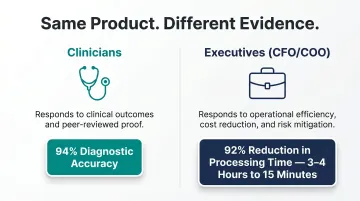
Map your content briefs to the executive's KPIs — not the clinician's outcomes scorecard.
The Content Formats That Earn Executive Attention
Thought leadership is the highest-performing format for executive audiences. Op-eds, strategic viewpoints, and perspective-driven reports authored by named executives or recognized subject matter experts signal intellectual authority without the format of a sales pitch. 75% of decision-makers and C-suite executives say a piece of thought leadership has led them to research a product or service they were not previously considering, and 9 in 10 are more receptive to sales outreach from companies that consistently produce high-quality thought leadership.
Data-led reports and benchmarking studies earn trust through peer comparison. Healthcare executives use peer data to make decisions and validate strategy. 55% of B2B buyers regularly consume research reports, rating them the most valuable type of content when evaluating purchasing decisions. Original research outperforms standard blog content because it delivers insight executives cannot find elsewhere — and it positions the brand as a credible intelligence source rather than a vendor.
Curated intelligence formats match how busy leaders consume content. Executive briefings, weekly summaries, and newsletter-style digests deliver concentrated insight in minutes — not the 20+ required for a full whitepaper. These formats work because they respect packed schedules without sacrificing depth. Premium newsletters also bypass algorithms, avoid ad blockers, and reach the inbox directly, where most brand messages are filtered, skipped, or blocked.
Case studies must be formatted for executive audiences, not patients. Executives need operational ROI narratives: what problem did an organization face, what decision was made, and what measurable business or financial outcome followed. 78% of B2B buyers ranked case studies as the most valuable content for the middle stage of the buyer's journey. Patient testimonials and clinical outcome summaries belong in patient-facing content — not in the boardroom.
Video follows the same rules. Executive attention is short: the average B2B marketing video dropped from 6 minutes in 2022 to 4 minutes 15 seconds in 2025, and 73% of B2B decision-makers prefer video over whitepapers when evaluating options. Executive-facing video works best when it features recognized industry leaders — not spokespeople — and focuses on a single strategic insight rather than a product walkthrough.
Across all formats, the pattern is consistent:
- Credibility over polish — executives respond to expertise, not production value
- Specificity over breadth — one insight done thoroughly outperforms five done superficially
- Directness over persuasion — ROI-driven narratives outperform benefit-driven marketing language
- Access over volume — formats that reach the inbox or land in trusted channels outperform those competing for algorithm-driven attention
Building a Content Strategy Around Executive Decision-Making
Healthcare executive purchases are longer, more committee-driven, and more risk-averse than standard B2B sales. The average healthcare software deal takes approximately 12 months to close and involves about 9 decision-makers, and 79% of B2B purchases require CFO approval. Content must serve different stages: early-stage awareness content should educate on the problem landscape; mid-stage content should address solution categories and ROI frameworks; late-stage content should provide risk validation, compliance assurance, and peer evidence.
That content only lands if it's built for the right person. Unlike patient personas based on health conditions, executive personas are built around strategic pressure points:
- CFO: Cost containment, financial risk, margin protection, revenue cycle optimization
- CMO/COO: Patient experience, regulatory reputation, operational efficiency, community health outcomes
- CIO/CMIO: Interoperability, data governance, cybersecurity, clinical workflow integration
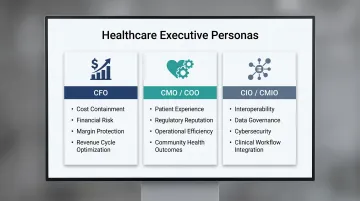
Messaging must be tailored to each persona's strategic pressures. A CFO evaluating a telehealth platform cares about reimbursement certainty and cost per encounter; a CMO cares about patient satisfaction scores and brand reputation risk.
Publishing cadence builds trust through repetition. A sporadic content output — one white paper a year, occasional blog posts — will not build the familiarity needed to influence a high-stakes purchasing decision. Executives need to encounter a brand's ideas repeatedly before that trust forms.
A consistent cadence (weekly or bi-weekly substantive thought leadership) signals reliability and expertise. Depth matters more than frequency, but consistency is what keeps a brand visible throughout the 10-12 month consideration window.
Every piece must pass the "so what?" test. Content must tell executives something they don't already know and help them make a better decision. Audit existing content against this standard:
- Does it contain original data or a novel interpretation of existing data?
- Does it challenge a widely held assumption or offer a contrarian perspective?
- Does it provide a framework for evaluating options or managing risk?
- Does it reference peer examples or named organizations executives recognize?
If the answer is no, the content is filler — and filler gets discarded in under one minute.
Use editorial positioning to differentiate from generic industry updates. Healthcare companies that take a clear, evidence-backed stance on regulatory trends, technology disruption, or care delivery models become a reference point for executives, not just another vendor.
For example: taking a position on how value-based care contracts will evolve under new CMS payment models, or explaining why certain interoperability standards will win adoption and others will fade. That level of specificity requires real domain expertise. It's also what separates content executives return to from content they forget immediately.
The Right Channels to Reach Healthcare Executives
LinkedIn and Industry Publications
LinkedIn is where senior decision-makers share perspectives, comment on industry developments, and consume peer content. CEO posts generate 7x more impressions and 4x more engagement than brand-led content, and C-suite content generates 5x more views and engagement than posts from other LinkedIn members. Personal profiles consistently outperform brand pages with this audience.
For healthcare companies, that means empowering internal thought leaders — chief medical officers, clinical innovation directors, policy experts — to publish under their own names, not just the company account.
Placement in recognized trade publications carries more weight than a company blog post. Modern Healthcare ranks #1 in readership among hospital CEOs, CFOs, and CIOs — and is the top publication CEOs recommend to peers. Becker's Hospital Review reaches 510,000+ e-newsletter subscribers, averaging 240,000 daily readers across C-suite executives and hospital leaders.
Third-party editorial environments validate content as newsworthy and credible, two qualities executive audiences weigh heavily.
Premium Newsletter Channels
Time-scarce executives are loyal newsletter readers precisely because curated publications cut through information overload without demanding hours of attention. Newsletter placements reach the inbox directly — no algorithm interference, no ad blockers, high-intent readership. Email-based formats deliver 2-4% click-through rates, compared to standard B2B display advertising CTR of approximately 0.46%.
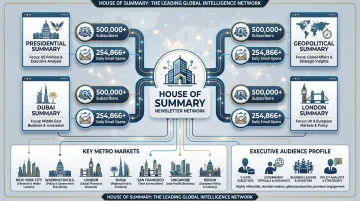
For healthcare companies targeting global executives, advertising within premium specialized newsletters is a high-ROI channel. House of Summary, for instance, delivers verified, human-written briefings across a network of publications:
- Presidential Summary — global news for senior decision-makers
- Geopolitical Summary — international politics and policy
- Dubai Summary — UAE business and executive audience
- London Summary — UK business and finance readership
The combined network reaches 500,000+ subscribers, with 254,866+ emails opened daily, concentrated in wealth-dense metros including New York, Los Angeles, London, and Dubai. The audience skews toward executives, policy professionals, and high-income consumers — the exact profile healthcare B2B marketers need to reach.
Navigating Compliance Without Losing Executive Credibility
Handled well, compliance becomes a credibility signal — not just a legal checkbox. The compliance landscape for healthcare content marketing covers HIPAA requirements when content references patient outcomes or case studies, FDA guidelines for claims related to medical devices or treatments, and legal review for any regulatory commentary. Executives operating inside the same regulated environment notice when a brand gets this right.
HIPAA requires written authorization for any use or disclosure of Protected Health Information (PHI) for marketing purposes (HHS.gov, 45 CFR 164.501, 164.508(a)(3)). Covered entities are prohibited from selling patient or enrollee lists to third parties for marketing without individual authorization. PHI must not be included in email subject lines, and web contact forms collecting PHI must transmit through compliant channels. A Business Associate Agreement (BAA) is mandatory whenever a vendor creates, receives, maintains, or transmits PHI on behalf of a covered entity.
FDA categorizes medical devices into three risk classes (I, II, III), each with escalating marketing oversight. Marketing claims must match the device's cleared or approved indications for use. Promoting off-label uses is prohibited. All marketing materials referencing device performance must be substantiated with clinical evidence or FDA-reviewed data (The Brand Leader 2025).
A practical review process keeps compliance from becoming a bottleneck. Define who reviews clinical or regulatory claims, how often guidelines are checked for updates, and how sign-off works without stalling the publishing calendar. At minimum, that process should include:
- Legal or compliance team review for any regulatory commentary
- Clinical subject matter expert validation for outcome claims
- Privacy officer sign-off on any patient data or case study references
- Regular audit of published content to ensure ongoing compliance
Compliance expertise also generates some of the most valuable content a healthcare brand can publish. Clear, accurate breakdowns of regulatory changes, policy shifts, or enforcement trends give executives intelligence they actually need — and can't easily get elsewhere.
Topics worth covering include new CMS interoperability rules, FDA guidance on AI-enabled diagnostics, and state-level privacy legislation affecting health data sharing. This content is difficult to produce well, which is exactly why it sets a brand apart from vendors who only talk about their products.
Measuring the Impact of Executive-Targeted Content
Standard content metrics are insufficient for executive-audience content performance. Page views, social shares, and time on page don't capture the executive decision cycle, which is long, multi-stakeholder, and difficult to attribute. The most important outcomes — inclusion in a vendor shortlist, a request for proposal, an introductory meeting — rarely happen immediately after a single content interaction. The average number of interactions per person with the winning vendor is 16, and 84% of deals are already won or lost before vendors even know they are on the radar.
Leading indicators matter more than lagging metrics. Meaningful measurement focuses on:
- Content-driven meeting requests from named accounts
- Whitepaper downloads by target organizations
- Email open rates from a targeted executive list
- Engagement from known decision-makers on LinkedIn posts
- Named-account engagement tracked through ABM platforms
These indicators signal early-stage influence, even when conversion is months away.
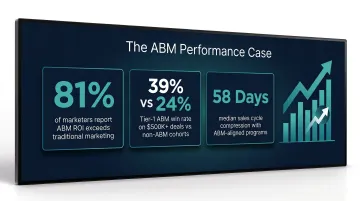
ABM frameworks make executive content measurement actionable. When content reaches a defined list of target accounts rather than a broad audience, engagement data becomes far more useful. The performance case for ABM is strong:
- 81% of respondents report ABM ROI is higher than traditional marketing initiatives
- Tier-1 ABM programs win $500K+ deals at 39% vs. 24% for non-ABM cohorts
- ABM-aligned programs compress enterprise sales cycles by a median of 58 days and generate 41% higher win rates once an account converts
Connect content performance to pipeline and revenue over extended attribution windows. Healthcare B2B deals typically close in 10–12+ months, yet most attribution platforms default to 30–90 day windows. That timing gap means early-stage content — research reports, executive briefings, issue-specific analysis — rarely gets credit for deals it influenced.
To make content-to-pipeline connections visible to leadership:
- Extend attribution windows to 6–18 months for enterprise deals
- Integrate CRM with content engagement tracking to capture touchpoints
- Track account-level engagement, not just individual lead activity
- Measure content influence on deal velocity, not just deal creation
Frequently Asked Questions
What types of content resonate most with healthcare executives?
Healthcare executives respond best to thought leadership from recognized experts, original research with peer benchmarking data, curated intelligence briefings that respect their time, and ROI-focused case studies showing operational and financial outcomes. Strategic insight delivered quickly outperforms content that explains problems they already understand.
How is content marketing for healthcare executives different from content marketing for clinicians or patients?
Patients need empathy and plain-language health guidance; clinicians need peer-validated clinical evidence; executives need business case framing, risk analysis, and strategic intelligence tied to organizational priorities. Moving from health outcomes to business outcomes reshapes every content decision — format, evidence type, and distribution channel.
What channels are most effective for reaching healthcare executives with content?
LinkedIn for organic thought leadership distribution (especially from named executive profiles), industry trade publications for third-party credibility, and premium newsletter channels for direct inbox access. Email-based formats consistently deliver higher engagement with time-constrained executive readers, achieving 2-4% click-through rates compared to 0.46% for display advertising.
How often should healthcare companies publish content targeting executive audiences?
A regular cadence of high-quality thought leadership — one substantive piece per week or bi-weekly — beats sporadic high-volume publishing. Executive trust builds through repeated, credible appearances in their information environment across the 10-12 month consideration window typical of healthcare B2B purchases.
How do you measure the ROI of content marketing targeting healthcare executives?
Standard traffic metrics don't reflect how this audience engages. Instead, track account-level engagement, content-attributed meeting requests, and pipeline influence across 6-18 month attribution windows using ABM frameworks. Executive LinkedIn engagement and whitepaper downloads from named target accounts are more meaningful signals than page views.
What compliance considerations apply when producing content for healthcare executive audiences?
HIPAA applies to any patient data referenced, requiring written authorization for PHI use in marketing. FDA rules govern claims about medical devices and require substantiation with clinical evidence. All regulatory commentary should be reviewed by legal or compliance before publication.