Introduction
Most outdoor and lifestyle brands have mastered the art of visual storytelling—stunning summit shots, aspirational adventure reels, and influencer-driven campaigns that dominate social feeds. Yet this content strategy leaves a significant blind spot: executive decision-makers who control substantial purchasing power and wield brand influence far beyond their individual transactions. These are the C-suite leaders, founders, and senior professionals who buy premium gear for themselves, influence corporate partnerships, and shape organizational culture through brand selection.
Executives consume content differently than mass consumer audiences. They filter aggressively, prioritize substance over spectacle, and have little patience for content that wastes their time. 71% of decision-makers find most thought leadership content average or below par, and they use ad blockers at nearly twice the rate of lower-income groups.
Reaching this audience requires a deliberate rethink of format, channel, and identity positioning — not just better visuals.
Key Takeaways
- Executives filter content ruthlessly, valuing credibility and relevance over visual volume
- Identity alignment drives engagement: content connecting outdoor pursuits to leadership, performance, and values earns attention
- Long-form editorial and inbox newsletters consistently outperform algorithm-driven social platforms for executive audiences
- Success metrics shift from vanity metrics to engagement depth, brand recall, and qualified pipeline signals
- Premium positioning requires purpose-driven content with transparency—executives spot hollow brand claims immediately
Why Executive Audiences Require a Different Content Approach
The Active Filter Problem
Executives aren't passive scrollers. 54% of C-suite leaders spend at least one hour weekly engaging with thought leadership content, but they actively filter what they consume. Research shows these professionals prioritize sources that respect their intelligence and deliver actionable insights within the first two minutes of engagement.
The typical outdoor brand content strategy creates noise, not signal, for this audience. High-volume social posts, influencer saturation, and trend-chasing produce skepticism rather than affinity. Consider that 47% of global audiences identify online influencers as a major source of false information—tied with politicians as the least trusted content source.
Identity Dynamics: Performance Values Over Product Features
Executives connect with outdoor and lifestyle brands as extensions of their personal identity, not merely as consumers. Research on endurance athletes reveals that 73-74% of marathoners and ultramarathoners hold higher education degrees, with self-employment rates nearly double those of recreational runners. These individuals are motivated by achievement-related goals and self-esteem — themes outdoor brands must weave into their content.
When an executive purchases Arc'teryx or Patagonia, they're signaling discipline and an alignment with performance values. Content must speak to who they are: their leadership philosophy, commitment to performance, global perspective — not just what they might buy.
The Trust Threshold Difference
Mass audiences can be swayed by social proof and virality. Executives require something different entirely. Nearly 75% of executives trust high-quality thought leadership more than traditional marketing materials, and 89% say strong thought leadership positively influences their perception of an organization.
This audience demands:
- Editorial credibility from named authors with real expertise
- Peer relevance demonstrating understanding of their context
- Brand substance backed by verifiable commitments
- Consistency over time, not sporadic platform-hopping
Higher-Value Decision-Making Context
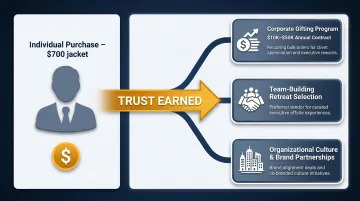
That trust, once earned, extends well beyond a single purchase. Executives don't just buy for themselves — they influence brand partnerships, corporate gifting programs, team-building experiences, and organizational culture decisions. A single executive making a $700 Arc'teryx jacket purchase may later approve a $50,000 corporate order for branded outerwear or select an outdoor brand for a company retreat.
This multiplier effect is why executive audiences require their own content strategy — one built around credibility and identity, not volume and reach.
Content Formats That Resonate With Time-Pressed Executives
The Case for Long-Form Narrative
Executives engage deeply with long-form content — when it earns that attention. Research shows executives prefer articles requiring 3-7 minutes of reading time, executive summaries of 1-2 pages focused on actionable insights, and long-form reports providing comprehensive analysis.
Outdoor brands should develop:
- Founder perspectives connecting business philosophy to outdoor pursuits
- Adventure-linked editorial pieces exploring leadership lessons from expeditions
- In-depth brand stories documenting commitment to sustainability or craftsmanship
- Technical deep-dives demonstrating materials science and product innovation
Arc'teryx exemplifies this approach, anchoring content on athlete stories and materials documentation rather than lifestyle aspiration. The brand's technical credibility—built through content that educates rather than entertains—sustains premium pricing despite broader market competition.
Curated, Summary-Style Content
Executives value information that is pre-filtered and expertly condensed. They face information overload daily; content that delivers focused insight without demanding significant time earns more attention than longer formats.
Effective formats include:
- Weekly roundups of industry trends with executive implications
- Curated gear recommendations based on specific use cases
- Condensed trip reports highlighting logistics and decision-making
- Expert-compiled buying guides that save research time
This explains the rise of specialized newsletters serving professional audiences. The best ones build a consistent editorial voice readers come to trust — and return to — precisely because they don't waste time.
Thought Leadership Bridging Professional and Personal Identity
52% of B2B marketers increased investment in thought leadership for 2025, recognizing its effectiveness with decision-maker audiences. For outdoor brands, thought leadership articles connecting outdoor values to professional contexts create powerful bridges.
Consider topics such as:
- Sustainability leadership: what mountaineering teaches about long-term thinking
- Performance culture: endurance training principles applied to business execution
- Wellness ROI: quantifying the business impact of outdoor experiences
- Risk management: decision-making frameworks from alpine environments
Done well, this content converts a product purchase into a shared worldview — which is considerably harder for competitors to replicate than features or price.
Visual Content: Substance, Not Spectacle
Executives do engage with visual content, but their preferences differ from mass audiences. The format matters less than whether it communicates something real.
Formats that perform well with this audience:
- Short documentary-style videos (under 3 minutes) tied to craft, sourcing, or process
- High-resolution imagery paired with technical or editorial context
- Supply chain transparency films demonstrating operational values
A 90-second film documenting how a jacket is built resonates far more than a reel of powder turns. One demonstrates something worth knowing; the other is entertainment executives have already filtered out.
Editorial Consistency and Cadence
Sporadic content or platform-hopping erodes credibility with this audience. Executives build trust with sources they encounter repeatedly — in formats and contexts they respect. A weekly or bi-weekly publication schedule, held consistently over months, creates the kind of familiarity that gradually converts an occasional reader into a loyal one.
Channels That Actually Reach Executive Audiences
Why Social Media Algorithms Fail This Audience
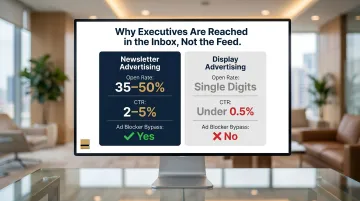
Social platforms structurally work against reaching executives. 52% of users earning over $100,000 use ad blockers—nearly double the rate of lower-income groups. Senior professionals spend less time on social feeds, consume content with heightened skepticism, and are more likely to engage with material delivered directly to them than discovered through algorithmic feeds.
Only 41% of people globally trust social media, and executives—trained to evaluate claims critically—exhibit even greater wariness. The influencer-saturated landscape outdoor brands dominate on Instagram simply doesn't reach this audience effectively.
Inbox-First Distribution: The Most Reliable Path
Curated newsletters delivered to inboxes provide the most reliable access to executive attention. These placements arrive without competing for algorithmic favor and create a one-to-one reading environment where attention is already engaged.
Professional newsletters targeting business audiences deliver strong performance metrics:
- Open rates of 35–50%, compared to single-digit figures for most display formats
- Click-through rates of 2–5%—approximately 4–10x higher than average display advertising
- Full ad blocker bypass, since newsletter ads are part of the opted-in content experience
House of Summary's network exemplifies this approach, delivering specialized content across global news, geopolitics, and city-specific summaries to over 500,000 subscribers, with 254,866 emails opened daily. Their audience comprises decision-makers and executives concentrated in high-income metros like New York, Los Angeles, London, and Dubai.
For outdoor brands, advertising within these editorial environments provides access to engaged executive readers in contexts where credibility is already established.
LinkedIn as Secondary Channel
LinkedIn serves as a useful secondary channel for executive-targeted content, particularly for thought leadership distribution and professional credibility-building. 98% of Fortune 500 CEOs on social media use LinkedIn, and 85% of B2B marketers name it their top-performing social channel.
Paid reach on LinkedIn, however, benefits from reinforcement through owned or newsletter-based content. Executives who encounter your brand first in a trusted newsletter, then see your thought leadership on LinkedIn, are far more likely to engage — recognition doing work that cold targeting cannot.
Earned Media in Premium Publications
Pitching stories to business, lifestyle, and geopolitical publications where executives already have reading habits outperforms attempts to draw them toward brand-owned social channels. 38% of global audiences turn to trusted news outlets first when verifying information, and 55% prefer reading text-based news for its speed and control.
Target publications that reach your executive audience:
- Business: Wall Street Journal, Financial Times, Bloomberg
- Lifestyle: Monocle, Gear Patrol, specialized outdoor media
- Geopolitical: Foreign Affairs, The Economist, regional business journals
Editorial placement in these contexts carries credibility that brand-owned channels cannot replicate.
Building an Outdoor Brand Identity That Appeals to Executives
Position Around Performance Values, Not Product Features
Executive-facing outdoor brands must emphasize performance values and aspirational identity rather than technical specifications. Content should reinforce themes like resilience, exploration, and intentional living—concepts that mirror how executives define success beyond the boardroom.
Arc'teryx demonstrates this positioning effectively. Despite approximately $3 billion in revenue and 38% CAGR from 2019-2024, the brand maintains premium positioning through technical credibility.
Product decisions are driven by alpinists and climbers, with content anchored on athlete stories and materials science. The brand never repositioned toward fashion despite organic adoption by urban professionals—a deliberate choice that preserved authenticity at scale.
That authenticity becomes even more critical when brands make purpose-driven claims, where executive audiences are the hardest audience to convince.
Purpose-Driven Content Requires Transparency and Specificity
55% of consumers globally are skeptical of brands' sustainability claims, with only 9% believing such claims outright. Executives, with their professional experience evaluating business operations, detect performative messaging immediately.
Effective purpose-driven content:
- Provides specific data on sustainability commitments with measurable progress
- Documents ethical sourcing with supply chain transparency
- Acknowledges challenges and trade-offs rather than claiming perfection
- Demonstrates community leadership through verifiable actions
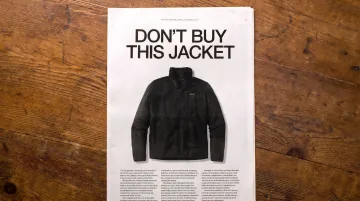
Patagonia's 2011 "Don't Buy This Jacket" Black Friday campaign exemplified this approach—a full-page New York Times ad urging consumers to consider environmental costs before purchasing. The counter-intuitive move worked because it was specific, verifiable, and cost the brand something real—the clearest signal to skeptical executives that a commitment isn't performative.
Specificity and credibility lay the groundwork for the next challenge: making content feel personally relevant rather than mass-produced.
Exclusivity Signals Through Tailored Content
Executives respond to content that feels selective and relevant, not mass-produced. This doesn't necessarily mean gate-keeping or artificial scarcity—it means demonstrating understanding of this specific audience.
Exclusivity signals include:
- Niche relevance addressing specific executive contexts
- Editorial selectivity that curates rather than overwhelms
- Personalization based on reader interests or geography
- Expert perspectives from named authors with real credentials
A newsletter covering geopolitical risk written by a named foreign policy analyst, sent to a C-suite audience, does more for brand perception than a broadly distributed lifestyle feature—even if the readership numbers are smaller.
Measuring What Matters: ROI Metrics for Executive-Targeted Content
Limitations of Standard KPIs
Impressions, follower growth, and engagement rates reflect volume, not value. These metrics mislead when targeting a small, high-value audience segment. An outdoor brand might generate 100,000 impressions on Instagram but reach zero qualified executives, while a newsletter placement generating 5,000 opens reaches 2,000 decision-makers.
Only 29% of B2B marketers rate their content strategy as extremely or very effective, with 56% citing difficulty attributing ROI to content and tracking customer journeys as top measurement challenges.
Alternative Metrics for Executive Audience Measurement
Brand Recall and Perception Lift:
- Surveys measuring brand awareness among target account lists
- Perception studies tracking attribute associations (quality, values alignment, credibility)
- Share of voice in executive-relevant publications and platforms
Qualified Engagement Indicators:
- Time-on-content for long-form pieces (3+ minutes indicates genuine reading)
- Newsletter open rates from verified professional audiences (35-50%+ baseline)
- Click-through rates on substantive content (2-5% indicates strong relevance)
- Repeat engagement showing return visits and ongoing relationship-building
Pipeline Attribution:
- Direct sales inquiries traceable to content touchpoints
- Partnership discussions initiated by content exposure
- Corporate or bulk order requests following individual executive engagement
- Speaking invitations and media requests indicating thought leadership impact
Account-Based Indicators:
- Target account engagement across multiple content pieces
- Executive downloads of gated resources (white papers, reports)
- LinkedIn engagement from verified decision-makers at target companies
- Event attendance from qualified executive prospects
The Importance of Patience and Compounding
Executive trust builds through multiple content encounters over time. 35% of decision-makers say C-suite thought leadership encouraged them to consider a vendor, but this influence rarely occurs after a single exposure.
Track repeat exposure and return engagement as early indicators of relationship-building, even before conversion signals appear. An executive who opens your newsletter consistently for three months, clicks through to two articles, and downloads one resource is demonstrating progressive trust—well before any purchase decision.
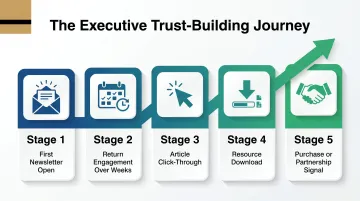
That pattern of behavior is your real leading indicator. Build measurement frameworks that capture these compounding signals, not just final conversions.
Frequently Asked Questions
Why is content marketing important for outdoor and lifestyle brands targeting executives?
Content marketing is the most credible, non-interruptive way to earn executive attention and demonstrate brand substance over time. These audiences carry high influence — their brand affinities shape personal purchases, corporate programs, and organizational culture alike.
What types of content resonate most with executive audiences in the outdoor and lifestyle space?
Long-form storytelling, curated editorial summaries, thought leadership pieces connecting outdoor values to professional contexts, and short documentary-style videos under three minutes perform best.
How is marketing to executives different from marketing to general outdoor consumers?
Executives require higher trust thresholds — they prefer editorial credibility and peer relevance over social proof, and connect with brands through identity alignment rather than product features. They consume content through newsletters, premium publications, and LinkedIn rather than algorithm-driven platforms, and respond to verified claims and specific examples, not broad adjectives.
Which channels are most effective for reaching executive audiences with outdoor lifestyle content?
Curated newsletters delivered to inboxes, premium editorial publications executives already trust, and LinkedIn for thought leadership distribution form the primary channel mix. These environments provide credibility and direct access without competing against algorithms or ad blockers that executives use at twice the rate of general consumers.
How can outdoor brands measure the ROI of content marketing aimed at executives?
Move beyond vanity metrics to track brand recall among target accounts, qualified engagement depth (time-on-content, newsletter CTR from professional audiences), repeat exposure patterns indicating trust-building, and conversion signals tied to specific content touchpoints.
What mistakes do outdoor brands make when trying to reach executive audiences through content?
Over-reliance on social media despite executive ad blocker usage and platform skepticism, visual-first content lacking substance, inconsistent publishing that undermines credibility-building, and failure to align content themes with executive identity values (leadership, performance, global perspective) rather than just product features.