

Introduction
Banner blindness is real. So are ad blockers, algorithm-throttled feeds, and audiences that have learned to scroll past anything that looks remotely like an ad. Traditional digital advertising is fighting an attention crisis — and most brands are losing.
Sponsored content placed within premium publishers works differently. Instead of competing for attention beside editorial content, your brand message lives inside a trusted editorial environment — read by an audience that chose to be there.
This guide is written for advertisers evaluating sponsored content as a channel. It covers what sponsored content actually is, why premium publishers outperform programmatic alternatives, how the process works from brief to live campaign, and what to verify before committing budget.
Key Takeaways
- Sponsored content places your brand inside trusted editorial environments, not beside them
- Ads on premium publisher sites deliver 67% higher brand lift than non-premium placements
- Newsletter-based placements bypass ad blockers entirely and reach opted-in subscribers without competing with banner ads or social feeds
- Audience fit, editorial quality, and disclosure practices matter as much as raw subscriber numbers — evaluate all three before committing
What Is Sponsored Content on a Premium Publisher?
Sponsored Content vs. Display Advertising
Sponsored content is paid content — written articles, video, or newsletter placements — produced with an advertiser's goals in mind and delivered in the same format as a publisher's editorial content. The IAB defines this category as "branded/native content": paid brand content published in the same format as full editorial on a publisher site.
The key distinction from display advertising: display ads sit beside editorial content. Sponsored content is the content — formatted, written, and placed to match the publication's editorial voice, with clear disclosure that it is paid.
What Makes a Publisher "Premium"
The term gets used loosely. From an advertiser's standpoint, though, premium has a specific meaning — and it has nothing to do with traffic volume alone. A premium publisher has:
- Consistent, high-quality editorial output with identifiable standards
- A loyal readership that trusts the publication's judgment
- A distinct brand identity — not just traffic volume
- Verifiable audience demographics, not self-reported estimates
Legacy news organizations, specialized digital publications, and curated newsletter networks can all qualify. The Financial Times, for example, reports that 29% of its audience are C-suite executives and 56% are business decision-makers — that's premium defined by audience quality, not just page views.
That audience quality matters most when choosing where to place sponsored content. The format you choose shapes how much of that quality you actually capture.
Sponsored Content Formats to Know
| Format | Description | Best For |
|---|---|---|
| Long-form article | Editorial-style piece on publisher site | Brand education, thought leadership |
| Newsletter placement | Inline "presented by" or "together with" integration | Direct reach, high attention |
| Branded video | Short or long-form video within publisher content | Awareness, storytelling |
| Sponsored series | Multi-piece editorial campaign | Sustained brand presence |
| Full-issue takeover | Single sponsor owns entire newsletter issue | Maximum brand impact |
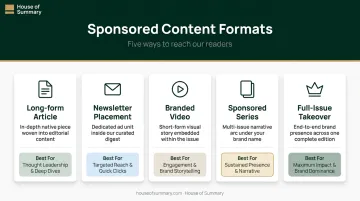
Newsletters deserve particular attention. Subscribers have explicitly opted in, read without algorithmic interference, and engage without the visual clutter of a web page. Your message reaches them directly — no algorithm deciding whether it's seen, no ad blocker stripping it out, no competing banner ads fighting for the same eyeball.
Why Premium Publishers Outperform Other Ad Channels
The Trust Transfer Effect
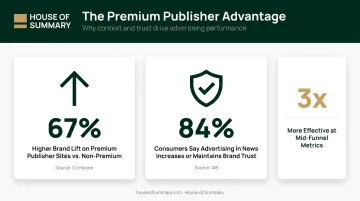
When your brand appears inside a publication readers trust, some of that trust extends to you. This isn't theoretical — a Comscore and Digital Content Next study found that ads on premium publisher sites delivered 67% higher brand lift than ads on non-premium sites and were more than 3x as effective at mid-funnel metrics including favorability, consideration, and intent to recommend.
An IAB study using 2,029 U.S. adults reinforced this: 84% of consumers said advertising within news either increases or maintains brand trust, and 90% had a positive or neutral response to brands appearing in news environments.
Programmatic's Brand Safety Problem
Programmatic campaigns often run across thousands of websites simultaneously. The ANA reported in 2023 that made-for-advertising (MFA) websites represented 21% of impressions and 15% of ad spend in programmatic campaigns — low-quality inventory that shows acceptable viewability scores while delivering almost no real engagement.
With a premium publisher, you know exactly where your content appears, who reads it, and in what context. That level of control is what makes premium placements worth the premium price.
Ad Blockers and Algorithm Dependency
Newsletter-based sponsored content sidesteps two of digital advertising's biggest structural problems:
- Ad blockers — newsletter placements are delivered as editorial content within an email, not as display ad units. They cannot be blocked.
- Algorithm dependency — social media organic reach is platform-controlled and unpredictable. A subscriber's inbox is a direct, one-to-one channel that delivers your message without a platform deciding whether it's worth showing.
Engagement Quality in Practice
Premium publisher readers are not passive scrollers. They opted in, they open deliberately, and they read with intent. Litmus data shows average email read time rose 21% between 2016 and 2018, with 61% of opened emails receiving at least 8 seconds of attention — a meaningful engagement window compared to display ad exposure.
Faik Serkan Ergun, CEO of BSH Hausgeräte, reported that a campaign on House of Summary's Dubai Summary newsletter produced click-through rates 4x higher than Google AdWords, crediting editorial tone alignment and the quality of the readership directly.
How Sponsored Content Works: From Brief to Live Campaign
The Briefing Stage
The brief is where most sponsored content campaigns succeed or fail. Before any content is created, the advertiser needs to provide:
- Campaign objective — brand awareness, thought leadership, or product education
- Target audience profile — industry, seniority, geography, intent signals
- Key messages — what the content must communicate
- Exclusions — topics, angles, or associations to avoid
- Success metrics — what good looks like after publication
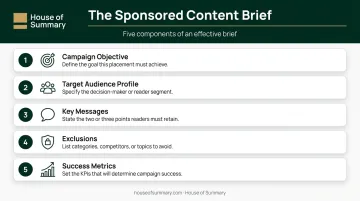
The more specific you are about what you want readers to think, feel, or do after engaging, the better the output. A brief with clear intent produces content with clear impact.
Content Creation and Editorial Oversight
In most premium publisher relationships, the publisher's editorial or studio team creates the content on your behalf — their writers know the publication's voice, and the result reads natively. What this means in practice:
- Expect content written in the publication's editorial style, not your brand voice
- The advertiser's newsroom is separate from commercial/studio content production — this preserves editorial independence and is standard practice across publishers like the Financial Times, Vox Media, and The Atlantic
- Over-commercializing drafts is the most common advertiser mistake — content that reads like a press release consistently underperforms content that reads like journalism
Most publishers offer one round of revisions before final approval. Use that round to ensure accuracy and brand alignment — not to turn editorial content into advertising copy.
Distribution and Disclosure
Distribution: When signing a media package, confirm where and how your content will be promoted. Standard distribution for newsletter-based sponsored content includes the primary newsletter send to subscribers. Ask specifically whether the package includes any additional amplification.
Disclosure: Every sponsored content placement must be clearly labeled as paid at every point where readers encounter it. The FTC requires clear and prominent disclosure — labels like "Sponsored by," "Paid Post," "Partner Content," or "Together with [Brand]" are all acceptable. Labels such as "Promoted" can be ambiguous and may not meet compliance standards.
Clear disclosure protects the publisher's editorial credibility — and your placement's effectiveness along with it. Readers who feel deceived disengage, and that cost falls on your brand.
How to Evaluate a Publisher Before Committing Budget
Not every publisher claiming "premium" deserves the label. Here's what to verify before signing.
Audience Fit First
Request a media kit that includes:
- Total subscriber count and growth trend
- Geographic distribution (country, city)
- Audience professional profile (industry, seniority, role)
- Open rates and click-through rates
- Gender and age composition
Audience quality matters more than audience size. House of Summary, for example, provides advertisers with detailed geographic data (66% USA-based, concentrated in New York and Los Angeles, with additional reach in London and Dubai), gender split, and qualitative audience profiles across its 500,000+ subscriber network — the kind of detail that determines whether a placement is worth the investment.
Editorial Quality Assessment
Once you've confirmed audience fit, evaluate the publication's editorial environment — this is where brand safety is actually built or lost. Look for:
- Is the editorial content factual, consistent, and well-written?
- Does the publisher have clear editorial standards and content restrictions?
- What brands have advertised there before? Are they peers or outliers?
- Does the publication's brand identity align with where you want your brand seen?
A publisher with weak or sensational editorial cannot deliver the trust transfer that makes sponsored content valuable. House of Summary, for instance, explicitly prohibits gambling, sensationalism, political campaign content, and adult advertising — because the editorial environment is the brand safety mechanism.
Sponsored Content Track Record
Ask for examples of previous sponsored content campaigns. Review them for:
- Clear disclosure at placement points
- Editorial credibility — does the content read like the publication?
- Relevance to your sector
You can request examples directly. House of Summary's sales team at sales@houseofsummary.com can provide campaign examples for advertisers targeting executives, decision-makers, and high-income professionals across its Presidential Summary, Geopolitical Summary, Dubai Summary, and London Summary newsletters.
Contract Clarity
Before signing, confirm the contract specifies:
- Deliverables (formats, word counts, placement positions)
- Timeline from brief submission to publication
- Approval rounds and revision process
- Reporting metrics and delivery schedule
- Disclosure language used at each placement point
- Make-good or rescheduling policy if a placement is missed
House of Summary's refund policy covers rescheduling or refunds if a newsletter is not delivered due to publisher fault, and addresses errors in placement — though performance-based refunds are not offered, as is common with fixed-placement newsletter advertising.
Pricing and Metrics: What Advertisers Should Expect
How Premium Sponsored Content Is Priced
The IAB identifies four main pricing models for branded/native content:
- Flat fee — fixed cost per piece or per campaign (most common at premium publishers)
- CPM-based — cost per thousand impressions on the promotional distribution
- CPE (cost per engagement) — based on interactions with the content
- Production + distribution — separate fees for content creation and media placement
Pricing varies significantly based on audience size, niche, content production scope, and placement type. No single benchmark covers the market. Request a media kit with transparent package pricing and ask specifically whether production is bundled or billed separately.
Metrics That Actually Matter
Track these for sponsored content campaigns:
| Metric | What It Tells You |
|---|---|
| Engaged read time | Did readers actually read the content? |
| Click-through rate | Did readers take action? |
| Reach / impressions | How many people were exposed? |
| UTM-tracked conversions | What downstream actions followed? |
| Brand lift (pre/post survey) | Did awareness or favorability shift? |
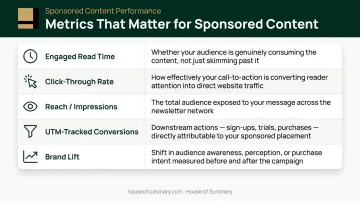
For newsletter placements specifically, email opens and ad click activity are your primary engagement signals — and UTM parameters let you track exactly what happens once readers arrive on your site.
Setting Realistic Expectations
Sponsored content is a brand-building channel. Evaluating it against the same metrics as paid search campaigns — immediate cost-per-conversion — misses the point. Brand-building investments produce compounding returns — improved recall, increased trust, and higher conversion rates over time — that direct-response campaigns simply don't generate.
A premium publisher placement earns its value through audience quality, editorial trust, and depth of engagement. Those factors don't show up in a cost-per-click report, but they do show up in pipeline.
Frequently Asked Questions
What is the difference between sponsored content and native advertising?
The terms are often used interchangeably, but native advertising is the broader category — any paid content formatted to match its surrounding editorial environment, including short in-feed ads. Sponsored content typically refers to long-form editorial content paid for by a brand and hosted on a publisher's platform.
How much does sponsored content with a premium publisher typically cost?
Pricing varies widely based on audience size, niche, and content production scope. Request a media kit and look for transparent package pricing that separates production fees from placement fees. Flat-rate packages are the most common model at premium publishers.
How do I know if a publisher's audience matches my target customer?
Request a detailed media kit with geographic distribution, professional profile, open rates, and CTR data. Ask specifically about subscriber industry, seniority, and geography — not just total subscriber count. A smaller, well-matched audience will consistently outperform a large, unfocused one.
What metrics should I use to measure sponsored content performance?
Focus on engaged read time, CTR on content and embedded links, reach, and brand lift. Sponsored content is a brand-building channel — measuring it on direct conversion rates will undervalue the placement.
Can sponsored content work for B2B brands?
B2B brands are among the strongest candidates. Specialized newsletters reaching professionals and decision-makers are ideal for thought leadership, product education, and executive-level awareness campaigns. The audience self-selects by topic, which eliminates much of the targeting guesswork from the start.
Does sponsored content get blocked by ad blockers?
Newsletter-based sponsored content bypasses ad blockers entirely. It's delivered as editorial content within an email, not as a display ad unit, giving it guaranteed visibility that web and social placements cannot match.